Graphic novels on systematic oppression

I was in a mood the last time I was at the library and these are the three other graphic novels I got along with Freedom Hospital, and all of them are about dealing with systematic oppression. Not necessarily successfully, but trying to. They are none of them cheery.
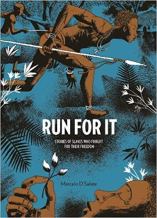
RunforitRun For It: Stories of slaves who fought for their freedom
by Marcelo D’Salete
2017

There’s four chapters, telling four somewhat interlinked stories of black resistance to slavery in Brazil. And it’s just heart-breaking. Individuals could and did fight for their freedom, but unlike a game of tag, there was no home base, no safety or home free. There was just constant risk of staying, even greater risk of trying to leave, and no alternatives.

And trying to organize for a rebellion against the structure itself was just more courting death.

It also really shows how slavery-based societies actively promote viciousness and suppress empathy, among everyone involved, slave owner and slave alike. And possibly the greatest rebellion that the slaves managed to (sometimes) win, was to maintain a sense of worth to their own lives and the lives of their loved ones.
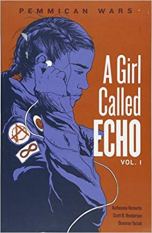
girlcalledechoA Girl Called Echo, Vol. 1: Pemmican Wars
by Katherena Vermette, Scott B. Henderson, and Donovan Yaciuk
2017

This a beautifully done YA comic about Echo, who has been placed in a new school and a new foster care house. In school, she’s learning the history of the Métis, the local indigenous tribe, from which she is descended but not raised with. She’s in a position where she doesn’t fit in with the people around her or even with the people who should have been her people, but about whom she doesn’t know anything.

But in an odd experience that comes with no explanation (in this volume, at least) she is transported back in time, for short periods, to the era that her modern history class is talking about. And that’s where she makes what looks like her first a friend, Marie, a young Métis girl. But Marie is experiencing the time that Echo is learning about in school: the series of conflicts between Métis and colonists that largely destroyed the Métis way of life.
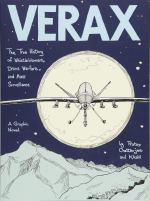
veraxVERAX: The True History of Whistleblowers, Drone Warfare, and Mass Surveillance
by Pratap Chatterjee and Khalil
2017

Pratap Chatterjee is a journalist and the graphic novel follows his years-long investigation into governmental mass surveillance and drone warfare. So the slow start and surprisingly long time it takes to get anywhere might be a realistic portrayal of the frustration of the investigation but it makes for a book that spends the first half alternating between victims speaking about their loved ones being killed in drone attacks and Chatterjee speaking about his editor not properly appreciating his nose for a story. Chatterjee does not look good in the comparison.

That said, about two thirds of the way through, it starts to pick up with Edward Snowden’s whistleblowing. At that point the story shifts from following an investigation to explaining the implications of the information found, and that was much more interesting.

VERAX brought up two things that I hadn’t given much thought to before:

First:

That unmanned drones are not actually unmanned: they have a crew of 180 people stationed around the world, keeping them in the air, flying them, analyzing the data, examining the video feed, and making the calls to fire. It means that Air Force enlisted kids right out of high school and sat them down in front of screens with crappy surveillance video (this is not the high def videos shown in the movies) and has them watch the grainy videos of people dismembered and dying from the missiles they helped launch. Rates of PTSD among drone pilots who never leave their offices is amazingly high.

My dad used to say, “be careful what you put into your head, because you can’t always get it out again.” Some knowledge is important to have, and certainly worth the pain of being a third party witness. But sometimes it is just too much: I can’t imagine spending years watching those videos live.

Second:

While mass surveillance is an invasion of privacy and terrifying in how pervasive it is, it is almost equally terrifying how rife with errors it is. It’s bad data and the government is making life-or-death decisions based on this data. That’s why there are so many civilian casualties by a method that is supposed to be created specifically to avoid them. Because how often have you called a wrong number or gotten a call from someone trying to reach someone else? Maybe it’s an old phone number of maybe a 5 got misread as a 6, or a 1 as a 7.

It’s full of bad data, such that a good third of the drone strikes were made on the wrong targets. And the institutions making use of the data tend heavily towards confirmation bias. Ie, if they’re looking for a weapon and they see someone in a person’s hands, that’s evidence that they have a weapon. As opposed to looking at someone carrying something and considering how many other things they could be carrying: a glass of water, a baby, a bag of skittles. No matter how smart you are, no matter how dedicated, you cannot make good decisions based on bad data.

But overall, as a book, it was a slow start that finished with a lot of ideas and was very thought provoking.

I recommend all three books, but they are draining as they show how hard and yet necessary it is to maintain hope.

Freedom Hospital by Hamid Sulaiman

freedomhospitalFreedom Hospital: A Syrian Story
written and drawn by Hamid Sulaiman, 2016
translated by Francesca Barrie, 2017

This is a gorgeous graphic novel, with stark images that carry a lot of impact. The style matches the story too, in its stark contrast that still manages complex characters in a confusing state of social collapse.

There’s a cast of twelve main characters in and around the underground hospital Yasmine has set up to provide medical treatment to the resistance of the current regime. It’s not strictly non-fiction — Sulaiman took liberties with combining characters and stories, but it’s not really fiction either. It starts in spring 2012, and covers the year in four seasons with a short epilog set in spring 2013.

It’s not particularly long or technically hard to read, but it’s a hard subject and the characters are all complex and the situation even more so. And I keep on thinking about days later. One of the things that really struck me about it was the way Sulaiman created a background by the simple matter of, when there was a time cut between scenes, there’s a small line saying how many hours or days later it was, and how many people had died in that time.

“six days later: another 731 killed.”
“ten hours later: another 69 killed.”
“two weeks later: another 2,157 killed.”
“twelve days later: another 793 killed.”

And the people who survive carry on trying to do something: to win, to get noticed, to be saved, to survive…

Some of them do and some of them don’t, and everyone just keeps on trying to find some right thing to do, whether it’s to stay or leave or join one of the militias.

It’s heart breaking and wearying and shows just how easy it is to become accustomed to truly horrifying circumstances.

The Murderbot Diaries by Martha Wells

3rogueprotocolThe Murderbot Diaries: Rogue Protocol
The Murderbot Diaries: Exit Strategy
By Martha Wells
2018

4ExitStrategyThis is a series of four novellas, the first two of which I’ve already reviewed, but I wanted to make at least a little post about the final two, which have now come out and complete the character arc. They are so good! They each stand alone, but they also all work together to be greater than any one part.

They’re also somewhat reassuring in the way that they are set in a dystopian universe but is still pretty blasé about the whole thing. The characters are trying their best, mostly, and while things do go well, mostly, it’s not world changing, except for the main individual who’s trying to figure out its own place in the world.

Life continues on, self-discover continues on, even when you’re wandering around in a world of corporate control and violent greed. And sometimes you can still have a realistically happy ending.

Other Media

Kinsey has mentioned this before, but in addition to reading, we also watch a lot of television and listen to podcasts. I have two very particular* recommendations that are bringing me joy in these extremely trying times:

The Dragon Prince

Netflix

TheDragonPrinceOh, The Dragon Prince! The first season of this cartoon just hit Netflix a few weeks ago, and it probably would have passed me by entirely except for a thread of kudos on twitter. And I absolutely loved it! It reminds me of my favorite cartoons from when I was a kid: character-driven and quest-oriented fantasies like The Secret of NIMH and The Last Unicorn. Rebecca and I rationed ourselves and watched the nine half-hour episodes over three days, but were still real sad when we finished them.

About halfway through, I commented to Rebecca that in a weird way it made me think of Game of Thrones for kids. The world is split into multiple kingdoms that have been fighting each other for some vague number of years. A variety of characters from different lands and backgrounds must form and break alliances to strive for their own goals. And, of course, the violence is turned way down and the sex eliminated entirely. Dare I say I enjoyed it more?

Wolverine: The Long Night

Stitcher

TheLongNightIf The Dragon Prince is Game of Thrones, then Wolverine: The Long Night is True Detective (season 1, the only season). The Long Night is Marvel’s first authorized podcast and it is a beautifully done drama in the style of old radio shows like Dragnet and The Shadow. Now I love a classic radio drama to begin with, but I really think this is something special.

Also like The Dragon Prince, each episode of The Long Night is disappointingly short, only about half an hour. For the first five episodes, at least, Logan himself is very much a peripheral character: talked about briefly, but only showing up in person (in voice?) a very few times. The primary narrators are two FBI agents who have been dispatched to rural Alaska after a fishing boat is found with the entire crew slaughtered. Once the agents are in town, they discover that previous suspicious deaths had been hastily charged to bear killings, and that the whole town is a tangle of secrets centering around the one wealthy family.

The whole show does a wonderful job of creating atmosphere just through different tones of voice, and some light musical overlay. The writers manage to convey an impressive amount of information through dialogue without a lot of single-person narration or exposition. It just makes me so, so happy, and my only qualification is that there isn’t enough of it (yet), so it can be a bit frustrating.

*I say particular because while I love both of these, they are each for distinct fan-bases. Rebecca loved The Dragon Prince, as well, but doesn’t care for any radio dramas, and certainly wouldn’t like a noir-like mystery radio drama. Kinsey, a big podcast fan, is not super into cartoons, though it is possible that The Dragon Prince is charming enough to overcome that.

One of Us is Lying

By Karen M. McManus

One_of_Us_is_LyingThis book is literally The Breakfast Club, but if someone killed Anthony Michael Hall (and if Anthony Michael Hall had a real mean streak). Simon, the victim, wrote a gossip blog, revealing secrets about his classmates. He’s killed before he can post a new piece, while in detention with the four classmates he wrote about. Of course, those four are an over-achiever, a delinquent, a queen bee, and a jock.

Which could have been a little too clichéd except that the chapters all rotate through the four teenage suspects in their own voices. It is just so clever because it is pretty much a locked-room mystery, but we get to read the thoughts of all the suspects and truly none of them seem to have done it. As the book goes on, in addition to being a real stumper of a mystery, the characters become more complex and sympathetic, and I don’t want any of them to have done it.

They all have their own different struggles, which are naturally not helped by being suspected of murder. But the investigation turns their lives around in such a way that each one has to discover how to be true to themselves, and that’s very satisfying to read, too.

A quote from one of the chapters really captured the feeling of the book for me: “I guess we’re almost friends now, or as friendly as you can get when you’re not one hundred percent sure the other person isn’t framing you for murder.”

Small Press Expo, 2018

I’ve enjoyed going to Small Press Expo every year since I discovered it existed at all, but this is the first time I’ve gotten around to writing a review of it. I just buy too many awesome things to keep track of and then wait too long to read them all. So this year, I’m just going to review the ones I’ve finished.


OTPcoverimageOTP Book One
Written and Illustrated by Maki Naro
published by: Box Plot Comic

This is an educational pre-historical romance between a thrinaxodon and a broomistega and it is adorable! Oh my heart! I was lying on the floor cooing at this book as I read it. It’s more of a BroTP in my opinion, but that just makes it even better! Best friendship is the best.

I also find is darkly reassuring to hear about the Great Dying that involved ocean acidification wiping out nearly all sea life and the only known mass extinction of insects. Because the world continued on and life evolved new and different animals.


zenithcoverZenith
Written and Illustrated by Iasmin Omar Ata

This is described as “a post-apocalyptic adventure about the phases of the moon, islamic futures, and asserting your identity” but I read as more of a fantasy-world look at being bi-racial. In some ways it reminded me of that aspect from InuYasha, but with more detailed look at growing up among animals deities as a half-human.

Also, I love that apparently The Six Pleasures of Medieval Islam were drink, clothing, intercourse, scent, sound and food, with food being the greatest of them all. That seems accurate to me.


A Courtesan’s Tale
Written by: Lynn Novella
Published by: Pretty Dark Tales

First of all, this is a tiny book, with measurements of about 1.5” x 3” x 0.5” and is hand bound. Adorable! And Lynn Novella was at SPX creating more of these books as she sat at her stall. She’s also adorable. We agreed that clearly people needed books sized appropriately to be able to carry anywhere and everywhere, so you could always have a book on you at any given time.

It’s not a graphic novel, just text, but the story is awesome and adorable and hilarious in the way it interacts with the stereotypical fairytale by adding practical characters who aren’t putting up with any of this nonsense. And if you’re in a terribly dangerous situation… get out while the getting’s good.


maamoulCan These Cookies Stop Islamophobia?
Written and Illustrated by Marguerite Dabaie

I really wanted to buy this one, but the author was away from her stall when I first saw it and didn’t return in the time it took me to read it. By the time I returned, she’d left early.

But since I’d wound up reading the whole thing while standing there, I’m going to review it here, because it’s sweet and socially aware. Rather than a standard graphic novel, it’s more like an illustrated treatise, a combination of love story to the middle-eastern cookies ma’amoul and a discussion of how blindly fearful people in the west have gotten about a whole culture and language.


PREVIOUS YEARS:

I haven’t read the rest of my acquisitions from this year, so I’ll need to post on them individually as I get to them. But I also want to take a moment to go back to a couple of my all-time favorite acquisitions from years past:

The Rabbit Hero
Written and Illustrated by Tony Brandl

This doesn’t really have a plot, per se, just character who get their only summaries. The titular rabbit hero is the first to be introduced: “Once, not so long ago, there lived among us, a Rabbit Hero. He was strong, and very brave, of course, but mostly, he could jump.”

It’s a small book that has a fun binding and while there’s no plot, the character summaries and illustrations (with the rabbit hero either present or just out of frame with only his plaid scarf visible) provide such potential for interaction that it’s inspiring. The reader is left to imagine how the story goes.


kingdomofwenramenKingdom of Wenramen
Illustrated by Wendy Pham
published by Clandestine Republic

This is another book without plot or even words this time, just a series of images that create a whole world of magic and spirits and animals and food. The central theme is definitely food, ramen in particular.

They’re just beautiful illustrations that really supports the classic idiom “a picture is worth a thousand words” because there’s so much world building going on in these pictures as well as successfully conveying a sense memory of eating really good ramen. I bought this book before I’d ever actually had any restaurant ramen, and really enjoyed it then, but now that I know what good ramen tastes like, ooh, this is so good, but also makes me hungry.

Small Press Expo

Private I

By Emily Willis and Ann Uland

Private_IPrivate I is about a gay private detective in 1940s Pittsburgh who teams up with a wealthy young society lady to investigate her sister’s death. As Rebecca said, it is pretty much perfect for me! It is not the most polished in either writing or illustration, but that’s not really what the Small Press Expo is about. There are several actual small presses with a small line of carefully curated comics, but even more of the exhibitors are individual creators, who self-publish and offer the highest quality they can afford. What I got is a printed ‘zine’ style comic of Chapter 1 of a web comic, which I’m now very much looking forward to following.

Run With Your Demons

By Isabella Rotman

Run_with_Your_DemonsThis is a tiny little comic, about 6” x 6”, that is also a lovely webcomic. It is not so much a story as a bit of motivation on how to deal with all the negative voices in your head, but I really liked the unexpected nature of how Rotman represents internal voices vs. internal resilience.

Your Black Friend

By Ben Passmore

Your_Black_FriendRebecca and I attended a panel for the first time, one on reporting and journalism in a comic format. It was really interesting, and I heard later that it was one of the better panels. Ben Passmore was one of the panelists, talking about how he’s narrated his experiences in current civil rights protests. After the panel, I went to his table and picked up Your Black Friend, which is a short book sharing what he would like to be able to tell his white friend about his experience as a black man but doesn’t feeling comfortable saying. It is simply written and constructed, but extremely effective. 

The Nib 

At least two of the panelists also work for The Nib, which collects political and nonfiction comics, with a liberal bias, of course. I’ve talked about this before, but one of the things I really appreciate about nonfiction comics is that they can make topics accessible that normally seem too complicated or fraught. One of the panelists touched on this from the creator’s perspective, saying “If what I’ve written is too wordy, it is a sign that I don’t know it well enough to really explain it.”

What She Ate

Current events at the moment seem specifically designed to fill me with rage, so at this point I am generally looking for escape in the books I read. I thought that What She Ate by Laura Shapiro–described as a look inside the lives of six famous women by examining the food they ate–would be a fun discussion of snacks and baking. In fact, what Shapiro actually did was highlight how the patriarchy has devalued the experience of women throughout history. So reading this did not help with my rage! But it was a completely absorbing, fascinating book.

Shapiro writes a chapter each on six famous women, using their own writings and primary historical sources to tell both their individual story and highlight some element of the time they lived in:

  • Dorothy Wordsworth, the sister of poet William, kept house for her brother in the Lake District until he married and struggled to find her place in 17th century English society as an unmarried woman.
  • Rosa Lewis, a famous caterer in Edwardian England used food to, if not defeat the English class system, then at least to make herself a good life within it.
  • Eleanor Roosevelt apparently pretty actively supported terrible food in the White House for a variety of reasons, but at least part of it being because she had (and wanted everyone to know she had) bigger things to worry about.
  • Eva Braun’s insane relationship to food and illustrated a tiny corner of the Nazis’ insanity and hypocrisy.
  • Barbara Pym was a brilliant author whose stories of domestic life offered a window into the world of middle-class post-war England.
  • Helen Gurley Brown, the famously skinny editor of Cosmopolitan who was trying to navigate the ever-changing role of women in the workplace and mostly just seems to have ended up torturing and denying herself at every turn.

Each woman’s story was interesting, but Shapiro also uses the book to make a larger point about how what is considered “important history” has long been determined by men. Food is enormously important to everyone–we all think about food all day!–but because food was traditionally women’s business, history rarely takes it into account. Literature, as well. Shapiro describes how the journal that Dorothy Wordsworth kept in the Lake District has long been considered only in terms of the insight it could offer into her brother’s poetry, but is actually a significant historical and literary document in and of itself. Apparently the fact the she talks about what she plans to make for dinner somehow negates it’s worth. This book is a huge step towards insisting that food be seen as an important element of history itself, as well as a tool for examining larger cultural forces.

I should also say that although each of these stories was engaging to read, most of them were not particularly happy. Perhaps that is just the fate of being a smart woman in most any period in recent history, but quite a number of these stories ended sadly. The only two women that I might consider swapping places with would have been Rosa Lewis and Barbara Pym–maybe because they were women least interested in fitting themselves into traditional roles and most willing to follow their own paths, regardless what anyone thought.

Kinsey’s Three-ish Word Review:  Sneakily-radical history via food

You might also like:  Each of the stories here made me want to track down more info on the person profiled (except for Helen Gurley Brown, she seems awful) and Barbara Pym is a goddamn genius so I obviously recommend that everyone go read her work. But if you’d just like to read something about fun that revolves around food, the novel Kitchens of the Great Midwest is lovely. And while I know it isn’t universally beloved, I really adore Julie and Julia by Julie Powell and I think she does a good job of discussing how Julia Child thought about food and how it impacted her life.


Magpie Murders

By Anthony Horowitz

Magpie_MurdersYou know how sometimes you want something interesting and different from what you’ve read before but also still want the same comfort and satisfaction as you get from those familiar books? I have to assume that I’m not the only reader chasing this catch-22.

Magpie Murders is a perfect fit for that particular mood! (Teaser: the rather awkward lack of “The” in the title is pertinent.) The novel is actually two mysteries from different genres, both titled “Magpie Murders”. The prologue introduces us to a modern-day editor who is sitting down to read the publisher’s proof of the latest mystery in a very popular mystery series. The next 175 pages is then that proof, a post-WWII English village mystery featuring an eccentric German detective. I was almost immediately sucked into this mystery, forgetting the more modern setting until it ended.

It was a bit jarring to then jump to the modern day, but the editor is very likable and sympathetic. She is convinced that the proof contains clues into a mystery regarding the author in her own time, and the remaining 200 or so pages follow her investigation.

Both mysteries are very good, and contrast well with each other, as well. I had some concern that the author would try to do something modern and clever and leave the reader hanging on one or both mysteries, but luckily it all ties up very satisfactorily. Almost anything more I say would begin to contain spoilers, so I guess I can only finish up with heartily recommending it.

Also, I found the book per a review on another wordpress blog that had been recommended to me, and which I promptly followed for the name alone (Anna’s unite!) and which I also recommend.

I am Raymond Washington by Fortier & Barton

RaymondWashingtonI am Raymond Washington
by Zach Fortier and Derard Barton
2014

The Crips were founded in Los Angeles, California, in 1969. This book mentions that there is some conflicting information regarding who takes credit for the gang, but that there shouldn’t be: it was Raymond Washington.

Raymond Washington was born on August 14, 1953 and died on August 9, 1979, just shy of his 26th birthday, and his story feels like something in between a classic rags-to-riches American myth and the story of Alexander the Great. He grew up in what was essentially an urban-American war zone and created order for his little section of it. He created something much larger than himself and died young. He was not the only kid creating a gang, but his particular gang grew and continues to grow well beyond the original intent some fifty years later.

Most of what I’ve read about gangs before (admittedly not a lot) has been from the external view: told from the perspective of police about these violent groups threatening the welfare of the established class. Despite Fortier’s history as a policeman, however, he clearly respects Washington and a significant amount of the book is recounting interviews with Washington’s friends and family. This gives the reader the interior perspective of the gang, where the violence is merely a necessary defense of what the gang really provided its members: a sense of structure in a chaotic community and a sense of protection from threats.

It really struck me that the way to fight gangs is not to be one more set of people fighting them, but rather to provide viable alternatives to the people who see the gang lifestyle as their only and best option. Because everyone, friends and family and Washington himself, knew that gang life was brutal and short and nothing you wanted for the people you loved. Raymond Washington was not a hero, but he also wasn’t a villain. Or maybe he was both. But he was certainly a complex individual.

Fortier is clearly impressed by Washington. It’s also clear that Fortier’s experience is as a cop rather than as an academic writer. The writing is very plain-spoken and direct, in some ways it feels more like an oral history than a written one. But he doesn’t buy into the mythos surrounding the conflict between cops and gangs; trying instead to get to the actual facts of the situation and the facts are fascinating. This is a really fascinating look at the impact of the racial tensions of LA in the 1950s-1960s on a child, and the impact in turn of the young man that child grew up to be on the world around him.