 Knife Children
by Lois McMaster Bujold
2019
I love that Bujold is enjoying her retirement by writing short stories set in the various universes she created with her novels. Previously, she’d been writing in the Challion and Vorkosigan universes, but this story is set in the Sharing Knife universe.
And somehow I never actually reviewed any of the Sharing Knife quartet here?
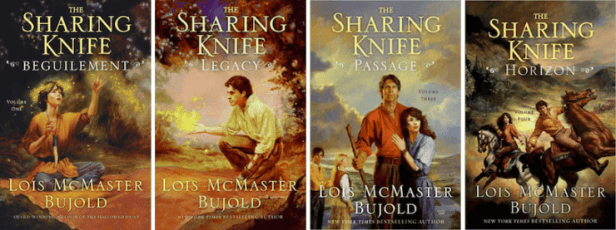
The Sharing Knife: Beguilement (2006)
The Sharing Knife: Legacy (2007)
The Sharing Knife: Passage (2008)
The Sharing Knife: Horizon (2009)
They are each their own independent book, with plot arcs and character arcs that come to excellent conclusions, but they also form a quartet that has it’s own overarching plot arc, more so than just a series of four books. And the world they have is amazing!
It’s a fantasy world with a frontier era with towns and farms and blacksmiths homesteaders, etc, but also with a significant bit of cultural conflict between the Farmers (settlers and city people) and the Lakewalkers (nomadic tribes with a type extra ability that they consider normal but that Farmers consider magic). And then there’s the malices. (“Malices” to the Lakewalkers who hunt them, “blight-boggles” to the Farmers who don’t always believe they exist.)
The first book starts the romance between a young Farmer woman, Fawn, and a significantly older Lakewalker man, Dag, but it’s also about starting: starting, or starting again, and trying, and doing ones best, even if you don’t quite know where you’re going or how it’s going to work out. Sometimes you just have to do something and see where it gets you. I don’t want to spoil events by even starting to summarize the others books, but continue to follow Fawn and Dag as they find their place and places in the world. And a strong theme having to work to communicate across cultures but that it’s possible and it’s worth it, and it works if both sides are trying and not so much when either side isn’t.
And deal with malices along the way, because there’s a lot of adventure too, mostly to do with hunting (and being hunted by) malices.
The world building is amazing, especially when it comes to the malices, which are these magical beings that suck the life out of everything around them, and are immortal. Rather than the traditional definition of immortal (can’t be killed), Bujold has created these creatures that don’t know how to die. And thus the “sharing knives”, which are special bone knives capable of holding a death that can then be shared with a malice. And just the thought that goes into the magic and the culture and the misunderstandings and just, oh so good!
I recommend them all.
But coming back to Knife Children: it’s set a dozen or so years after the end of the book series. It follows Barr, a character introduced in Passage, as a young ass of a Lakewalker who slowly becomes a better person over the course of two books, and his teenage half-Farmer daughter Lily, who was not previously aware of her half-Lakewalker heritage. Unlike the books, there’s only peripheral malice conflict, and the plot is driven almost entirely by the character arcs, and those characters are wonderful.
I’m not sure how well the short story stands on its own, but it was certainly intended to. And I’d be interested in hearing if anyone tries it, what their thoughts are.
But mostly I want to reiterate that Bujold is amazing and I highly recommend her and all of her writing.
 My Sister, the Serial Killer
 I am obsessed with the Duggars. Yes, in this golden age of peak TV, I have devoted many, many hours to watching various iterations of their TV show and even reading gossip blogs. As someone raised as an only child, I have long been fascinated with stories about big families. As a kid, I used to LOVE the Boxcar Children books and a 1950s time capsule series called the
 This novel is described as “a novel of language and love that tells one young Chinese woman’s story of her journey to the West—and her attempts to understand the language, and the man, she adores.” I was expecting a love story, quite honestly, though one with a unique approach. It is, uh…not that.
 This was on all sorts of Best of lists and the description sounded amazing; this was the quote from the New York Times review: “A mind-bending romp through a gender-fluid, eighteenth century London . . . a joyous mash-up of literary genres shot through with queer theory and awash in sex, crime, and revolution.” I like all of these things! This should be awesome! But even after multiple tries, I never made it past the third chapter. It was written in some of Olde Englishe dialect that my brain just wouldn’t parse at all. I feel like if I could have gotten over the hump and into the story I would have liked it, but I guess I’ll never know.
 Of course, everyone was reading this book. In DC, naturally, but I think there was a mad scramble for it nation-wide. I don’t really buy books anymore, and the library waitlist was over 900 people, so I figured I’d probably get around to reading it in a couple years once the next big exposé came out. However, at Thanksgiving my dad said that I could borrow his copy, as long as I return it at Christmas. A month! Plenty of time, right?
 With a title like that, how could I not want to read it? Also, the book is a 20th anniversary edition that was being highlighted at my local library as a recommendation from one of the librarians, and it’s about modern life on an Indian reservation. It’s a collection of 24 short stories, most of them only about 10-pages long.
 Your Black Friend and Other Strangers
 Artemis
 This is like Wibbly-Wobbly, Timey-Wimey: the novel. The book is covered in blurbs raving about how original and fascinating it is, but I’m not sure that I ever got a full grasp of what was happening. Every so often, I’d get a spark of understanding, which was pretty cool, but then it would inevitably lead to even more confusion.

