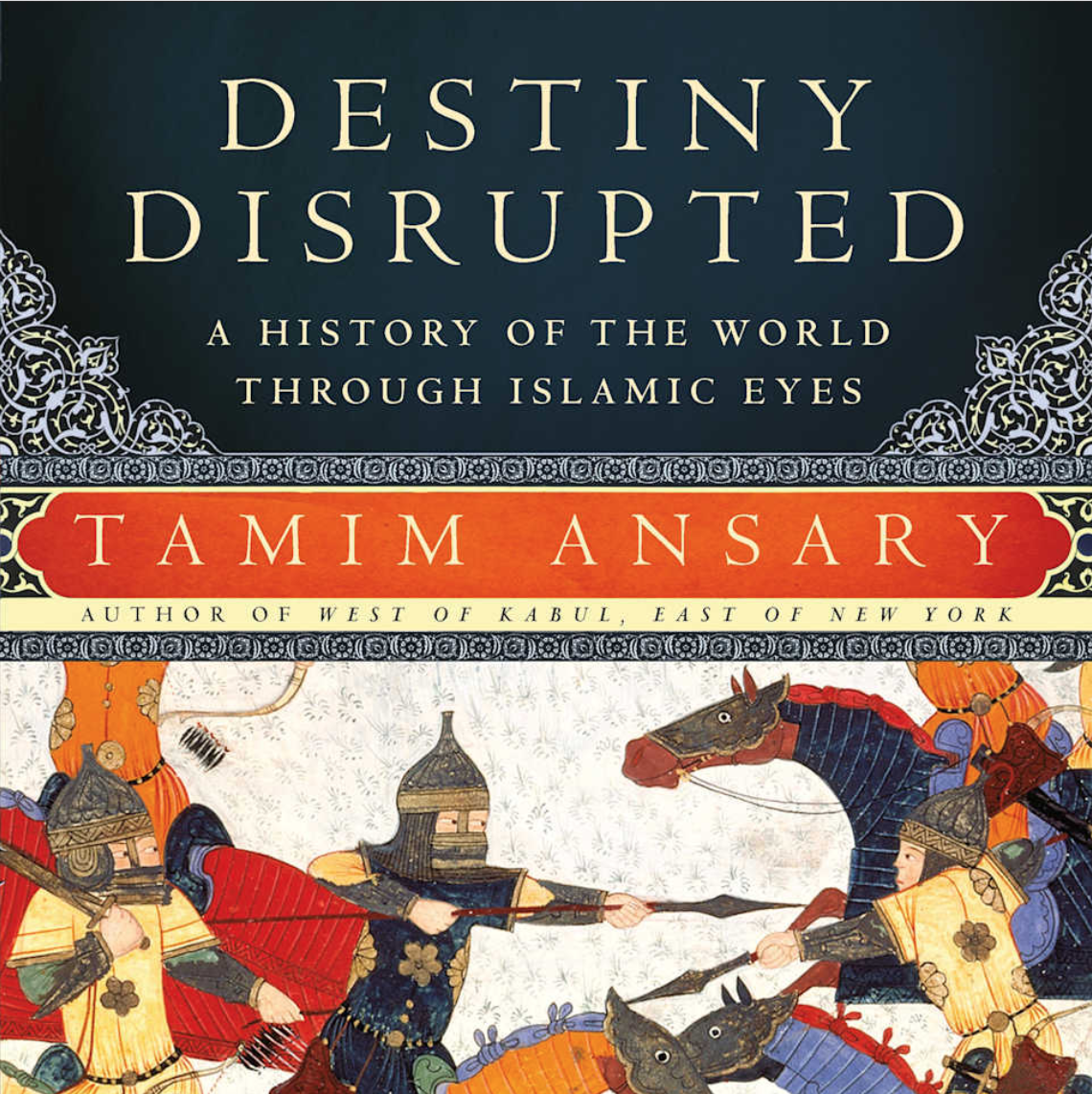
Destiny Disrupted by Tamim Ansary

Destiny Disrupted: A History of the World Through Islamic Eyes
written by Tamim Ansary
read by Tamim Ansary
2009

This is an amazing book and I highly recommend it. I listened to the audiobook version which was read by the author, which I always appreciate. It is also unfortunately timely, what with the current war with Iran. I’ve been sitting on this review for a couple of weeks now because I’ve had trouble figuring out how to describe this book, beyond just saying that everyone should read it.

On the one hand, I want to talk about the things I learned — about the history of the Khalifate, the schism between Shia and Sunni, the Mongol holocaust, the various reform movements, and all of the fascinating stories that kept me variously enthralled and horrified, and surprised in how it all fit together. But if I start, I’ll just want to quote the entire book. Ansary has a conversational way of writing about history, both discussing broad themes and recounting specific events, peppered through with humor. With that in mind, this book is a delightful read.

On the other hand, I want to point out how these stories are the background by which whole populations see the world and make decisions based on the patterns in history that they know. Being in the US, protestant Christianity is pervasive and history is told with the US as the focal point, to the extent that it can be a struggle to image an alternative. This book provides an alternative, showing what history looks like when Islam is the pervasive religion and the geography Ansary defines as “the middle world” is the focal point. With that in mind, this is an important read.

This book is very much what it claims to be: it’s a world history book written for a western layperson, and also a demonstration of how subjective even factual history can be, based on which events are considered important or not. In the introduction, Ansary talks about how he was inspired to write this book as a result of having previously written a history textbook, specifically for a Texas school system in 2000, that had a set outline of what was important to discuss, with most of Arab history missing entirely. He was inspired to write a pointed response, since in this book, much of European history is insignificant and the US is barely considered a nation before the late 1800s.

Ansary makes a point that there are many world histories that can be truly told very differently depending on which culture is providing the perspective. World histories told through the East Asian, African, or Native American eyes would have just as little or even less overlap than world histories through Islamic and European eyes have. I kind of want to read those histories now too. But in the meantime, I’ll just have to read Ansary’s other books, because he really is an excellent writer.

While writing up this review, I also discovered that the book is available, in its entirety, on the Internet Archive! Go read it!

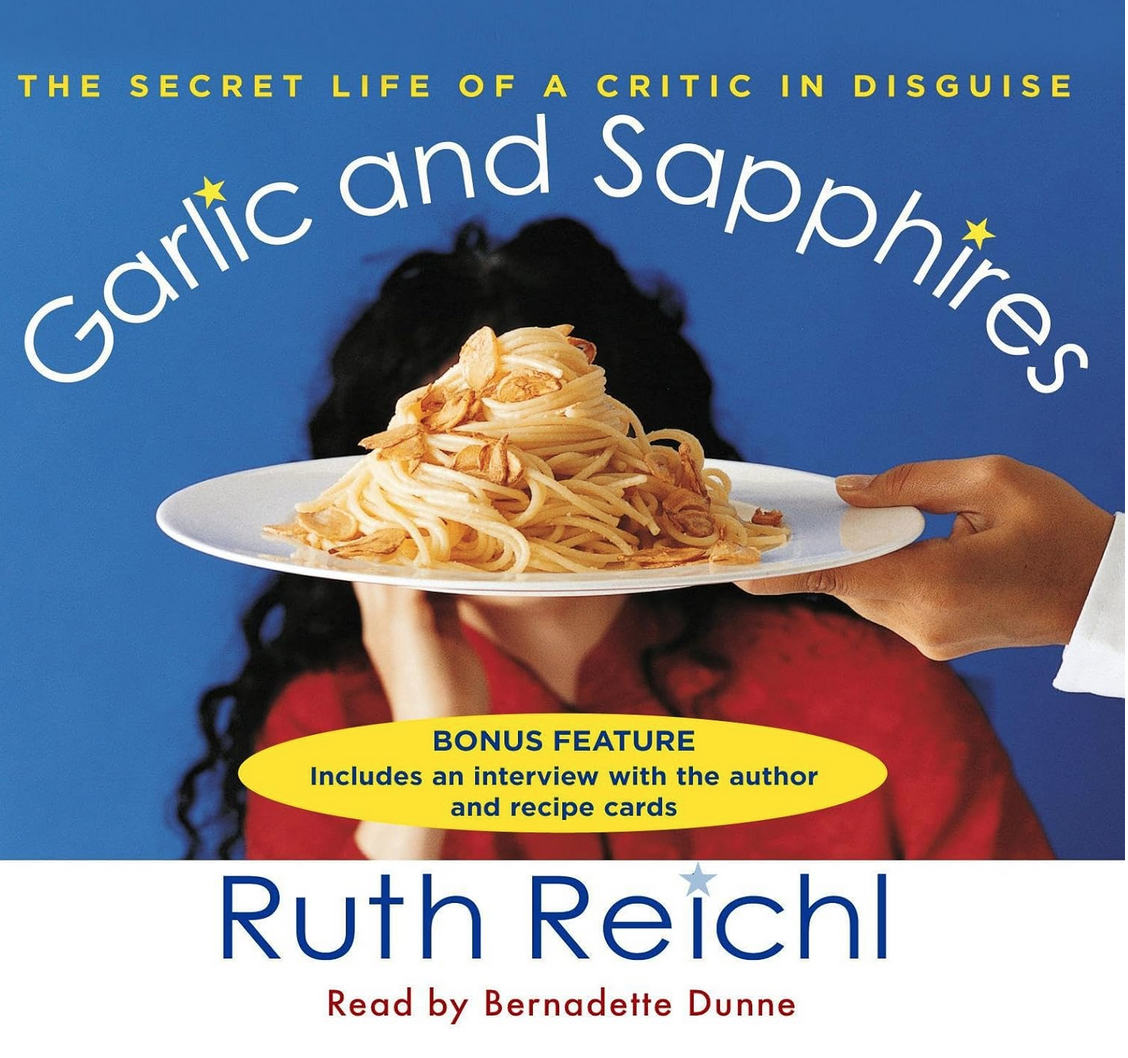
Garlic and Sapphires by Ruth Reichl

Garlic and Sapphires: The Secret Life of a Critic in Disguise
written by Ruth Reichl
read by Bernadette Dunn
2005

This is a fascinating and funny book that kept me well entertained on my commute, and I may need to check out the hardcopy from the library after this because the author includes recipes between chapters and there are a couple of ones that sounded fun to try. The book is a memoir of the author’s time as the food critic of the New York Times, starting with her being head-hunted from the LA Times to a decade later when she accepts an offer from Gourmet Magazine, and it is wild! The New York restaurant scene is intense! When she discovers that restaurants are preparing to identify and cater to her specifically in order to sway her reviews in their favor, she decides the answer is to check them out while in disguise: costumes, wigs, and whole personas are created in order to fool the waitstaff and see what the food and service is like for whoever she is being at that time.

The book is divided into sections based on the personas she creates, including discussions of how that persona came to be. She worked with a family friend who was an acting teacher to develop her first character, and others came in a variety of ways from mimicking a stranger she noticed to having a friend insist that they would dress her up. There’s at least on vintage clothing shop she describes that I desperately want to visit!

Reichl is clearly some kind of supertaster who can both identify and enjoy all kinds of food and I loved hearing her raptures about the flavors and textures and experiences at all of these restaurants she reviewed. At one point, Reichl describes her rules for her dining companions: they could order as much as they thought they could eat, but there were to be no repeat dishes on the table and she got to take a bite of every dish. It sounded amazing and I wish I could have had the chance to eat with her. Apparently, such meals were a semi-regular charity auction item, but the usual winners thought it meant that they could have a free meal at an expensive restaurant rather than seeing the background on how a restaurant critic judged the experience. A missed opportunity!

Despite not being able to experience it in person, this book is a great look at how a restaurant is more than the food, it’s the experience as a whole: the setting, the service, and the expectations. And it can all vary wildly based on who you are perceived to be and what your expectations are. My conclusion though, was that in addition to that, the restaurants have to contend with the mood that the food critic happened to be in that day or week or month. I was also struck by how often she would compliment a dish by describing it as unlike anything she’d ever had before. And I get it: she’s eating out *a lot* and thus having something unique would be a wonderful experience, but a unique dish would not necessarily be good for someone who wasn’t already glutted by standard fare.

Restaurants do come in a range, and restaurant reviews are useful resources, but at the same time, absolutely all of it should be taken with a grain of salt. That said, I really enjoyed the book!

Wicked Plants, Wicked Bugs by Amy Stewart

Wicked Plants: The Weed That Killed Lincoln’s Mother and Other Botanical Atrocities
by Amy Stewart
read by Coleen Marlo
2009

Wicked Bugs: The Louse That Conquered Napoleon’s Army & Other Diabolical Insects
by Amy Stewart
read by Coleen Marlo
2011

These books were each between four and five hours long as audio books, so not all that long as these things go, and were kind of a stream of mini non-fiction cozy body-horror stories, which is a crazy intersection of genres but that makes it all the more fun.

In many cases, they’re not even precisely stories; more like entries in a lexicon: something between a dictionary, encyclopedia, and field guide. Not something I would normally sit down and read, cover-to-cover, but I could easily set the audiobook to play without worrying about being too distracted from driving. I didn’t so much learn the details of anything in particular, but got all sorts of inspiration for writing, either mysteries with weird symptoms or science fiction/fantasy with weird creatures and societies. (It turns out there are plenty of peculiar creatures and societies right here on Earth!)

The various entries are interesting and funny, horrifying and gross, but also somewhat disappointing, especially in the few cases where I just happened to know more about a given topic than the author does. They fit into much the same niche as Mary Roach‘s writing, but the comparison doesn’t do them any favors. Mary Roach does deep dives and really digs into the crazy/scary/gross topics she writes about while Stewart accurately introduces the books as something of a dilettantes look at the subjects rather than any sort of expertise. Stewart writes from the perspective of a lay person with a very human-centric perspective. The application of modern protestant morality to the plants and bugs she discusses is done humorously but also distracts from how cool they really are when viewed simply as themselves rather than through the lens of their impact on humans.

I’m incredibly impressed with Coleen Marlo’s reading skills. She not only seamlessly reads the scientific names of each entry, but just overall does a wonderful job of reading the book in such a way that it just flowed smoothly. I didn’t spend any significant time thinking about her voice because it was just naturally the sound of the book. It can be difficult to properly value the skill that takes until you try listening to an audiobook by a reader who doesn’t have it.

To sum up, Wicked Plants and Wicked Bugs were both good for what they were: not deep but fun and interesting and inspirational for fiction writing ideas.

Wicked River by Lee Sandlin

Wicked River: The Mississippi When It Last Ran Wild
written by Lee Sandlin
read by Jeff McCarthy
2010

This is a wild ride. It’s a non-fiction black-comedy history book. It’s a collection of crazy stories about unpleasant people living awful lives and they are hilarious. Except that sometimes it gets grim enough that it overloads my sense of humor and just gets super depressing even in its ridiculousness. But it really is fascinating and an excellent look at American history and social movements. It’s kind of amazing how many patterns of events and types of people I recognize as being present in today’s world.

This is by the same author who wrote Storm Kings , which I enjoyed so much that I immediately checked out their other audiobook. Storm Kings is the better book, with a more cohesive storyline, while Wicked River is more a scattershot of stories and events, but it’s still very good and very impactful. Each chapter looks at a different aspect of life along the Mississippi, mostly pre-Civil War, skipping around in time and location, with a lot of stories about the lives of specific individuals and events. It gets into the nitty gritty of life and death and trade, the horrors of recurring epidemics, the cognitive dissonance of slave-holding societies, the lawlessness of the various settler justice systems, intermittent excesses of debauchery, celebrations of casual violence, ubiquitous drunkenness, and a vast cast of characters from all walks of life.

The book concludes with the Mississippi River Commission being established immediately post-Civil War and essentially taming the river, at the same time that railroads were replacing boats for transport. In the end, there’s a sense of nostalgia for the wildness that has been lost, because the river cultures were amazing and easily romanticized, even though, or perhaps especially because, they sound truly awful to have lived through.

Storm Kings by Lee Sandlin

Storm Kings: The Untold History of America’s First Tornado Chasers
by Lee Sandlin
read by Andrew Garman
2013

This is AMAZING! I had expected it to be vaguely interesting, enough to keep me entertained on my commute without being a problem to stop whenever I arrived. I had also expected it to be about modern storm chasers. Instead, it was utterly fascinating and surprisingly funny and I had to turn it off occasionally when I got to tricky intersections in my driving because the story was too distracting. For about two weeks, I started the majority of conversations with “In this book about weather….” because it just filled my thoughts and I wanted to share the fascination with everyone around me.

Via the focus on tornadoes, the book covers the development of weather research in the United States from colonial days to the present, following the work of maybe a dozen pivotal individuals driving tornado research. And let me tell you: the people who dedicate years, decades, or whole lives to the study of tornadoes are some truly fascinating characters!

Tornadoes by themselves are interesting phenomenon, but more than that, the books focus on tornadoes gives an amazing perspective on a wide range of history of the United States and the history of scientific studies in general, allowing the book to cover a wide range of issues without ever getting too far away from the primary topic. The book touches on Benjamin Franklin’s famous lightning experiment, the establishment of the Smithsonian, the displacement of American Indians, various arctic explorations, the great dust bowl, and a number of wars, all while discussing how these specifically related to the study of tornadoes. Sandlin does a really amazing job of covering long time periods succinctly and then covering specific events in minute-by-minute detail, and not letting the story he’s telling get bogged down in either.

The book also felt rather timely, as the current news reports storms and deaths and political decisions that interfered with factual weather knowledge, because it turns out that none of that is new or unusual to the weather service. This book is full of storms and deaths and the politics that go into deciding which facts to look at and which theories to believe. But it’s also distant enough to not be just one more bit of depressing news.

Overall, this book was fascinating and funny and horrifying and jaw-dropping, and I highly recommend it. Also the reader for the audio book is excellent.

The Age of Magical Overthinking by Amanda Montell

The Age of Magical Overthinking: Notes on Modern Irrationality
written by Amanda Montell
read by Amanda Montell
2024

It took me awhile to write up this review for an audiobook I finished a couple of weeks ago, which is helpful because I want to say that it stuck with me. Not constantly, but every day or every other day, I have the thought of: oh this reminds me of that section of The Age of Magical Overthinking! And that is quite impressive.

I can’t recall how I ran across this book but my library had it as a book-on-tape (ie, CDs) and I have a commute that goes faster if I’m listening to something interesting. This was definitely interesting and gave me plenty to think about. Montell has a bubbly upbeat voice and matching word choice, her book is filled with fun metaphors and sitcom-esque anecdotes, and that combination tried valiantly to keep the tone of this book cheerful as she discusses cognitive biases and how they impact people on both an individual and societal level, including some pretty grim scenarios.

Magical thinking is the idea that your thoughts alone can manifest changes in the world. Montell picked the title of this book with intention, because this isn’t a book about magical thinking, it’s a book about magical overthinking. And she does the same thing with each of these biases: acknowledge that they developed for a reason and have a reasonable place in our mental toolkit. They are not inherently wrong, but they can cause immense harm when they’re over-used or used inappropriately.

The table of contents lists the biases she covers and also gives you a sense of her conversational writing style:

  • Make it make sense : an intro to magical overthinking
  • Are you my mother, Taylor Swift? : a note on the halo effect
  • I swear I manifested this : a note on proportionality bias
  • A toxic relationship is just a cult of one : a note on the sunk cost fallacy
  • The shit-talking hypothesis : a note on zero-sum bias
  • What it’s like to die online : a note on survivorship bias
  • Time to spiral : a note on the recency illusion
  • The scammer within : a note on overconfidence bias
  • Haters are my motivators : a note on the illusory truth effect
  • Sorry I’m late, must be Mercury in retrograde : a note on confirmation bias
  • Nostalgia porn : a note on declinism
  • The life changing magic of becoming a mediocre crafter : a note on the IKEA effect.

Most of these I’ve long been aware, and none of them came as a shock, but some of them I hadn’t given much thought to before this book. And they’re all worth thinking about. This book does an excellent job of introducing the biases to the reader for further contemplation.

In cases where I had already spent a lot of time thinking about them, Montell’s discussion was still an introductory overview that didn’t cover some of the more complex aspects, which is fair given the kind of book it is. But for the biases where I hadn’t been thinking about them, this was a good jumping off point, to start the process of thinking about how I’m thinking.

Love, Death + Robots: The Official Anthology : Volume One

Love, Death + Robots: The Official Anthology: Volume One
2021, audiobook 2025

I have not watched the animation series, but I’ve heard good things about it and I saw that this audiobook existed and so I got it and listened to it on my work commute. And I didn’t quit halfway through, though I was extremely tempted. It has some of the worst writing I’ve ever read/heard. Like, at least one story that’s right up there with Eye of Argon, and others that were close runners up. What’s also crazy is that, as I was listening, increasingly appalled with each new story, I realized that they were managing to cover a wide range of ways in which writing can be poorly written.

In retrospect, I realized that there were two entries that are explicitly screenplays and thus can be forgiven (I suppose) for going into details about exact camera angles, and scene changes, and repetitions of the exact time of day even though it didn’t change, but wow was it hard to get through on my commute. The fact that one of those screenplays (“The Witness” by Alberto Mielgo) literally opened with “a beautiful woman is naked in front of a mirror, applying make-up” felt like such a stereotype/cliche that I wondered if it was intended as a spoof. Sadly, if it was intended as satire, it never made any particular point.

A lot of the stories (“Suits” by Steve Lewis, “Sucker of Souls” by Kirsten Cross, “Shape-Shifters” by Marko Kloos, “Blind Spot” by Vitaliy Shushko, “The Secret War” by David W. Amendola) had men with overwrought machismo fighting slavering aliens, with the type of clinical descriptions of violence and gore that I might expect from an audio-description of a visual media, but not from even a book adaptation of a movie. (“Lucky Thirteen” by Marko Kloos, has a woman with machismo fighting human soldiers, but the rest remains the same.) Text and video are different types of media and text is better served trying to describe the impact of violence/gore on the characters rather than just a description of a picture. However, most of them couldn’t even make their violence impactful. Plus, a really eerie pattern I noticed was how in these stories, there was all this extreme violence between the “main characters “good guys” who feared for this lives but stayed strong through it all because they needed to protect their people, versus the “bad guy” alien others who were mindless killing monsters with no thought or culture of their own, only an endless desire to kill humans. But their actions were the same, extreme violence towards one another: just one side was good and one side was bad. It felt like video games for armchair warriors, who wanted to feel powerful and liked gun statistics and weren’t at all interested in the source of any given conflict.

Some of the stories (“Sonnie’s Edge” by Peter F. Hamilton, “The Witness” by Alberto Mielgo, “Beyond the Aquila Rift” by Alastair Reynolds) had an interesting concept and/or twist that I would have enjoyed seeing presented better and with less of a look at the authors’ sexual issues.

“Beyond the Aquila Rift” was actually the first story (ie, the seventh story) that I thought was genuinely well-written. And then it swerved into focusing on a middle-aged dude’s feelings about his extra-marital affair and it mostly stayed there for the rest of the story, pushing aside the interesting science fiction scenario and reminding me of the stereotypical English professor writing a novel about having an affair. The author tried his best to make the affair plot-significant and mostly managed to make the protagonist so self-centered he came across as a sociopath.

There were some decent stories. (“The Dump” by Joe R. Lansdale, “Fish Night” by Joe R. Lansdale, “Ice Age” by Michael Swanwick, “Alternate Histories” by John Scalzi.) It’s too easy to forget them when I think back on the book. But they were there. They were short, but interesting and fun and funny.

There were two genuinely good stories that I enjoyed a great deal and actually recommend. Luckily, I can even provide links to them (the written versions, not the audio):

Good Hunting” by Ken Liu is excellent and heart-breaking and heart-warming and all that about China losing it’s magical culture during the British colonial period and then regaining it in a steampunk fashion.

Zima Blue” by Alistair Reynolds is fascinating and thought-provoking and I have so many thoughts about it but also don’t want to provide any spoilers, because the story itself is so well laid out in the way it presents the situation and slowly makes the reveal, and then leaves the reader to continue to thinking about all the implications for days afterwards. It’s about an artist who went through extreme body modifications in order to have experiences no one else could, and the reporter who interviewed him about his final piece.
Entangled Life by Merlin Sheldrake

Entangled Life: How Fungi Make Our Worlds, Change Our Minds, and Shape Our Futures
by Merlin Sheldrake
read by Merlin Sheldrake
2020

I adore this book! It is fabulous! It made various lists in 2020 and I’ve been sort of vaguely meaning to read it since then, but only just recently got to it when I was looking for an audiobook for a road trip. But it is so good!

Sheldrake is so deeply delightfully peculiar, surrounded by similarly peculiar researchers, that the most shocking point, beyond even his loving description of zombie ants as fungi who have temporarily become ants, or his musings on the heat produced by decomposition as he stewed himself at a fermentation spa, is when he refers to someone else as “eccentric”. I’m just like: “Sir!, you are not in a position to call someone else eccentric!”

He has a wide range of stories from his studies, his life, the studies and lives of his friends and peers, and from world history about how people think of and related to fungi, and they are all fascinating in ways I hadn’t previously imagined.

Sheldrake reads his book with a soft melodic voice that soothes the reader into an understand of the world from his perspective, from the fungal perspective, and makes a convincing argument for how important that perspective is.

He reminds us that there’s still a lot of unknowns in the world, and scientific theories are only as good as the phenomenon they explain. For any given law of nature that we think we know, there seem to be a variety of exceptions and ambiguities, and this book is focused on a huge category of beings that are pressure testing much of our current understanding of the world, and have been for as long as we’ve been aware of fungi as something to study. For example: the very word “symbiosis” was only created in 1876 to describe lichen, and “symbiotic” is even more recent as it became evident that the relationship was more common than just in fungal scenarios.

This book is fascinating and funny while giving an accessible overview of the current state of fungal studies. (Just take a moment to consider that sentence: fascinating! funny! fungal studies?) It also introduced me at least to the existence of a community of professional and amateur fungal enthusiasts I had not previously been aware of. They sound delightfully bonkers while still having some very real ideas and possible solutions to saving the environment and showing that both humans and fungi have a role in a sustainable ecosystem.

The entire audiobook is available for free online at the Internet Archive. I highly recommend it.

Braiding Sweetgrass by Robin Wall Kimmerer

Braiding Sweetgrass: Indigenous Wisdom, Scientific Knowledge and the Teachings of Plants
by Robin Wall Kimmerer
2013
read by Robin Wall Kimmerer
2016

This is a gorgeous and fascinating book, and I’m glad that I was able to listen to a version read by the author. The book is a wide ranging series of stories and musings about her life, family history, biology, ecology, and reclaiming that which is too nearly lost. It starts with a very personal focus, about her life and self-reflection and moves onto some really fascinating discussions of plants and of Native American culture and history, and then continues onto a discussion of both the dangers of ecological destruction and the importance of not giving up on repairing such casualties.

Kimmerer was raised with a Native American’s perspective on nature which gave her a love of plants and a desire to study them, and then went on to get a PhD and then a professorship in biology with a very scientific perspective on nature. It was later that she realized how important it was to combine the two approaches to nature rather than to give up one for the other. The scientific perspective is one of studying plants as objects, with scientists as unbiased outsiders, while the Native American perspective is one of being part of the nature with humanity as the younger sibling needing to learn from the plants and animals who came before them.

One of the themes that really got to me was her description of how nature is a gift economy: plants give fruits and berries to the birds, and birds give transportation of seeds to the plants. And also how humans are part of this gift economy, not separate from it. Our role in nature is supposed to be taking what is given with gratitude and giving back with reciprocity. The dangers comes with refusing what is given, taking what is not given, not having gratitude, and not giving back.

Another metaphor that she used to great effect was delving into the story of the windigo — a Native American monster that is constantly hungry and can never be satiated — and how capitalist society is trying to turn everyone into this very monster: hungry for more and never satisfied.

The audiobook is approximately 17 hours long, so I’ve been listening to this on my work commute for more than a month, and Anna has been inundated with “In Braiding Sweetgrass…” statements, because every day there is some new and fascinating story or perspective. I’ve also had to deal with becoming a bit teary-eyed while driving a few times.

This is truly an amazing book, and I highly recommend it to basically anyone and everyone.

My Planet by Mary Roach

myplanetMy Planet: Finding Humor in the Oddest Places
written by Mary Roach
read by Angela Dawe
2013

I’ve loved (and been grossed out by) every book that I’ve read by Mary Roach… except this one. This is quite the departure from the other books since it’s actually a compilation of short anecdotes that she wrote for a regular column in Reader’s Digest. They’re often cute and funny but I didn’t find any of them particularly interesting and by their very nature, they were fairly repetitive when in a collection rather than a serial: her husband Ed gets introduced at the beginning of at least half of them. They’re essentially a cheery little sitcom of a life, with many of the traditional sitcom tropes including both mocking and perpetuating 1950s stereotypes of married life. And I just don’t care for sitcoms.

To summarize: it’s well written for its intended audience, but that audience isn’t really me.