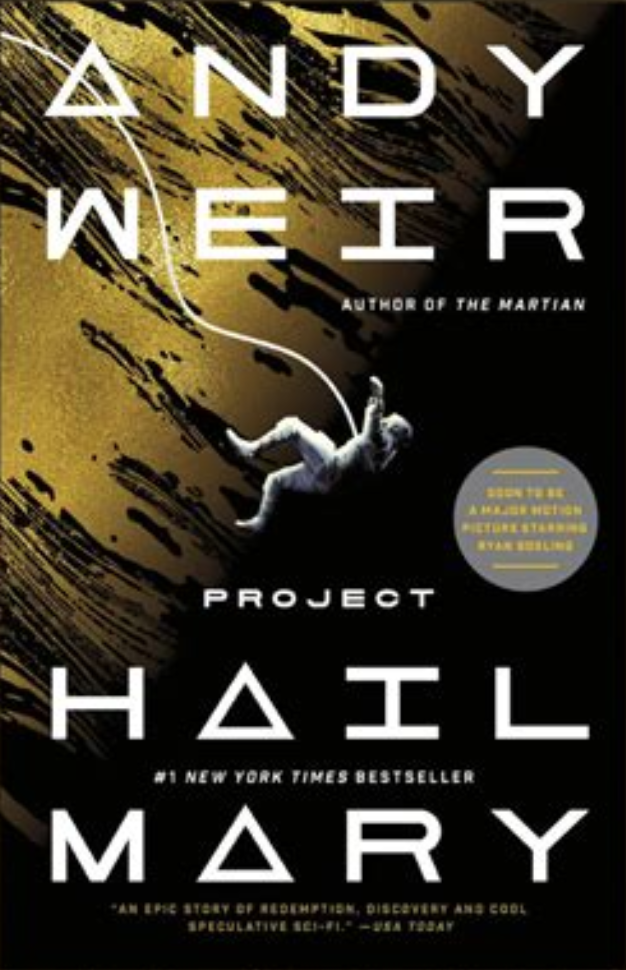
Project Hail Mary by Andy Weir

Project Hail Mary
by Andy Weir
2021

This book was a lot of fun and I read all 476 pages in three days. I do love a good science montage scene and and this was full of them. It was also extremely similar to Weir’s breakout novel, The Martian, which I had enjoyed very much. This one is obviously less bound by actual science — introducing both aliens and alien technology — but it’s clear that Weir is trying to at least keep some of the math accurate.

The book tells parallel stories of Dr. Ryland Grace waking up alone on a spaceship with no memories and figuring how what he needs to do and then doing it, interspersed with the flashbacks that tell the history that got him to that point as his memories return to him. I would sometimes wince at the choices the main character was making but I appreciated the in-story acknowledgements that his decision making skills were compromised because he’s working under a lot of stress with imperfect knowledge. I did have to suspend disbelief that it worked out for him (and humanity) as well as it did.

There were some points when I had to pretty actively suspend disbelief, less about the science technology and more about the social decisions. Having all the world governments come together to send an incredibly expensive space mission that *might* have results in 26 years seems a lot less likely than most of them deciding that it would be cheaper and quicker to come up with a local solution, but that’s not actually addressed at all: the premise is all the world unites to do this one mission. Talking around spoilers: At another point, there was an argument between two characters where it was pretty obvious that Weir was writing it purely for the drama of a conflict but didn’t actually know what the real counter argument was, so put a pretty dumb strawman argument into our protagonist’s voice. Events could easily have played out the exact same way just more interesting if it had been a real argument between two valid sides.

I enjoyed this book. It was fun and kept my attention. However, the more I think about it, the more the flaws stand out. In some ways it reminds me of Tom Godwin’s short story, The Cold Equations (1954). Both are science fiction stories that deal with the trolley problem and making hard decisions while ignoring how much their premises focuses on physics while ignoring engineering: the math works out, but it’s really bad engineering to create systems that are so inflexible. This particular book also has a meta-layer of unintentional satire provided by the interview in which Weir stated that his writing isn’t political at all, which is so fractally wrong that it’s more mind boggling than any part of the actual book.

So in summary: I enjoyed it, but it feels a lot like some of the classic science fiction stories of generations past with both the pluses and minuses that entails.
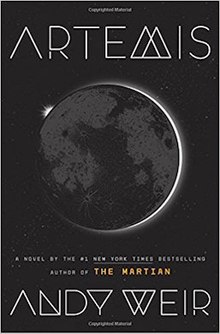
Artemis by Andy Weir

220px-Artemis-Andy_Weir_(2017)Artemis
by Andy Weir
2017

This book was fine. I enjoyed it. Mostly. But it had a series of flaws, some more serious than others.

For the good parts: it’s got a diverse cast of characters, and it does what most good science fiction novels do and takes some theories of how science could develop and looks into how those developments impact society. The ideas for how a moon colony would operate are fascinating, both from the science side and from the social side.

It’s also a bit of a heist story which is always fun. Where Weir’s first book, The Martian, was man-vs-nature, Artemis is man-vs-man, which opens up some additional opportunities for interesting conflicts.

But the man-vs-man story line generally needs you to like your characters and pick your side, and I was a bit thrown off by it ultimately being a conflict between a ‘good’ billionaire and a ‘bad’ billionaire. I guess the difference is that one kicks puppies and the other doesn’t? (Metaphorically, at least: there were no pets of any kind in this book.) And there’s ongoing commentary about how unions are like protection rackets that hurt the best skilled workers.

The main character, Jazz (short for Jasmine), is a fine point of view character except for the parts where she literally complains about how everyone is always telling her how much potential she has and offering her opportunities to develop her potential. (We should all have such trials and tribulations.) But she doesn’t take any of them up on the offers, and then feels betrayed the one time she can’t get a pass she wants because potential is fine but you actually need achievement to be successful. (This isn’t a spoiler, it’s the second scene in the book, which is admittedly before she starts complaining about people offering her opportunities, so isn’t quite so jarring until you think back about it.)

In the end, she’s so smart that she can do pretty much everything with just a little extra studying, and everyone is very impressed with it. There’s a level of wish-fulfillment meets entitlement that I find off-putting (also ignoring the difference between intelligence and education.) Weir is flipping a trope by writing it as a female character, at least, since mostly I see that as guys writing guys, but there’s only so much credit for that. Especially when paired with the narration about how she’s slept with so many men, but then the details seem to be that it’s only two men, both while in monogamous relationships (on her part at least.)

It all comes together like warning signs that Andy Weir might be going the way of Robert Heinlein and Orson Scott Card: talented science fiction writers who went increasingly extreme in being uber-conservative, with a side-order of sexual hang-ups. I grew up reading and enjoying their books, but I’m too old and entitled now myself to deal with that anymore.

Anyway, to sum up: The Martian was amazingly great and any next book of Weir’s would necessarily have a high standard to meet. Artemis didn’t meet that standard, but it’s no worse than many other science fiction novels I’ve read. I’ll keep an eye out for any other books he writes because The Martian was a masterpiece, Artemis was interesting, and two data points is a poor way to predict the future, but I’m not particularly optimistic.