 How to Be Alone
written by Jonathan Franzen
read by Jonathan Franzen and Brian d’Arcy James
2002
Franzen starts out introducing this book of essays with some reflection about how angry, zealously elitist, and deeply navel-gazing he had once been as a younger man, and I’m listening to the remaining essays, glad that he’s found his own sense of self-improvement but also realizing that these essays are the most angry, zealously elitist, and deeply navel-gazing that I’ve ever read/listened to. In large part because I actively avoid the genre I would normally typify as Guy-in-your-MFA High Literature, but this is a set of nonfiction essays by a literary author and I have a commute, so I might as well listen to this one through to the end. With each successive CD, I had to convince myself anew to complete it if only just to write this review.
He discusses a variety of issues that I actually find moderately interesting, if depressing: the Clinton-Lewinsky-Starr-Report scandal, the problems with the Chicago postal service, the internal conflict between research departments and legal departments in the tobacco industry, the for-profit prison industry, the commercialization of sex. However, his essays are like op-ed pieces where he presents himself as speaking for “the silent majority” who all agree with him, and is distraught by the “cheap attacks” of naysayers with their statistics and surveys pointing out that he is, in fact, in the minority. The facts of a given situation are quickly overwhelmed by his personal interpretations. He is the everyman and speaks for everyone.
He states that High Literature = The Social Novel = Tragic Realism, and that all of these are best demonstrated by being about the unmarked straight white male. I generally avoid any modern novel calling itself “Literature” because it seems to me to be a genre made up of unpleasant people living unpleasant lives. Franzen agrees, except he thinks this is a good thing.
In fact, he seems to be carefully cultivating his own dissatisfaction with life. He’s not glorifying the problems of the world, per se, but glorifying his own knowledge of those problems, throwing it in contrast to the bourgeoisie others who “don’t fully understand.”
Part of his unhappiness is based on his apparent belief that being lauded by the masses is his proper default state and thus nothing to take pleasure in, while anyone not actively being impressed by him is taking something away from him. He is insulted that his demands for solitude and privacy are met without demure. He’s bemoaning the loss of his rape fantasy: he wants to be able to say “no” to demands for his opinion and then have that “no” disregarded.
As he bemoans the loss of interest in “real” literature, he remarks without any acknowledged irony, that publishers are instead publishing more works done by women and people of color. These he considers genre rathe than literature, by default. He argues that authors should not pander to the masses while also despairing that the masses do not like his books as much as they should. (Keep in mind that this is the complaint of an award-winning author.)
I can understand, in theory, that it must be very hard for straight, white men who have long been told that their concerns are universal, and that other’s concerns are merely genre issues, to be confronted with the discovery that they are actually just one more demographic. I can understand that it is a hardship for them all, and this author in particular. But I can’t managed to dredge up much actual sympathy.
In contrast, I realize that he is likely creating the background against which hopepunk and solarpunk have developed. And that, I think, is a gift.
 Hit by a Farm: How I Learned to Stop Worrying and Love the Barn
 Havana Nocturne: How the Mob Owned Cuba…and Then Lost It to the Revolution
 Stones into Schools
 Hanif Abdurraqib is very smart and funny on
  This was on all sorts of Best of lists and the description sounded amazing; this was the quote from the New York Times review: “A mind-bending romp through a gender-fluid, eighteenth century London . . . a joyous mash-up of literary genres shot through with queer theory and awash in sex, crime, and revolution.” I like all of these things! This should be awesome! But even after multiple tries, I never made it past the third chapter. It was written in some of Olde Englishe dialect that my brain just wouldn’t parse at all. I feel like if I could have gotten over the hump and into the story I would have liked it, but I guess I’ll never know.
 Of course, everyone was reading this book. In DC, naturally, but I think there was a mad scramble for it nation-wide. I don’t really buy books anymore, and the library waitlist was over 900 people, so I figured I’d probably get around to reading it in a couple years once the next big exposé came out. However, at Thanksgiving my dad said that I could borrow his copy, as long as I return it at Christmas. A month! Plenty of time, right?
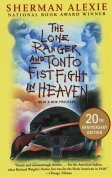 With a title like that, how could I not want to read it? Also, the book is a 20th anniversary edition that was being highlighted at my local library as a recommendation from one of the librarians, and it’s about modern life on an Indian reservation. It’s a collection of 24 short stories, most of them only about 10-pages long.
 Your Black Friend and Other Strangers
 An Age of Barns


 Biblio-therapy