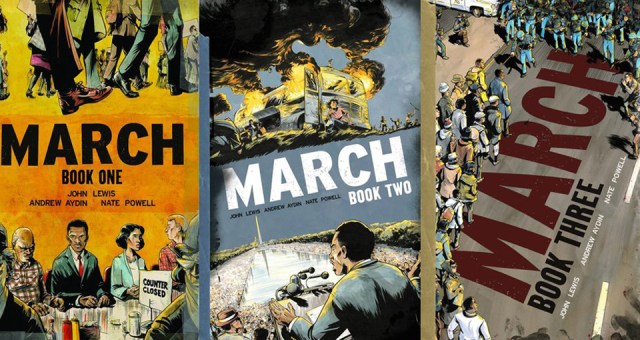
March, books 1, 2, and 3
written by John Lewis and Andrew Aydin
illustrated by Nate Powell
2013, 2015, 2016
John Lewis is a g**d*** hero and every school child should learn his story and every adult should know it. That’s my take away from these books. I am embarrassed at how much of these events I didn’t previously know.
These books were both heart-wrenching and inspirational, made all the more so by the starkness of the story telling. Lewis is not specifically trying to be heart-wrenching or inspirational, he’s just telling the story. And the story is intrinsically heart-wrenching and inspirational.
John Lewis felt, feels, so strongly about achieving what is right that he knowingly walked into situations where he could be killed, refusing to physically fight back, and instead demanding that the world be better than it was through acts of faith and friendship in the face of hatred and anger. That takes levels of courage that I can’t really comprehend and yet want so much. He wanted to live and yet was willing to risk his life to accomplish something because, live or die, succeed or fail, just the attempt would be worth it.
That is a freaking hero.
These books are autobiographical and nonfiction. They give the reader a look at a specific part of history that often gets glossed over in the textbooks. But it’s important history, in part because it’s still ongoing. These events were only some fifty years ago and John Lewis is still alive and working today. And the issues he dealt with are still being dealt with today as well. These books make you think. They don’t necessarily tell you what to think, but they show you events that require thought.
So read them.
Read them now.
Something that gets to me about modern politics is how scared people are. Trump’s supporters want to cower behind a wall, protected from anyone and everything different from them. Trump’s detractors are terrified that he’s going to either kill them outright for being different or force them into a poor homogenous society cowering behind a wall. (I’m over simplifying, but I stand by the summary.)
John Lewis’s life is a testament against that level of fear. He could face fear and not let his warp who he was or change him into someone he didn’t want to be. Everyone should learn that lesson.
Another thing that struck me in these books was how evil some of the white people were. It’s generally not covered in text books, but it’s still historical fact—and not even all that historical. But there were just ordinary citizens who were also monsters and they raised their kids to be monsters. They went out of their way to kill, spread misery and spew anger.
It has occurred to me before that there is a level of cognitive dissonance in this type of violent racism, that clearly shows that the racists know themselves to be in the wrong and lying to themselves. True-believer racists go the white-man’s-burden route. But by violently trying to create a society that they consider to be natural, they demonstrate just how unnatural it really is.
These books also got me thinking about how methods change and evolve in every war as both sides learn how best to attack and defend. In the 1960s, the civil rights leaders made being jailed work for them by overfilling the jails and refusing to pay bail, forcing the cities to take the expense.
Unfortunately, racists have evolved since then and have turned the jail system into a for-profit venture and they benefit off the number of black bodies they imprison.
I’m reminded of the story of Jesus turning the other cheek. It’s often seen as purely an act of humility, but that’s because not many people know the cultural implications of Jesus story. Left and right hands were seen very differently, as were open handed slaps and backhanded slaps. Jesus wasn’t merely submitting to being slapped again, he was changing the situation so that the person slapping him faced a very different set of options.
I’m not sure what the modern version should be, but I do know that it needs to change with the times.
And a final thought:
One of the things that I find difficult with any civil rights movement is that I can never do enough, and so I become paralyzed and wind up doing nothing. But Lewis makes the point with this story, the story of his life and the lives the people he worked with, that no one person can do everything and that’s okay. Because you do what you can, don’t do what you can’t, and rely on others to do what they can. Civil rights, all politics for that matter, isn’t a single sprint: it’s a marathon and a relay. You work together and you go for the long run, and you pass the baton back and forth. You have some wins and you have some devastating losses, but hopefully over the course of years and decades you wind up with more achievements than setbacks. And that is a message that is always important, but especially important in today’s political scene.
 Freedom Hospital: A Syrian Story
 I am Raymond Washington
 Fire Monks: Zen Mind Meets Wildfire at the Gates of Tassajara
 Rebecca has read a fair amount of
  Courage is Contagious: And Other Reasons to Be Grateful for Michelle Obama
 fail, fail again, fail better
 This Book is Overdue: How Librarians and Cybrarians Can Save Us All
 Between the World and Me
 Biblio-therapy