The Tomato Thief by Ursula Vernon

The Tomato Thief
by Ursula Vernon
2016

Some time ago I bookmarked this short story, intending to read it later, and then mostly forgot about its existence until I was searching through some old bookmarks wondering why I had so many of them.

It’s really good! It’s sort of magical-realism, fairy-tale like, with a cranky old woman as the main character and is a delight.

It reminds me of Zen Cho’s short stories, including “Prudence and the Dragon” which Anna reviewed previously, and the stories in “Spirits Abroad” which apparently I never got around to reviewing here, but are also fabulous.

But you should go ahead and read The Tomato Thief here.

Your Black Friend and Other Strangers, by Ben Passmore

yourblackfriendYour Black Friend and Other Strangers
by Ben Passmore
2018

I saw Ben Passmore speak on a panel discussion at the Small Press Expo this year. And he was one of the better speakers about doing nonfiction journalism in graphic novel format. I definitely wanted to read his book, which is twenty short stories in graphic novel format – between 1 and 21 pages each. All twenty combined are 120 pages.

The first story, the titular “Your Black Friend”, was remarkably hard to get through. It was fabulous, but it was also deeply uncomfortable because it pointed out my own problems and how none of us get to opt out of a racist society. We can do our best to try to improve society and make it less racist, but we’re all impacted. Black people don’t get to opt out of being oppressed and white people don’t get to opt out of being the oppressors. And here’s a constant struggle with stereotypes in both directions and from all sides.

When reading it, I could feel myself becoming defensive (“I don’t mean it that way!” the white person’s version of “not all men!” etc.) and that itself was an important realization to have, and a reaction I know to guard against.

Once I got through that one though, the rest were (relatively) smooth sailing. Some of them were more impactful than others, and they tended to deal with just different issues that Passmore had run into during his life and travels, many of them about racial inequality but certainly not all of them, and a few that were pure navel-gazing philosophy.

All the stories are good, but a couple of that I want to call out in particular are:

“It’s Not About You”, which does a hilarious and fantastical job of addressing the fact that we’re all dealing with our own issues and struggles and yet that doesn’t excuse us from acknowledging other people’s issues and struggles.

and

Ally I Need is Love”, which is a hilarious and biographical story from his past as a pedicab driver dealing with intersectionality issues, generational changes, and stereotyping.

Anyway, the art isn’t my usual style preference but it carries the stories well and is distinctly his Passmore’s own style, which I can now semi-reliably recognize in other contexts (such as on The Nib, which I follow on Instgram.)

I definitely recommend this book.

In writing this review and checking some links, I also discovered that “Your Black Friend” (the short story, rather than the whole book) got turned into a 3-minute youtube video available here.)

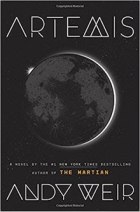
Artemis by Andy Weir

220px-Artemis-Andy_Weir_(2017)Artemis
by Andy Weir
2017

This book was fine. I enjoyed it. Mostly. But it had a series of flaws, some more serious than others.

For the good parts: it’s got a diverse cast of characters, and it does what most good science fiction novels do and takes some theories of how science could develop and looks into how those developments impact society. The ideas for how a moon colony would operate are fascinating, both from the science side and from the social side.

It’s also a bit of a heist story which is always fun. Where Weir’s first book, The Martian, was man-vs-nature, Artemis is man-vs-man, which opens up some additional opportunities for interesting conflicts.

But the man-vs-man story line generally needs you to like your characters and pick your side, and I was a bit thrown off by it ultimately being a conflict between a ‘good’ billionaire and a ‘bad’ billionaire. I guess the difference is that one kicks puppies and the other doesn’t? (Metaphorically, at least: there were no pets of any kind in this book.) And there’s ongoing commentary about how unions are like protection rackets that hurt the best skilled workers.

The main character, Jazz (short for Jasmine), is a fine point of view character except for the parts where she literally complains about how everyone is always telling her how much potential she has and offering her opportunities to develop her potential. (We should all have such trials and tribulations.) But she doesn’t take any of them up on the offers, and then feels betrayed the one time she can’t get a pass she wants because potential is fine but you actually need achievement to be successful. (This isn’t a spoiler, it’s the second scene in the book, which is admittedly before she starts complaining about people offering her opportunities, so isn’t quite so jarring until you think back about it.)

In the end, she’s so smart that she can do pretty much everything with just a little extra studying, and everyone is very impressed with it. There’s a level of wish-fulfillment meets entitlement that I find off-putting (also ignoring the difference between intelligence and education.) Weir is flipping a trope by writing it as a female character, at least, since mostly I see that as guys writing guys, but there’s only so much credit for that. Especially when paired with the narration about how she’s slept with so many men, but then the details seem to be that it’s only two men, both while in monogamous relationships (on her part at least.)

It all comes together like warning signs that Andy Weir might be going the way of Robert Heinlein and Orson Scott Card: talented science fiction writers who went increasingly extreme in being uber-conservative, with a side-order of sexual hang-ups. I grew up reading and enjoying their books, but I’m too old and entitled now myself to deal with that anymore.

Anyway, to sum up: The Martian was amazingly great and any next book of Weir’s would necessarily have a high standard to meet. Artemis didn’t meet that standard, but it’s no worse than many other science fiction novels I’ve read. I’ll keep an eye out for any other books he writes because The Martian was a masterpiece, Artemis was interesting, and two data points is a poor way to predict the future, but I’m not particularly optimistic.

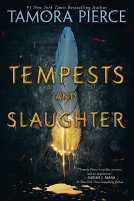
Tempest & Slaughter by Tamora Pierce

TempestAndSlaughterTempest and Slaughter
by Tamora Pierce
2018

This is a very odd book.

Like many girls in my generation, I grew up reading Tamora Pierce books, and while I don’t read them quite as religiously anymore, there are only a handful I haven’t read. This particular book was making waves before it was even published because not only is it the first time she’s written with a primary male protagonist, it’s also giving the backstory to the powerful and mysterious Numair Salmalin, the love-interest from one of her other series, The Immortals. This book is the first in a series about his youth as young Arram Draper, attending a school for magic.

The problem with any prequel, of course, is that regardless of what happens in the plot, you have a pretty good notion of how everything ends up.

But Pierce seems to have gotten around that by just deciding not to include a plot?

So there’s a lot of world-building (although much of the magic seems more similar to her Emelan universe rather than her Tortall universe where this particular book is set) and a lot of fun character interactions (although no character development), and a whole lot of foreshadowing. But no actual plot.

Like, stuff happens. But nothing ever develops.

I still enjoyed it, because I do love world-building, and Pierce is a talented writer, but… it’s just really odd to read a book without a plot.

Also, Arram was fine enough as a point of view character but he’s a bit of a goody-two-shoes in a way that I found surprisingly off-putting. It wasn’t that his ethics were wrong, in fact, they were very much on-point; it was more that they were unearned. He is a child growing up in a society that keeps slaves, and yet he is alone in wanting to speak out against it? Where did those ethics come from? What made him decide to speak out against what his friends and family who are fine with? And why are there no others that share his opinion? For all that he’s a teenager through most of the book, his ethical perspectives felt a bit like seeing a toddler at a protest rally being cute but clearly not able to truly argue the perspective.

Anyway, to sum up: interesting, but odd, with a few pointed problems. But I’ll definitely read the next book in the series to figure out what (if anything) happens next.

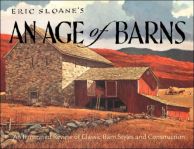
An Age of Barns by Eric Sloane

ageofbarnsAn Age of Barns
by Eric Sloane
1967

It probably says a lot about my general reading habits that my first thought about seeing this was that it was like a fantasy world guide except that what it describes and shows detailed pencil sketches of is all real. It starts with pictures of different tools and then moves on to show different types of boards and logs and different ways of making a wall and the different layouts for the structures and the different purposes for the different structures. (And I have now learned that there are cellars vs ground cellars and dry cellars vs wet cellars; not to mention that those crescent moon cut-outs on out-houses mark those as being women’s privies – they’d be sun cut-outs for men’s privies.)

My second reaction, after I’d actually started to read it, was really thinking about how smart and skilled those early farmers were. They would cut down and then carve these trees into interlinking logs. They really are like Lincoln Logs(TM) except more detailed, more individualistic, and a gazillion times more heavy. They knew how they wanted these logs to connect and then they carved them to slot together just so, all while using a medium that can’t be manipulated by one man on his own. It has to be a massive group project.

My third reaction, after having gone to see a barn that I’d previously seen several times, was that once I started to have an understanding of how a barn was put together, I started to see things that I had completely overlooked before because it didn’t previously hold any meaning for me. Before I had thought, huh, that log has an odd wavy texture to it; now I look at it and go: that was hand hewn using a broad ax. Before I hadn’t even noticed some notches on a banister, and now I look at it and go: that is repurposed wood from a different section because the notches on it were intended for something different.

And a final thought: this was written well-before Wikipedia existed but it is still this deep-dive into an esoteric research rabbit hole and it’s amazing. I love getting to see someone else’s passion about something that wouldn’t have otherwise occurred to me as a thing to even really think about.

Anyway, the whole book is only about 90 pages, most of it images and diagrams, and it’s not really intended to be read through the way I did, but it’s still fascinating and I liked it.

Spinning Silver by Naomi Novik

spinningsilverSpinning Silver
by Naomi Novik
2018

I spent an afternoon and two evenings gasping “oh no!” in between bouts of giggling, and stayed up way too late both nights and had a very difficult time putting it down for a night and a work-day in the middle. I love Novik’s writing and her characters are a delight, and she keeps her plotting fast and dense, and just so much happened and I loved it all!

The story is clearly inspired by Rumpelstiltskin, but makes a lot of changes, and really focuses around the theme of trading value for value, as it tells the interlinked stories of a young jewish money lender, a poor servant girl, the daughter of a duke, a tsar, and the king of the winter elves.

The world-building is also amazing as Novik introduces a whole magical realm in parallel to a more historical Russia, and then leaves both the reader and the main characters to piece together the rules of magic and society that permeate that alternate world.

It also made me realize that while, like any fairytale, it’s something of a morality tale, the morals quite difference from the standard. Many fairytales have the moral that if you remain kind even in abusive situations, then you’ll eventually get out and go on to have a good life. Which is an important lesson and is touched on, but isn’t the main one here. And this one is equally valuable: be ruthless in your demands for fair treatment and harden your heart against those who would emotionally manipulate you to avoid the consequences of their actions.

So, to sum up, this was amazing and I highly recommend it. It also kind of reminded me of not only Novik’s previous book Uprooted, but also Bujold’s Sharking Knife series, and Mckinley’s Sunshine, all of which I also really liked and recommend.


art history from The Met

I wasn’t particularly aware that The Met (aka The Metropolitan Museum of Art) had its own publishing house, but I’m certainly not surprised. It focuses on art history books.

What does amaze and delight me is that they’ve apparently decided to put their out-of-print books online for free, available to read online or download.

Sweet!

As of writing this, there are 569 books available in their entirety. From just a random pass, they include:

The Academy of the Sword: Illustrated Fencing Books 1500-1800

Peruvian Featherworks: Art of the Precolumbian Era

Words and Images: Chinese Poetry, Calligraphy, and Painting

I haven’t read any of them yet, but having discovered this small archive of amazing books, I figured I needed to spread the word. Cheers!

Graphic novels on systematic oppression

I was in a mood the last time I was at the library and these are the three other graphic novels I got along with Freedom Hospital, and all of them are about dealing with systematic oppression. Not necessarily successfully, but trying to. They are none of them cheery.
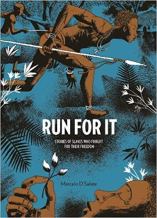
RunforitRun For It: Stories of slaves who fought for their freedom
by Marcelo D’Salete
2017

There’s four chapters, telling four somewhat interlinked stories of black resistance to slavery in Brazil. And it’s just heart-breaking. Individuals could and did fight for their freedom, but unlike a game of tag, there was no home base, no safety or home free. There was just constant risk of staying, even greater risk of trying to leave, and no alternatives.

And trying to organize for a rebellion against the structure itself was just more courting death.

It also really shows how slavery-based societies actively promote viciousness and suppress empathy, among everyone involved, slave owner and slave alike. And possibly the greatest rebellion that the slaves managed to (sometimes) win, was to maintain a sense of worth to their own lives and the lives of their loved ones.
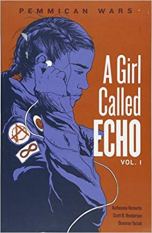
girlcalledechoA Girl Called Echo, Vol. 1: Pemmican Wars
by Katherena Vermette, Scott B. Henderson, and Donovan Yaciuk
2017

This a beautifully done YA comic about Echo, who has been placed in a new school and a new foster care house. In school, she’s learning the history of the Métis, the local indigenous tribe, from which she is descended but not raised with. She’s in a position where she doesn’t fit in with the people around her or even with the people who should have been her people, but about whom she doesn’t know anything.

But in an odd experience that comes with no explanation (in this volume, at least) she is transported back in time, for short periods, to the era that her modern history class is talking about. And that’s where she makes what looks like her first a friend, Marie, a young Métis girl. But Marie is experiencing the time that Echo is learning about in school: the series of conflicts between Métis and colonists that largely destroyed the Métis way of life.
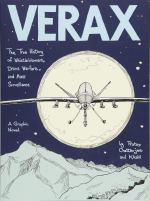
veraxVERAX: The True History of Whistleblowers, Drone Warfare, and Mass Surveillance
by Pratap Chatterjee and Khalil
2017

Pratap Chatterjee is a journalist and the graphic novel follows his years-long investigation into governmental mass surveillance and drone warfare. So the slow start and surprisingly long time it takes to get anywhere might be a realistic portrayal of the frustration of the investigation but it makes for a book that spends the first half alternating between victims speaking about their loved ones being killed in drone attacks and Chatterjee speaking about his editor not properly appreciating his nose for a story. Chatterjee does not look good in the comparison.

That said, about two thirds of the way through, it starts to pick up with Edward Snowden’s whistleblowing. At that point the story shifts from following an investigation to explaining the implications of the information found, and that was much more interesting.

VERAX brought up two things that I hadn’t given much thought to before:

First:

That unmanned drones are not actually unmanned: they have a crew of 180 people stationed around the world, keeping them in the air, flying them, analyzing the data, examining the video feed, and making the calls to fire. It means that Air Force enlisted kids right out of high school and sat them down in front of screens with crappy surveillance video (this is not the high def videos shown in the movies) and has them watch the grainy videos of people dismembered and dying from the missiles they helped launch. Rates of PTSD among drone pilots who never leave their offices is amazingly high.

My dad used to say, “be careful what you put into your head, because you can’t always get it out again.” Some knowledge is important to have, and certainly worth the pain of being a third party witness. But sometimes it is just too much: I can’t imagine spending years watching those videos live.

Second:

While mass surveillance is an invasion of privacy and terrifying in how pervasive it is, it is almost equally terrifying how rife with errors it is. It’s bad data and the government is making life-or-death decisions based on this data. That’s why there are so many civilian casualties by a method that is supposed to be created specifically to avoid them. Because how often have you called a wrong number or gotten a call from someone trying to reach someone else? Maybe it’s an old phone number of maybe a 5 got misread as a 6, or a 1 as a 7.

It’s full of bad data, such that a good third of the drone strikes were made on the wrong targets. And the institutions making use of the data tend heavily towards confirmation bias. Ie, if they’re looking for a weapon and they see someone in a person’s hands, that’s evidence that they have a weapon. As opposed to looking at someone carrying something and considering how many other things they could be carrying: a glass of water, a baby, a bag of skittles. No matter how smart you are, no matter how dedicated, you cannot make good decisions based on bad data.

But overall, as a book, it was a slow start that finished with a lot of ideas and was very thought provoking.

I recommend all three books, but they are draining as they show how hard and yet necessary it is to maintain hope.

Freedom Hospital by Hamid Sulaiman

freedomhospitalFreedom Hospital: A Syrian Story
written and drawn by Hamid Sulaiman, 2016
translated by Francesca Barrie, 2017

This is a gorgeous graphic novel, with stark images that carry a lot of impact. The style matches the story too, in its stark contrast that still manages complex characters in a confusing state of social collapse.

There’s a cast of twelve main characters in and around the underground hospital Yasmine has set up to provide medical treatment to the resistance of the current regime. It’s not strictly non-fiction — Sulaiman took liberties with combining characters and stories, but it’s not really fiction either. It starts in spring 2012, and covers the year in four seasons with a short epilog set in spring 2013.

It’s not particularly long or technically hard to read, but it’s a hard subject and the characters are all complex and the situation even more so. And I keep on thinking about days later. One of the things that really struck me about it was the way Sulaiman created a background by the simple matter of, when there was a time cut between scenes, there’s a small line saying how many hours or days later it was, and how many people had died in that time.

“six days later: another 731 killed.”
“ten hours later: another 69 killed.”
“two weeks later: another 2,157 killed.”
“twelve days later: another 793 killed.”

And the people who survive carry on trying to do something: to win, to get noticed, to be saved, to survive…

Some of them do and some of them don’t, and everyone just keeps on trying to find some right thing to do, whether it’s to stay or leave or join one of the militias.

It’s heart breaking and wearying and shows just how easy it is to become accustomed to truly horrifying circumstances.

The Murderbot Diaries by Martha Wells

3rogueprotocolThe Murderbot Diaries: Rogue Protocol
The Murderbot Diaries: Exit Strategy
By Martha Wells
2018

4ExitStrategyThis is a series of four novellas, the first two of which I’ve already reviewed, but I wanted to make at least a little post about the final two, which have now come out and complete the character arc. They are so good! They each stand alone, but they also all work together to be greater than any one part.

They’re also somewhat reassuring in the way that they are set in a dystopian universe but is still pretty blasé about the whole thing. The characters are trying their best, mostly, and while things do go well, mostly, it’s not world changing, except for the main individual who’s trying to figure out its own place in the world.

Life continues on, self-discover continues on, even when you’re wandering around in a world of corporate control and violent greed. And sometimes you can still have a realistically happy ending.