The Seven Moons of Maali Almeida

By Shehan Karunatilaka

Work is sending me to Sri Lanka tomorrow, so I scrambled to check out several travel guides from the library. They weren’t really holding my attention, though, so I had the thought to track down a fictional novel by a Sri Lankan author and set there. Unsurprisingly, the vast majority focus on the long and brutal civil war, and that wasn’t what I was looking for in this particular moment.

The Seven Moons of Maali Almeida has a fascinating premise, and was described as “bawdy, wisecracking” and “comic, macabre, angry and thumpingly alive,” which seemed more like it. However, it was very much also about the civil war, which upon consideration makes a lot of sense: the 26-year war only ended in 2009, recent enough that it would probably be absurd for any novel to not feature it someway or another. (I also think it worked: I have a much better general sense of the recent history and culture, though I had to frequently remind myself that I was reading a critique of the most negative side.)

The novel opens with Maali Almeida, a photojournalist, arriving in the afterlife, which spotty memories of his life and none of his death. The very bureaucratic helper explains to him that he has seven moons before his chance to move to the next stage, whatever that will be, closes. As he travels around Colombo, revisiting old homes, family, and friends, dodging various other ghosts and demons, pieces of his life come back to him, and he scrambles to make meaning of it before he must go on.

Maali not a very likeable man, though neither is anyone else, and the situation in Sri Lanka is impossible. The tone of the book in general reminded me of Catch-22, in that it was actually quite funny when showing truly horrifying circumstances. Upon reading the first chapter, Rebecca said it reminded her a bit of Slumdog Millionaire, and perhaps there is genre of books that reveal the worst of humanity through the darkest of humor. For all that, though, it ended in a surprisingly optimistic view of humanity and life in general, which caught me off guard but that I really appreciated. (As an aside, the beginning of the book caught me off guard with its second-person present tense, which is an usual style that can be difficult to get into, but I adjusted more quickly than I expected and came to really appreciate it.)

The Mysteries

By Bill Watterson and John Kascht

I first heard about Bill Watterson’s latest publication from Midnight Pals’ twitter thread, which is funny, a little mean, and pretty accurate. I wasn’t sure what to expect, but the extremely slim volume with one sentence and one picture per page still took me by surprise. It’s described as a “fable for grown-ups” and it is a very quick read — my whole family read it in an afternoon.

It is very much a departure from his Calvin & Hobbes work, though some family thought they could recognize trace similarities in the illustrations. I wasn’t previously familiar with John Kascht, apparently a renowned caricaturist, but per the afterward, both art and writing were a collaborative effort. Whatever each of their roles were, it is clear that they are both fairly fed up with the cultural discourse over the last few decades and perhaps humanity itself. Though it is overall a hopeful message, it reminded a number of us of this comic.

It’s a lovely little book that would probably make a nice gift for a fan or completionist; everyone else should also check it out, but perhaps from the library.

Unexpected Night

By Elizabeth Daly

This book is a trip — not exactly good by today’s standards, but very entertaining! First published in 1940, Daly is a contemporary of Agatha Christie, though not nearly as prolific or renowned. I was going to give Daly some extra credit for avoiding the n-word where Christy would absolutely have used it, but she follows up later with some blackface and different (less charged?) slurs, so I guess there’s that.*

The narrative structure and characters are certainly dated, but that was part of the charm for me. I was often kept guessing at the twists in plot, more because I don’t understand many of the lifestyles and character tropes of the time (why is everyone going out golfing the day after a suspicious death?!) than any planned surprise reveals, and occasionally I couldn’t understand what the characters were on about, with their contemporary slang. It adds a certain spice to the reading experience!

Unexpected Night introduces Daly’s primary detective, Henry Gamadge, an antique book verifier, who gets dragged into mysteries under the flimsiest of excuses. In this case, he is vacationing at a resort in Maine, coincidentally along with a casual friend of his, who’s family then becomes embroiled in the suspicious death. Like I said, Gamadge doesn’t have much of a connection, and I very much appreciated the variety of characters that were also puzzled at his involvement, including the long suffering sheriff.

Since this is her first published book and the first in the Henry Gamadge series, I’m guessing that some of the rougher narrative and character parts will get smoothed out, and I look forward to continuing the series.

*Well, I started the second novel in the series, Deadly Nightshade, and unfortunately it features depictions of “gypsies” so offensive I had to quit, so I guess that’s that.

The Poppy War by R. F. Kuang

The Poppy War
by R. F. Kuang
2018

Some years back, I first heard of this book in a recommendation list that had tagged it as grimdark. That’s not a subgenre I appreciate at all, and so I didn’t read it then. More recently, I ran across a recommendation somewhere else, and it looked interesting so I gave it a shot, and for the most part it slots pretty neatly into a lot of fantasy and YA war books that deal with horrible situations. However, out of 530 pages, there are about 30 at the 400 page mark that are absolutely horrifying and I wish I hadn’t read.

While the book is set in a fantasy world, it’s clearly inspired by China and Japan and the Japanese invasions of China. And those 30 pages are inspired by the Rape of Nanking, aka the Nanking massacre of 1937-1938. If you ever want nightmares, look up that bit of history. As a piece of fiction, it comes across as a series of gratuitously detailed descriptions of physical and sexual abuse on a massive scale; as a reminder of the depths of horror that humans perpetuate upon each other, it made me wonder why I was reading fiction and not somehow doing something to stop any of the current genocides taking place, and how horrible is it that none of them are as horrifying as Nanking was.

But, you know, other than that, the book felt like a combination of The Magicians (which I didn’t care for) and Iron Widow (which I did). The plot focuses on Rin, a young orphan girl being fostered by drug runners who’s determined to get out of an arranged marriage by passing the entrance exam for the premier military academy (which come with an automatic full scholarship) and going on to do great things.

The book is organized into three parts, the first part of which is basically an extremely long training montage. I do love a good training montage, so this isn’t a bad thing from my perspective, although some of it broke my suspension of disbelief. (Forcing yourself to stay awake for days on end to rote memorize texts you don’t understand is unlikely to actually lead to a good test grade.)

The next two parts are the war. And also where the characters get increasingly full of themselves even as they make increasingly questionable decisions. The training montage section dealt with a lot of cool world building and magic theory, but not much about military structure, strategy, tactics, or logistics, all of which they could have been helpful later on.

There is an extremely dramatic conclusion with Rin coming into her power and rather conclusively ending the war, while also setting up for an even more dramatic sequel. However, it also falls a bit flat as it tries rather quickly to address the philosophical question of whether or not atrocities in response to atrocities are ever acceptable.

So over all, this was well written, but I didn’t actually like it, and while I’m curious to know what happens in the next book, I don’t think I’m going to read it.

Ruined by Vaughn, Searle, and Smith

Ruined
written by Sarah Vaughn
pencils and colors by Sarah Winifred Searle
inks by Niki Smith
2023

This is a regency romance graphic novel and it’s delightful and well-done and extremely fictionalized. It’s not so much set in the British regency era as it is in the universe of the Bridgerton TV show, not explicitly but pretty obviously, as it mostly maintains the fashions of the historical era while ignoring the social and political issues.

In this universe there is no racism or homophobia. Sexism is alive and well in the systemic way that drives so many romance novel plots, especially arranged marriage ones such as this one, but not in the individual way. Systemic classism is also highly present but largely ignored. If this book had been trying to be historical fiction, it would be a failure, but as a romance with aesthetic, it’s a delight.

Our heroine has been compromised! She must marry immediately in order to avoid a terrible scandal! Our hero has inherited an estate that’s in terrible repair and near bankruptcy! He must marry for money! They must give up all hope of a love match and have an arranged marriage!

The story opens at their wedding, and then they proceed to get to know each other and fall in love. There’s also a number of secondary characters with at least two other couples who get together with their own intersecting shenanigans. The book is very cute, beautifully illustrated and everyone makes ridiculous decisions regarding their love lives. It’s also got a couple of explicit sex scenes, which are very much part of the story and character arcs, but were surprising to me since otherwise the story telling feels very general audience and open to all ages.

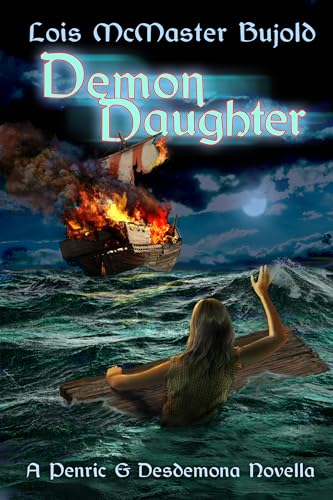
Demon Daughter by Bujold

Demon Daughter, a Penric & Desdemona Novella
by Lois McMaster Bujold
2024

Yay! A new Penric & Desdemona story! And I’ve been distracted enough that I had to discover it from an Amazon notice since I follow Bujold. (And it says something that it took three weeks for them to notify me.)

This is a novella that has a plot around a kid lost at sea, but contains some even more interesting explorations about what demons are and what they can do, as well as showing how Penric, Desdemona, and Nikys are evolving their family. It introduced enough interesting lore that it also makes me wonder if there’s a larger work in progress to take advantage of the implications. I live in hope! But if not, this still is a wonderful addition to the series.

Also, a mini-spoiler: I always love it when a saint of the Bastard is a character because they are all hilarious and awesome!

Doppelganger

By Naomi Klein

So, I didn’t really know who Naomi Klein was, or Naomi Wolf for that matter, but I’d seen the rhyme going around twitter:

If the Naomi be Klein / You’re doing just fine / If the Naomi be Wolf / Oh, buddy. Ooooof.

and it made me laugh, even without context. And, well, here’s the context and then some! Naomi Klein, I learned, is a renowned author who has previously focused on criticisms of capitalism and government, and who has long been deviled by the inability to distinguish her completely from the “Other Naomi.” Naomi Wolf first became famous as a feminist author in the 90s, a sort of peer of Camille Paglia.*

With the exponential popularity of social media and then the pandemic shutdown, the confusion grew even worse, and Klein became somewhat obsessed with her other, tracking Wolf’s sharp turn into deep right-wing conspiracies and alliances with Steve Bannon and Tucker Carlson among others. Klein uses her particular relationship (such as it is) with her doppelganger as an extremely effective jumping off point to comment on a wide variety of societal issues, such as increased isolation coming out of social media, polarization in politics, and the various grifters that take advantage of it all.

Some of the criticisms of the book are that it is too wide ranging, and would be better to have narrowed the focus, but I strongly disagree. One of Klein’s theses is that our social systems are all interconnected, and in order to make change, one must be able to take a wide view of everyone and everything. The disenfranchisement we’re seeing in politics, economy, environment, personal relationships, and on and on, are all tied together, and Klein’s general framework of doppelgangers and mirror worlds is a very effective thread leading the reader through them all.

It’s such a sprawling and deep look at issues I don’t often read about for pleasure, that I was continually caught off guard by how funny Klein is. Just about every passage had me laughing out loud, her accounts of being very occasionally mistaken for Naomi Campbell being a notable example. That said, it does get more serious as it goes, an effective way to lead more casual readers like me into deeper philosophical waters than we are used to.

Speaking of deeper philosophical waters, Klein references several times the docuseries “Exterminate All the Brutes” currently on HBO, which looks at the history of genocide in establishing “civilized” societies. I have currently just watched the first of the four hour-long episodes, since the topic is devastating and takes some time to sit with. The meandering, montage style took me a while to get used to, and the images and topics are definitely a bombardment to the psyche. But it is also increasingly clear that we’ve been taught a very white-washed and sanitized version of history, and it is critically important to try to unlearn that propaganda whenever and wherever we can.

* I have never read Camille Paglia, either, but at least was familiar with her due to a scorching review by Molly Ivins.

The City Beautiful

By Aden Polydoros

Published in 2021, Aden Polydoros notes in the afterward, “I wanted to write a book where the Jewish characters weren’t just passive victims, but where they fought back and rose above the people who wished to do them harm.” The political climate today is a little trickier, but it does feel like both Hamas and IDF are doing their best to erase the beauty of Jewish culture each in their own way. Polydoros, however, does a powerful job of capturing the complexity of Jewish immigrant experience, in this case in Chicago in the late 1800s.

The City Beautiful packs in a lot, actually – it is a YA historical fantasy murder mystery, tying together the historical realism of immigrant life in the Chicago tenements with Jewish folklore in an enthralling story. Years after a traumatic Atlantic passage and the death of his father, Alter Rosen is focused on staying out of trouble and earning enough money to bring his mother and sisters to America. The disappearance of young men in his neighborhood is common enough that he doesn’t pay it much heed until his roommate and unrequited crush is found drowned. When preparing the tahara, the ritual purification ceremony for dead, he is taken over by the other boy’s dybbuk, or vengeful spirit, and driven to uncover the murder in order to free himself and lay the spirit to rest.

He is assisted by friends and neighbors who all represent varied facets of Jewish and immigrant experiences, occasionally in conflict with each other. The novel captures how messy and uncontained life is, and by contrast how false and damaging stereotypes and propaganda are, even if they seem more easily digestible on the surface. At a more basic level, it is also an absolutely thrilling mystery and ghost story, and a sweet YA-appropriate romance.

Grave Expectations

By Alice Bell

I guess I just really love the very specific premise of a real psychic, who finds it easier to pretend to be a fake medium, has to solve a murder mystery in an old English country estate, because I loved A House of Ghosts and I loved this one! Despite the obvious similarities above, Grave Expectations has a much lighter, quirkier tone, at least partially due to the modern setting.

30-something Claire has been ‘haunted’ by her best friend ever since Sophie was mysteriously murdered when they were both in high school. This has clearly been a mixed blessing for both Claire and Sophie, but they have settled into a relatively routine life at the novel’s start. Claire makes a basic living as a medium, using Sophie mostly just to eavesdrop and dig through personal items for information.

Claire and Sophie are very reluctantly drawn into a murder investigation by a recent ghost, and their apathy is only matched by their ineptness, which makes for some really excellent comedy. Oddball members of the deceased’s family, both living and dead, join in the investigation, adding to the general hilarity. Halfway through, I was already hoping this is the start of a series.

I was snorting and giggling along, and was completely blindsided (in a good way) by the surprising pathos of the crisis point, when the author gives us a peek into the much more realistic trauma of two women struggling to come to terms with one of their unnatural deaths. I’m only a little ashamed to admit that I teared up. …And then we were back to slapstick reveal and denouement, poking fun at many of the traditional murder mystery tropes! I would have expected it to have felt uneven; it was jarring, but in a really skilled way that used the precarious balance of comedy and drama to strengthen the impact of each.

Apocalyptic Travel graphic novels

Touring After the Apocalypse, Volumes 1 – 3
by Sakae Saito
translated by Amanda Haley
2022-2023

I randomly checked these manga out from the new release section of my local library and they’re adorable. Youko and Airi are (or at least appear to be) two teenage girls who are traveling via motorsbike around Japan, seeing the sights, following Youko’s older sister’s previous touring schedule, but while the pictures and social media posts that the sister posted look (more or less) like regular posts we might see today, Youko and Airi are seeing the sights after they’re long abandoned and worn down and completely absent any other people. But they’re so excited to see everything!

In each volume, there’s some discovery that to me-the-reader acknowledges the whole tragedy of the empty and crumbling infrastructure of society and what it means that there are so many people not there. To the two girls, it’s fun and interesting and then they move on to the next thing. It keeps the whole mood light-hearted, while also highlighting how much society changes in a single generation as kids who didn’t live the history are accustomed to their lives as being the norm.

There’s a slowly building reveal that something else is going on with these two, but while there are various hints and teases so far, I haven’t figured it out yet.

I’m also really impressed with the translation job since there’s a lot of pop culture references and word games that flow perfectly naturally while I’m reading the English and I can only imagine were incredibly difficult to transpose from the original Japanese.

The Electric State
by Simon Stålenhag
2017

Oof, this is beautiful and moody and horrifying and dark, and it ends in such a way that there’s just enough hope for the future that I think “maybe…”, even though it’s very clear that there’s no real hope. But, just, maybe…?

My first thought when looking at this book was that it was an art book, full of beautiful full page and two-page spreads of various post-apocalyptic scenes. And it is! But it’s also a novella with a story, written in text and full paragraphs and absolutely no text boxes or the like, so it’s more of a picture book than a graphic novel in the way the text and the images interact.

The story is about the narrator Michelle and her companion Skip making a cross country trip in a thoroughly failed cyberpunk society. The setting is intra-apocalyptic rather than post, and oof, does it dip into all sorts of horror, with the implication that at least three types of apocalyptic disasters were all happening at once: war, environmental, and technological. It was reassuring that the events were set in the 1990s with a different history prior to that because this book would have been even more horrifying if it was set in the 2040s. There are a series of flashbacks that reveal the narrator’s backstory, but it’s only in the final third of the book that the reason for trip and Skip’s story are finally revealed, and it’s such a magnificent twist that just twists my heart and stomach.

The differences between these two titles is kind of amazing, just in tone and visualization, especially given how similar the premise and frameworks are. It very much highlights how two people can tell the same story in such different ways that they become two different stories. Reading these two so soon one after another reminds me very much of the Holy Shit! Two Cakes! meme.