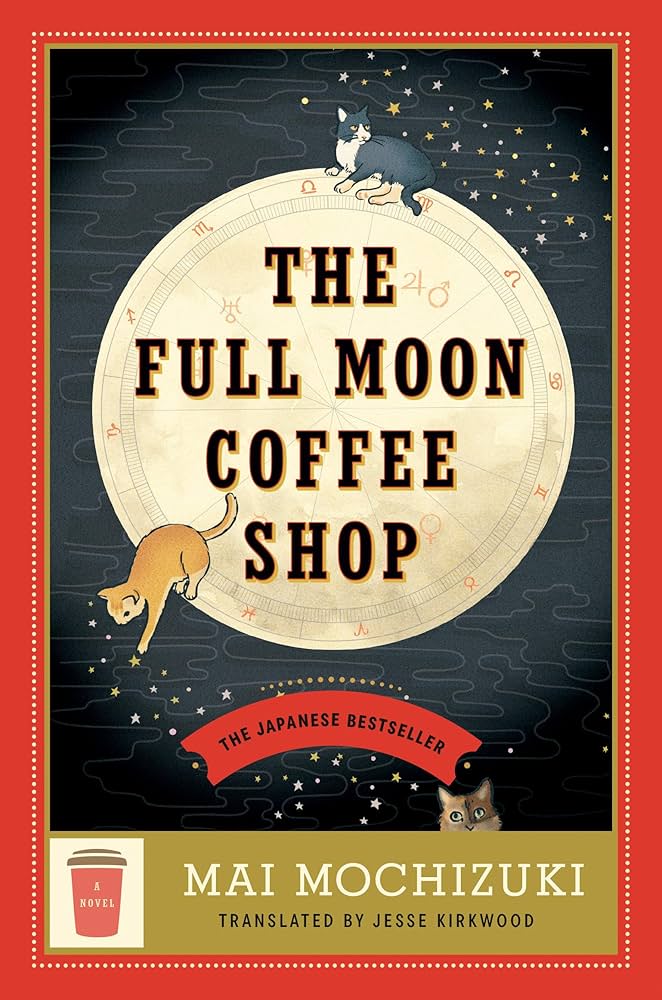
The Full Moon Coffee Shop by Mai Mochizuki 2020 translated by Jesse Kirkwood 2024
This is a charming story about interconnected characters facing difficulties in their various careers getting their lives sorted out and on a better path, via dreams of a little pop-up coffee shop run by cats/gods who explain their astrology charts to them.
So, to break that down:
It’s charmingly written. Kudos to both the author and the translator!
The characters are all adults struggling with adult issues, which I definitely appreciated.
I also really enjoyed the magical-realism that merges very real world issues with mystical coffee shop: it’s hilarious as each character has their own approach to responding to having a magical experience in an otherwise non-magical world.
The explanations of the astrology charts got a bit repetitive for me as the reader and that was not helped by the characters responding with complete confusion at first but then quickly agreeing that now they understood where they had gone wrong with their lives and what changes they needed to make given what the planets said about them.
I was reminded of the Mrs. Piggle Wiggle series, which I last read as a grade-schooler so my memory could easily be faulty, but had the same structure applied to kids having bad habits and a mystical person with powers teaches them to be better. A very cute series of morality tales, targeted young.
However, I did really enjoy the seemingly random interconnections of the characters, where each vignette includes as a side character the protagonist of the next vignette, as well as a reference to how much better the prior protagonist is doing having implemented the changes they needed.
The epilogue explaining why this all happened and how these character were connected by a good deed as children and thus earned the gratitude of the cat gods felt both unnecessary and contrived, as well as a bit disappointing, in that it restricted the possibilities of who might wind up finding this mystical pop-up coffee shop to just that one group.
But I did really enjoy the softness of showing characters struggling with failing career paths, finding a way forward into success and happiness.
All that to say: I enjoyed it but not without qualifications. I recommend it to readers looking for some soft reassurance and willing to put up with some basic lessons in astrology.
We have a little joke about Connie Willis: when she is good, she is very, very good; when she is bad, she is horrific. That is to say that she is so technically skilled that you will either be rolling on the floor laughing or deeply traumatized. Although this isn’t quite at Willis’ peak (for that, see To Say Nothing of the Dog), The Road to Roswell is quite funny, about a woman grudgingly attending an alien-themed wedding in Roswell and then even more grudgingly dealing with a real alien abduction, along with a ragtag group of other abductees.
It is very funny, in Willis’ customary gentle satire of people of all types. However, it also has Willis’ customary frenetic energy – she portrays the onslaught of minor stresses we all deal with every day so well that even her comedic books come with some visceral stress. Additionally, it is very much influenced by Willis’ love of movies – there is a constant stream of allusions to classic westerns, which I thoroughly enjoyed, and some heavy screwball comedy tropes, which I enjoyed less.
Our protagonist is doing her best under admittedly very trying circumstances, but is enough of a classic Ditzy Broad to make some eye-rollingly bad decisions. It was all fun and games until we got to a (PG-rated romantic) trope that is a particular squick of mine, so I had to speed read through that a bit. I will say that the ending is immensely satisfying in a suitably ridiculous way.
For those new to Connie Willis, this could be a very entertaining introduction; for us old fans, there’s a fair bit of retread as she returns to a number of themes (aliens, linguistic confusion, meandering road trips) that she’s explored in earlier stories that felt more groundbreaking (possibly simply because I read them first). That said, I was extremely interested to read in her bio that she is currently writing a new entry to her Oxford time-travel series, which is truly her standout work.
This is apparently the author’s first adult novel after a slew for young adults, and I have to admit that I’m not convinced it is fully aged up. Genevieve, the teenage protagonist, is very Feisty™ in a particularly young adult way (i.e. with all the common sense of a young adult). She is confident and sassy in situations that she would probably be better suited just observing or even fading into the background, and then acquiescent at times when she should really take a stand. She jumps to a number of fairly obviously wrong conclusions, which she then has to apologize for, which always makes me cringe.
All of that out of the way, the plot is a quite juicy gothic mystery surrounding the tragic death of a beautiful young heiress. Genevieve, raised as a scam medium under the tutelage of her mother, has been brought in to contact her spirit by two different men at cross purposes, one to set the other’s mind at ease, and the other to uncover a murderer. Once in the classic gothic sprawling estate of decaying wealth, she begins to experience strange occurrences that test her skepticism. I love a false medium/real ghost scenario!
While the writing continued to read juvenile to me, with a lot of the sort of repetition one offers to younger readers to make sure they are following along, the plot really did hold up all the way through. I was full of guesses but had no solid predictions of the final reveal, and felt it held up in a suitably melodramatic way.
I love going to the Small Press Expo every year and seeing what new and unusual things are available and buying a whole stack of comics/graphic novels, and hanging out with a really fun crowd of creators. This was the first year that I attended some of the workshops in addition to the panels and vendor market, and they were so much fun and extremely inspiring. I bought a stack of new comics and have already read a number of them:
Garibaldiology: Japan Travelogue 1 by Garibaldi, 2014 This is an extremely cute little travelogue/drawn journal about the artist going on a trip to Japan, and is quite funny in a day-in-the-life manner about exploring a new place and meeting new people being a little gremlin. What particularly struck me is how non-judgemental, good or bad, it is in narration even as the person is judging the things around them. Their opinions are their personal opinions and not to be taken as anything greater than that. The over-all effect is just: wow, this is a thing that happened. And it’s just very cute.
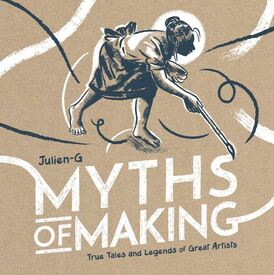
Myths of Making: True Tales and Legends of Great Artists by Julien-G, 2024 The art is really striking restricted pallet of only three colors, that works to excellent effect, with retelling 25 stories and legends from pre-64,000 BCE, up to 2022. I really enjoyed both the art and the stories, but what really caught my eye was the book binding, which is beautifully done sewn pages onto a fabric spine with heavy board covers, such that a quite thick volume can be opened to lay flat without any concern for the gutters. I do have an appreciation for the artistry in bookbinding.
No Pants Revolution #8: Acceptance by Andrea Pearson, 2024 This is the eighth issue in a series for which I haven’t ready any of the preceding issues, but it’s okay because each one is a stand-alone auto-biographical collection of thoughts and experiences. In this particular issue, the author is contemplating acceptance as in a stage in grief, a prayer for serenity, and part of self-care.
I Got a Tattoo Every Month of 2023 and Now I’m Broke, by Clau, 2024 I got this at the same stall as No Pants Revolution, because it is very small accordion format zine and I liked the way the artist used a cartoon kewpie figure to show where the tattoos were located. It also seemed like a representation of how many people are struggling to get through the year, finding their own methods for motivation.
Body Issues: Comics About Body Image, art by Babs New, 2022 One of the workshops I went to at this small press expo was a life drawing (ie, nude model) class hosted by the artist/author of The Cadaver Diaries, which I’d bought and enjoyed last year, and modeled by Babs New, the non-binary artist for this book. This book is composed of short accounts by people talking about their struggles with feeling comfortable with their own body and societal perception, and illustrated by this artist. Each speaker has a little cartoon animal representative and then concludes with a simple line drawing of them in the nude, revealing the body they’ve been struggling with.
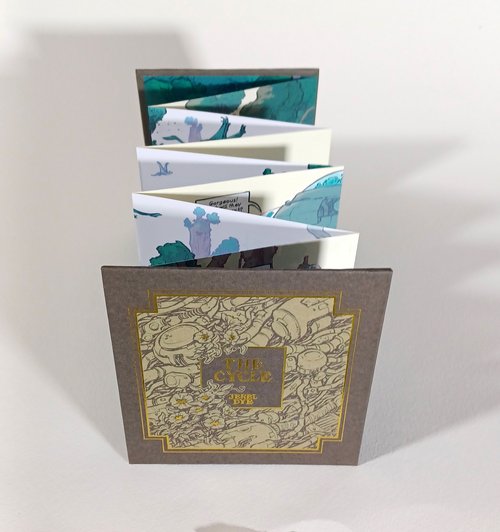
The Cycle by Jerel Dye, 2023 This is gorgeous little accordion book that is so beautifully crafted that I bought it without even really considering the story, but the art is lovely and the story is both simple and increasingly deep as I continue to think on it. I do love the use of gold foil on the cover. It’s drawn as a single scene in both the front and the back but it’s also a timelapse of events, scanning over a scene. The author makes excellent use of the different ways the book can be read.
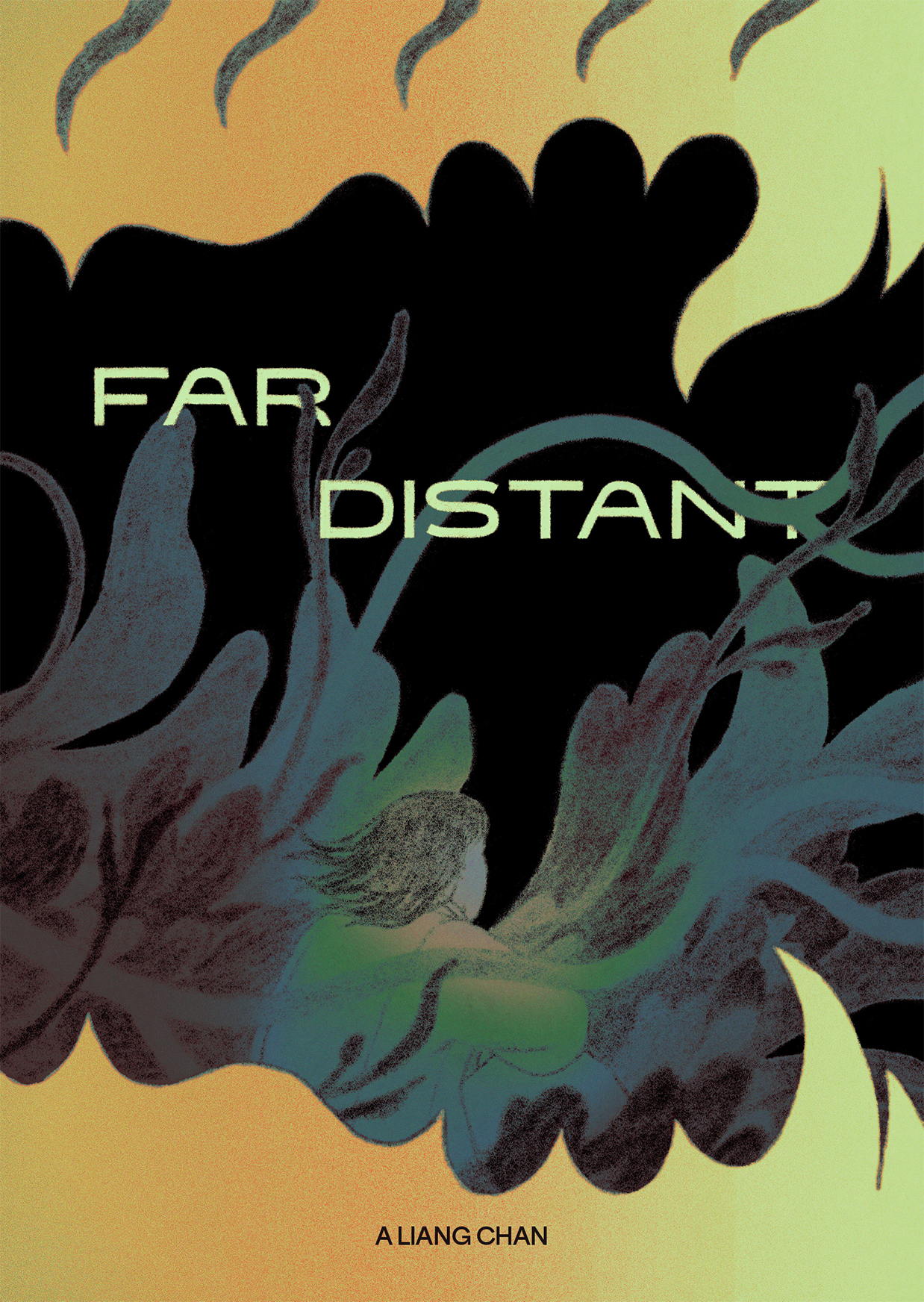
Far Distant by A Liang Chan, 2023 This is a beautifully illustrated stand-alone short story graphic novel about a researcher stationed alone on a distant outpost in charge of managing some transmissions, but receives a series of transmissions that at first seem to simply be corrupted, but instead are a communication from something else entirely. This is a really excellent example of stories that require thought to tease out the implications rather than having everything be explicitly told, and I really enjoyed it. It also felt like a good companion piece with The Cycle, although they are completely unrelated.
Devil in the Pines by Natasha Tara Petrović This is a beautifully illustrated “short comic about the tragedy of the Jersey Devil“, which I hadn’t particularly known about before, but this is beautiful and tragic, and makes me sad for a little devil who’s own mother cursed it. It’s just 16 pages long, and feels like it sits in the middle ground between a comic book and a picture book. It’s just a little devil who was born that way, does no harm, and is lonely being it’s own unique self.
Coextinct by Edea Giang, 2024 This is just 12 pages in black and white, a short but direct manifesto about how extinction events are happening across all species, not just the cute and beautiful ones, and how important it is to not ignore the small and unsightly. It looks specifically at the louse that lived exclusively among the feathers of a single species of bird that was also going extinct. The rescue workers who successfully managed to pull the bird species back from the brink of extinction, were also the ones who killed the the last examples of the louse. There was no evidence it actually hurt the bird at all, merely that it lived among the feathers. And no one knows what the relationship was between the louse and the bird.
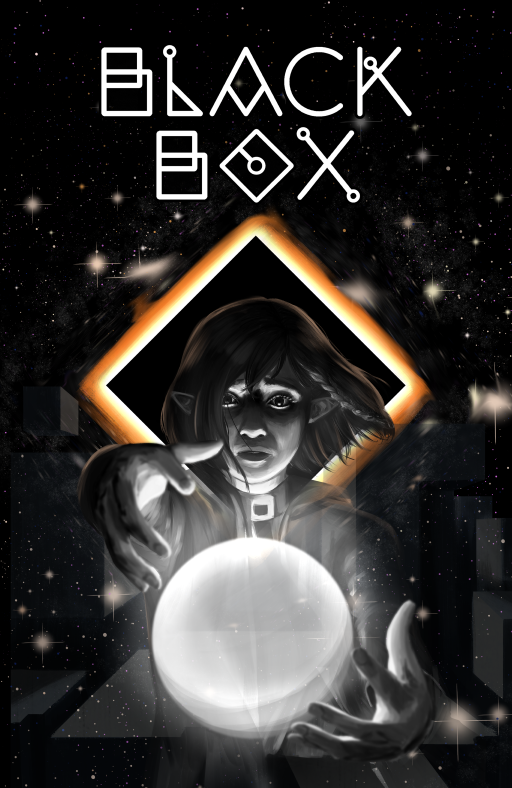
Black Box by Carlos Chua and Regina Chua, 2024 This is the first issue in a proposed comic book series, so it’s just setting the premise but the premise is both a delight and a horror: it’s a fantasy world based on magic, but it’s also a modern world with capitalism and stock exchange, and our main character is an oracle who’s feeling burnt out after years of running prophesies about how stocks will fluctuate, and finally quits after she prophesies a major disaster and her boss reams her out for not suppressing that in her report. It felt remarkably realistic.
2020 was HELL but the KPOP was good! by Kori Michele The first workshop I attended at small press expo was held by this author, about making extremely small zines, with simple folding techniques: teaching us how to make them and showing us examples of artists who had used them to good effect. This isn’t an example of those folding techniques, but is an example of her philosophical approach, which was to just make a zine as a way to give information to her friends and families: such as a playlist of the songs she was enjoying. The workshop was both fun and inspiring, and I got one of the authors larger books as well, but I haven’t read it yet. I also got this little zine, because it was a fun introduction to a music genre I’m not particularly into. I have since watched/listened to all the music videos, and it was a fun intro, even though it’s still not my music genre of choice. But it remains an inspiration of a fun way to create a modern mix-tape, leaving it to the reader to actually acquire the songs.
And, of course, these are just the relatively short comics that I’ve already read in the week since I got them. I have another stack of five larger and more extensive graphic novels that I need to read. But just, I do love the Small Press Expo and the whole range of people and creations that I see there.
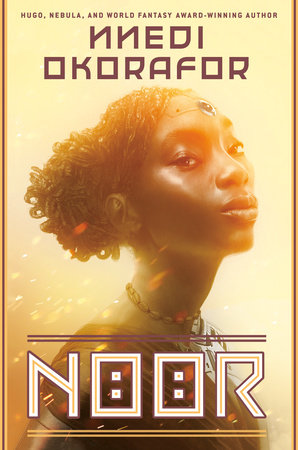
This is really good and I highly recommend it. It’s Afrofuturistism with the plot beats of a YA novel but a complexity to the characters that makes it feel more adult. It’s set in a relatively near future that grew from our current world. It’s scifi with technology that has continued to advance from what we have, but with a thread of mystical realism that makes me look at the current world and wonder if that is how a religious true believer sees the world. (I’m in this with the main character, AO, who is solidly atheist and yet is beginning to wonder…) It’s set in Nigeria, which is a culture that I’m not particularly familiar with and thus can’t always tell what is based on reality and what has been fictionalized. But the characters and the world are so beautiful and so difficult.
The plot is that our two main characters have each been through separate traumatic attacks in which they defended themselves with lethal force. But they both know that society does not recognize them as having the right to self-defense at the cost of their attackers’ lives. Our primary main character, AO, was born with severe birth defects and now uses extensive and experimental prosthetics, that make many of the people around her question if she is truly human or not. On the run from both her own actions and societies judgement of her, she learns more about other people on the outskirts of society and the exact nature of the experiments that have been done with her and her prosthetics.
The plot also just feels very timely as it comments on how easily the terms “attack” and “defense” can be swapped back and forth when someone’s mere existence is considered a threat to a dominant power in society. And how useful having such a threat can be in maintaining that power, right up until it turns out to actually be a threat rather than carefully massaged propoganda.
Anyway, I really enjoyed and highly recommend this.
I’ve been listening to the Jordan, Jesse, Go! podcast on MaximumFun lately (Jordan and Jesse are very funny and a little spicy), and Jordan Morris has just released his new graphic novel Youth Group. Set among a Christian church youth group, I wasn’t at all sure this was my sort of thing, but figured it couldn’t hurt to check it out from the library.
However, Morris treats everything with astonishing nuance and empathy, particularly for a story that revolves around said youth group exorcising the demons that are haunting the world. He truly captures the teenage spirit in a way that is incredibly rare, and had me laughing out loud multiple times. McCurdy’s art is also gorgeous, which goes a long way for me in a graphic novel.
There’s been lots of comparisons to Buffy the Vampire Slayer, understandably, and while it isn’t as similar as one would think with the topic, it captures a lot of the same feeling I had when I first watched Buffy way back when: utter delight! (It was really, really nice to revisit that feeling after the subsequent stories about Joss Whedon tainted it.) Youth Group takes the usually overly grimdark genre of religious horror and makes it light and funny and caring and surprisingly inclusive. And the art matches it perfectly, bright and colorful and just fun!
Of course the title and cover of this booked grabbed my attention immediately! I’d read articles about romance scams before and wondered how anyone could fall for them. And, as the author points out, thinking yourself impervious to a particular type of scam can lead you to lower your guard and become more susceptible. So, I clearly had to learn more.
Becky Holmes is quite funny, in a particularly British way that I don’t always get, so while I was giggling out loud several times, I also occasionally just sort of shrugged. She begins with a lot of texts leading various scammers on, which is entertaining but gets repetitive. This is also how she first got interested in the topic, entertaining herself with the various scam messages she got across social media platforms. The silliness sometimes felt a little jarring in contrast with the harm being discussed, but as she got more into the topic with accounts from victimized people, it got fairly grim and I appreciated the levity.
As ridiculous as the scams sound when reading them from the comfort of one’s own home, she explains that they are most effective on people going through other trauma in their lives, and desperate for love and connection enough to overlook the signs of fraud that are obvious to the rest of us. And in that light, scammers purposefully looking for people in trouble and illness is particularly disgusting. The people Holmes interviews look back at their own situation and can’t quite believe they were in such bad shape to fall for the lines they did, which really struck me because I’ve certainly related to being retrospectively astonished at how stress and exhaustion can compromise my reasoning.
Towards the end of the book, though, the cumulative stories all started to feel a bit draining. I felt discouraged by the cynicism of the scammers preying on people looking for love, and wondered what it was doing for their long-term psyche. Even worse, I fell back into some victim blaming, not for falling for fairly blatant false scenarios, but their willingness to go along with some incredibly shady dealings that could have gotten them in serious legal trouble if they’d been real.
The author’s total and unconditional support of the victims (and mild scolding of anyone even remotely critical of them) didn’t help. Holmes explicitly compares romance scams to abusive relationships, but they seemed more comparable to addiction to me. The victims become so attached to the scammer that they’ll do anything for them and deny all reason, including pushing away family and friends. (Especially shocking is when some admit that they would welcome the scammer back if they got back in touch.) Of course this is terrible and they need help and understanding, but it is not such a shock that their other personal relationships have taken a hit in the process.
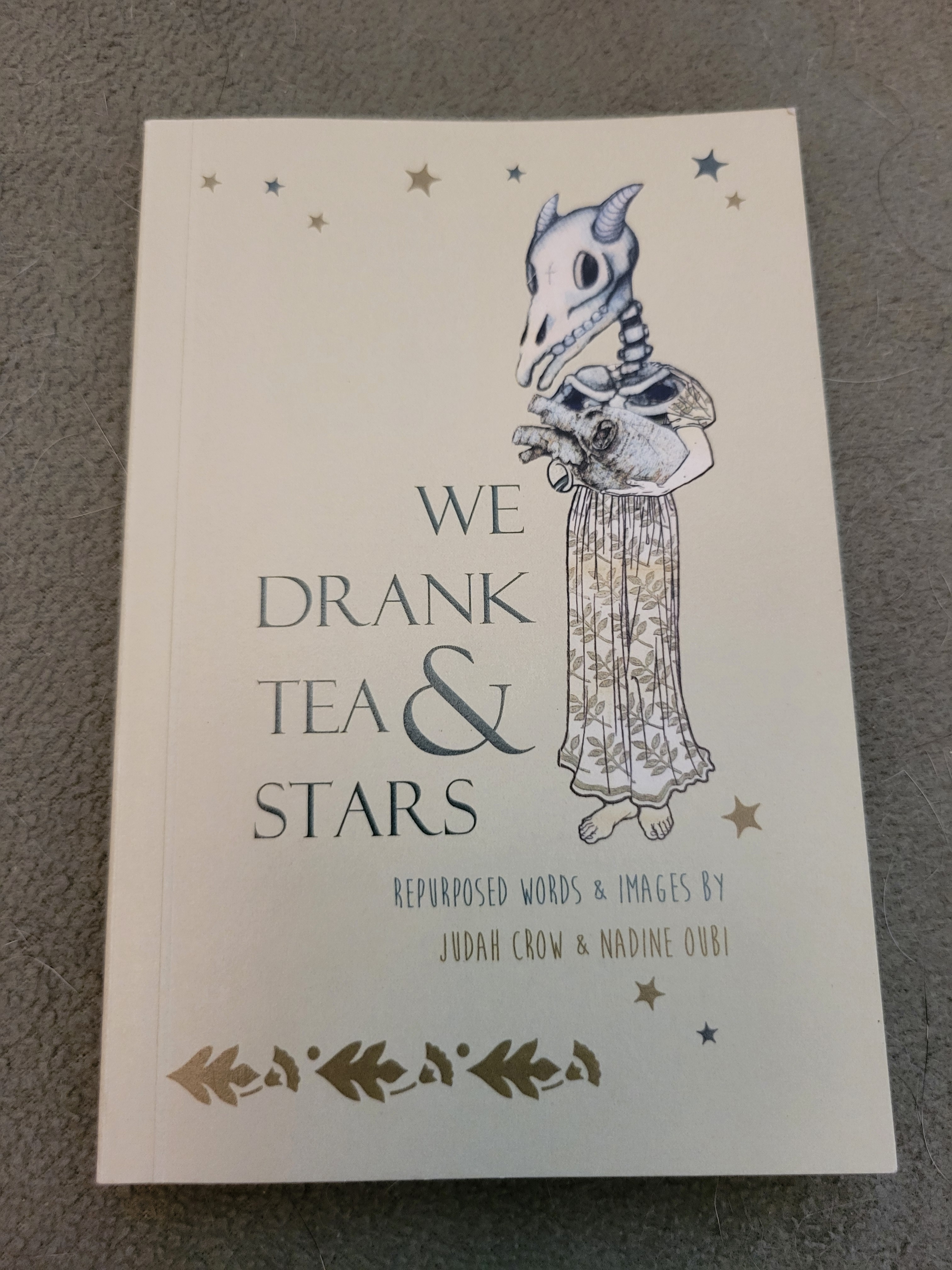
This is a fascinating little independent publication that I can’t find listed anywhere online, but ran across on my uncle’s bookcase, after he had apparently found it in a little free library. Poems by Crow and illustrations by Oubi, the really fascinating part is that they’re all collages, both the visual and the text.
I’m familiar with collage art and immediately recognized it when I saw it, and these were fascinating and fun examples of that. But I hadn’t even heard of collage poetry before, the closest I’ve come is erasure poetry: using found text and erasing everything except the words the new artist wants to highlight for their poem. Instead of that, this collage poetry samples lines from other written works and combines them in new ways. Crow also points out that there’s an extra level of collaboration that came from the way most of the samples were from translated works: so there’s the original author, the translator, and then Crow, each providing a different context.
Poetry isn’t really my reading genre of choice, but I do love seeing people do new and interesting things with text. And while I could admire the poetry without any particular understanding or critical thinking, I really enjoyed the afterward talking about the process, and also the Sources list, which ranged between works I’ve never read to works I’ve never even heard of.
I just read Penric & the Bandit, the 13th and most recent addition to the Penric & Desdemona series by Lois McMaster Bujold, and it was a lot of fun, although not necessarily a stand-alone story. I highly recommend the whole series, and the books set in the same universe, and pretty much everything by this author. However, reading this latest story reminded me of how there was some really excellent fanfic set in Bujold’s Five Gods universe that I highly recommend.
One of the real benefits of fanfic, as a genre separate from the canonical source material, is that it can explore ideas that are mutual exclusive to one another, and explore endings without actually concluding the story. Several of these stories deal with what happens to Desdemona when Penric eventually dies.
End of the Road by Gwynne Summary: Desdemona has moved from one rider to another a dozen times. This is just one more. My review: This is short, only 975 words, and brings tears to my eyes every time I read it, but it’s not sad: it’s glorious. Penric dies a peaceful death that he and Desdemona had prepared for, but this death is different from any of her previous riders and Desdemona is different too and the god recognizes and rewards that.
After the End by allonym Summary: Given the choice of jumping to her, or being dissolved in the unfathomable energies of the Bastard’s Hell, Penric kin Jurald’s demon had chosen its destruction. Somewhere, the Bastard is laughing at Eleni. My review: This is a fabulous continuation of Gwynne’s End of the Road, showing events and consequences for people who did not have the perspective to see the meeting between demon and god. And also includes Penric’s funeral, as a beloved saint of the Bastard, and those funerals are always hilariously chaotic.
Penric’s Last Ride by Zarz Summary: Pen and Des have had a long and happy partnership together as demon and rider, but Des is well aware that humans don’t live forever, and one last mission to deal with an invading army proves to be Pen’s last. Now Des is stuck as an unwilling ascended demon with an unresponsive rider. Des may be struggling after outliving yet another rider, but being eaten by a saint and dissolved back into chaos isn’t her preferred outcome either. But maybe, just maybe, the Lord Bastard has more grace for His demons than any of them ever realized. My review: This is a different take on how Penric dies and what happens with Desdemona, that really leans into the idea that the gods are parsimonious, and use the deaths of their saints to further their goals just as they used their lives, but it works out because their goals are to their people’s benefits as well.
Inheritance by silverbirch Summary: Generations after the events of Paladin of Souls, an old man finds an heir, and a young man finds a new vocation. My review: Once more, this is a story about the death of a sorcerer and the response of the demon, but instead of Penric, it’s Foix dy Gura, a character from the books The Curse of Chalion and Paladin of Souls, with Penric mentioned as the author of a book written centuries before. This reads very much like a reprisal of the first Penric & Desdemona story, Penric’s Demon, while also being a short look into the future of those characters we met in the first two novels, and I love both of those things.
The Saint, the Scholar, and the Whale by Neotoma Summary: Ista in Jokona meets an unusual divine on an unusual mission. My review: In contrast to the other stories in this list, this is not about death, but a pure adventure that shows Desdemona continuing on being her immortal self with a new host and a new set of friends and family around her, centuries after Penric, who is still loved and remembered as an imprint, but there are other things to think about and new people to save and demons and befriend and saints to interact with. Life goes on and it’s an adventure!
I do love the way fanfic is a modern version of storytelling around the campfire, where anyone and everyone gets a chance to offer ideas and insights into what could or couldn’t happen in all sorts of scenarios real or imaginary.
This is a very odd book. I did enjoy but also, just, huh. It’s a first-person demonstration of overthinking everything, while also just letting it all flow past.
The plot, such as it is, is that the narrator rides an escalator from the lobby to the mezzanine, returning to work after his lunch break. The style however is a detailed and rambling documentation of his thoughts as they veer from the immediacy of his current sensations to memories both recent and long past to considerations for the future and back again. His thoughts would be tripping over themselves with how many and how rapid they are, overlapping and given depth from history, except that Baker has given them space to be fully articulated in a 135-page novel with a multitude of long footnotes such that he describes both a three-minute experience and the entirety of a character.
This book also reminded me of how journals kept by the most obsessively boring of individuals can be the most valuable to historians as they’ll document details that other diarists don’t bother to mention. Most books skim past a character going from point A to point B, with a single line or phrase. This book makes it clear that such a phrase can be treated like a fractal: the closer you look, the more details appear. There are a thousand questions: how did he come to be at point A? why is he going to point B? What is the process of going to point B? Why that process? What sense memories are attached to the process? What history? What is he bringing with him? Why those items? How did he come by those items? etcetera ad infinitum.
I have previously denigrated the literary genre, but this is actually really good despite being very much within that genre. I think the difference is that in so many literary books there is a scene in which the narrator looks at other people in a crowd and think to themselves: those people don’t have interior lives like I do. This book has as it’s very premise that each and every person has a rich interior life. The narrator in this book is no different on the surface level from any of the others, and yet, he is uniquely strangely himself, and so too would be every other person if one looked as deeply.