Atlas Shrugged, part 2, chapter 4

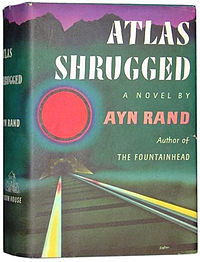
AtlasShruggedOne of my problems with this book is the way that it’s dated. I increasingly get the sense that this book is fighting a war that’s already been won. Ayn Rand is right and society acknowledges it: inventors who create impressive things can and should be rewarded richly by being able to monetize their inventions. Standing up for yourself, declaring your motives and taking pride in your accomplishments, is not only accepted but encouraged. Inventing, and being rewarded for it, is standard. Think of the way society looks at Steve Jobs or at Bill Gates. They’re impressive people and society respects them greatly. From the perspective of the 1950s, maybe this argument still needed to be made. From the perspective of 2013, though, it’s going too far and turning into bullying.

This is not the fault of Rand or her book, but (as her own arguments go) fault is not actually the issue at hand. It doesn’t matter whether there is fault, what matters is that there is a problem that needs to be addressed. The problem is that the book argues that wealthy business owners need to be given more rights and freedoms than they currently are. In the world of Atlas Shrugged, those wealthy business owners are being severely prosecuted. It makes sense to give them more rights, i.e. stop prosecuting them. But we’re not in a society that hates inventors and hates people who make money. We’re in a society where the banks demand bailouts, where the Disney corporation demands control of the intellectual property of a man half-a-century dead, and corporate theft is a standard practice to quash start-up companies.

I think Ayn Rand would be rolling in her grave regarding some of the people who use her arguments to rationalize their behaviors.

Anyway, first a summary of events (it’s only short in comparison to the chapter itself), and then a bit more about how Rearden, despite being rather awesome in this chapter, is also being incredibly blind, and how Francisco has fallen off the deep end.

Continue reading

Atlas Shrugged (in the news!)

Once again Atlas Shrugged has made the news – this has seriously been a very timely reading! An Idaho lawmaker has proposed a bill requiring every high school student in the state to read and pass a test on Atlas Shrugged before graduation.* I had a series of reactions:

  • Ugh, those poor students! Oh, man, those poor teachers!
  • You know what, this is totally going to bite him in the ass. I have never heard of a single person who’s favorite book turned out to be one they read as a requirement. There’s something about the simple fact of the requirement that takes away a lot of the inspiration from reading.
  • Considering the somewhat explicit and very uncomfortable sex scenes, the PTA would be howling! Actually, this specific lawmaker would probably be howling just as loudly about any other book that contained similar passages. (Although given the Republican Party’s recent comments on rape, perhaps they wouldn’t be all that bothered.)

*I linked to Fox Nation because I thought we should have a supporting view of it (though they actually seem pretty noncommittal), but you should also check out the “Pic of the Day” on the right  column, because it is super cute!

—Anna

Atlas Shrugged, part 2, chapter 3

AtlasShruggedIn this chapter, Rearden just begins to touch on some issues that I hope Rand intends to delve into further.

First, is the definition of “success.” Success is not just making money, or the characters would have accepted the various deals the corrupt officials keep offering them. Oddly, for all that they would deny it vociferously, the characters appear to define success as earning public accolades. They don’t go out seeking it, but they sure are upset when they don’t receive it. Unearned accolades are, of course, for parasites like Jim Taggert et al., but having earned those public accolades, they had better get them. Rearden touches on it, when “He thought—in bitter astonishment and for the first time—that the joyous pride he had once felt, had come from his respect for men, for the value of their admiration and their judgment. He did not feel it any longer. There were no men, he thought, to whose sight he could wish to offer that sign.” If you can’t define success as people looking up at you in awe, what does success mean?

Second is their ignorance of people as a resource that can be developed. Again, Rearden touches on this, when he wonders, “We who were able to melt rock and metal for our purpose, why had we never sought that which we wanted from men?” I have wondered this too, given the amount of times they complain at how hard it is to find good workers. All these men fresh out of college aren’t anywhere near as experienced as their veteran workers. Why don’t you train your own workers?

Meanwhile, Francisco remains an idiot savant. He has wonderful skills at all things, and he continues to make these Faustian arguments that have just enough truth to seem right, huge amounts of flattery to ease their way into Rearden’s psyche, and vast numbers of fallacies to stick in my craw.

So a quick summary of events and then a bit more of reaction from me:

Continue reading

Atlas Shrugged, part 2, chapter 2

AtlasShruggedGiven the recent Super Bowl, I have a sports metaphor for you:  Dagny and Rearden are like Olympic-grade field and track athletes who have stumbled onto a professional football field. They are extremely fast, they are extremely strong, they can get that ball from one end of the field to the other with no problem… and they have no clue why those referees keep on yelling at them, or why those other guys on the field are working together and even strategizing. There are two different competitions going on here, but Dagny and Rearden aren’t willing to learn the rules of football and the rest of the world isn’t willing to give up the game in order to celebrate pure individual strength.

In some ways, this book seems to foretell the shift our society went through in the way it treats information. We are so inundated with information, in today’s world, that someone’s attention is a valuable resource. Marketing firms make and spend fortunes focusing attention. Facebook is monetized based on the idea that people and corporations will pay money in order to get the attention of various demographics. Dagny and Rearden are the dinosaurs in this new economy. They are the takers rather than the makers when it comes to attention. They demand it of others, but they don’t give it to anyone else. That is why they are currently failing so hard. They ignore their “men in Washington” and their boards of directors just as they ignore the vast majority of people. Dagny even states that she doesn’t think her brother’s new wife is worth the attention it would require to form an opinion of.  The economy based on a currency of time and attention is something that she and Reardon are completely unaware of. They wander through the marketplace, wondering why no one will barter with them, when they so obviously have nothing to give.

Anyway, a quick summary of events and then a discussion of money and logic and why Francisco is an idiot.

Continue reading

Atlas Shrugged (Part 2, Chapter 1)

By Ayn Rand

Cover: Atlas ShruggedSigh.

Rebecca read my previous post, where I complained at the end that there were too many characters to keep up with, and commented that I had neglected to mention Dr. Robert Stadler. I said that was because I didn’t care about him. She simply smirked, so of course this chapter opens on Dr. Robert Stadler, renowned theoretical physicist and head of the State Science Institute. Continue reading

Kurt Vonnegut short stories

KVonnegut3Kurt Vonnegut
1922-2007

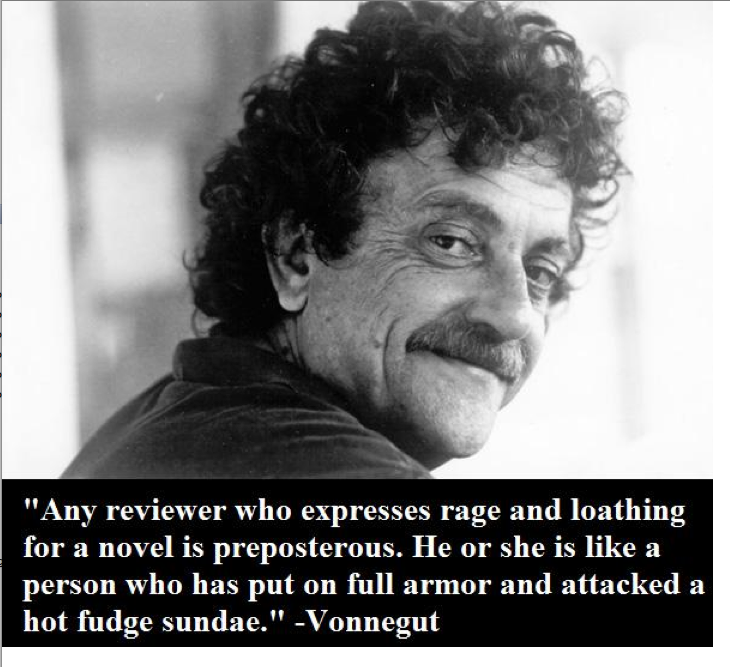
I have mixed feelings about Kurt Vonnegut. I think he has some extremely important ideas in his writing and I know he’s deeply affected a lot of people, but I don’t actually care for most of his writing. He’s still worth reading and I was thinking about him yesterday while I was reading my daily quoto of Ayn Rand (25 pages per day, five days a week.) Despite making a comparison between two authors without having actually read all that much by either, I think they have many similar points of view and many similar styles. But Vonnegut not only writes much shorter books and even short stories, I think he also has a more nuanced sense of people.

He makes many of the same arguments that Ayn Rand does, about the importance of individuality and personal achievement, about rebelling against totalitarian societies, but he also goes on to talk about the importance of working to make the world a better place, if only because it is the world you live in and there’s no opting out.

Anyway, some of his short stories can be found online.

The story that I was particularly reminded of was “Harrison Bergeron.” This story talks about equality and the importance of realizing what exactly you want to be equal. As a die hard liberal, I think everyone should have equality in opportunity. In contrast, the idiot liberals in Harrison Bergeron (and in Atlas Shrugged) seem to be arguing for equality of results. This is an extremely important distinction. Not everyone should be paid the same amount or receive the same amount of accolades. Not everyone is a winner. But everyone should be a contestant. Everyone should have the opportunity to try.

Another of his stories, one that I actually really enjoy, is “Report on the Barnhouse Effect.” While this story also deals with the individual’s ability to achieve great things and to effect the world as a whole, it’s also about taking personal responsibility for the world as a whole, and even the possibility of (as Tony Stark says) privatizing world peace. Privatizing world peace is not something I would approve of in the real world, but it sure makes a good story and I do like the look at personal responsibility on a global scale.

KVonnegut

vonnegutTerror1  KVonnegut2

Kurt-Vonnegut-Quotes-3  kurt_vonnegut1

Atlas Shrugged (Chapters 9 and 10)

By Ayn Rand

Cover: Atlas ShruggedI’m feeling a bit broken down by this book at this point, and I’m only a quarter of the way through it (which, I would like to add, is the length of a normal-sized book). I feel like maybe I’m being brainwashed? I don’t even have the strength for resistance anymore.  Send help! What’s the anti-Ayn-Rand?

Anyway, the plot is getting pretty dense at this point, so while I was initially trying to confine my summaries to two or three paragraphs a chapter, I’m not sure that is going to be possible, and I refuse to let you escape hearing about some of the most uncomfortable sex scenes I’ve had to read.

Continue reading

An “Atlas Shrugged” Theme Post

I’m still grinding my way through Atlas Shrugged (I’ve made it past the 300 page mark! I’m a quarter of the way through! … Urg.) But, it also appears to be taking over my life.

For instance, The Colbert Report talked about The Atlasphere: a dating site for fans of Atlas Shrugged and The Fountainhead. (It starts at 1:55 in the clip below.)

(Wowza. Plus, given the skeeviness of the sex scenes in this book, I would not want to date anyone taking their pointers from it.)

But that’s only the tip of the iceberg.

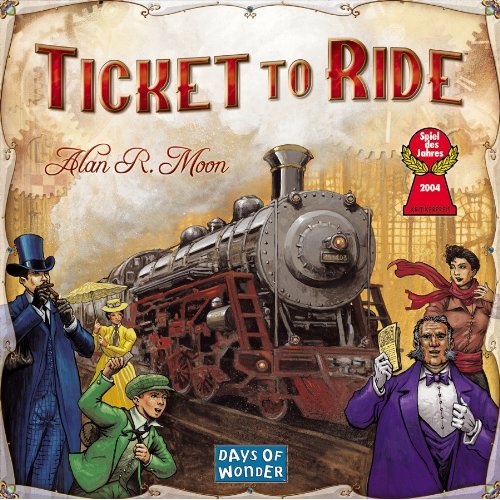
I also joined a new gaming club, for board games and card games and the like. I’ve learned two new games in the last few weeks. Both of them are a lot of fun… and both of them involve building train systems.

Welcome to “Ticket to Ride” and “Trans America.”

TicketToRide     TransAmerica

And finally, when I was just talking (read: venting) to Anna about the book, my playlist comes to Billy Joel singing about living in a small dying industrial town, Allentown:

Atlas Shrugged is taking over my life!

But at least the extra bits are really fun.

Eli the Good

While I’ve been enjoying Anna and Rebecca’s fall into the Randian rabbit hole that is Atlas Shrugged, I think it might be time to break all that up with something a little lighter. So let’s talk about the book that might be the polar opposite of Atlas Shrugged: Eli the Good by Silas House. One of the Amazon reviews called this book gentle, and that is the absolutely perfect word for it–it is a gentle story about a young boy growing up in a small town in the South in the 1970s. More specifically, the story follows Eli through the Bicentennial summer of 1976 as he and his family try to deal with his father’s trauma after coming home from Vietnam and the sudden arrival of his war-protestor aunt. I feel like that description makes it sounds more dramatic than it really is. While dramatic things definitely happen, overall the book has the sort of slow, leisurely feeling you get in the summer when even important things happen at half speed.

For me, the most powerful part of the book was how well House captures what it was like to be a kid in the rural South in the 70s. I am not quite old enough to remember the Bicentennial, but so many of the things he talks about in the book–trying to sleep in a house with no air-conditioning, riding bikes all over town with your best friend, riding around in the bed of a pick-up truck–were almost painfully familiar. (Okay, to be fair, my mother never let me ride in a truck bed. At the time I thought she was no fun, but now I’m thinking I should call and thank her for being ahead of her time in auto safety and for keeping me alive. See also: not letting me play with the fireworks you could buy on the side of the road.) The book also has a powerful feeling of nostalgia, since it is about Eli as a child but is told from a perspective of him looking back as a adult. This made the book feel even more like memories of my own childhood. I also really liked perspective on the political tensions of the Vietnam era. I feel like people don’t talk about that time much today–maybe because it’s too recent to be considered “History” but too long ago to be at the top of our minds–but it has shaped all sorts of things about the world today, so I always like reading about it.

At one point Anna and I had discussed doing one-word book reviews, and I think that is shorter than I can handle, but I am going to start trying a couple of new things in my reviews. From now on, I’m going to include a three-word review of each book, and a sort of book association game: “if you liked this other thing, you might enjoy this thing I am recommending.” My hope is that this helps our readers get a sense of the books, while also helping me really crystallize my feelings about the books. So, for Eli the Good:

Kinsey’s Three Word Review: Sweet Southern tale.

You might also like: Bridge to Terabithia or anything by Lee Smith.

And now the Atlas Shrugged live blogging can continue. (And for the record, while I remember enjoying The Fountainhead well enough when I read it in college, these days you couldn’t pay me enough to tackle Atlas Shrugged. I will stick with my YA and vampire books.)