Youth Group

By Jordan Morris and Bowen McCurdy

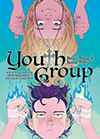
I’ve been listening to the Jordan, Jesse, Go! podcast on MaximumFun lately (Jordan and Jesse are very funny and a little spicy), and Jordan Morris has just released his new graphic novel Youth Group. Set among a Christian church youth group, I wasn’t at all sure this was my sort of thing, but figured it couldn’t hurt to check it out from the library.

However, Morris treats everything with astonishing nuance and empathy, particularly for a story that revolves around said youth group exorcising the demons that are haunting the world. He truly captures the teenage spirit in a way that is incredibly rare, and had me laughing out loud multiple times. McCurdy’s art is also gorgeous, which goes a long way for me in a graphic novel.

There’s been lots of comparisons to Buffy the Vampire Slayer, understandably, and while it isn’t as similar as one would think with the topic, it captures a lot of the same feeling I had when I first watched Buffy way back when: utter delight! (It was really, really nice to revisit that feeling after the subsequent stories about Joss Whedon tainted it.) Youth Group takes the usually overly grimdark genre of religious horror and makes it light and funny and caring and surprisingly inclusive. And the art matches it perfectly, bright and colorful and just fun!

Keanu Reeves Is Not In Love With You

The Murky World of Online Romance Fraud

By Becky Holmes

Of course the title and cover of this booked grabbed my attention immediately! I’d read articles about romance scams before and wondered how anyone could fall for them. And, as the author points out, thinking yourself impervious to a particular type of scam can lead you to lower your guard and become more susceptible. So, I clearly had to learn more.

Becky Holmes is quite funny, in a particularly British way that I don’t always get, so while I was giggling out loud several times, I also occasionally just sort of shrugged. She begins with a lot of texts leading various scammers on, which is entertaining but gets repetitive. This is also how she first got interested in the topic, entertaining herself with the various scam messages she got across social media platforms. The silliness sometimes felt a little jarring in contrast with the harm being discussed, but as she got more into the topic with accounts from victimized people, it got fairly grim and I appreciated the levity.

As ridiculous as the scams sound when reading them from the comfort of one’s own home, she explains that they are most effective on people going through other trauma in their lives, and desperate for love and connection enough to overlook the signs of fraud that are obvious to the rest of us. And in that light, scammers purposefully looking for people in trouble and illness is particularly disgusting. The people Holmes interviews look back at their own situation and can’t quite believe they were in such bad shape to fall for the lines they did, which really struck me because I’ve certainly related to being retrospectively astonished at how stress and exhaustion can compromise my reasoning.

Towards the end of the book, though, the cumulative stories all started to feel a bit draining. I felt discouraged by the cynicism of the scammers preying on people looking for love, and wondered what it was doing for their long-term psyche. Even worse, I fell back into some victim blaming, not for falling for fairly blatant false scenarios, but their willingness to go along with some incredibly shady dealings that could have gotten them in serious legal trouble if they’d been real.

The author’s total and unconditional support of the victims (and mild scolding of anyone even remotely critical of them) didn’t help. Holmes explicitly compares romance scams to abusive relationships, but they seemed more comparable to addiction to me. The victims become so attached to the scammer that they’ll do anything for them and deny all reason, including pushing away family and friends. (Especially shocking is when some admit that they would welcome the scammer back if they got back in touch.) Of course this is terrible and they need help and understanding, but it is not such a shock that their other personal relationships have taken a hit in the process.

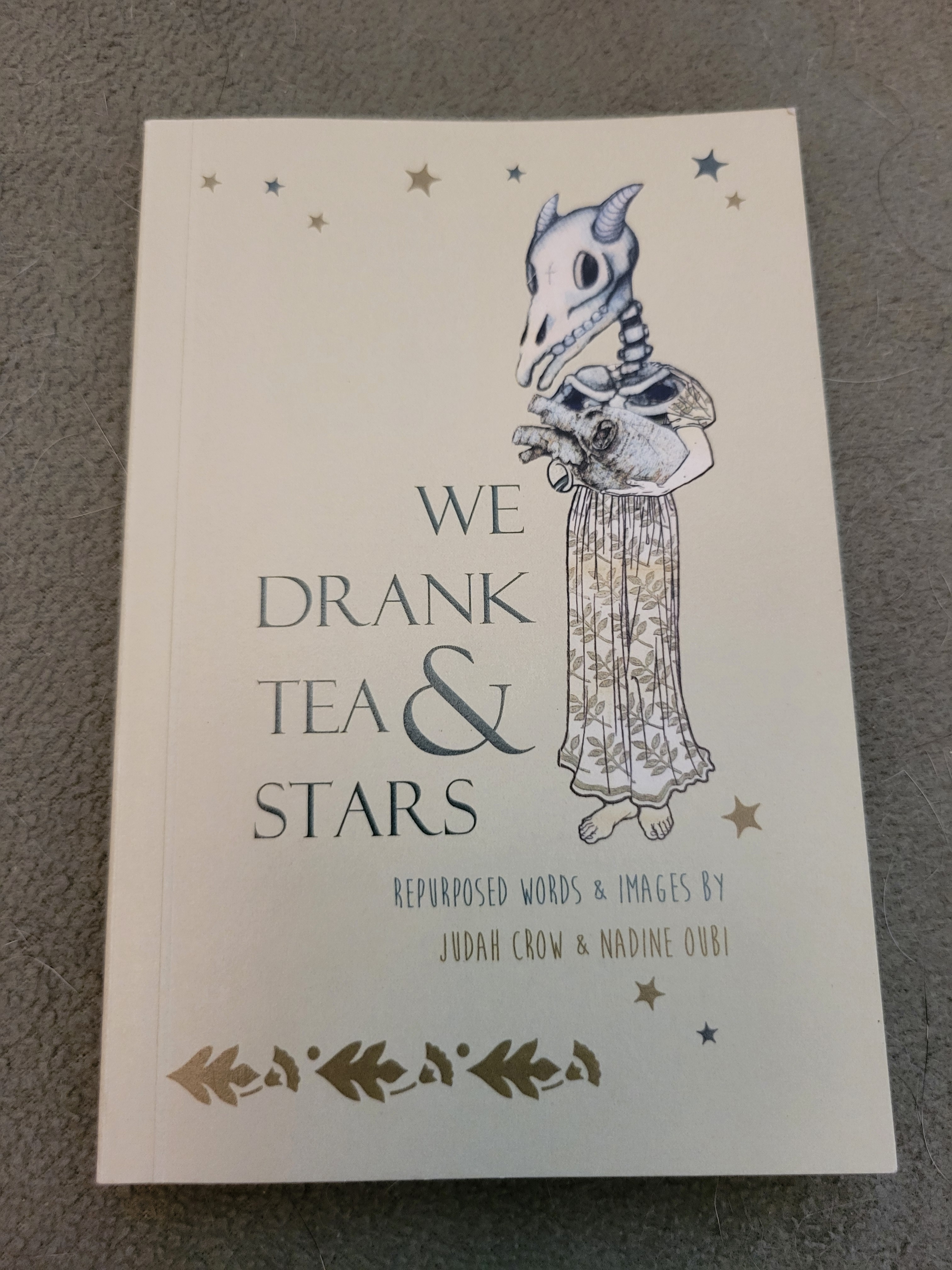
We Drank Tea & Stars by Crow & Oubi

We Drank Tea & Stars
by Judah Crow & Nadine Oubi

This is a fascinating little independent publication that I can’t find listed anywhere online, but ran across on my uncle’s bookcase, after he had apparently found it in a little free library. Poems by Crow and illustrations by Oubi, the really fascinating part is that they’re all collages, both the visual and the text.

I’m familiar with collage art and immediately recognized it when I saw it, and these were fascinating and fun examples of that. But I hadn’t even heard of collage poetry before, the closest I’ve come is erasure poetry: using found text and erasing everything except the words the new artist wants to highlight for their poem. Instead of that, this collage poetry samples lines from other written works and combines them in new ways. Crow also points out that there’s an extra level of collaboration that came from the way most of the samples were from translated works: so there’s the original author, the translator, and then Crow, each providing a different context.

Poetry isn’t really my reading genre of choice, but I do love seeing people do new and interesting things with text. And while I could admire the poetry without any particular understanding or critical thinking, I really enjoyed the afterward talking about the process, and also the Sources list, which ranged between works I’ve never read to works I’ve never even heard of.

Five Gods (Bujold) Fanfic

I just read Penric & the Bandit, the 13th and most recent addition to the Penric & Desdemona series by Lois McMaster Bujold, and it was a lot of fun, although not necessarily a stand-alone story. I highly recommend the whole series, and the books set in the same universe, and pretty much everything by this author. However, reading this latest story reminded me of how there was some really excellent fanfic set in Bujold’s Five Gods universe that I highly recommend.

One of the real benefits of fanfic, as a genre separate from the canonical source material, is that it can explore ideas that are mutual exclusive to one another, and explore endings without actually concluding the story. Several of these stories deal with what happens to Desdemona when Penric eventually dies.

End of the Road by Gwynne
Summary: Desdemona has moved from one rider to another a dozen times. This is just one more.
My review: This is short, only 975 words, and brings tears to my eyes every time I read it, but it’s not sad: it’s glorious. Penric dies a peaceful death that he and Desdemona had prepared for, but this death is different from any of her previous riders and Desdemona is different too and the god recognizes and rewards that.

After the End by allonym
Summary: Given the choice of jumping to her, or being dissolved in the unfathomable energies of the Bastard’s Hell, Penric kin Jurald’s demon had chosen its destruction. Somewhere, the Bastard is laughing at Eleni.
My review: This is a fabulous continuation of Gwynne’s End of the Road, showing events and consequences for people who did not have the perspective to see the meeting between demon and god. And also includes Penric’s funeral, as a beloved saint of the Bastard, and those funerals are always hilariously chaotic.

Penric’s Last Ride by Zarz
Summary: Pen and Des have had a long and happy partnership together as demon and rider, but Des is well aware that humans don’t live forever, and one last mission to deal with an invading army proves to be Pen’s last. Now Des is stuck as an unwilling ascended demon with an unresponsive rider. Des may be struggling after outliving yet another rider, but being eaten by a saint and dissolved back into chaos isn’t her preferred outcome either. But maybe, just maybe, the Lord Bastard has more grace for His demons than any of them ever realized.
My review: This is a different take on how Penric dies and what happens with Desdemona, that really leans into the idea that the gods are parsimonious, and use the deaths of their saints to further their goals just as they used their lives, but it works out because their goals are to their people’s benefits as well.

Inheritance by silverbirch
Summary: Generations after the events of Paladin of Souls, an old man finds an heir, and a young man finds a new vocation.
My review: Once more, this is a story about the death of a sorcerer and the response of the demon, but instead of Penric, it’s Foix dy Gura, a character from the books The Curse of Chalion and Paladin of Souls, with Penric mentioned as the author of a book written centuries before. This reads very much like a reprisal of the first Penric & Desdemona story, Penric’s Demon, while also being a short look into the future of those characters we met in the first two novels, and I love both of those things.

The Saint, the Scholar, and the Whale by Neotoma
Summary: Ista in Jokona meets an unusual divine on an unusual mission.
My review: In contrast to the other stories in this list, this is not about death, but a pure adventure that shows Desdemona continuing on being her immortal self with a new host and a new set of friends and family around her, centuries after Penric, who is still loved and remembered as an imprint, but there are other things to think about and new people to save and demons and befriend and saints to interact with. Life goes on and it’s an adventure!

I do love the way fanfic is a modern version of storytelling around the campfire, where anyone and everyone gets a chance to offer ideas and insights into what could or couldn’t happen in all sorts of scenarios real or imaginary.
The Mezzanine by Nicholson Baker

The Mezzanine
by Nicholson Baker
1986, 1988

This is a very odd book. I did enjoy but also, just, huh. It’s a first-person demonstration of overthinking everything, while also just letting it all flow past.

The plot, such as it is, is that the narrator rides an escalator from the lobby to the mezzanine, returning to work after his lunch break. The style however is a detailed and rambling documentation of his thoughts as they veer from the immediacy of his current sensations to memories both recent and long past to considerations for the future and back again. His thoughts would be tripping over themselves with how many and how rapid they are, overlapping and given depth from history, except that Baker has given them space to be fully articulated in a 135-page novel with a multitude of long footnotes such that he describes both a three-minute experience and the entirety of a character.

This book also reminded me of how journals kept by the most obsessively boring of individuals can be the most valuable to historians as they’ll document details that other diarists don’t bother to mention. Most books skim past a character going from point A to point B, with a single line or phrase. This book makes it clear that such a phrase can be treated like a fractal: the closer you look, the more details appear. There are a thousand questions: how did he come to be at point A? why is he going to point B? What is the process of going to point B? Why that process? What sense memories are attached to the process? What history? What is he bringing with him? Why those items? How did he come by those items? etcetera ad infinitum.

I have previously denigrated the literary genre, but this is actually really good despite being very much within that genre. I think the difference is that in so many literary books there is a scene in which the narrator looks at other people in a crowd and think to themselves: those people don’t have interior lives like I do. This book has as it’s very premise that each and every person has a rich interior life. The narrator in this book is no different on the surface level from any of the others, and yet, he is uniquely strangely himself, and so too would be every other person if one looked as deeply.

Eli Harpo’s Adventure to the Afterlife

By Eric Schlich

This book is an utter trip! (Pun semi-intended?) Eric Schlich captures and satirizes, with what I can only assume is great accuracy, what he calls the heaven tourism genre: Heaven is for Real and books of that ilk. Though I haven’t read any of those purported nonfiction books, this novel has enough similarities to the description of Todd Burpo’s book that I’m guessing the publisher had to brush up on the fair use rules for parody.

At age 4, fictional Eli Harpo had emergency heart surgery, and told his parents of visiting heaven while under anesthesia. His dad has since written a book about it (Heaven or Bust!) and ekes out a living selling and giving talks about the book. Eli happily supports this relatively small potatoes endeavor, but when a renowned televangelist comes calling and the publicity blows up, Eli is faced with increasing doubts. 

The chronology jumps around a bit, with most of the book being a flashback as middle-aged Eli is revisiting Bible World, the Christian theme park where his budding fame came crashing down at age 13. Most of the book details how Eli and his family got there, both physically and mentally, with some flashforwards to college, where he rebuilt his nonreligious life. The book pointedly does not reflect Eli any younger than 13 because he himself cannot remember any of the original pivotal near-death experience that has brought them all to this point.

Described as “witty, satirical, and profoundly big-hearted,” it was that, but the praise didn’t mention that it is also utterly mortifying. I don’t suffer from second-hand embarrassment as much as others, but I was both agog and cringing at most of the scenes in the novel. Which I mean in a good way — if it wasn’t so well written, it wouldn’t have nearly the impact! I didn’t relate especially closely to any of the characters (though other reviewers who experienced much more stringently religious upbringings than I have said that it is quite accurate), but I found it all fascinating. They could have so easily been caricatures, but truly each character contained unexpected dimensions. Schlich details each scene which such realism and matter-of-fact first-person narration from Eli, that I periodically had to check that this was in fact a novel and not a memoir.

Fourth Wing by Rebecca Yarros

Fourth Wing
by Rebecca Yarros
2023

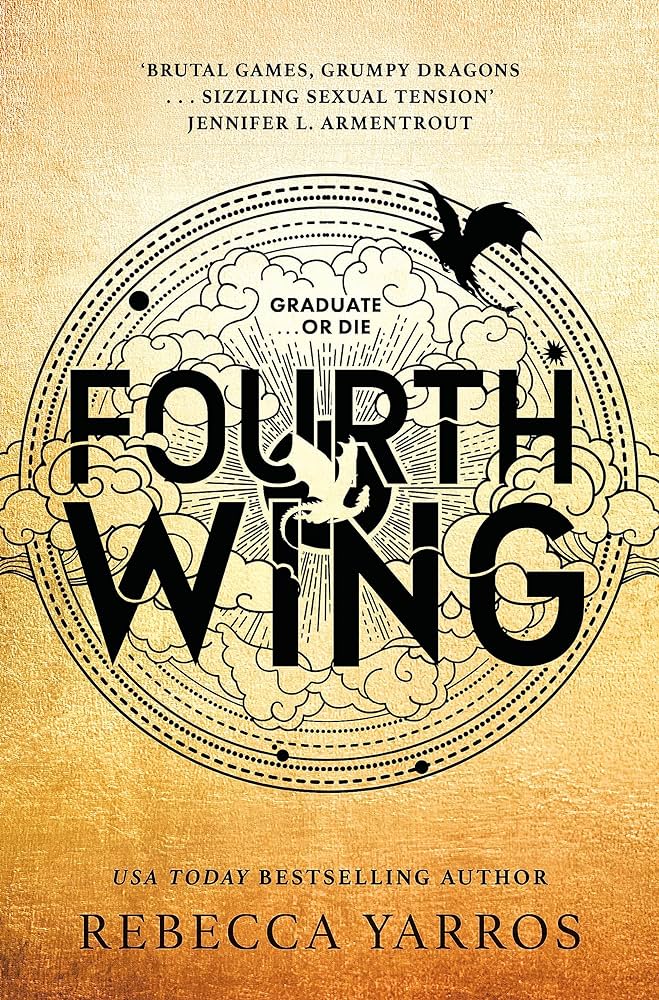
I enjoyed this book, and I do recommend it, but it was good enough that its flaws stood out. I was frustrated that it wasn’t better. It felt like an amalgamation of Iron Widow, The Hunger Games, A Deadly Education, and Dragon Riders of Pern, rather than entirely it’s own unique thing. The plot arc was also similar enough like The Poppy War that I was nervous that it was going to get overwhelmingly gruesome at some point. It didn’t, which was a relief. By about page 100 I had a basic concept of how the plot and characters would develop and what kind of twist there would be at the end. It’s not a subtle book. I still blasted through all 500 pages in two days.

Our heroine Violet is forced to enter the training for dragon riders, which has something like a 25% survival rate, and where the students are not quite encouraged to kill each other but certainly not discouraged from doing so. It makes me wonder how much the current real world trend of extreme bullying in schools is coming out in fiction. In theory every student is a volunteer, since dragon riders are highly honored, but Violet’s mother is the general in charge and demands Violet enter despite her having a congenital condition weakening her bones and joints. The children of the executed traitors of an earlier rebellion are also required to enter. Notably the children of traitors who were executed by Violet’s mother.

The students are all in their early twenties and training for peak physical fitness and constantly in mortal danger and are completely horny with it all. There are two students in a classic love triangle with Violet — one is her best friend from childhood and the other is the son of the executed rebellion leader. This is not a subtle love triangle and had me rolling my eyes at the introductions (they’re both so strong and sexy!), but I was really impressed with how the relationships develop and how the situation concludes. Also, a special call out to how well done the sex scenes were, at being character and plot significant and also both sexy and hilarious. Special kudos on those!

The part of the world building that I particularly love is that the dragons are large vicious beings who are not just sentient but actually the ones in charge of the dragon/rider relationship. The dragons pick their riders and they kill the ones that annoy them and no one gainsays what a dragon decides. The humans are essentially familiars to the dragons who can use them to access magic in a way that they can’t without a rider. It’s a fabulous premise that I adore and wish had been fully developed and integrated into the rest of the societal world-building, but it’s just not. The demonstrated command structure is still very much human-oriented, although maybe that will change in the sequel.

Bodies

By Si Spencer

This is a new(ish) program on Netflix, which looks both intriguing and confusing. The graphic novel it is based on turns out to also be intriguing and confusing. It is set in London but over four different years: 1890, 1940, 2014, and 2050. Investigators of each time period are faced with the mysterious appearance a brutally murdered corpse with no identification. The thing is that it is the same corpse for all of them.

I don’t have great facial recognition in general, so was impressed that I was vaguely able to recognize the reoccurring corpse, even across the different art styles. Each year has its own artist, all significantly distinct and all quite good. The art complements the writing in capturing the cultural changes of each time period as well. All that to say, it is a beautifully done graphic novel, and I still have only the vaguest sense of what it is all about.

I think it is probably very British? It reminded me a bit of Watchmen and V For Vendetta in overall style, though Bodies is generally more optimistic. Each year is a time of upheaval for England, highlighting different threats, both internal and external, that England has faced. It ends in a very English-centric declaration that I assume might resonate more if I were English.

… I decided I should probably at least watch the first episode of the show so that I can give my two cents on that, fully expecting to be unenthusiastic, but the show is actually really good! It takes significant divergences from the source, but they mostly improve the suspense and pacing to my mind, as well as making the characters a little more nuanced, though I’m still only halfway through the series. Rebecca pointed out that the cinematography is so good that it surpassed the illustration for her.

The show also made a theme more explicit that I’d initially missed from the comic: that all four investigators from the various time periods are various degrees of acab, exerting their power over vulnerable characters, but they are also each from a discriminated population themselves, possibly using their borrowed authority to balance.

How to Give Up Plastic

By Will McCallum

Like a lot of people I’m sure, I’ve been reflecting more and more lately on how much waste and plastic in particular there is in my life. It feels really daunting though, to try to cut it down, so I jumped on getting some clear guidelines on where to start. This turns out to have been a very timely read, since I just learned about the Plastic Free July campaign, started in 2011.

Will McCallum is Head of Oceans at Greenpeace UK, so feels VERY strongly about all of this, naturally. He begins by making the case for trying to eliminate plastics with some rather harrowing stories of natural devastation that I kind of wish I hadn’t read. I gritted my teeth and got through the first two chapters, though I wasn’t sure why I was pointing myself through the stress of it all, since I was already on board. However, I began to understand later why McCallum hits it so hard. A lot of the approaches toward eliminating plastic are going to be annoying (to you and others), inconvenient, and a little confrontational at times, so it is important to keep in one’s mind the criticalness of the endeavor. I also found some resolve in the idea of fighting against the notoriously anti-environment petroleum companies, who are incredibly invested in continuing to escalate plastic use for their own profits.

The third chapter gives some hope with initiatives that are beginning to work around the globe, primarily government and policy interventions; the fourth on the impact that individuals can make, both in their own actions and influencing their community and local government; and finally in the fifth chapter we get down to the nitty gritty of tracking down plastic alternatives. Luckily, the easiest replacements also seem to be the most critical. The book mentions the Big 5 of disposable plastics, those plastic items that we use for mere minutes one time and then throw out: cups and lids, straws, water bottles, plastic cutlery, and of course plastic bags.

A quote by oceans activist and actress (Ginny Weasley!) Bonnie Wright sums it all up nicely, “If I had a message, it would be that yes, it is very overwhelming and it is a really big issue, but these small changes that you are making are significant. It can be hard, so just choose one part of your household—like food, or cleaning products, or toiletries—to tackle first.”

Mystery Comics

A friend asked me for a recommendation for a graphic novel to introduce her to the medium, which is always a fun challenge. She stumped me, though, when I asked her preferred genre, and she said ‘cozy mystery’! I would have previously thought that graphic novels covered pretty much all genres, but I couldn’t think of a single cozy mystery. I sent her Jason Little’s Shutterbug Follies, which I would classify as more of a quirky mystery than cozy (a fine distinction), while I did a deeper dive through my library stacks.

The Good Asian by Pornsak Pichetshote and Alexandre Tefenkgi

This is very much noir, and not cozy, but is also super interesting! Starting with him stuck in an immigration detainment camp, Edison Hark is a Chinese police officer working in San Francisco in 1936. Tracking down the missing Chinese maid of a millionaire family takes him through all levels of society. The author and artists capture classic noir perfectly in both narrative and style, and weave in an impressive amount of historical detail. My only complaint is a common one with graphic novels, that is was just too abridged. The characterizations and plot felt rushed to the point that I had some trouble keeping track of the investigation, which certainly blunts the suspense and reveals a bit. Even with the compression, volume 1 ends on a cliffhanger with no solution yet in sight.

Continue reading