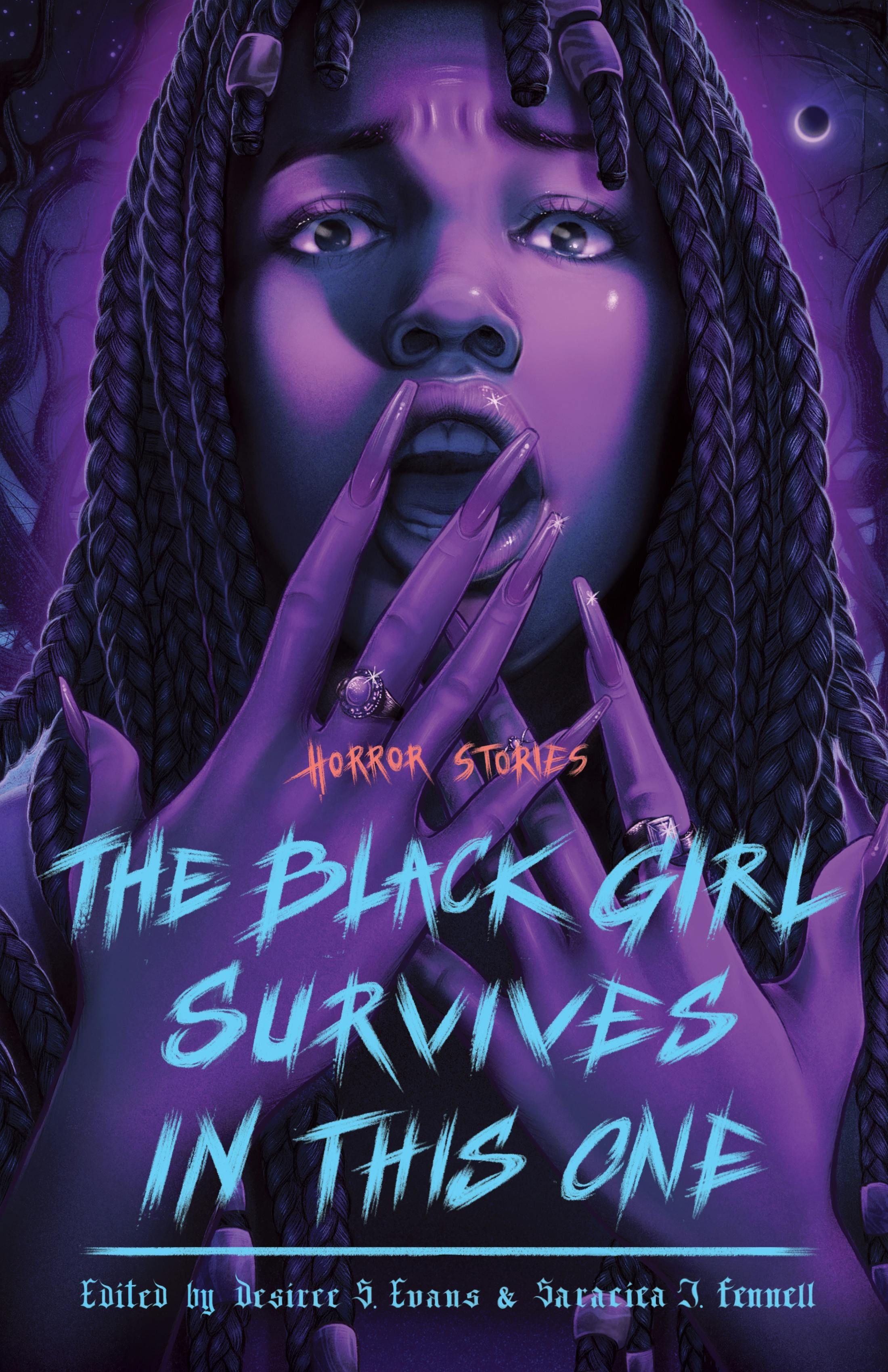
The Black Girl Survives In This One

Edited by Desiree S. Evans and Saraciea J. Fennell

A collection of horror short stories with an assured survival? Yes please! (Though the authors occasionally split hairs by ending the story before the perhaps inevitable conclusion.) In my enthusiasm, however, I’d overlooked that this is very much for young adult readers (and is clearly branded so). The fifteen stories all feature black girls in high school or college, all feeling the impatience for adulthood and independence that makes middle-aged me feel tired (and sympathetic for the adults around them).

So, I wasn’t exactly the audience for this, but the stories covered a truly impressive variety of horror subgenres and intersected them with Black life in a really fascinating way. Southern gothic hits a lot different with the added generational trauma of slavery, but also how do the cults of wellness MLMs punish Black bodies even more than white? Remote nature spaces can already be uninviting to many Black people, with or without supernatural horrors, and what would that look like in futuristic space exploration?

But then, there’s also the comfort in reading these, knowing that you won’t be exposed to an onslaught of abuse. In these stories the Black girls fight back, survive, and often triumph, even if occasionally leaving a truly impressive amount of destruction in their wake.

The stories varied in quality and my personal taste, of course, like any anthology, but I was really impressed with what a comprehensive overview it provided. I always particularly enjoy short story anthologies as a way to be introduced to new authors, including here two up-and-coming writers who won an open call with their submissions that fit in beautifully.

Nicked

By M. T. Anderson

Described as a “wildly imaginative, genre-defying, and delightfully queer adventure,” I knew Nicked was going to be weird, but I hadn’t expected it to be quite so laugh-out-loud funny. In many ways, the humor had both a dryness and absurdity that reminded me of Catch-22, without being nearly so bleak, which is saying a lot for a 11th century setting.

A lowly monk is voluntold by his local bishop to accompany a ‘saint hunter’ in ‘liberating’ the reliquary bones of St. Nicholas from its celebrated gravesite and temple to the monk and bishop’s own town. In the middle of a plague, they hope the reportedly healing bones will be able to save the populace, so there is some redeeming motivation. The author claims that this based on a true story, and has the references to back it up, though he also explains that any deviation from strict accuracy is also highly representative of medieval nonfiction, which took plenty of licenses of its own (his afterward is well worth a read).

The humor comes from both the strangeness of the period in general and the quest in particular, and the familiarity of political and religious bickering across all times and geographies. The common people everywhere make due during times of great upheaval, and every interaction is a delight. The heist is also so well written, with setbacks and twists and turns that kept me agog. My one caveat is that there is a framing narrative that sometimes gets very philosophical and that I couldn’t always follow, but it is also used sparingly, so I didn’t find it a detraction.

Shubeik Lubeik by Deena Mohamed

Shubeik Lubeik
written, illustrated, and translated by Deena Mohamed
2022

This graphic novel is amazing! I highly recommend it. It came to me as a second-hand recommendation with the suggestion to just go into it cold, with no expectations of what it is. Just know that it is brilliantly done and beautifully illustrated, award-winning, and anyone reading this should definitely give it a shot. That said, this is a book review blog, so I’m going to go into more (ie, some) detail, but am respecting the original recommendation enough to put those details under a cut.

Continue reading

Naomi Kritzer’s prophetic vision(s?)

Whew, it’s been a month (or three) hasn’t it?! I don’t have much else to say except to thank Rebecca for continuing to push this blog forward when I ran out of steam for a while there. You can thank her too for dragging me back in by sending me these links and then haranguing me until I finally read them:

So Much Cooking

Rebecca sent me the link to this novelette (8,410 words) that has been making the rounds on social media lately. Written in 2015, it is eerily accurate for 2020, down to some of the tiniest details. Told in the style of a food blog, it stays grounded in everyday life, capturing the broader human experience through the smaller individual shared experiences. Though Kritzer is anticipating (again: frighteningly accurately!) an unusually difficult period in the modern era, she also highlights the strength and generosity that people can and do bring to shared struggles, making it a much more hopeful reflection than one would expect.

The Year Without Sunshine

This slightly longer novelette (10,883 words) came out in 2023, along with readers’ hopes that it doesn’t turn out to be quite so on-the-nose this time around, though it sadly doesn’t seem out of the realm of possibility. Though the scope of the crisis is even larger this time, so is the community that comes together to bolster each other in truly innovative ways. I very much hope it doesn’t come to quite this extreme, but Kritzer again focuses on the positive, the basic good of most people and how they want to and can help each other. Through this, she provides some innovative blueprints for what different kinds of mutual aid can look like, and isn’t that what scifi does best, showing us a path toward a better future? I look forward to more of her writing (with only a little dread, haha)!

A Prayer for the Crown-Shy by Becky Chambers

A Prayer for the Crown-Shy, a Monk and Robot Book
by Becky Chambers
2022

I enjoyed the first book in this series, and I think I like this one even more. It feels particularly relevant to my life right now as it considers what it means to have or not have a purpose, dealing with burnout, and the yearning for something undefined but different from what you have. Each of the six chapters is its own little mini-story on Dex and Mosscap’s journey from the deep woods through the rural and farming communities towards the central city. They’re not quite stand-alone stories but feel like individual stepping stones. It’s an overtly philosophical book, as the philosophy is not in the narration or the plot, but very specifically in what the characters are struggling with.

It’s also very open-ended. I can hope that there will be more books in this series, although I can understand why there might not be: the questions the characters and thus the author is asking are so very hard to answer. But I think even with just two books, this isn’t a duology like I’d thought when I read the first book, because the story doesn’t conclude with this second book. The characters are on a long meandering path that doesn’t have a definite end point, that they don’t want to have a definite end point.

It’s remarkably soothing and meditative. It’s also imaging a world where everyone has enough and no one is struggling just to survive, which is something that seems both entirely possible and also so out of reach. It leaves me yearning for something more, but also with the thought that maybe I can try to reach for that something more even if I don’t quite know what it is or how it will go.

A Psalm for the Wild-Built by Becky Chambers

A Psalm for the Wild-Built
by Beck Chambers
2021

This is a charming book that struck me immediately as a mixture of Nghi Vo’s The Singing Hills Cycle and Peter Brown’s The Wild Robot series with a bit of Mai Mochizuki’s The Full Moon Coffee Shop thrown in for good measure. It is also the first of a two-book series and I definitely need to check out the second book. Our main character is Sibling Dex, a monk who has been a gardener for many years but decides at the beginning of this book that they have received a new calling to be a tea monk: someone who travels around the countryside with a pop-up tea stall to provide the populace with tea and comfort. I do love fictional religious explorations and narrow focus narrations too about the tea and the carriage and the villages.

The setting is a quiet futuristic post-industrial utopia on a moon, several hundred years after the Great Awakening when the robots that manned the factories spontaneously developed awareness and declared that they were going to depart human society to explore nature and they didn’t want to be followed. In response, humanity had a Great Transition where they found a balance with nature and since have lived in essentially bucolic comfort. The exact details are not delved into, but it’s against this backdrop that Sibling Dex finds themselves yearning for something more than they have while being confused about how they can be dissatisfied with what they have. And yet.

And it is Sibling Dex, in the midst of their struggles to identify what they need that’s more than what they already have, who makes the first contact between humans and robots in centuries, with a robot who has come to see how humanity is doing. It is very much a culture clash of individuals who are both trying their best but also thoroughly confusing and confused by the other.

No solutions are found by the end of this book, but conversations are had and explorations of both ideas and locations. But overall it was very sweet and extremely relatable.

The Archer by Paulo Coelho

The Archer
by Paulo Coelho
illustrated by Christoph Niemann
translated by Margaret Jull Costa
2020

I picked this up randomly at the library when I was searching for something else, and I’m glad I did. It’s a short book (only 160 pages) with beautiful illustrations, and it feels like a combination of Zen and the Art of Archery by Eugen Herrigel and Sun Tzu’s The Art of War. The text is not quite poetry, but I want to refer to the verses rather than paragraphs, due to the care and curation that has gone into the prose. It’s a short book but not a quick read, not because it’s difficult but because it leads me to slow down and take breaks and think about what it’s saying.

It has an extremely basic framing story where a boy discovers that the local carpenter in his little village is a famous archer, and asks him how one masters archery. The archer says that he can tell the boy how in an hour, but doing so takes years. The bulk of the book is made up of the short descriptions on what it takes to master a skill and thus master oneself. It’s essentially a book of meditations, with the skill of archery being itself a framework for self improvement.

The framing story sets this book as fictional with characters and events — that was what had originally drawn me to it and I enjoyed both the opening and the closing chapters — but it feels more like nonfiction to me. This book consists of the advice man gives to a boy about how to live a good life: how to be a bow, aim an arrow, pick a target, and be respectful of it all.

Also, the illustrations really are gorgeous, in a very simple style.

A Sunny Place for Shady People by Mariana Enriquez

A Sunny Place for Shady People
by Mariana Enriquez
translated by Megan McDowell
2024

This is not at all my usual genre, but I really enjoyed it and was impressed by it. I noticed only after reading it that while I got it from the New Releases section of my local public library, it is marked as ultimately intended for the Horror section. I probably wouldn’t have given it a chance if I’d noticed that before, but the title, the cover, and the blurb about a fantastical and hypnotic view of Argentina drew me in. The twelve short stories are horror, but more significant to me is the way they lean in to the magical realism of living in a world where the supernatural is right around the corner. There’s a dream-like quality to all the stories with no clear line between reality and hallucination. And a decided implication of: maybe all the hallucinations are real.

While I often read stories in anthologies out of order, I read this book from front to back, in order, and it was absolutely the right choice. The stories feel like steps down into deep water, creating a path that doesn’t dunk the reader too quickly and also gives a good exit. The first story, “My Sad Dead”, is nearly soft in its portrayal of death, and the trauma for both the dead and surviving. And the second story, the titular “A Sunny Place for Shady People” is a love letter to the people who enjoy delving into the macabre. The sexual violence that comes in the third story “Face of Disgrace” is merely a prelude to the body horror. By the eleventh story, “A Local Artist”, I was reminded of Hieronymus Bosch paintings of demons and temptations. But the twelfth story, “Black Eyes”, felt like a happy ending: they got through, they got out. None of the stories are directly related to one another, they all have different characters and different scenarios, but together they create a version of Argentina that is filled with people trying their best to live their lives even when violence and trauma has left long lasting wounds.

On the one hand, this book kind of needs all the content warnings — body horror, medical horror, psychological horror — but on the other hand, none of it felt gratuitous, and it was really well done. Those warnings would have put me off reading this, so I’m glad I didn’t get them. I also consider these stories an example of the noir genre, which is another genre that I don’t particularly care for, presenting a deeply cynical perspective on humanity. But that the perspective of every person being deeply flawed and just doing what they can to survive, feels like a kindness rather than a condemnation in these stories.

I really enjoyed these stories, even though I had to read them one by one, taking a break between each one. They’re extremely well done and well worth reading and I want to highly recommend them, while also giving the caveat of: take care of yourself.

more graphic novels

It is all too easy to buy a whole bunch of really cool graphic novels from either Small Press Expo or Toronto Comic Arts Festival, be absolutely delighted with them all, and then go home and get distracted from actually reading them, in part because there are so many and where do I even start? (It turns out collecting books and reading books can be two separate hobbies!) But I don’t want to forget about these in my ever-growing to-read pile, and so here are another three graphic novels that I acquired, read, and enjoyed.

She Walks With The Giant
by John V. Slavino
2022

This is a beautifully illustrated book with gorgeous vistas set in a post-apocalyptic world in a fantasy ancient Asia. The girl is an orphan in a ghost town who first sees the giant robot appear, and decides (much to the giant robot’s dismay) to follow along. The first part of the book is an exploration of the world as it is, while the second part is an exploration of the history that brought it to this point, where the giant came from, and how there’s no real escape from being part of that history.

Skip to the Fun Parts: A Guide to Cartoons and Complains about, the Creative Process
by Dana Jeri Maier
2023

Admittedly I bought this with the expectation that this would be something of a guide to the creative process written by a published graphic novel writer/artist despite the clear strike-through of those exact words, and it’s decidedly not that, but I still found it remarkably reassuring and comforting, and also extremely funny and with a few good ideas thrown in. It felt comforting to see someone successful face some of the same issues I am with energy vs inspiration, and still persevering with good humor.

The Pineapples of Wrath
by Catherine Lamontagne-Drolet
2018

A friend who wasn’t particularly interested in graphic novels was curious to try one out and asked for a recommendation, so we asked her what genres she generally read, since graphic novels come in all genres. At which point she asked for a cozy mystery and Anna and I were both stumped. Graphic novels do come in all genres… but that was a rare one! However, we persevered and found a cozy mystery graphic novel: The Pineapples of Wrath, which is hilarious and adorable and has quite the body count as Marie-Plum, bartender and mystery-reader, determines that her elderly neighbor was murdered and if the police won’t investigate, then she will! The setting is a fictional little-Hawaii neighborhood in Québec, Canada, and it is just as ridiculously touristy as you can imagine and maybe a bit more.

The Incredible Story of Cooking by Douay and Simmat

The Incredible Story of Cooking: from prehistory to today, 500,000 years of adventure
written by Stéphane Douay
drawn by Benoist Simmat
translated by Montana Kane
2021, 2024

This is such a fabulous premise, and at first glance it looked well done, with good art and nine chapters creating an interesting outline about a truly fascinating topic. I was extremely pleased to acquire it at the last Small Press Expo. After reading it, though, my conclusion is that it was… decent. But it didn’t live up to the premise and that was ultimately disappointing. As a 200-page graphic novel covering 500 thousand years of global history, it was obviously always going to be a quick skim over the topics, but it often felt more like disjointed trivia rather than even a summary. There was some general overview and where there wasn’t, the trivia was still fascinating.

What really struck me, though, was that the authors don’t seem to appreciate or enjoy food. Given that it was about how people throughout history had developed all sorts of wild cuisines, it was weird and off-putting how the authors’ distaste for those cuisines came through so much stronger than the historical figures’ enjoyment of them. There was more focus on the politics of food distribution than there was on the development of the dishes, and the text was often felt both judgemental and mocking.

There were a number of basic recipes that were referenced in the text, but of course were very generalized in such a way that you couldn’t actually follow them, which makes sense for being embedded in the story. However, there’s also a section at the end that contains 22 recipes from around the world and throughout time, and they just aren’t good recipes. It’s not that the dishes aren’t good, but that the instructions are poorly written, with ingredients and processes skipped or listed out of order, and written in ways that introduce a lot of ambiguity. An experienced cook or baker could probably fill in the blanks, but they are clearly written by someone who doesn’t cook or know how to write directions for others to follow a process.

I don’t want to just slam this book, because it was interesting and well-illustrated, but it was such a great concept. Why couldn’t it have been better?