The First Fifteen Lives of Harry August by Claire North

The First Fifteen Lives of Harry August
by Claire North
2014

This is a fascinating premise and it’s well-written, but I had more than a few issues with it. I still read it to the end and was impressed overall.

The book is written in the first-person, by Harry August, a man who is born in 1919 and generally dies in the 1990s, and when he dies, he wakes up again, born in 1919. He’s not the only person living and re-living such recursive lives. They call themselves kalachakra. Their first lives are normal, their second lives tend to be short and filled with madness as they freak out about what is happening, and then they settle into the pattern of just reliving their lives, with both more comfort and more tedium each time through. Their society really highlights the apathy that comes from not thinking that we can do anything to effect the terrible things that are happening in the world.

At the beginning of this book, a child shows up at Harry’s 11th deathbed to explain that she’s one link in a chain of messages being sent from the future into the past, from the very young to the very old, to tell them that the end of the world is speeding up, and they don’t know what’s causing it, but it has to be something happening in the past. Then Harry dies in 1996 and is born in 1919 and he goes to find the oldest kalachakra currently living within reach of a small child, to pass along the message.

Fascinating!

Then he discovers what is causing the problem and it’s during his lifetime. So then he has to figure out what to do about it. The main plot takes place over the course of lives 12 thru 15 (which are told in order) but with frequent intermittent descriptions of lives 1 thru 11.

A brilliant idea and well implemented. In some ways, it reminded me of This Is How You Lose the Time War, a book I enjoyed a great deal. But any recommendation for this book comes with a lot of caveats.

First caveat: Much of the action takes place in the 1950s and 1960s, with all that entails, specifically: cold war era and a sense of science having all the answers. Everyone is very certain of themselves, which leads to them doing really terrible things because they don’t pause to consider that they might not know best, and simply shrug off all the harm as unavoidable consequences of progress. I don’t find any of the characters particularly likeable.

Second caveat: There’s a lot of torture. At least four extremely specific torture scenes and more than that depending on what counts, and a general sense that this is just how the world is. Characters, setting, and plot are written such that the torture makes perfect sense, and it’s an unpleasant world view that’s a bit too convincing.

Third caveat: The worldview is not completely convincing, especially as the reveal happens of what’s causing the end of the world. It’s written as an obvious and logical sequences that I don’t actually think works as a logical sequence. Or if it does, it’s a commentary on how time works that I don’t think the author fully intends. If it was intentional, then it would have been interesting but this book is too well written for that commentary to be so poorly implemented.*

Fourth caveat: There’s a lot of convincing by the antagonist to the protagonist. It reminded me a bit of Oscar Wilde’s the Portrait of Dorian Grey, except without Wilde’s humor and with a lot of scientific zealotry.**

The concept of the kalachakra is so cool, and the writing is really well done, but I just wish it had been explored in a less grim and gritty way.***

* In Connie Willis’ To Say Nothing of the Dog (a book I whole-heartedly recommend), there’s a deep dive into discussion about how time is effected by time travel and what changes a time traveler can and cannot make, and what happens when a person tries. This book would have made a lot more sense if Claire North had made the argument that the timeline is relatively stable but can be slowed down or sped up, rather than simply saying that changes to the timeline are merely taboo due to messing things up for future kalachakra. Then there could have been a deep dive into the ramifications about that. But instead there are a few half-hearted discussions of alternate timelines and branching time theory, and protecting the future world for the kalachakra that live in those futures, but no real discussion of the stability or malleability of the timeline.

** There was not any less homosexual subtext though. I spent a lot of pages waiting for at least some seduction between the antagonist and protagonist, but it’s all very 1950s lets just sleep with women while thinking about each other but no-homo type of thing. It’s just obsession, not attraction, your honor!

*** Especially since there are at least several dozen rather delightful fanfic stories that I’ve read about people re-living their lives to better or worse effect.
Little Mushroom by Shisi

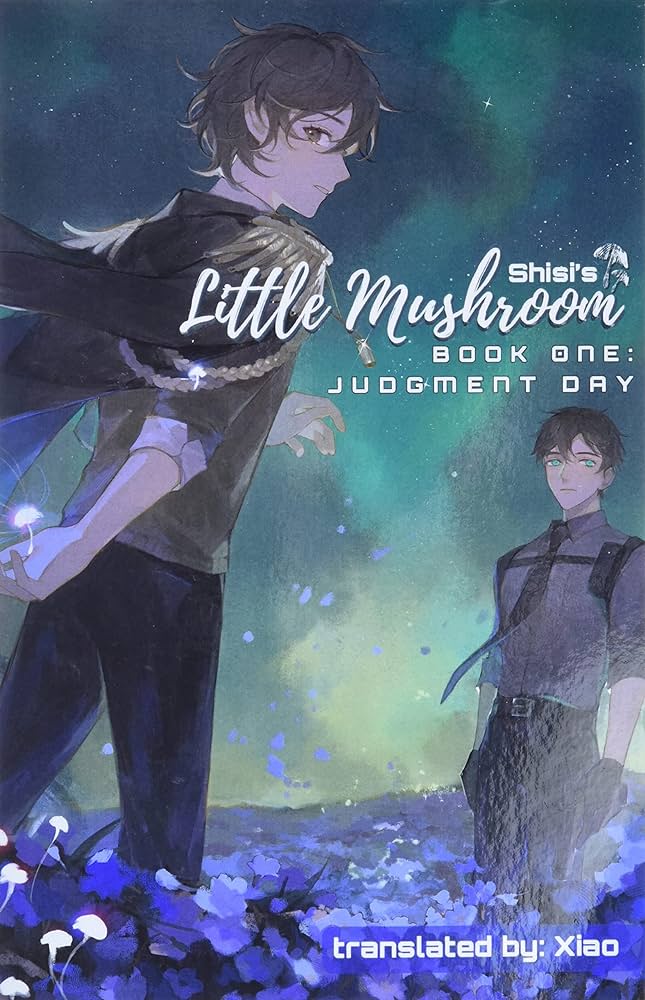
Little Mushroom
by Shisi
translated by Xiao
2022

This is adorable and hilarious and horrifying. This is set in a post-apocalyptic world (with all the scientific explanation of Star Trek, ie, absolutely ludicrous but boy does the author and a series of scientist characters try) where the final bastions of humanity are in a handful of highly guarded cities under military rule, while plants and animals outside are all aggressively mutating and mutagenic. Get stung by an insect and within a couple of hours you’ll become a giant insect monster going on a killing rampage. The nature aspect reminds me of Scavengers Reign, and the writing is clearly intended to evoke specific visual images that sometimes comes across oddly in a written medium, but this would make a stunning animation.

The society is an extreme form of fascism that’s written as a necessary evil with the protestors dying horrible deaths for not understanding the necessity of the military department with little to no oversight that executes anyone suspected of being tainted with a mutation. The slogan of “Humankind’s interests take precedence over all else” very much includes the rights of any individual. There’s the military, the scientists, the breeding program, and everyone else. It’s a grim society, on the cusp of destruction: an extreme dystopia.

However, the book’s perspective is not from the point of view of a human. While humans are struggling for survival in an increasingly hostile world due to the mutating animals and plants, one such mutation is a mushroom who has gained sentience, mobility, and the ability to shape change into the form of a human. That mushroom, named An Zhe, ventures forth into the human city to reacquire part of itself that had been collected by a human research team. Human massacres just aren’t as traumatic to a mushroom as they are to a human and An Zhe’s calm curiosity permeates the book. What does he know about humans and morals and society? He’s just a little mushroom! Adorable!

Lu Feng, the human in charge of executing any human mutations, takes one look at An Zhe and essentially goes: huh. An Zhe is definitely odd but not in the way of a mutated human. Deeply suspicious, but to all appearances just an oddly sweet and naive human.

And thus the plot develops: the human race losing the century-long war against the increasing number of devastating disasters while desperately trying to figure out what’s causing the mutations, An Zhe trying to figure out how to fit into human society while searching for his lost “spore”, and Lu Feng developing unwanted feelings for the one person who isn’t scared of him.

It is utterly ridiculous and adorable — despite the gore, body horror, and overarching destruction — and somehow ends happily.

While this is printed in two volumes, it was originally written as a webnovel with three books and then a series of epilogues and side stories. I’d originally just bought the first volume which is books one and two (despite the cover which says “book one” on it). It does come to a good conclusion and is a natural break in the story… except that there are some really distracting loose ends (a mannequin that’s a perfect replica of Lu Feng was created, confiscated, and then never shows up again? I think not!) so I immediately ordered the second volume and then had to wait a week for it to show up.

There’s definitely some cultural commentary and common Chinese tropes that I don’t have the context for, but I still really enjoyed these books. I can’t give a blanket recommendation since the society is seriously grim dark with the aforementioned body horror and gory deaths, so readers will need to judge their own preferences, but it really is amazing how chill and even hilarious the narration can be regarding the horrors when the POV character is a self-aware mushroom.

The Wild Robot by Peter Brown

The Wild Robot
2016
by Peter Brown

This was clearly written for young readers with simple language, chapters that are only a page or two long, and fun illustrations on most pages. It’s also 300 pages long, covers a lot of ground in those many short chapters, and is lovely to read as an adult, with a heart-felt plot arch. The titular wild robot, Roz, is a general assistant robot made for by and for humans with a learning AI component, who is lost in a shipwreck and wakes up for the first time on an island full of wild animals, and no humans at all. So Roz must learn directly from nature and the wild animals, which whom she learns to speak and live and become wild.

It’s light and fun with the animals all talking in their animal language and having an hour of truce every day between predator and prey to gather and discuss the island news, but it does acknowledge (albeit lightly) that sometimes the predators do kill and eat the prey animals, because that’s the nature of nature. But it’s a lovely feel-good story, with adventures, found family and beautiful wilderness.

The Wild Robot Escapes
2018
by Peter Brown

Although they were published two years apart, the sequel feels like the second half of a duology. This is another 300-pages of many short chapters riddled with illustrations and a simple plot arch that’s also emotionally deep and resonant. It continues directly from the end of the first book, and creates some lovely parallels.

There is a third book, The Wild Robot Protects, that I’ll probably read eventually as well, but I’m guessing it’s more a stand alone story, while these two are definitely paired.

I highly recommend these for any kid who’s just getting into longer full-text books, or for any ESL readers who want something that’s interesting with plot and characters while still needing simply language, or anyone like me who just wants a somewhat relaxing read about sweet characters figuring out how to succeed.

Also, as a little extra, DreamWorks is making this into an animated movie. The trailer looks adorable, and I’m deeply curious as to what they do with the plot arc.

Apocalyptic Travel graphic novels

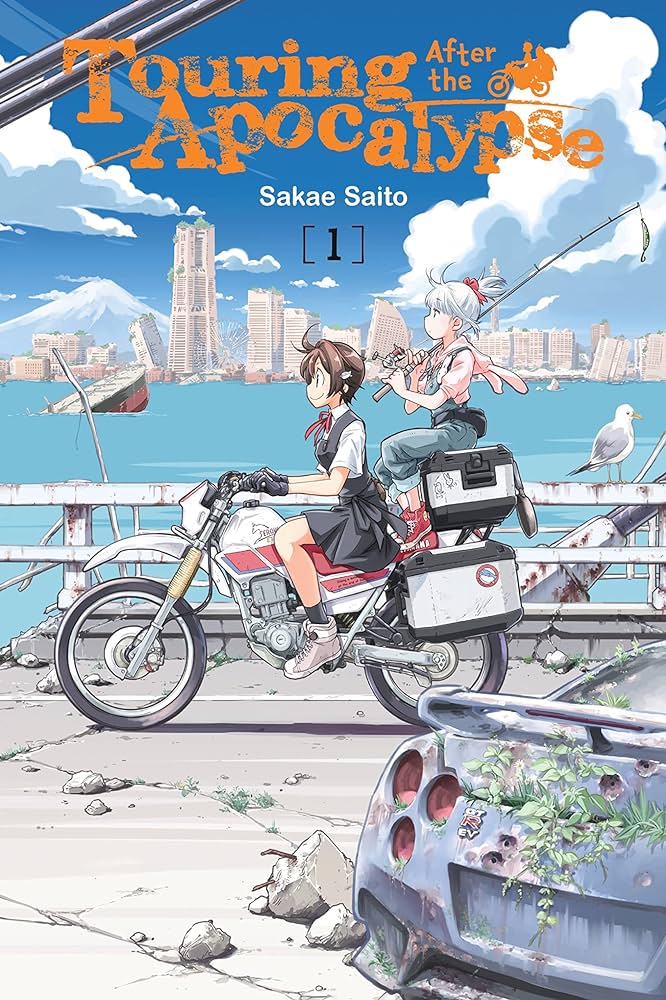
Touring After the Apocalypse, Volumes 1 – 3
by Sakae Saito
translated by Amanda Haley
2022-2023

I randomly checked these manga out from the new release section of my local library and they’re adorable. Youko and Airi are (or at least appear to be) two teenage girls who are traveling via motorsbike around Japan, seeing the sights, following Youko’s older sister’s previous touring schedule, but while the pictures and social media posts that the sister posted look (more or less) like regular posts we might see today, Youko and Airi are seeing the sights after they’re long abandoned and worn down and completely absent any other people. But they’re so excited to see everything!

In each volume, there’s some discovery that to me-the-reader acknowledges the whole tragedy of the empty and crumbling infrastructure of society and what it means that there are so many people not there. To the two girls, it’s fun and interesting and then they move on to the next thing. It keeps the whole mood light-hearted, while also highlighting how much society changes in a single generation as kids who didn’t live the history are accustomed to their lives as being the norm.

There’s a slowly building reveal that something else is going on with these two, but while there are various hints and teases so far, I haven’t figured it out yet.

I’m also really impressed with the translation job since there’s a lot of pop culture references and word games that flow perfectly naturally while I’m reading the English and I can only imagine were incredibly difficult to transpose from the original Japanese.

The Electric State
by Simon Stålenhag
2017

Oof, this is beautiful and moody and horrifying and dark, and it ends in such a way that there’s just enough hope for the future that I think “maybe…”, even though it’s very clear that there’s no real hope. But, just, maybe…?

My first thought when looking at this book was that it was an art book, full of beautiful full page and two-page spreads of various post-apocalyptic scenes. And it is! But it’s also a novella with a story, written in text and full paragraphs and absolutely no text boxes or the like, so it’s more of a picture book than a graphic novel in the way the text and the images interact.

The story is about the narrator Michelle and her companion Skip making a cross country trip in a thoroughly failed cyberpunk society. The setting is intra-apocalyptic rather than post, and oof, does it dip into all sorts of horror, with the implication that at least three types of apocalyptic disasters were all happening at once: war, environmental, and technological. It was reassuring that the events were set in the 1990s with a different history prior to that because this book would have been even more horrifying if it was set in the 2040s. There are a series of flashbacks that reveal the narrator’s backstory, but it’s only in the final third of the book that the reason for trip and Skip’s story are finally revealed, and it’s such a magnificent twist that just twists my heart and stomach.

The differences between these two titles is kind of amazing, just in tone and visualization, especially given how similar the premise and frameworks are. It very much highlights how two people can tell the same story in such different ways that they become two different stories. Reading these two so soon one after another reminds me very much of the Holy Shit! Two Cakes! meme.

Hench

Ages and ages ago, Rebecca reviewed a funny romance novel called Love for the Cold-Blooded, which peeked behind the scenes of life as a super-villain’s sidekick. That story felt so fresh because it subverted the ubiquitous hero/villain tension by making the heroes seem kind of dumb and the villains seem reasonable, if perhaps a little dramatic. It also featured a surprisingly sweet romance. If you’re interested in a book that flips the traditional script on superheroes but with a very different feeling, Hench by Natalie Zina Walschots avoids all the sweet predictability of a romance.

In Hench, Anna Tromedlov (even she knows this name is a little silly) is a data analyst scraping by doing temp jobs for small-time villains. She’s not overly ambitious or too concerned with the morality of her work, until she becomes collateral damage when a hero sweeps in to save the day. As she recovers from a serious injury that no one will admit was caused by a “good guy,” she becomes obsessed with the damage that heroes can do. She starts applying her intellect and skills to the problem, and she gets drawn right into the heart of the hero/villain conflict. What seemed like just an ethically-dubious desk job is suddenly a much more dangerous proposition.

I appreciated that Anna was never overly concerned with whether she was fighting on the right side or not–her alliances are clear from the beginning. Rather, she has to figure out just how much she’s willing to put into her job, what allegiance we owe to the people we follow and what we expect from them in exchange, and how all her villain-izing will impact the rest of her life.

There is a lot of overlap between this story and The Boys on Amazon, which is a good, interesting show addressing some of these same issues. I do like The Boys, but I also find it grosser than I can handle at times, and awfully overloaded with a bunch of loud white guys. I think the fact that Hench is a book (so I can skim over some of the grosser stuff) and is the internal story of a smart, take-no-shit woman (who also has no patience for overbearing dudes), made it more compelling and enjoyable for me.

Kinsey’s Three-ish Word Review: Darkly-funny villain adventure

You might also like: This is a tough one, because Hench has such a specific voice. But a few other books that put a twist on some traditional situations/tropes include Sign Here by Claudia Lux, Vampire Weekend by Mike Chen, and Everyone in My Family Has Killed Someone by Benjamin Stevenson.

Kickstarter comics

As the year at work started off with a cascading series of problems, I have been in a bit of a reading slump , not able to focus on reading and getting distracted even from stories that I’m actively enjoying. I’ve started a number of books and haven’t completed any of them, and it’s definitely me rather than any judgement on the books. Hopefully I’ll get back to those later and be able to enjoy them when I’m in the right mindset.

But one of the things I enjoy doing is browsing the comics section of Kickstarter. There’s always a wild array of possibilities there with stories that couldn’t or wouldn’t or just haven’t found a way into mainstream graphic novel publishing, at least not in the US. I semi-regularly support the stories that catch my eye and then just wait to see what shows up as a surprise gift to myself however many months later.

Last week while I was moping around not able to read anything much, one of the projects I supported was fulfilled and I received a package that contained two thin volumes that were each short enough that I could just sit down and read them in one go:

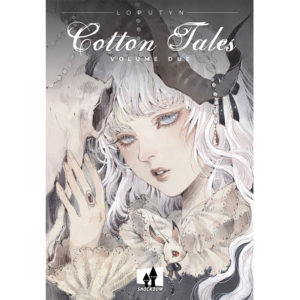
Cotton Tales, Volumes 1 & 2
by Jessica Cioffi, AKA Loputyn
2022

These beautiful books full of ethereal images tell a gothic story of a boy who has woken from an injury with no memories in a mansion that’s haunted by a ghost and there are a huge number of rabbits that only he can see. The world has magic in it, but it’s unclear what is real to that world and what isn’t. And everyone he meets has ulterior motives and hidden histories.

It’s a fairy tale story with a simplicity that let me read and enjoy it within a day and break my streak of unfinished books. I’m also looking forward to seeing if there is an eventual volume 3, although volume 2 does end with a satisfying conclusion even as it sets up for the next stage of events. Volume 1 ended with much more uncertainty so I’m glad I got these both at once.

Having enjoyed these books so much, reminded me of another Kickstarter comic that I’d received some time back and then never got around to completely reading:

Elements of Fire
edited by Taneka Stotts
2016

This more hefty book is a limited-palette graphic novel (black, white, and red) anthology of 23 stories with lengths ranging between two to sixteen pages each. The first couple of stories reminded me of why I hadn’t completed this before: they weren’t bad, just not to my taste: one high fantasy and one overly twee. But this time I persevered and I am so grateful that I did because the third story blew my mind! It was so good and so beautiful both visually and conceptually. And then there were twenty more stories!

With any anthology there are going to be better and worse stories but this is really an amazing collection. I loved more stories than I didn’t and now I’m a bit embarrassed for having set it down for so long. The artists made some amazing and fascinating choices with how to use the restricted palette to best effect, and created vast and complex worlds in just a few pages each.

Each story is unique — Stotts did an amazing job of curating a wild diversity with this collection that went above and beyond the stated intent of diversity in having all creators of color. It really shows a diversity of cultures and styles and approaches to the art of graphic novels.

While they all very good, my favorites — the ones where the stories and the art combined to touch my heart — were:

  • Cactus Flower by Sara Duvall
  • Pulse by Der-Shing Helmer
  • Hearth by Jaid Mandas and Marisa Han
  • Preta by Chloe Chan and Nina Matsumoto
  • Meta Helmet by Deshan Tennekoon and Isuri Merenchi Hewage
  • Caldera by Jemma Salume and Taneka Stotts
  • Firestom by Melanie Ujimori and Chan Chau
  • Home is Where the Hearth Is by Veronica Agarwal

I highly recommend this anthology to any and everyone to see which stories and images touch them. Because all of the stories are skillfully written and drawn: after that it’s a matter of personal preference.

This anthology also really presses home why I browse Kickstarter so much more often than I step into any comic bookstore anymore. A good comic book store will have an “Other” section in addition to their Marvel and DC, but they necessarily cater to the masses in a way that Kickstarter doesn’t have to. Plus each comic is a unique creation of love by an artist rather than a business decision by a corporation, so even when they wind up not to my taste (which happens sometimes), I never regret supporting them.

It was also wonderful to sit down with some books and actually read them, cover to cover, and have a sense of completion that I’ve been missing in the last couple of months.

Hugo-Nominated Novellas

I’m usually not a fan of novellas (they often feel to me like bare outlines of better, longer books), but after reading Nghi Vo’s two last year, I was ready to reconsider. The Empress of Salt and Fortune won the 2021 Hugo novella category, and since I loved that one so much, I decided to check out some of the others. These authors have definitely proved me wrong – with each one, I paused multiple times to just take in fully how good it was! And honestly, right now, being less than 200 pages is perfect for my attention span.

Ring Shout by P. Djèlí Clark

I had first read Clark with his short story, A Dead Djinn in Cairo, which I highly recommend – he has a companion novella, which I enjoyed quite a bit, and a sequel novel, which I hope to read soon, set in the same magical, steampunk world. They are fun, adventurous murder mysteries with fantastical elements.

Ring Shout is a bit of a divergence, set in Georgia in 1922 during the rise of the KKK, but still maintains the exciting pace of an adventure story, as well as a wide variety of delightful characters. Clark masterfully balances the reverberating horrors of slavery with a celebration of Black life and resilience. Instead of a harrowing look at the evils perpetrated by white supremacy, he focuses on our resistance heroes who triumph against both earthly and other-worldly aggressions.

More subtly, he weaves in themes of how fear and anger can corrupt into hate, on all sides no matter how righteous or justified, and I definitely needed to do some self-reflection after reading.

Upright Women Wanted by Sarah Gailey

The tagline for this is “Are you a coward or are you a librarian?” and it is perfect! Set in a Gilead-like dystopian future, restrictive gender and hetero-normative identity has been enforced by an authoritarian government. Our protagonist runs away from her stifling home life to join the Librarians, who disperse government-approved literature throughout the country, among other things.

Another exciting adventure story, with Western overtones, since horses and wagons have once again become the norm, with the limited cars and fuel being reserved for military use. Along with the protagonist, we get to know better the other librarians, and their role in a larger-scale resistance movement. Like Ring Shout, it is exciting, suspenseful, and ultimately hopeful.

FINNA by Nino Cipri

FINNA is set in a fictional IKEA, and I’m not sure a better dystopian setting exists. Ava and Jules are co-workers and recent exes who must awkwardly work together to rescue a customer from a wormhole, which apparently not infrequently opens in random big Scandinavian furnishing stores. Another enthralling adventure as the duo have to cross through several multiverses, with a very funny but pointed satire of capitalist grind and work culture.

Each world is a fascinating look at how trade and commerce can play out in society, diverging farther from the US standard the further our protagonists go, but I have to say that the laugh-out-loud funniest parts for me were in the prime store and all the very accurately satirized agony of working retail.

This Is How You Lose the Time War by El-Mohtar and Gladstone

This Is How You Lose the Time War
by Amal El-Mohtar and Max Gladstone
2019

This is a fascinating book that has both time travel and a branching universe physics as the background to a war between monolith entities, and all of that as a background to the relationship that builds/grows between Red and Blue, the respective top agents of each side. They are each other’s main foe and foil and the book starts when they begin an unsanctioned correspondence.

The authors make the extremely good decision to not explain how the technology works, or the physics of the universe, since that would simply bog down and distract from the relationship that is the focus. And so the hints and peaks of that background are little teasers that define a rich background and could act as prompts for a hundred other stories. But this story is about two agents who are closer to each other as enemies than they are to their allies, comrades, or commanders.

How, and why, (and when!) that relationship develops has it’s own twists and turns. While this is not a long book (less than 200 pages), there were several points where I thought I knew how it was going to go and then it twisted away in such a manner that was both completely unexpected and yet entirely perfect and how had I not seen that coming?

A good portion of the book consists of the letters that Red and Blue send to each other, so there are also three distinct voices in the text: Red, Blue, and the third-person omniscient narration that alternates which character it’s following. While the letters sometimes get a bit florid for my taste, it’s also interestingly true to the characters who write them.

This is a beautiful and fascinating story and I definitely recommend it.

Iron Widow by Xiran Jay Zhao

Iron Widow
by Xiran Jay Zhao
October 7, 2021

O.O

Wowza.

This book.

The main character is kind of the embodiment of “Are you tired of being nice? don’t you just wanna go apeshit?” Yes. Yes, she does. And thus, so she does.

The book was described as a re-imagining of the life of the only ruling empress of China, Wu Zetian, in a futuristic sci-fi/fantasy China that merges Pacific Rim with The Handmaid’s Tale.* There are giant mecha robots piloted by male pilots and powered by female concubines… who don’t tend to survive the process. Wu Zetian is a pretty peasant girl filled with rage. Her older sister was already sold to the army as a concubine and she’s going next, but she’s planning a revenge assassination rather than dutiful self-sacrifice.

In a society telling her that girls and women are naturally gentle and soft, appeasing and submissive, Wu Zetian knows that’s wrong from her own personality. As the book progresses, she peals back more and more layers of her own assumptions, revealing how aspects of the world that seemed like natural laws are instead very much man-made. What seems like basic history, is instead thick layers of propaganda difficult to even find the edges of. With lies and manipulations twisting any understanding of the world, moral decisions are nearly impossible. And the prize after every victory is a more difficult battle.

The whole book is a series of dramatic battles — mental, emotional, physical, you name it — that build to greater and greater heights, and the end is less a conclusion as it is a launching point. It’s extremely satisfying, so I wouldn’t call it a cliff hanger, but there’s no resting on one’s laurels in this universe. I really hope there’s a sequel and I also have no idea how the author will manage to write a sequel to this.

This is Xiran Jay Zhao’s first book, but I was first introduced to their twitter account and the very good, very funny analysis of various movies set in China and what they get horribly wrong, or occasionally right, examples: Mulan (2020) and Mulan (1998).

I highly recommend this book, but also just wow: this character is amazing and she pulls absolutely no punches. And also her whole relationship situation is fabulous, summed up by her statement, “Love doesn’t solve problems; solving problems solves problems.” And she is out here to solve some @#$@%ing problems!

* Without having read The Handmaid’s Tale, I’m still going to assume it (much like Jane Eyre) would be vastly improved by the main character being more murderous. And Wu Zetian is here for that murderous response to subjugation.

The Kingdoms by Natasha Pulley

This is a tricky review to write because this book was fascinating and well-written, but I didn’t care for it and I don’t think it quite managed to pull off what it had intended to.

I have a great deal of respect for Natasha Pulley as an author, and really enjoyed her previous three books. She always has really interesting concepts and does amazing things with timey-wimey stuff, and this book is no exception. The Kingdoms is unrelated to the previous series, with its own world and characters, mostly around an alternate history of the Napoleonic War (1805 – 1807), but also in “Londres” some 93 years later (1898 – 1900).

Not to include too many spoilers, but as you might guess, this delves into time manipulation and changing timelines and people changing because of changing timelines even more than any of the previous books had. Unfortunately, I think this is the first time she didn’t quite manage to pull it off.

The chapters skip around in time a lot, and I often had to just go with the flow rather than completely understand how the parts interconnected, and there are some parts that I don’t think make sense based on the internal world-building. I considered reading the book a second time to more fully track the course of events, but that brought me to my second problem: I found all of the characters vaguely unpleasant in a wide variety of ways. For good and valid reasons: they’re all horribly traumatized in a variety of ways too, but that just makes reading about them even less pleasant. A mixed blessing was how low-key they all were about the horrifying circumstances and the even more horrifying adaptive behaviors.

The only part that I really enjoyed was the last 50 pages or so in which everything came together and a variety of explanations clicked into place and there’s a couple of impressive feats. There’s even a mostly happy ending (as long as you don’t think about it too much.)

So, to sum up: I didn’t enjoy it but I hope that there are other readers who did. And I’m impressed with the writing that tried to do something really difficult. I’ll still keep an eye out for anything else that Pulley writes.