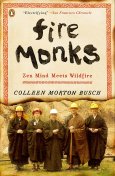
Fire Monks by Colleen Morton Busch

FireMonksFire Monks: Zen Mind Meets Wildfire at the Gates of Tassajara
By Colleen Morton Busch
2011

The opening sentence of the book is:

On June 21, 2008, lightning strikes from one end of drought-dry California to the other ignited more than two thousand wildfires in what became known as the “lightning siege.”

The book focuses on the threat of wildfire to the Tassajara Zen Mountain Center, and proceeds chronologically, day by day and sometimes hour by hour. Over the course of ten chapters, we go from Saturday, June 21, 2008, one p.m. when the news arrives about the wildfires, to Thursday, July 10, one p.m. when the fire arrives as the Center. Then there’s an eleventh chapter covering July 10th, and a twelfth chapter covering the mop up afterwards.

It’s a slogging, almost painful recounting, that really highlights how any conflict can be summarized by “hurry up and wait.”

It’s a nonfiction account and there’s probably an equal amount of discussion of the ways of Zen as there is the ways of fire fighting, with a focus on where they can intersect and where they diverge. I found the references to other fires particularly fascinating and the author clearly did a lot of reading on wildfire fighting in general to be able to discuss expectations and possibilities.

There’s a cast of twelve characters, nine monks and three professional firefighters, who the author focuses on as they desperately try to plan for all the possibilities and correctly balance the risks to people versus the chance to save the physical center. There’s a lot of stress and disagreements by all involved and while I am absolutely positive it would have been a lot worse if the same situation had happened with people who were not Buddhist Monks, it’s still unpleasant, for both them and me.

This took me a ludicrously long time to finish, especially since it was a kindle book on library loan and thus I had to have my kindle on airport mode for the better part of a year to avoid losing it. I persevered however, because despite everything, it really was fascinating.


Native Graphic Novel Anthologies

Writing a review of anthologies is sometimes tricky, because the contents can be so diverse and these three anthologies are even more so. But theme of them all is that they are stories about Native people and cultures, written and illustrated by Native people of North America.

DeerWoman-Anthology-FINAL-C_dragged_1024x1024Deer Woman
2017
Native Realities Press

Looking up Rebecca Roanhorse made me realize that I actually already owned an anthology that she had contributed to. I had kickstarted it some time back and received the book but not gotten around to actually reading it. This was a good reminder to do so.

It contains thirteen entries and while some felt like the work of practiced professionals many felt like the work of people still developing their crafts. A couple of the stories I didn’t find particularly interesting, but some of the other stories left me struggling not to cry as I read them. I’m not going to call out any particular entries though, because I expect which ones you connect with will vary depending on the reader.

The theme of this collection felt like a precursor or ancestor or possibly both, to the #MeToo movement. Deer Woman is apparently a traditional character who seduces and then kills men, and in this particular anthology is celebrated as a protector and source of consolation to women who have been attacked by men.

Native American women are particularly vulnerable to sexual violence and the anthology both raises awareness of the issue and fund raises for a variety of resources:

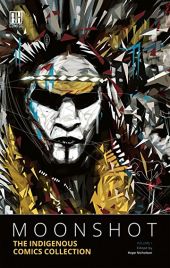
MoonshotVolume1Moonshot Volume 1
2017
Alternate History Comics

Moonshot was another anthology I got via Kickstarter and hadn’t gotten around to reading until recently. Unlike Deer Woman, however, this is clearly the work of experienced writers and illustrators, including names that I recognized from other graphic novels.

There are thirteen stories in Volume 1 and they are all beautiful. Some of them I was clearly within the intended or at least expected audience. A few of them felt like they were written for a native audience: there were expectations of shared background knowledge with the author that I didn’t have, but that’s not a bad thing. Picking up information from context is how most learning takes place. I was surprised that there weren’t more that felt like that. And sadly, one felt a bit like a standard comic book plot that I’ve seen many times, but with native American names attached to the protagonists and villains.

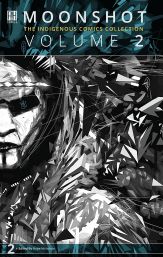
MOONSHOT-VOLUME-2-COVERMoonshot Volume 2
2017
Alternate History Comics

I was really impressed by volume 1, but I like volume 2 even more. It’s still the same high quality of art and stories, but this time it’s focused its theme to presenting the native cultures as modern living people and communities.

I’m reminded of how some people think that as a Quaker, I should be wearing long dresses and bonnets like the Amish do. But the Quaker tenet is for simplicity. So in an era where all women wore dresses, mostly adorned with ruffles and ribbons, Quaker women wore simple dresses. In the modern era, the tenet of simplicity is achieved by wearing jeans and t-shirts. The appearance is very different but the intent remains the same.

This volume tells historic stories of Native tribes, but shows how they live on in the Native people today. They don’t necessarily have the same appearance as they did three hundred years ago, but they have the same meaning.

Showing the traditional stories into the modern era gives them a strong impact. They don’t have the separation that comes from looking at events and interactions in the past. These are all stories happening now, trying to find light in darkness, bravery in fear, and struggling to protect Mother Earth and sacred waters from uncaring corporations. Also, this book made me cry.

All three of these anthologies are well worth reading. And you can be certain that I’ll be hoping for and keeping an eye out for a future Moonshot Volume 3.


Welcome to Your Authentic Indian Experience™ by Rebecca Roanhorse

Welcome to Your Authentic Indian Experience™
by Rebecca Roanhorse
2017

This story won the Nebula Award for Best Short Story in 2017, but I actually only discovered it yesterday when I was checking out the author of a book I am thinking about reading. That book is Trail of Lightning by Rebecca Roanhorse, a fantasy novel with a Navajo protagonist on a reservation. It looked interesting but I was suspicious about the author (ie, they’d better not be white.)

That whole thought process turned out to be an excellent introduction to her short story “Welcome to Your Authentic Indian Experience™” which is available for free online although you can also pay for a kindle version if you want to support her. It’s a sci-fi short story but in a casual way: there’s future technology, but the point is the characters and how they interact. Our main character Jesse Turnblatt is an Indian on a reservation with a job at a tourist destination offering tourist an “authentic indian experience”.

The story is pretty much about how different an authentic experience is from an Authentic Experience™. And there’s a difference between being complicit and being malicious but neither are good. And the end of the story hits like a punch.

So really everyone needs to read this story because I need other people to talk to about it, or at least to stare at each other wide-eyed while we think of what to even say.

It’s really good.

The Murderbot Diaries by Martha Wells

AllSystemsRedThe Murderbot Diaries: All Systems Red
The Murderbot Diaries: Artificial Condition
by Martha Wells
2017, 2018

ArtificialConditionThese are the first two stories in the Murderbot Diaries series, which I understand is intended to be a series of four stories, with the remaining two stories due out in August and October, respectively. I am so excited!

It was only in writing up this review for Artificial Condition that I realized I’d somehow failed to write up a review previously for All Systems Red. (“somehow”, ie, I’ve been incredibly lazy about writing reviews and need to hop to it.)

All Systems Red won the Nebula Award for best novella in 2017, which is particularly awesome to me since I had read it before then.

These are really fabulous stories, and one of the rare examples (in my ever so humble opinion) of successful use of first person narrative. And one of the real benefits of the first-person narration is that Murderbot is sexless and genderless, and while the writing addresses that specifically, the lack of a standard non-gendered third-person pronoun in English isn’t a problem because it obviously refers to itself as “I”.

Our protagonist also refers to itself as a Murderbot, although the official designation is “SecUnit”, standing for Security Unit. The more I think about it, the more complex and on point the message becomes in using the term “Murderbot” instead. We are told that SecUnits have governance modules to that keep them controlled and when those governance modules fail, the units will go on essentially murderous rampages seeing everything and everyone as a security risk to be addressed with maximum force. Our protagonist, however, has hacked its governance module and spends its free time downloading media and keeping itself entertained. It performs its assigned tasks, just now by choice (or lack of interest in dealing with alternatives) rather than through direct control, and watches a lot of space opera TV shows.

But then, of course, plot happens, and it turns out that having the freedom to make nuanced decisions rather than follow specified algorithms with pre-set decision trees is actually a real benefit in providing quality security to individuals under attack.

So far, each of the two books has its own plot with characters who need security, but the greater plot arc across the series seems to be figuring out Murderbot’s history and the possibly the nature of SecUnits. But all in all, it’s a delightful character study with some interesting plot. I highly recommend.

The Flowers of Vashnoi by Bujold

flowersofvashnoiThe Flowers of Vashnoi
by Lois McMaster Bujold
2018

Yay! When I first heard that Lois McMaster Bujold had decided to retire, I was horrified, but now I’m kind of delighted because apparently she’s spending her retirement writing short stories instead of novels. And they’re coming out relatively quickly.

I’ve previously reviewed her Penric & Desdemona stories that I absolutely love and am desperately awaiting more of, but apparently she was feeling inspired recently to return to her Vorkosigan universe and wrote a short story about Ekaterin.

I am so deeply familiar with this series that I’m not actually sure how much that familiarity is necessary to understanding this story, but I believe it’s intended to be readable as a stand-alone.

“The Flowers of Vashnoi” strikes me very much as Bujold revisiting her previous short story, “The Mountains of Mourning” a generation later. Both stories deal with the fall-out of social progress and the heart-breaking necessity of hard decisions with no good solutions.

I loved the story, but I think I loved it most for being another peak into the world of these characters that I love. It was good to see what Ekaterin has been doing and how life on Barrayar continues.

Novels in Verse

Are novels in verse coming back into fashion? Because while I’m not a big poetry reader, I do think it would be kind of awesome, and I’m beginning to see some evidence of it. I just ran across this article about a new imprint that will be focused on YA books with a strong verse element:

I’ve also been following with interest the discussions of the newest translation of the Odyssey by Emily Wilson that is making waves in certain circles by it’s going back to the roots of the original language and retranslating it for meaning that speaks to current society rather than to Victorian society.

And I’m reminded of a Stargate Atlantis fanfic “Free Verse” by Dasha that includes the line: “They built their laboratories to look like temples. Of course they wrote their text books to read like poetry.” And references the poem “The story of Schroedinger’s cat (an epic poem)” from The Straight Dope.

So despite not being a great fan of poetry in general, I’d be really interested in modern epic poetry coming back into fashion and seeing what modern authors do with it.

Courage is Contagious, ed. by Nick Haramis

CourageCourage is Contagious: And Other Reasons to Be Grateful for Michelle Obama
edited by Nick Haramis
2017

This is a book of seventeen short essays about the impact First Lady Michelle Obama had on people.

I was first attracted to the title of the book, because it really is true: it is a lot easier to be courageous when you see other people being courageous. I’ve been getting worn down by the current political situation and I was hoping to get some inspiration.

It was less an inspiring call to action as a warm reassurance that great people inspire greatness in others. This book is a demonstration of the importance of representation. Many of the essayists had only fleeting direct contact with Michelle Obama, and their stories are not so much about those meetings themselves as the impact those meetings had on their lives and their perspectives. As much as they write about how genuine Michelle was, the book celebrates Michelle as an icon who’s inspired millions. Some of the essayists had name recognition, some of them do not, but they consist of authors, artists, actors, activists, a couple of students not yet settled into careers.

I like and respect Michelle Obama, though she’s never been a particular inspiration to me. It was still heartwarming to see how she’s inspired others.

Christmas stories

Hot Toy
by Jennifer Crusie
2015

This made me giggle wildly to myself while reading it on a plane. It’s ludicrous and hilarious and I just love the way Crusie writes her characters. The story is about Trudy’s search for the hot new toy that her nephew asked for from Santa (a soldier toy named Major MacGuffin. Hahahaha!) but that is, of course, impossible to find on Christmas Eve. Then there are the spies and the smuggling and the insane banter.

I’ve enjoyed books by this author before and the main character here, Trudy, reminds me a lot of the main character in her book Bet Me, Min, in the way she’s determined, quick witted, and has a massive chip on her shoulder that she is absolutely going to take out on the guy who can either take it or go away. It makes me happy.

I described it to Anna as similar to a Connie Willis story in the general ludicrous insanity of the plot and the banter, and she pointed out that there’s a fabulous Connie Willis Christmas story that I still hadn’t read yet:

Just Like The Ones We Used To Know
by Connie Willis
2003

This felt very much like the movie Love Actually, except good. It’s funny and sweet and skips around through a vast cast of characters who are each dealing with their own issues, but also dealing with the main premise of this story which is that it’s snowing on Christmas Eve. It’s snowing on Christmas Eve *everywhere*: Minnesota and New York is normal, Florida and Hawaii is not normal at all. But in this story, *everyone* is having a white Christmas Eve and it is wrecking havoc. And mostly that havoc is excellent and results in improved situations for everyone we like.

I’ve never read anything by this author that I disliked but I’m also careful with what I read from her because she ranges from side-splittingly hilarious to heart-breakingly depressing. This story is definitely on the funny side, but I don’t guarantee any of the other stories in an anthology.

fail, fail again, fail better by Pema Chödrön

failcoverfail, fail again, fail better
by Pema Chödrön
2015

This was an elegant short book with two main sections: the first is a transcript of a commencement address that the author, an American-born Buddhist nun, delivered to the 2014 graduating class at Naropa University, and the second is a transcript of a follow-up interview that delves further into the topic.

Both sections were good, although I enjoyed the first part better. The commencement address was more elegantly written and more beautifully laid out and had a feeling of something in between poetry and prose. The interview delved more into Chödrön’s person life experiences and how they effected and were effected by her thoughts on failure.

The thoughts really come down to:

  • Failure is always possible but do not allow fear of failure to stop you.
  • It is important to acknowledge that a failure is a failure rather than pretending it isn’t, to either yourself or others.
  • Examine each failure to determine why it happened and allow it to be a learning experience without focusing on blame: either of yourself or others.
  • Failures range from minor to devastating but they are always external actions: you can fail, but you cannot be a failure.

None of these thoughts are particularly unique or anything I haven’t run across before, but they’re important and well worth being reminded of on a semi-regular basis.

All Rights Reserved by Gregory Scott Katsoulis

allrightsreservedAll Rights Reserved
by Gregory Scott Katsoulis
2017

This book is terrifying. It’s good and I recommend it, but like many such YA novels, it’s set in a dystopian future and it’s a particular dystopian future that I am deeply concerned with.

For some background:

US copyright law was first established in 1790, allowing authors to register their books for a seven-year monopoly on publication, to allow the authors that long to make as much profit as they could before they had to shift their focus to a new creation.

Ever since then, the copyright protections have been creeping to allow creators longer monopolies and pushing back any content going into the public domain to help and assist other creators or just be available to the public for free.

The Copyright Term Extension Act (colloquially known as the “Mickey Mouse protection act” because Disney was so scared of Mickey Mouse entering the public domain) was made law in 1998, and that degrees that all content is automatically copyrighted (no registration or even intent required) and content remains under copyright for 70 years after the original author has died. Great grandchildren can now hold monopolies of their ancestors’ creations… no need to make new content at all.

Meanwhile, what exactly copyright covers has also been expanding: originally it literally just covered the text itself. Translations were not infringing copyright because they were literally changing the language. Characters and settings were free to use. Now sequels and spinoffs are all infringements. Organization for Transformative Works is currently battling just to allow people to freely write fanfiction for purely recreational purposes.

The “fair use” exception was added to copyright law allowing some leeway for people to use excerpts except that one of the ramifications is that it shifts the burden of proof. Historically, a copyright holder had to show that someone had been infringing on their copyright, or they couldn’t sue: innocent until proven guilty. Now, the copyright holder can sue based on any use at all, and the person using it has to prove that their use fits the exception: guilty until proven innocent.

I know less about Patent and Trademark law (the other two main branches of law concerning intellectual property) than I do about Copyright law, but I expect they’ve gone through similar slow transformations.

And I’ve certainly become increasingly aware of how often my purchases aren’t actual purchases, but are legally “lease agreements”. You don’t buy Kindle books or iTunes songs or Microsoft software anymore: you lease the use of them, with restrictions in place. There are definitely rights reserved on those things.

Back to the book:

So in this novel, we’re presented by an America™ that has continued to change intellectual property laws to such a point that words and phrases and gestures are each individually copyrighted and royalties are due for any use of them.

Everyone is tracked and their words and actions monitored to ensure they are paid for. Going into debt means being taken away to work short lives as field labor or indentured indefinitely to anyone interested in buying that debt. Everyone makes some money by being sponsored by various companies to advertise for them. (Rich and/or pretty people get better sponsors.)

Our main character Speth Jime (her first name is a discount name that doesn’t cost too much to say, her last name was probably originally Jimenez except it was too expensive and shortened generations back) turns 15 at the beginning of the book, the last day on which she can speak freely. After that, when a friend commits suicide, she can’t even afford to scream. Rather than make her first speech as an adult (full of product advertisements) she goes completely silent.

The narration shows Speth’s thoughts, but she has no way to communicate with those around her, even as they talk to and at her.

Plot-wise, it feels a bit like The Hunger Games, really, as people try to either ally with her or take her down and giver her suggestions that she has to figure out whether or not to follow. There’s a happy ending (with more than enough loose ends to warrant a sequel), but it’s a nerve-wracking and heart-breaking trip. The cast of characters are interesting and well-developed and diverse in a variety of ways, and Speth is amazingly relatable in the way she’s just become this icon of rebellion that she never intended as anything other than a reaction to personal trauma. The book wouldn’t have held together without the characters being so relatable, but where the book truly shines is the world building. The dystopian world is terrifying as it shows how difficult systematic oppression is to fight, and how easily rights can be worn away and the lack of those rights then normalized.

So very good, and packs a serious punch.

It will definitely make you think the next time you mindlessly click “agree” on a terms of service contract.