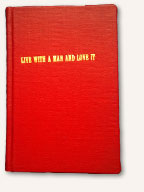
Live With A Man and Love It

By Anne Fisher

Book Cover: Live With a Man and Love ItLive With A Man and Love It, published in 1937, is a small red book that Thomas and I ran across several years ago at the Boulder library sale. We bought it for a dollar to have a laugh, and then promptly forgot about it.* I was additionally a little charmed by the author’s acknowledgement that one wouldn’t naturally and automatically love living with a man.

Book Inside Page: Live With a Man and Love ItWhen I finally cracked open my copy, I found several pages have some disconcerting rust-colored stains, hinting at the possibility that at least one reader decided not to learn to love living with a man, and chose a more violent solution.

Anyway, Live With A Man and Love It unfortunately falls in sort of a murky area between being hilariously out-of-touch and being an actually useful relationship guide. I was surprised how modern some of the advice seemed to be:

“During the first year have a monthly check-up in which you both agree to be perfectly honest and frank, and tell the other fellow about the things he does that are irritating. Promise not to get sore, but endeavor if possible to change the faults.”

Seriously, that’s not bad advice at all (though probably easier said than done). But before I could get too impressed she would bust out some shockingly dated language:

“Urge him to see other people once in a while. He won’t get that love-strangled feeling and he’ll come into the noose without knowing it’s tightening!”

My favorite part of the book is getting a peek into life and marriage in the 1930s, like spending evenings visiting friends and neighbors, playing bridge and handing out calling cards. That is so different from my own life that it blows my mind! It sounds like it could be kind of nice, actually.

The book also brings up a personal rant of mine, so I’m going to take the opportunity to share it here: Rule 11 in the book is “Never Go to Sleep With a Quarrel.” I think that rule is just the worst and was probably invented by a divorce lawyer. Just keep staying up later and later, while you both get increasingly tired and cranky, until you both dissolve into crying and screaming barely coherent insults? Seriously, just go to bed! You’ll be amazed at how much less you care about whatever you were fighting about once you get a good night’s sleep. So, there’s my relationship advice for you: always go to sleep (actually that’s sort of my general advice for most things in life).

*I had a little daydream that perhaps this overlooked little book would be a rare antique, but no luck.

—Anna
Whispers Under Ground

By Ben Aaronovitch

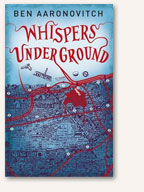
Book cover: Whispers Under GroundI have been eagerly awaiting this third book in the series for several months now, and I should have been using that time to reread the first two books. Whispers Under Ground does not stand alone very well, and unfortunately I’d forgotten a lot more of the previous books than I’d realized. No doubt due to my poor memory, the plot seemed a bit muddled, but the characters were just as charming as ever (seriously, PC Peter Grant is one of the most likable characters I’ve ever read).

Addressing the characters, however, leads me to a bit of a rant about the book publishing industry: why don’t the people writing the blurb on the back of the book actually read the book?! Here’s the last few sentences of the back cover description for Whispers Under Ground:

“…It’s up to Peter to plumb the haunted depths of the oldest, largest, and —as of now—deadliest subway system in the world. At least he won’t be alone. No, the FBI has sent over a crack agent to help. She’s young, ambitious, beautiful…and a born-again Christian apt to view any magic as the work of the devil. Oh yeah—that’s going to go well.”

I first read that and was actually kind of dreading this new character, which seemed like such a fantasy and mystery trope: the mismatched partners, with the protagonist having to scramble to cover all evidence of anything magical. I don’t think it is a spoiler to say that this character doesn’t exist in this book. There is an FBI agent; she is female, smart and ambitious; the book never mentions her religion or level of attractiveness. I liked her, and I was impressed by Aaronovitch writing her. I’m not impressed with the author of the back blurb trying to fit an unusually professional relationship into a trite drama.

Okay, rant over and back to normal programming: Aaronovitch, who previously wrote episodes for Dr. Who, is clearly, and endearingly, a huge fan of the entire fantasy genre. Affectionate references to the Lord of the Rings, Avatar: The Last Airbender (cartoon, not movie), Dungeons & Dragons, and The X-Files are sprinkled throughout the text. It became kind of a game for me to try to track down all allusions.

—Anna

Thirteenth Child and Across the Great Barrier

Patricia C. Wrede

Book Cover: Thirteenth ChildPreface and warning: I have been a HUGE Patricia C. Wrede fan ever since my best friend gave me Talking to Dragons for my birthday when I was twelve. At the time, I’d never read anything like it: adventure, fantasy, humor, and light romance all together in a book with a narrating hero that a preteen girl can empathize with and a heroine that she can admire. Wrede is particularly clever with creating characters and narratives that subvert traditional fantasy tropes: clumsy knights, ditsy princesses, wizards that melt with soapy water, and dragons that demand complicated etiquette, I believe to date that I have read all of Wrede’s books, even though they tend to be quite young, “young readers” rather than “young adult.” (Upon a quick consultation with amazon, there is actually one of her books I have not read – a ‘junior novelization’ of The Phantom Menace, and I think I can be excused for not only not reading it, but pretending it simply doesn’t exist.)

She also manages to blend the fantasy genre and period-piece genre better than almost any author I’ve read. I won’t totally divert this review, but Sorcery & Cecilia is just such a wonderful fantasy story set in the Regency period, and is just such a perfect blend of historical romance and fantasy that it seems so easily done, but it clearly isn’t*.

Book Cover: Across The Great BarrierAnyway, the Frontier Magic series is set in an alternative universe that is obviously similar to our pioneer days in the United States, but with a world that developed with magic. The main character and narrator is a young girl who is born the thirteenth child in her family, which is considered extremely unlucky, to the point where relatives insinuate she probably should have been “taken care of” at birth. Within the first book, Thirteenth Child, she grows from about 5 years old to 18, growing up, going to school, and learning magic, and then the second book continues for the next couple of years, where she takes on her first magical job as a young adult. The third book, The Far West, sounds like it starts off where the second book ends.

Both books are a bit more atmosphere-driven, and less crisis-driven, so it has a leisurely pace that can take a little adjustment as a reader of rip-roaring adventure stories. However, it is such a charming book in every way, from the magical elements to just the frontier elements—it reads a bit like a fantasy version of Little House on the Prairie. And, seriously, what could be better than that?

—Anna

*Aside rant: how is this so difficult? Seriously, one would think the two would go hand in hand—vampires and all sorts of other magical creatures are immortal, after all. The audience that reads fantasy books has a pretty big overlap with the audience that reads historical novels and romances, I believe. How is almost every period-piece fantasy book I’ve read just terrible?

Rest in Peace, David Rakoff

I have been seeing and reading a lot of eulogies for David Rakoff today, and wanted to add my two cents. I knew who he was, of course, but hadn’t realized how ubiquitous he was. Author, commentator, artist, dancer, comedian: truly a Renaissance man in the modern world. I only realized now how much he contributed to so many of the mediums I love. I’m sad that I didn’t know his works better, and am going to try to remedy that as soon as I can.

—Anna

Restaurant Reviews From a Privileged Nine-Year-Old

By Jesse Eisenberg

A couple of nights ago, I was just feeling kind of off, you know? Like, nothing was wrong, but nothing seemed quite right, either. Probably because my days are no longer spent mostly on the beach, napping, and snacking. I couldn’t find anything interesting to me, and I was sort of half-heartedly browsing my regular blogs and one of them linked to a series of fictional essays that actor Jesse Eisenberg (The Social Network or Zombieland, depending on how high or low your brow is; I think you can probably guess which movie I know him from [go see Zombieland—it is awesome!]) has been writing for McSweeney’s.*

Anyway, Eisenberg is enviably as good an author as he is an actor, and the stories, called Restaurant Reviews From a Privileged Nine-Year-Old, both made me laugh and kind of broke my heart, and were just the perfect reading for an hour before bedtime.

*I don’t know what it is about McSweeney’s, but I find it really daunting, so I never just go on and browse. Maybe because it is so beautifully designed or so chock full of very clever writing? Whatever it is, it is clearly too nice a site for me. However, whenever anyone sends me a link to an essay on McSweeney’s, I can pretty much guarantee that I’ll love it.

—Anna

Is Everyone Hanging Out Without Me? (And Other Concerns)

By Mindy Kaling

Having finished The Checklist Manifesto on my beach vacation (taking a lot of grief from my friends for bringing such antithetic beach reading), I picked up Mindy Kaling’s memoire, Is Everyone Hanging Out Without Me?, at my friends’ house while waiting for my airplane back home, and it really would have been a much more suitable book for the beach. I really enjoy Mindy Kaling as Kelly Kapoor in “The Office,” and I’m a little embarrassed that while I realize logically that as a successful writer, director and producer, she must be much smarter and more insightful than Kelly, she does such a good job of inhabiting that character that I keep sort of forgetting that she’s not Kelly. At least I’m not alone at this, because Kaling includes a whole list of ways she is similar and ways she is dissimilar to Kelly as a service to her readers. In all of our defense, she does actually have quite a few similarities, including the tone of the book.

My friends had warned me that it isn’t quite on the level of Tina Fey’s Bossypants, and it isn’t, but I think I enjoyed it just as much, quite frankly. Bossypants is a much more traditional memoire, while Is Everyone Hanging Out Without Me? is more of a collection of comedic bits strung in chronological order of her life. I perhaps would have liked a little bit more about her actual life stories, like her childhood in what sounds like a very well-to-do and predominantly white neighborhood in Massachusetts, the lasting friendships she made in college, and her breakthrough in New York and then LA. But, I wouldn’t have wanted to sacrifice the stand-up-comedy tone of the book, either. I do also love “listicles,” which are getting a bit of a backlash on the Internet nowadays, and there are several chapters that are structured as lists.

So, basically, this would have been a great book to read on the beach but was also a good book to read during the Olympics’ endless volleyball games, being then easy to put down for the gymnastics or diving.

Graphic design addendum: I think this book just has the prettiest cover ever. Like, lots of covers are elegant, striking, distinguished, mysterious, or garish, but I can’t think of another one that is just so straight-up pretty.

—Anna

Daytripper

By Gabriel Ba and Fabio Moon

Confession #1: Daytripper is the only comic that has ever made me cry.

Book cover: DaytripperAfter reading the review of it on NPR’s Monkey See blog, I had sort of vaguely put this on my list and then forgotten about it until I ran across it in the library a couple of months ago.

I promptly picked it up but read it over the span of a week or so, which is pretty unusual for me with  graphic novels. It reads like poetry, really, where a little goes a long way and after every ‘chapter’ of the book, I had to put it down and think about it for a little while. The plot, such as it is, is tough to describe; it is really more of a philosophical exploration of life, death, and the relationships that make up our lives.

It took me a while to write a post about it, because it is unlike any other graphic novel I’ve ever read. Glen Weldon at Monkey See described it way better than I could as “the way death, whenever and however it comes, retroactively imposes a shape on a person’s life.”

Confession #2: I read comics almost primarily for the illustrations; I mean it has to be well-written, too, but if the illustrations aren’t to my liking, I won’t read it no matter how well-written it is.

And Daytripper is absolutely gorgeous. The inking is expressive of the mood of each panel but the coloring is where it really stands out, with gorgeous, watercolor-like spreads. It is set in Brazil, and beautiful, expansive spreads showcase the city- and country-scapes of the region.

Seriously, check these out:

Illustration from Daytripper

Illustration from Daytripper

—Anna

The Old Gods Waken

By Manly Wade Wellman

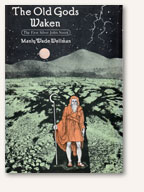
Book Cover: The Old Gods WakenSo, in my continued effort to not have to try anything new, I recently picked up The Old Gods Waken by Manly Wade Wellman, a favorite author of mine in high school. His main protagonist is ‘Silver John,’ a nomadic folk singer who travels throughout the Appalachian area, picking up old songs and stories and tackling the odd supernatural force along the way. (He’s called ‘Silver John’ because his guitar strings are silver.) The cover advertises The Old Gods Waken as Wellman’s first Silver John novel, but he had several books of short stories previously published.

As a teenager, I had been fascinated with the descriptions of the very rural characters and settings, it being unlike anything I’d ever experienced so far, growing up in suburbs of Boston and Austin. It felt so authentic, so…earthy! There was a purity to the simple country lifestyle and I loved it. Even the supernatural elements seemed more realistic somehow, since they were often the product of old folklore.

Today, it reads quite romantic, and I don’t mean that as a compliment. It feels a bit contrived, like the Romantic Period, with all those paintings of pretty, fresh-faced shepherdesses tending flocks of bright white, fluffy sheep. (The first time I saw sheep in real life—a field trip in college—I was appalled at how dirty and kind of mean looking they are.) Wellman’s characters are all perhaps a little too folksy, his settings a little too pastoral, and his dialogue a little too colloquial; the whole thing comes off a bit manipulative and twee.

In a discussion with Rebecca, however, I wondered if perhaps I wouldn’t have felt all of this so strongly in a pre-Palin world, where I hadn’t been inundated with “you betcha’s” for a year or so. Perhaps it is not just me, but that the whole world is getting too cynical for a true appreciation of simplified life in nature. Or perhaps I’m just crabby because it is so damn hot.

— Anna

Fair Game

By Patricia Briggs

Book Cover: Fair GameA couple of weeks ago, I wrote about the first two Alpha & Omega books, and mentioned that the third one was out in hardcover. Fortunately for me, my new local library had it, so I was able to read it without paying a hardcover price. My expectations were moderate since Briggs has a tendency to lose steam with her ongoing series, but I was satisfied with Fair Game. It wasn’t as well-crafted as Cry Wolf, the first book, but I thought it stood on par with the second book, Hunting Ground, but in a different direction.

Cry Wolf had a really good balance of fantasy and mystery, while Hunting Ground tipped more toward the fantasy, pushing the mystery into the background a little bit and focusing more on the dynamics of the werewolves and vampires. Fair Game goes in the opposite direction, being a pretty surprisingly straightforward murder mystery with the fantasy elements just adding a bit here and there. Now, I really like murder mysteries, so this was a-ok with me, and if given my preference would almost always chose for the mystery to come first and the fantasy second.

I wish I’d thought to mention this in my previous post, but Briggs does this so well that while I really appreciate it, I don’t always notice it, if that makes sense. Her Alpha & Omega books are all written from multiple points of views, changing the narrating voice by chapter, or occasionally within different sections of chapters. It reads a lot more naturally than you’d think it would, with different characters stepping in when they have information that the reader needs. In the previous two books, the narrators have all been werewolves; in Fair Game, for the first time, one of the narrators is a human investigator, which is a refreshing outside perspective and emphasizes the mystery aspect of the story.

Spoiler-y, but not really: the very end does something very, very interesting with the world Briggs is building in the these books, so I’m actually now super-excited for the next books in both this series and the Mercedes Thompson series, which both take place in the same world, since there are going to be some dramatic changes.

— Anna

The Dead Authors Podcast

By Paul F. Tompkins

So, I’m still atoning for my recent lack of posts, but haven’t read any new books to review, so here’s a link instead.

I first heard about this podcast in the comments section of a pop culture blog I follow regularly, and several people there recommended it. I’ve only just started getting into following podcasts, primarily because my job currently entails checking long documents page-by-page to make sure nothing screwy happened during the saving process.

The Dead Authors Podcast is a live performance at the Upright Citizens Brigade Theatre in Los Angeles, and the premise is that H. G. Wells uses his time traveling machine to bring famous, now deceased authors from a variety of times to be interviewed on his talk show.

The actor playing H. G. Wells, drops interesting true-life biographical details of the various authors into the interviews, which are quite interesting. The actors playing the guest authors have done variable jobs of research, so some seem more in character (H. P. Lovecraft) than others (P. G. Wodehouse), which for me makes the podcasts varyingly entertaining. However, in each episode the actors/comedians are having such a good time doing it that it is very infectious.

Of the nine episodes currently available, I’ve listened to four, and “Appendix B: Friederich Nietzsche and H. P. Lovecraft” was by far my favorite, just for the bat-shit-crazy verve that the actors bring to those two authors. It was also the first one I listened to, and each subsequent one seemed to get a little less funny for me (Emily Dickinson, P. G. Wodehouse, Dorothy Parker), which might mean that the podcast doesn’t exactly match my personal sense of humor or that I was getting increasingly grumpy about my current work document. Those two possibilities seem equally possible, quite frankly.

I am still looking forward to listening to the chats with Aesop and Charles Dickens later this week, though.

— Anna