Alpha & Omega Series

By Patricia Briggs

Sigh.

Sorry about the recent lack of posts. At the beginning of the month, I moved halfway across the country from Boulder, Colorado to the Washington, D.C. area. I was all prepared with three prewritten posts to get me through the chaos of the actual move itself. What I hadn’t predicted is that I would get so overwhelmed with everything being new and different that I would immediately retreat into simply rereading my trashy comfort books, which is what I’ve been doing for the past few weeks at a furious pace.

I’ve reread all five of Ilona Andrew’s Kate Daniels books, which Rebecca has already written about, and both of Patricia Briggs’ Alpha & Omega books, which I figured I’d introduce here, since it could be a little while since I read anything new.

Briggs is better known for her Mercy Thompson series, featuring a female mechanic who shape-changes into a coyote, but was raised by a pack of werewolves. It is your typical werewolf/vampire genre series, but just done far better than most. Whenever I run into Charlaine Harris fans, I always make a point of recommending Patricia Briggs, since Mercy Thompson is everything Sookie Stackhouse isn’t: smart, independent, funny, etc. The first two books are immensely entertaining (I might read them next), and the third one is equally good but delves into some unexpectedly difficult-to-read territory (I am not going to read that next). After that, Briggs seemed to lose interest a little bit, and the subsequent books do not have the same quality of writing and plotting.

However, Briggs then turned her attention to a new series, the Alpha & Omega series, currently with two books in paperback and one in hardcover, which I haven’t read yet because I’m very much against hardcover books. This new series is great! It features peripheral characters from the Mercy Thompson books who are a little darker and tortured, which I always appreciate, and is set smack in the middle of the werewolf pack, instead of on the fringe.
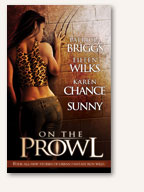
The series actually kicks off with a short story/novella in the book On the Prowl, which is often shelved in the romance section and has a cover that will embarrass you to be seen carrying around. On Rebecca’s advice, I haven’t read any of the other stories in the book, but the Alpha & Omega story is actually good enough to be worth the full cost of the book, in my opinion. (Although, on a side note, the story is available on its own for the Kindle through amazon.com, which is one of the best arguments for a kindle that I’ve heard so far.) The story does set the entire series up to the point that the reader would be missing serious background information if they started with the first full novel.
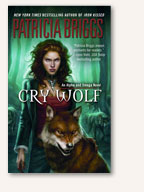
Book Cover: Cry WolfThe first full novel is Cry Wolf, and just really delves into the characters and their relationships with each other, all within the confines of a very well structured and paced narrative. The second novel, Hunting Ground, doesn’t have quite the same tight plot structure, but is still very entertaining. I’m somewhat afraid I’m seeing a bit of a pattern with Patricia Briggs, so I’m mentally preparing myself for the third book being a potential disappointment, but I’m still very much looking forward to reading it. Right at this moment, I’m more into comforting fluff books than quality, so I’m sure it will live up to that.

— Anna
Vanish in an Instant

By Margaret Miller

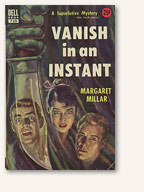
Book Cover: Vanish In An InstantI previously wrote about my love of pulp and noir mysteries, showcasing some of my favorites, and from the list, you can see that it is very much a man’s genre. Which makes sense, I guess; there weren’t as many published women at the time, and the kind of nihilism described in noir novels is kind of the antithesis of traditional femininity.

Margaret Miller is the exception, though, and she is brilliant. Vanish in an Instant, published in 1952, is my favorite, but I’ve read and enjoyed many of her other novels. The thing that makes Vanish in an Instant so exceptional that it is a love story in addition to a murder mystery, which should negate the noir style but only serves to emphasize it, as the two characters cling to their love as a fragile and temporary way to stave off the full bitterness of the world.

This quote captures Miller’s writing, and noir writing in general:

“Outside the wind was fresh, but he had a sensation of suffocating heaviness in his throat and chest, as if the slices of life he had seen in the course of the morning were too sharp and fibrous to be swallowed.”

Yay! I have no idea why this kind of writing gives me such satisfaction, but I do love these noir books and reading them actually brings me a sort of comfort in a way that I cannot analyze at all.

*I’d like to add that my copy is a reissue from the 70s and has much more subtle and attractive cover art.

— Anna

Pyongyang: A Journey in North Korea; Shenzhen: A Travelogue from China

By Guy Delisle

Kinsey, these may be the comic books for people who don’t really like comic books. They are really more travel journals that use the illustrated panels to give atmosphere in a way written descriptions can’t quite capture.

The author is an animator who gets sent to various sites to oversee the outsourced animation, so in addition to the interesting locales, he also throws in a few details about the animation business, which is equally interesting to me.

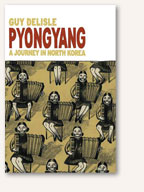
Book Cover: PyongyangPyongyang: A Journey in North Korea was published in 2005. A couple of pages in, I realize that this is Eloise for adults! He lives out of a hotel for the entire trip, and has a guide and translator who serve as nannies for him, escorting him anywhere he travels outside of the hotel. The atmosphere he describes in North Korea also sounds very similar to that in Eloise in Moscow, first published in 1959.

Shenzhen: A Travelogue from China, published in 2006, is a disconcerting contrast to Pyongyang, still very foreign, but in an almost diametrically opposite way. After being immersed in the very communist North Korea, every mention of Rolexes and Gold’s Gyms comes as a bit of a shock.

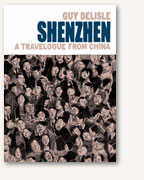
Book Cover: ShenzhenAt the beginning of Shenzhen, Delisle says that he has trouble starting the writing/drawing process, and I have to say that it shows. It is much more a collection of vignettes and is a little disconcertingly random, while Pyongyang has a much tighter story narrative. I think that Delisle found his stay in Pyongyang not more enjoyable, exactly, but more interesting, just due to the foreignness of it all. He finds Shenzhen a bit of a grind, and it shows. I would recommend reading both back to back like I did, since I think they are good companion pieces, but if you are only going to read one, go with Pyongyang.

(From my quick amazon.com research, he has also done graphic chronicles of Jerusalem and Burma, both of which I very much look forward to reading.)

Short Story Glut

I really like collections of short stories – I think they are a great way to get introduced to new authors and to see a lot of different authors’ perspectives on a shared topic. However, I’ve started to get irritated with these collections recently published that all feature a subset of the same best-selling authors the fantasy genre. It seems like such a blatant money-grab.

I love Patricia Briggs but do not care for Charlaine Harris, so instead of just publishing a book of Briggs’ stories, there is always one of hers in a collection that also includes Harris and other authors I have no interest in. And, I’m sure fans of the other authors feel that way about Briggs. So, this seems like a very calculated ploy on the part of the publisher to try to make us all buy books in which we are only interested in about a quarter or even less of the content (especially disappointing if that quarter turns out to be not all that great, either).

I fell for it and bought two such collections, but wizened up this time and went to the library, and am very glad I did. I originally intended to gather all of Patricia Brigg’s short stories that I hadn’t already read, but an Ilona Andrews story slipped in, too.

Book Cover: Naked City1) Naked City, with the tagline “Tales of Urban Fantasy,” has a nice theme of each story being set in a recognizable city that the author gives some attention to describing. Of the five stories I read (out of the 20 in the book), four of them featured plots that were very specifically tied to a feature of the city, which was very interesting. Oddly, though, the fifth, Melissa Marr’s “Guns for the Dead,” was actually my favorite, taking place in an Old West type environment that is kept somewhat generic purposefully for the plot reveal.

Patricia Briggs’ “Fairy Gifts,” was my second favorite, of course, with new characters for her and set in Butte, Montana, which is just so interesting to read about given the complete lack of romanticism around that city. Briggs clearly loves the area, though, and writing about immortal beings such as vampires and fairies allows her to delve into the history of the place.

Book Cover: Home Improvement2) Home Improvement: Undead Edition, with the tagline “All-new Tales of Haunted Home Repair and Surreal Estates,” also features Patricia Briggs and Melissa Marr, and theirs were the only stories I read out of the twelve. This theme didn’t work as well – perhaps it was too specific? Again, Marr’s story edged out Briggs’.

Marr’s “The Strength Inside” features a protagonist of a supernatural kind that I didn’t recognize from any of the normal Western mythologies. I’m not sure whether she was dipping into a more esoteric mythos or whether she invented it herself, but it was interesting either way. And, it is about battling Home Owners’ Associations, which is always entertaining, even if a little clichéd.

Brigg’s “Gray” features a vampire, though not one of her regular characters, buying and renovating an old condo. It has some very sympathetic characters, but isn’t anything original.

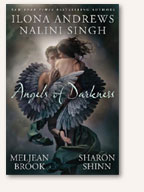
Book Cover: Angels of Darkness3) Angels of Darkness features Ilona Andrews, and was the most worrisome to me when checking it out. The cover looks more like paranormal romance than fantasy, and I knew that Andrews’ books walk that line more than my other favorite authors. And, I was absolutely right to be worried, though it was even worse than I feared.

You know how people criticize the story “The Beauty and the Beast” for basically being a romaticization of Stockholm Syndrome? Imagine Ilona Andrews tried to take that idea, make it super overt, but still try to keep it romantic. It is even more appalling than you are imagining right now.

At 124 pages, her “Alpha: Origins” story is more of a novella than a short story, and is set in a different universe than either her Kate Daniels series or her Edge series. It took me almost a week to finish it because I kept having to put it down because it made me feel kind of dirty, reading about this level of subjugation in a clearly romantic plot.

It reminded me of a call for submissions of fantasy romance books by a publisher that Rebecca told me about. They specified that the story had to feature an older or in some other way societally superior hero and the heroine had to be somehow in his power. It made me gag a little bit.

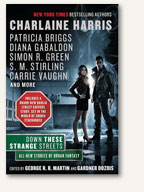
Book Cover: Down These Strange Streets4) Down These Strange Streets was my favorite collection, leaning toward the noir side of urban fantasy and mystery. There were some really terrific stories, and some not-so-terrific stories, but the great thing about a collection of short stories is that after a couple of uninspired pages, I can just move on to the next story.

It did bring home the point that a good noir mystery is harder to write than people think; the author has to somehow steep the entire story in a casual grimness. A surface gloss of darkness doesn’t cut it, and is quickly recognizable when reading a series of stories by different authors all in a row.

Once again, though, Briggs’ story took second place, this time to a really engrossing story by Laurie R. King, who I had previously known only as a mystery writer. Her fantasy mystery, “Hellbender,” was subtle, realistic, and unfolded with perfect plotting, and I would love to read a full book of the same characters and universe.

Briggs’ story, “In Red, with Pearls,” was my favorite of hers that I read in this glut, and featured one of her regular but peripheral werewolf characters, Warren, and his boyfriend Kyle. The short story structure didn’t give her as much time to explore characters and relationships as I would have liked, but was still a very entertaining mystery.

* * * * * * * * * *

Kinsey’s very acute analysis of her preference in memoirs made me revisit my short story collection preferences, and I think it is very similar. The more collections I read, the more I respect the editors. It seems like they need to tread a very fine line, where collections should have a common theme that tie all the stories together, but not such a narrow theme that the stories seem repetitive. “Urban fantasy” is too generic; “house renovations” is much too narrow.

—Anna

Finder Library: Volume 1

By Carla Speed McNeil

Finder is my favorite graphic novel. Period.

As much as I defend graphic novels and truly believe that they can be equal to any novel, most of them aren’t. Finder, however, blows most novels out of the water. When I first stumbled across one of the graphic novels, Sin-Eater, at a library years ago, I was entranced; her stories and characters stayed with me in all the years since then, and last week, I was overjoyed to see that Dark Horse has published an anthology of her Finder novels, including Sin-Eater.

It is hard to even describe the scope of Finder. McNeil builds an entire world with a blend of futuristic technology and mysticism, and populates it with dozens of different tribes of people, many of whom borrow attributes from various real-world cultures, such as ancient Egyptian, Chinese, and Native American. Our protagonist is from the tribe most like Native American, and he is a “finder” by trade, which is a bit of a cross between tracker and private detective. Through his adventures (and each book-length graphic novel follows just one) we explore the entire world, traveling to the different lands and meeting peoples of different tribes.

Every single panel of the 600+ page anthology adds details to the cultures and histories. Many of them include references to our real-world culture (though it is clearly not set in our world; or possibly our world many millenia in the future). Ones I caught included The Last Unicorn, Neil Gaiman, and Masquerade, and they were just enough for me to recognize that for each reference I caught, there were no doubt dozens that I missed.

For some of the ones I missed, McNeil has endnotes in the back (of both this anthology and the original graphic novels) in which she explains some of the references and elaborates on many of the characters and places. I had already been impressed with the expanse of the book, but the endnotes were where I really began to feel awe toward the author. She has back stories for characters that only feature in a single page and names for characters that only have a single panel!

The book is insidious, really—you pick it up thinking to read an adventure story about a lone-wolf character, but the density of it all gets in your brain and has you picking at it for days afterward, trying to unravel it all.

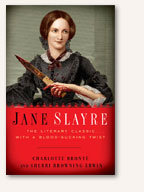
Jane Slayre

By Charlotte Brontë and Sherri Browning Erwin

Book Cover: Jane SlayreI read Pride and Prejudice and Zombies a few years ago and was not impressed. It felt like a very awkward mash-up, like just reading Pride and Prejudice, and then BOOM, ZOMBIES, and then back to Pride and Prejudice. It was very disjointed, with the inserted zombie scenes feeling unrelated and jarring in the rest of the text. Once I finished, I just wanted to read Pride and Prejudice without zombies.

Happily, Jane Slayre is significantly better. There are a number of possible reasons for this, and I can’t quite tell which ones actually apply and whether it is due to the author or myself as the reader:

  1. Sherri Browning Erwin understands Bronte’s voice better than Seth Grahame-Smith understands Jane Austen’s.
  2. Jane Eyre already has a gothic sentiment that lends itself better to the addition of vampires/werewolves/zombies than Jane Austen’s comedy of manners.
  3. I don’t actually remember Jane Eyre all that well, so it was harder for me to recognize when deviating scenes started.
  4. I also didn’t enjoy reading Jane Eyre as much as Pride and Prejudice, so wasn’t as disturbed by the added scenes, and didn’t have any inclination to reread the original.

I will say this, though: especially with the added vampires, Jane Eyre/Slayre comes across as the Twilight of 19th century with a fairly Mary-Sue-ish young woman (she isn’t traditionally beautiful, but everyone who sees her compares her to a fairy or some other elven creature) teaching an older and extremely rude but wealthy man how to love again.

However, the Slayre part (so clearly borrowed from Joss Whedon that it could possibly be grounds for a lawsuit if he were so inclined) gives Jane some added spunk and value as a character, and makes the admiration of all around her make more sense. Erwin weaves the vampires (and zombies and werewolves) throughout Jane’s entire story, so it does become an established part of her character.

I even thought several times that the additions Erwin made were interesting enough that they could have been the basis for a quite interesting original book, if she had only taken Jane Eyre as a inspiration and hadn’t had to stay so close to the original.

—Anna

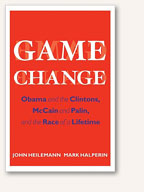
Game Change: Obama and the Clintons, McCain and Palin, and the Race of a Lifetime

By John Heilemann and Mark Halperin

I know I haven’t posted in a while, and it is because I’ve been hauling my way through a large and very unusual book for me—political nonfiction—so I’m writing a very long post to compensate.

I checked this book out from the library the day after seeing the HBO movie of the same name, which was just a narrow slice of the full scope of the book*. I enjoyed the movie; I knew all the public politics already, but it was fascinating seeing all the behind-the-scenes shuffling, like peering backstage at a show. I wanted to know more about it, so I checked out the book.

And very quickly realized that I did not want to know more about it. Politics isn’t a Broadway show, it’s a sausage factory**, and if I wanted to still enjoy sausage, I damn sure didn’t want to see how it is made. Now, I’m a democrat and the book reads somewhat democrat-leaning, though the authors are political correspondents and journalists who I am sure pride themselves on their unbiased stance. However, every single person comes across as single-mindedly, self-centeredly ambitious in a microcosm of politics that not only doesn’t seem to have much relevance to the rest of the nation, but seems to disdain the rest of the nation a bit. So, I guess that, at least, is something bipartisan.

I will give Game Change this: it is so minutely, exhaustively researched that it sort of boggles the mind. It is written in a narrative structure, following the various candidates like protagonists in a story. When tracking Obama in 2006, well before he was in the national consciousness, they extrapolate his frame of mind from a note he passed to another senator in a committee meeting and a hand gesture (not the one you are thinking of right now) he made in the hallway of the Capitol. I imagine the two authors scouring every building he ever set foot in and asking everybody and anybody there, “Did you ever see President Obama? What was he doing? Did he say anything—anything at all?!”

The best part is reading about the events that I actually remember from the race, but reading them in context with everything else that came between. The oddest part, though, is reading about pivotal, influential events about which I had no idea here in the midlands of America. (ex. Apparently, Maureen Dowd wrote an article in which she interviewed David Geffen about his disillusionment with the Clintons? It was a big moment where democrats felt free to criticize the Clintons and support Obama instead? I mean, I know who Maureen Dowd is, though I’ve never read anything by her. I initially thought David Geffen might be Liza Minnelli’s most recent husband, until it quickly became clear that wasn’t right.)

I guess I can kind of see where politicians get their contempt for all the rest of us, but I think that contempt comes from a very ignorant place—they have no idea how we think and how we make decisions. And because they don’t understand it, they disdain it. I imagine that it is stories like my own that drive politicians crazy: I saw the campaign ads, read articles, and still couldn’t make up my mind between Clinton and Obama. Then, I read a post on a small blog that I regularly check out where the author commented that if Clinton gets elected, two families would have been running the White House for 24 years and that is some disconcerting dynasty-building right there. And that’s what did it for me—that one post made my decision.

Later, it occurred to me that this phenomena kind of highlights how insular the political world is, at least for the active players. For myself, only the largest of political events break into my brain space that is otherwise occupied with my daily office work, what I’m making for dinner, how to balance this month’s budget, etc. For the people in this book, though, this is their entire life.

When the HBO movie came out, Palin understandable objected to it, and HBO tried to argue that it wasn’t necessarily an unflattering portrait, which of course it is. The book is not truly flattering either, but it is a lot more balanced in assigning blame equally on McCain’s people.

The vast majority of the book is spent on the democratic primaries, to the point where it gets a little bogged down, but then it rushes through the general race at breakneck speed, making me feel like I was missing things that they simply weren’t discussing.

This is perhaps the best compliment: Game Change already has me looking at the 2012 race in a different light.

A couple of random concluding thoughts:

  • The book does a great job of humanizing the politicians. It is a little embarrassing to admit, but it had not occurred to me that politicians could actually be sad or get their feelings hurt while on the campaign. I guess I just thought that so much of the discourse was overblown wind-bagging, that it all was. I was kind of shocked how many of them break down into tears at one point or another.
  • Hillary Clinton’s political career so far could almost be a Greek play (I’m not sure yet whether a tragedy or comedy): her husband is the one that initially gives her the political clout and name-recognition to run for president, but he was also her biggest obstacle in the campaign and probably the strongest reason she lost.
—Anna
__________________________________________

*A VERY narrow slice – the book breaks down as follows:

  • Pages 1-267: the race for the Democratic nomination, focusing on the Obama and Clinton campaigns, with some discussion of Edwards (which has been very informative in light of the current trial)
  • Pages 268-319: the race for the Republican nomination, focusing almost entirely on McCain with a few pages about Giuliani
  • Pages 320-436: the general election (the events of the HBO movie are all contained within pages 353-416)

**The 12-year-old in me says, “YEAH, it is!” (sorry)

Wait Wait…Don’t Tell Me!

Every Saturday morning, I go grocery shopping, and on the drive I listen to either Car Talk or Wait Wait…Don’t Tell Me!, depending on how early I’ve gotten up (yes, I know, my life is full of glamor and excitement). This morning, I turned on the radio part way through Wait Wait…Don’t Tell Me! where they were chatting with a guy they introduced as the most prominent children’s book author who is also a felon. I’d missed the part where they actually said his name, which may have made it even more engrossing.

He starts by telling his story and it’s like when you are at a party and everyone is chatting, but as one person keeps adding anecdotes that get stranger and stranger, everyone else gradually stops talking and are just hanging on this one guy’s words. I don’t want to give any of it away because it is really worth it to hear it in his own words here.

(Looking up the link, the author is Newbery Honor recipient Jack Gantos, who I’m not actually familiar with, and the interview is a recast from January, but if you haven’t heard it before, it is well-worth a listen and is only 11:22 minutes.)

—Anna

Baltimore; Or, The Steadfast Tin Soldier and the Vampire

by Christopher Golden and Mike Mignola

Book Cover: Baltimore; Or, The Steadfast Tin Soldier and the VampireI heard about this “illustrated novel” when I read Baltimore: The Plague Ships during my comic book glut a few weeks ago. I wasn’t quite sure what an illustrated novel was, but figured that since I liked illustrations and novels, it was probably for me. Also, while I enjoy comic books, I actually like novels better, so I figured that if I really liked Baltimore the comic book, I was going to love Baltimore the novel. You’ve probably already figured out from this lead-up that I did not.

There were a couple of issues, and I think the main one is that there is a reason that comic books/graphic novels and novels are two distinct mediums. They have significantly different narrative structures, and it is the rare author who can work in both (even more kudos to Neil Gaiman, then). In graphic novel Baltimore, the art and text worked together seamlessly and each provided content that the other lacked.

In illustrated novel Baltimore, the illustrations were small, simple black-and-white woodcut-style illustrations that kind of floated in the text on every few pages. I had imagined that they would be full color, full page reproductions of paintings, something even more impressive than the art in the graphic novel, something to distinguish it from the graphic novel and justify having a medium called an illustrated novel. (Thinking it over, Miss Peregrine’s Home for Peculiar Children better matches my idea of the definition.)

I can’t be entirely impartial on the written content because it was in a style that I find particularly difficult to read: characters telling stories. The majority of the novel consisted of three friends of Lord Baltimore sitting in a pub, telling stories about themselves and their relationship to Baltimore, while waiting for him to meet them. Sometimes, while telling stories about their past, their past self would then tell a story! It all got very convoluted, and that kind of flashback narrative lacks a sense of action and urgency to me.

It read like almost the opposite of a graphic novel, which has to be mostly action-oriented in order to support engaging illustrations. This came as a bit of a shock to me, but in retrospect, it kind of makes sense. For a dedicating author of comic books and graphic novels to try his hand at writing a full-length novel, the author must want to try something different, to write something that couldn’t be supported in a comic book structure.

Christopher Golden and Mike Mignola’s effort feels like what it probably is: an amateur attempt at an unaccustomed medium. They didn’t know a whole lot about writing novels, but they knew that novels were different than comic books, so they wrote something as different as possible.

—Anna

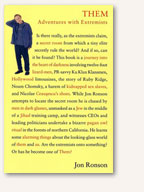
Them: Adventures with Extremists

By Jon Ronson

I am very much a believer of Occam’s Razor—that the simplest answer is usually the correct one—which makes me pretty much anti-conspiracies. I have to admit, though, that Jon Ronson’s Them gave me pause.

The front cover has this description:

Is there really, as the extremists claim, a secret room from which a tiny elite secretly rule the world? This book is a journey into the heart of darkness involving twelve-foot lizard-men, PR-savvy Ku Klux Klansmen, Hollywood limousines, the story of Ruby Ridge, Noam Chomsky, a harem of kidnapped sex slaves, and Nicolae Ceausescu’s shoes. While Jon Ronson attempts to locate the secret room he is chased by men in dark glasses, unmasked as a Jew in the middle of a Jihad training camp, and witnesses CEOs and leading politicians undertake a bizarre pagan owl ritual in the forests of northern California. He learns some alarming things about the looking-glass world of them and us. Are the extremists onto something? Or has he become one of Them?

Book Cover: ThemI had previously discovered Jon Ronson when he was on a hilarious episode of NPR’s This American Life, talking about his most recent book, The Psychopath Test. (If you haven’t heard the episode, you definitely should—they bring in a psychologist to administer the “psychopath test” to the NPR staff.)

I promptly picked up the book at the library and realized that I had experienced Jon Ronson before—he wrote the book Men Who Stare At Goats, which was made into a movie a few years ago with Ewan McGregor and George Clooney. Several things became clear all at once: Ronson has a writing style unlike anything I’ve read before. He describes himself as a humorous journalist, but he writes in a kind of nonfiction stream-of consciousness. I enjoyed the movie “Men Who Stare At Goats,” but the characters just seemed to sort of float along and kind of accidentally run into important people or pivotal events. It didn’t seem very realistic in the movie, but it now seems very much how Ronson operates, and once you get used to it, it is pretty awesome being along for the ride.

Ronson just seems like the most pleasant, unassuming, agreeable person, and he must be because he gets interviews I wouldn’t have believed possible. In “The Psychopath Test,” he meets with CEOs, even after telling them he wants to see if they are psychopaths! It is unbelievable—they are just sort of amused. I think he must have some superpower of not giving offence. Them starts off with him spending a year off and on with Britain’s self-proclaimed right-hand man of Bin Laden, even though Ronson himself is Jewish.

Ronson has a very active voice in his books, unlike most journalists, and that is very much part of the charm. The reader gets a much clearer sense of the full interactions, and I started to notice that Ronson asks lots of questions but only very rarely disagrees or confronts people. Even his questions are very inviting, sort of “I’m sure I’m being very stupid about this, but what about….” People seem usually pretty delighted to speak with him. (Although if I recall, The Psychopath Test begins with one of his subjects from Them being very unhappy with his treatment in the book and threatening him.)

In the book’s preface, he explains how he came up with the title Them. While in the middle of researching the book, he describes his research to a friend, and the friend replies, “You are sounding like one of THEM.” And I have to warn that after reading this book, not all the extremists will seem so extreme to you, either.

It reminded me of watching a tv program on the Society of Masons with Tom. They had lots of conspiracists describing various farfetched theories about the Masons, and Tom and I had a good time laughing at how ridiculous it all was. Then, the program interviewed a representative from the Masons, and he was so slick with complete non-answers (“why, we are just a normal fraternal order, how could you possibly think otherwise?”) that for the first time I had some momentary doubt.

—Anna