Lincoln’s Dreams

By Connie Willis

Book Cover: Lincoln's DreamsSo, with all the movies about Lincoln cropping up (I’m counting Lincoln and Abraham Lincoln, Vampire Hunter as ‘all the movies’), I was inspired to reread Connie Willis’ Lincoln’s Dreams, which I’d only read once many years ago.

It is a bit of a mess, I’m afraid.

It also turns out to be just the second novel she wrote, which explains a lot.

There are four central characters to the book, and while there are other peripheral characters coming in and out of scenes, the whole book focuses on the tension between these four: an author writing a novel about the Civil War, his research assistant, a young woman having persistent dreams about the Civil War, and her doctor, who is also the old college roommate of the research assistant.

(With the limited characters and settings, it occurred to me that this could actually be made into an interesting stage play, though the script would definitely need some tightening-up. This is the one nice thing I’m going to say about it.)

Actually, one more compliment: each chapter begins with a piece of trivia about the Civil War, and the research assistant describes more within the chapters. For those readers like me who want a lot of narrative with their nonfiction, this is the most palatable way to take in Civil War facts. (I also know from Connie Willis’ other books that she is extremely interested in history and does meticulous research for her novels, so I trust her historical accuracy.)

Okay, now on to the savaging. About a third into the book, I started noticing that the single female character didn’t have very many actual lines, and when she does speak she is often interrupted or instructed by a male character.* The woman is pretty much the central character, around which the three male characters orbit, so it took me longer than it should have to notice what an extremely passive character she was, really more of a target for the male characters’ expressions of emotion than a character in her own right. Even the final climax of the book, in which the cause of her dreams is discovered, supports the idea of her as a vessel to be filled with male ideas rather than a fully functioning person.

From reading Willis’ other books, I trust that she was actually doing this on purpose, and making a commentary on how, by trying to protect people we care about, we can end up marginalizing them, and thus doing more harm than good. It ends up being kind of a pat observation, though, and is not sufficiently explored enough for me. I have to admit that I might be being a bit unfair to Willis, though; I find that I am judging her early books in comparison to her later books, and then criticizing them for not being nearly as good.

The final thing is, though, that I would actually continue to recommend this book to people. Certainly not as an introduction to Connie Willis (for that, read To Say Nothing of the Dog), and not even as a good read, necessarily, but definitely a book that gives a different and interesting viewpoint of the Civil War and even wars in general, and for that I still consider it completely worth-while.

—Anna

*This is becoming a bit of a bee in my bonnet, actually. I’ve just recently started noticing that female television pundits get interrupted and talked over a lot more than male pundits. I know that shouldn’t surprise me, and it doesn’t, really; it just makes me really mad at how blatant it all is.
Steel’s Edge (excerpt)

By Ilona Andrews

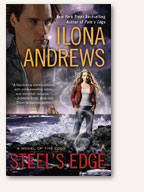
Book cover: Steel's EdgeSo, Rebecca has previously reviewed the third book in Ilona Andrew’s Edge Series, and in her review she wrote that she thought each book in the series was better than the preceding one, which I disagreed with. The third book was actually my least favorite and had pretty much convinced me to bow out of this series.

Then, I was bored one day and noticed that Andrews had posted a lengthy excerpt from the brand new fourth book, Steel’s Edge, on her website; I figured it couldn’t hurt to read it, just to congratulate myself on my decision not to read any more of them.

However, as you have probably noticed from this lead-in, it is really good! Each books features a male protagonist introduced in a previous book and a new female protagonist, and I was almost immediately interested in the new female character. Both characters are also in their early- to mid-30s, which is both refreshing and increasingly more relatable to me. I’m now very much looking forward to reading this one, though I’m at least sticking to my guns on not buying it, so I’ll await the library.

—Anna

Sunshine

By Robin McKinley

Book cover: SunshineYou know those Eat This, Not That books? This is a Read This, Not That book review. During the height of the Twilight craze, whenever I saw someone reading or talking about the Twilight books, I wanted to grab them and shout, “Go read Sunshine!”

It is definitively the best spunky-young-heroine-and-vampire novel I’ve yet read, and that is saying a lot considering both how saturated that market is and how many of them I’ve read. McKinley has a long history of writing strong female leads (The Blue Sword was one of my favorites growing up), but lately she’s been sort of dicking around with dragons and pegasus, when she must know perfectly well that her fans all want a sequel to Sunshine.

The heroine, nicknamed “Sunshine,” is just out of high school and working as a baker in her family’s cafe (there are lots of extraneous but delightful descriptions of pastries) in a post-magic-war world where various magical creatures are an acknowledged reality but avoided if possible. The world-building is solid and interesting, and the action begins fairly quickly when she gets randomly kidnapped by a gang of vampires.

Avoiding spoilers, but attempting to describe what makes this book so much better than the Twilight series, especially for teen female readers: Sunshine acts almost entirely on her own recognizance at all times, relying on her own intelligence and summoning up unexpected personal strengths when the situations call for it. The particular vampire she aligns with is both frightening and intelligent, and their alliance is born out of need and not romantic in any sense (at least not right off the bat).

Sunshine actually takes three-dimensional characters, puts them in fraught situations, and then fleshes out how that changes and matures them. It is seriously the anti-Twilight, and everyone should read it (although perhaps not young kids, because it does have sex and violence).

—Anna

Willful Impropriety

Edited by Ekaterina Sedia

Book Cover: Willful ImproprietyIn spite of considering myself an avid reader, I don’t actually buy books very often. I have a history of moving every 4-5 years, and after a couple of times moving countless heavy boxes of books, a large personal library just seems cumbersome. However, when I saw a copy of Willful Impropriety in the store, I bought it without a second thought. Young adult fiction, with some Fantasy elements, set in the Victorian Era? Yes, please!

Plus, I had originally heard of the book on the blog of one of the contributing authors, Genevieve Valentine, of whom I’m a big fan. (Also, she tends to contribute stories to more esoteric collections that are not picked up by my library.) Valentine is a bit of a conundrum for me, though. I love both her blog and her fictional writing, but they are shockingly different. Her blog is very funny with acute analysis of current popular culture, while her fiction has a lyrical and melancholy tone, and her story in this collection is no exception.

I was also pleasantly surprised that another of the authors, Caroline Stevermer, was the co-author, along with Partricia C. Wrede, of Sorcery & Cecilia, which I’ve already raved about here. Her story was probably my favorite of this collection, and has inspired me to track down some more of her books Another author, M. K. Hobson, whose story felt a bit like a P.G. Wodehouse story but with magic, also wrote The Native Star, which Kinsey recommended to me a while ago, and while is definitely going on my to-read list.

The introduction to the book describes that young adult literature set in the Victorian Age seemed like a complimentary match, since YA Lit is often about rebelling against the status quo to establish an individual identity, and the Victorian Age sure had a lot of status quo to rebel against. But after more than a dozen stories, I was a little saddened by how many of them ended with the heroine finding a solution in a relationship with a man.

Which, of course, is one of the few historically accurate ‘happy endings’ for women, but the stories didn’t stay so rigidly accurate in other features, so having them return to that trope was a bit of a bummer. The stories that did not include such a pat ending stood out all the more, though.

— Anna

The Handmaild’s Tale

By Margaret Atwood

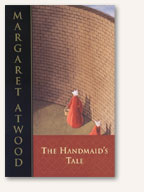
Book cover: The Handmaid's TaleWarning: this is going to be a blatantly and quite politically biased post. As everyone, left- and right-leaning, has been saying, Tuesday is going to be quite a deciding factor for our country, and will take us in one of two very different directions. (I’m feeling a bit guilty myself for having moved my vote away from a key swing state this year.)

Early on in the campaigns, I was so taken aback by the backlash against Sandra Fluke and the willingness of conservative women to outrageously slut-shame other women with no awareness of how such language could eventually come back to bite them as well. In discussing this very fact, I read the below comment on Videogum, one of the blogs I read daily:

Has everyone read “The Handmaid’s Tale”? It’s a. GREAT, and b. set in a future America where a very repressive regime that is pretty shitty to women has taken over. There is a passing moment where the narrator talks about how a woman she knows used to be a great big televangelist who would always talk about how a woman’s place should be at home is turned into a chattel slave like every other lady once the new regime takes over, and how she seems mad that someone “took her at her word”.

After reading this comment, I thought perhaps The Handmaiden’s Tale could give me more insight into this kind of mindset.

This book is terrifying, far scarier than any horror story I could have picked for Halloween. My only comfort was that it seems unrealistic that such a drastic change could happen all within one generation. In the novel, the narrator went to college, got married, and had a daughter, all before she was restricted to being a “handmaiden,” a fertile woman supplied to couples unable to have children in order to surrogate for them by government orders, in her mid-30s. Although maybe Atwood’s point is that if you aren’t paying attention or participating in politics, it could run right over you before you even notice.

In addition to terrifying, though, the book is enthralling; I couldn’t put it down. I’d worried that it would be painful to read, but the narrator takes such a matter-of-fact tone that even the most stressful scenes had a comfortably numb tone that both made them easier to read and reflected the mental state one would have to be in to survive. I’d thought about ‘live-blogging’ my progress through it, but I devoured it in a matter of days, and then spent the next couple of weeks trying to write a post that encapsulates all of my feelings about it, which turns out to be impossible. Instead I’ve compiled a little game for you – it will be fun!

Here is a list of quotes, some from The Handmaid’s Tale and some from a variety of political leaders and pundits; can you tell the difference?

  1. “If you look at the Scriptures, I believe it’s clear that God has designed men to exercise authority in the home, in the church, in society, and in government.“
  2. “Our country might have been better off if it was still just men voting. There is nothing worse than a bunch of mean, hateful women. They are diabolical in how than can skewer a person.”
  3. “Money was the only measure of worth, for everyone, they got no respect as mothers. No wonder they were giving up on the whole business. This way they’re protected, they can fulfill their biological destinies in peace. With full support and encouragement.”
  4. “Nature demands variety, for men. It stands to reason, it’s part of the procreational strategy. It’s Nature’s plan. Women know that instinctively.”
  5. “The problem with women voting is that women have no capacity to understand how money is earned. They have a lot of ideas on how to spend it. And when they take these polls, it’s always more money on education, more money on child care, more money on day care.”
  6. “What we’re aiming for is a spirit of camaraderie among women. We must all pull together.”

Answers after the break.

Continue reading

A City of Ghosts

By Betsy Phillips

Since it is very possible that all three authors of this blog will lose power due to Sandy for the next week, I’m posting my Halloween post a few days early.

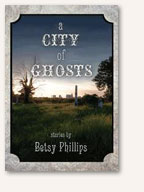
Book Cover: A City of GhostsKinsey and I were discussing the blog, sort of roughing out upcoming posts, and I mentioned how I like to read something spooky in honor of Halloween, but that I couldn’t actually remember ever reading a book that truly scared me, like so scared I don’t want to turn out the lights. (After more thought, the story of “The Monkey’s Paw” made me very unhappy at the time of reading it, though didn’t interfere with my sleep at all, and Steinbeck’s The Pearl has given me a lifetime phobia of scorpions, so those seem to be as close as I get to scared.)

Anyway, Kinsey lent me A City of Ghosts, which is a collection of ghost stories set in Nashville, self-published by the author in 2010. I was somewhat dubious about this book for a couple of reasons: 1) I am a huge snob about self-published books; and 2) I am a huge skeptic; not only do I not believe in ghosts, I can’t even imagine any evidence that would make me believe in them, up to and including seeing one for myself.

However, it was really, really good! Not spooky, but just super interesting. It was a comfort to me that the author notes in several places at the beginning of the book that this is a work of fiction, since then I could just enjoy the stories without picking apart the possible truth behind them. Although, Phillips writes in such an easy, first-person, conversational style that I had to reconfirm for myself several times that she did indeed state upfront it is fiction.

I read it more like a book of poetry, especially since the stories were very short, mostly ranging between one to three pages long. Phillips uses the small vignettes to flesh out (so to speak) aspects of Southern society, like the shadow of slavery and the ongoing racism and classism, that are hard to encapsulate in concrete terms on their own. I interpreted the ghost stories as metaphors for how events can become permanently embedded in our social consciousness and dictate how our lives are led even decades later.

The book is dividing into two sections, the first titled “April,” and the second titled “October.” The stories in “April” are a bit lighter in tone, reading a bit more like traditional ghost stories and addressing more individual cases; “October” has several stories that include flood waters, very clearly dealing with post-Katrina recovery. Even while typing this, I can see how ghost stories about the victims of Katrina sounds like it could be incredibly insensitive, but the stories instead describe the hurricane as a specter itself that hangs over the survivors with nightmares of the flood waters and grief over the victims.

I just found it very poignant, and in that way, much more lastingly enjoyable that I would more traditional ghost stories.

— Anna

Slaughterhouse-Five

By Kurt Vonnegut

Banned Books Week 2012Book cover: Slaughterhouse-FiveWhen I decided to read Slaughterhouse-Five for this year’s Banned Books Week (and the couple weeks following, as well, apparently), I was a little baffled that I hadn’t already read any of Vonnegut’s books because I like science fiction and I’ve had Vonnegut recommended to me multiple times. I even vaguely recalled meaning to read some books but never getting around to it.

Then, I got a couple of chapters in, and remembered that I hadn’t just meant to read his books before, I’ve actually started several of his books in the past, and put them down again. I just cannot get started into Vonnegut’s books, which is so frustrating because I really enjoy both sci-fi and social satire, and he is a king of both. So, I bring you this review in three Acts: Dismissiveness, Grudging Respect, Zealous Appreciation.

Act I: Dismissiveness

I spent roughly the first half of the book trying to put my finger on the problem. It isn’t as though I especially disliked it or thought it was a bad book; I just felt that I didn’t totally get what he was trying to say and that his writing style wasn’t one that speaks to me. When Tom asked if I was enjoying it, I had to admit that I wasn’t, and when he looked a bit disappointed, I followed up by saying that I thought it was a little too philosophical for me, like Vonnegut is communicating a theory about life, instead of sharing a concrete facet of life, and I get impatient with that. Tom nodded, because he has despaired of my disinterest in philosophy before, but I continued to mull over my answer.

And I think it was something even further, that his people weren’t interesting to me as characters. That they seem more like placeholders in his philosophical argument; their actions only serve to augment the message of the book. So, I didn’t have any vested interest in the future of the characters, which is especially true in this non-chronologically-linear novel where the future is all spelled out early on, and even the characters in the book don’t have much interest in it, either.

Acts II and III with spoilers and excerpt after the break…

Continue reading

Things I Learned at the National Book Festival

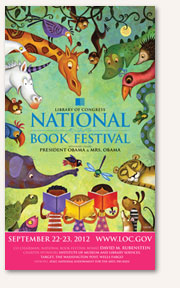
National Book Festival 2012This weekend, I went with Kinsey to the National Book Festival on the National Mall, and it was an awesome conglomerate of book lovers! We went to hear John Green, Patricia Cornwell, and Lois Lowry speak, and it was fascinating listening to them discuss their various approaches to writing and relationships with their books, because they really were widely different (and I’d like to encourage Kinsey to comment or post with her reasons for wanting to hear Patricia Cornwell speak, because they are very amusing).

Five things I learned at the National Book Festival:

  • If I listen to an author talk about a book for long enough, I will want to read that book.
  • Authors really appreciate libraries and librarians, which I had sort of wondered about since it conceivably cuts into revenues.
  • Having an author talk about a fictional character as a separate, independent entity makes me a little uneasy.
  • There are lots of ways to ask the infamous question, “where do you get your ideas?” (but the answer is always a variation of “beats me”).
  • All spouses of authors deserve our respect and sympathy.

I also was embarrassed to realize that the one-year birthday (September 17) of this blog had blown right past without me realizing it, so happy belated birthday, Biblio-therapy!

This was brought to my attention at the booth for Banned Book Week, which is also coming up (September 30-October 6, 2012), and which was our first collection of themed blog posts. For many years, I have been fielding many, many recommendations for Kurt Vonnegut, and have been slightly ashamed that I haven’t actually read any of his books, so I may pick up the frequently banned Slaughterhouse-Five in honor of Banned Book Week. It appears to have been most recently banned in 2010 because it “glorifies drinking, cursing, and premarital sex,” all of which I am very much in favor of, so it might be a good pick for me. However, I have a couple of other books on my list, as well, so I guess I’ll see how I feel next week and surprise you!

—Anna

Rosemary and Rue

By Seanan McGuire

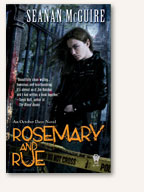
Cover Image: Rosemary and RueRosemary and Rue…isn’t terrible. It is one of those books that is perfectly serviceable, but also demonstrates how difficult writing really is. I joke about my fantasy ‘trash’ books, but the truth is that my favorite authors manage to create empathetic characters in a relatable world, even when that world is so crawling with vampires, werewolves and fairies that it bears very little resemblance to the real world. They make it seem so effortless and natural that I can laugh off the books as ‘trash,’ until a book like Rosemary and Rue reminds me how much skill really goes into writing fantasy by showing me the pitfalls that other authors have avoided.

In case I haven’t damned it enough with the faintest of praise, Seanan McGuire writes like I would, constantly having to remind the reader (and possibly herself) of the perimeters of the supernatural elements of her world, that amateur error of telling (over and over) instead of showing. Unfortunately, even the telling often contradicted itself, to the point where I seldom fully understood what was going on in the plot. Some examples after the spoiler cut:

Continue reading