Twitter links

I’m currently reading a couple of Kinsey’s recommendations, so in the meantime, I thought I’d pass along a couple literature-related twitter feeds for recommendation:

Guy In Your MFA (@GuyInYourMFA)

Profile summary: “Two re-writes away from finishing the Great American Novel. Maybe about a 20-something in Brooklyn?”

Laugh at this guy, so that you don’t kill the actual guy in your MFA (or writing group).* Also, at www.guyinyourmfa.com, if you aren’t into Twitter. He has a buzzfeed quiz on how many books by white men have you read, and for the first time, I was proud to have read as few as I had.

The Worst Muse (@WorstMuse)

Profile summary: “No, seriously, go for it. It’ll be a bestseller.”

A long and hilarious list of what not to do in your writing.

—Anna

*Or the guy just this morning holding up the line at Starbucks while he explained to the baristas that he is a Writer (emphasis his) and so really pays attention to people and conversations and cultural transitions, and used that as an excuse to inquire into all of their ethnic backgrounds in a really uncomfortable way.

Fresh Off The Boat

By Eddie Huang

Book Cover: Fresh Off The BoatEddie Huang is funny and smart and has a really interesting story and perspective on life, but he’s also kind of an asshole.

He wrote his memoirs a couple years ago, which inspired a new sitcom just this season. Reading a review of the sitcom, I figured the book would be an interesting account of a first generation American’s experience. And it is. What it doesn’t really seem to be is material for a sitcom. As I got further in the book, I was more and more confused about how on earth they were going to make this family-friendly. Like, Huang’s family is all sorts of crazy, with some serious abuse problems to boot, and Huang has more than a few thug tendencies.

A lot of the story has been left out of the sitcom, naturally, but some has just been cleaned up. In one episode, the grandma teaches Eddie’s little brothers to play poker and promptly fleeces them of all their toys. It is a cute scene (my favorite part is when they appeal to their mom to get their toys back, she solemnly tells them that their grandma won them fair and square), but the reality is that Huang’s grandma had a gambling addiction that impoverished her husband and son.

Huang talks a lot about how meaningful he finds hip hop and the hip hop culture. I hadn’t ever thought about it like this, but he says that growing up in a chaotic and abusive household (his parents went far past the point of just being traditionalist; the children’s school reported the family to child protective services), the rhetoric used in hip hop about hard living on the streets gave him a frame of reference for his abuse at home. So, I found that to be a very interesting perspective, if not one that I could always understand.

Sports, basketball in particular, are also an important part of his life, and he discusses that at length, as well. Again, interesting, but not much relevance to my own experience.

What I could really relate to, though, was when he starts talking about food. He describes wanting to make a traditional American Thanksgiving (amusingly, his mother turned her nose up at most American food, but became a fan of green bean casserole), and watching a bunch of Food Network for research before settling on a combination of brining and infused herb butter under the turkey skin, which almost exactly replicates one of my first Thanksgivings on my own.

It is also through cooking that he was able to create his own identity and find a place in society that he was comfortable with, after many, many years of acting out. Similar to other memoires I’ve read by people in their 30s, relating their road to eventual success, the vast majority of the book is spent on the early struggles, with the success sort of just coming together at the end. I guess I’d prefer a somewhat later memoir that gives a little more attention to maintaining the point of success once it has been achieved.

—Anna

How To Be Black

By Baratunde Thurston

Clearly I’m not so much the intended audience for this book, though author Baratunde Thurston was very kind of include a welcome to non-black readers in his introduction:

Book Cover: How To Be BlackIf you are not black, there is probably even more to be gained from the words that follow. They may help answer the questions that you’d rather not ask aloud or they may introduce a concept you never considered. You will get an insider perspective, not only on “how to be black” but also on “how to be American,” and, most important, how to be yourself. This book is yours as well.

He does provide a caveat though:

If you purchased the book with the intention of changing your race, I thank you for your money, but there will be no refunds. None.

This made me laugh and also feel better about reading about it, though not enough to read it in public. (In fact, Rebecca told me that it made a list of poorly-chosen books to read in public.) Then, I felt worse when I realized when I was reading it. Another excerpt:

Now, more to the heart of the matter, the odds are high that you acquired this book during the nationally sanctioned season for purchasing black cultural objects, also known as Black History Month. That’s part of the reason I chose February as the publication date. If you’re like most people, you buy one piece of black culture per year during this month, and I’m banking on this book jumping out at you from the bookshelf or screen. Even if you’re reading this book years after its original publication, it’s probably February-ish on your calendar.

And so I am. Sigh. I actually heard about the book through Samantha Irby on her blog bitches gotta eat, (which I’m slowly reading all entries backwards in order to catch up) in which she talks about getting to open for Thurston at his Chicago show.

Anyway, the book is a combination of his personal memoirs, thoughts on the black culture in the United States, and interviews with a group of other writers and artists. It is just really funny (as it should be—Thurston works for The Onion), and really informative.

This is making me very uncomfortable to write, but I think it is important. It is very easy to fall into the liberal trap of ‘black people aren’t scary, just culturally different’ while still keeping them very much grouped as one solid entity and separate from yourself. I was continually surprised at how many similarities there were between my childhood and Thurston’s.

First off, my mom and his mom would have gotten along like gangbusters, both outspoken and often radical feminist professionals in large urban areas (Boston and DC, respectively) with long-standing hippy tendencies. We were both the first ones in our peer group to know what tofu was and to have eaten, if not enjoyed, it regularly for dinner. Both of our parents struggled with the idea of sending us to underfunded public schools, before deciding to send us to the local private Quaker schools (of course, his turned out to be Sidwell, so he won this round).

The funny thing is that some real disconnect for me happened around college, when Thurston describes going to Harvard, and while he mentions certainly having to deal with entrenched racism, the experience was overwhelmingly positive and his main take-away was that anything was possible for him and his fellow Harvard grads. At which point, the grubby little communist in me rose up to bitch about how these rich college boys think they can just have whatever they want whenever they want, which was certainly not a response I thought I would have to this book.

Honestly, though, the biggest take-away for me, the thing that was the most important lesson and revealed some hidden racism on my part, was just how funny I found the book to be. Because a lot of humor is shared experiences and personality, and I guess I’d figured that Irby and I are both women, so I relate to her humor in that way, but I just hadn’t expected to relate to Thurston so much. I’m glad I did, of course, and more than a little ashamed that I assumed I wouldn’t.

—Anna

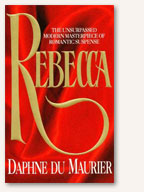
Rebecca

By Daphne du Maurier

Book Cover: RebeccaI’d tried reading Rebecca years ago, but it starts off with a lengthy dream sequence that is just a description of a decaying estate, and that is a lot to get through right off the bat. I was inspired to try again by the “Rebecca” chapter in Mallory Ortberg’s Texts from Jane Eyre. (I received two copies of this for Christmas, which was good, because it meant that my cousin’s wife didn’t have to steal my copy. This is also the second classic it has inspired me to read.)

The thing is, Rebecca makes me feel old. Perhaps if I’d read it when I was 22, the age of the unnamed second wife and narrator, I’d have been full of righteous indignation about what an awkward situation she’s in and how much more difficult everyone around her is making it. But, instead, I find myself sympathizing with the disdainful and bullying housekeeper, who loved and respected Rebecca, the first wife, and now has to deal with this shrinking child who can’t seem to do anything but apologize for her existence.

As soon as her much older husband starts showing exasperation, though, I’m all in her corner, and she gets somewhat less cringing as the book goes on and she even starts to show some personal agency. Also, du Maurier has a real skill at building a suspenseful atmosphere, so I was still invested in the scenes when not totally invested in the characters.

It took me a few chapters to realize something, but once I did, I was able to enjoy the book even more: I’d had a vague sense that this was a ghost story, either literal or metaphorical, but it is in fact a mystery, and unnamed second wife is not unlike Nancy Drew (in that she behaves like an exceptionally naïve teenager). Rebecca died under mysterious circumstances, and there are hints that she was not exactly as people thought she was. Reading the unfolding of that is actually quite satisfying, and I was even surprised by the series of big reveals at the end, which is always nice.

I wish I’d thought to live blog this one because just every scene is so full of craziness: the costume ball that goes predictably but still agonizingly wrong! The demonic housekeeper trying to hypnotize our narrator into suicide! The shipwreck unearthing secrets of the deep! (Another horrifying reveal that is too spoilery for me to discuss here, but that all the characters took in much better stride than I did!) It is not unlike The Shining, really, with an unbelievably passive woman feeling oppressed by a building and her emotionally distant husband, and would have been fun to go through chapter by chapter, but I was also able to read the book in under a week, which makes a bit of a rush job out of live blogging.

—Anna

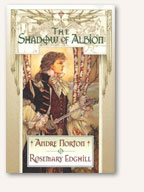
The Shadow of Albion

By Andre Norton and Rosemary Edghill

Book Cover: Shadow of AlbionWhen I first read this book, I recommended it to Kinsey as “the best time-traveling, regency romance, espionage fantasy book you’ll ever read” and I stand by that, even if it isn’t time-traveling so much as alternative realities, but that’s splitting hairs a bit, I think.

The only drawback is that the authors pack the plot so full of intrigue and plot threads that they weren’t able to tie them all up in this book, or even the sequel, and then most unfortunately, Andre Norton passed away in 2005, and I’m just a little resentful that Rosemary Edghill didn’t finish off the third one on her own. (The second one has a blurb at the end saying that they are working on the third! Also, the sequel was published in 2002, and Norton didn’t die until 2005, so what were they doing those three years?!)

Anyway, the premise is a little difficult to explain, especially with my very murky knowledge of history. The year is 1805, and our heroine, Sarah Cunningham, is introduced both dying in her ancestral mansion in England and orphaned in colonial Maryland. In order to fulfill mystical oaths to the land, the living Sarah is brought from her world (our world) to take the place of her dying double in a world in which magic exists. Magic!

So, in this other world, each artistocratic land owner is magically tied to their land, and each king is tied to his country through even greater magic, which means two things: one, overthrowing kings is much trickier to do, so the Stuart family still rules England; and two, Napoleon is playing even more havoc with Europe than he did in the mundane world. Politics!

Also, in this other world, Sarah turns out to be betrothed to the dashing and dangerous Duke of Wessex, who of course she has never met. Wessex is also an undercover agent for not one, but two government agencies, where he foils assassinations and facilitates treaties. Espionage!

Honestly, I don’t know why I’m trying to summarize the plot for you – dukes and duchesses, kings and queens, spies, assassins, fairies – honestly, that should be good enough, just read it!

I’m not even going tell you anything about the sequel, except that it has all of the above, but shifts the setting to the new world, where there are pirates, native mysticism, and the Marquis de Sade, communing with very real demons. Read it!

Gabriel: A Poem

By Edward Hirsch

Perhaps I should add a tag for “mourning” here? I feel like I readreadread as much escapist nonsense as I can take in, but then suddenly get jerked to a stop by some book that looks like it might address my reality in an important or useful way. I saw this headline from NPR on my facebook feed: “A Poet On Losing His Son: ‘Before You Heal, You Have To Mourn’”, and I thought, that sounds promising; I don’t feel like I’m healing much at all yet – maybe I just need to mourn some more.

I’m actually not that big on poetry, either; I have great respect but little understanding for it. The following excerpts caught ahold of me, though:

Some nights I could not tell
If he was the wrecking ball
Or the building it crashed into

*****

Like a spear hurtling through darkness
He was always in such a hurry
To find a target to stop him

Turns out this…was not an easy read. It has taken me two months to get through 78 pages of short lines of poems (and an additional month to post about it). I’ve been reading other books, too, of course, because I couldn’t bear to take this one on my commute with me. So, I read a few pages at home until I needed to stop and then I waited until the next day.

I truly don’t really get poetry. Even reading this, I don’t understand how Hirsch has managed to capture so much of what I’ve been going through more accurately in like 15 words than the various prose books have in pages and pages of text.

Hirsch dedicates the majority of the poem to describing Gabriel and their history together. And there were so many similarities: Gabriel was adopted like Thomas, was raised in an upper middle-class and highly academic family, and had serious teenage rebellion that included drug use and short stints of homelessness.

Toward the end of the poem, Hirsch describes his own mourning, and there were even more similarities: the desperate practicalities that have to be done even though you are barely holding yourself together, the agonizing over what you were doing the exact moment your loved one died, what you were doing just before that when you could maybe have done something to prevent it instead.

Yeah, this was a tough read, but a lot of the lines continue to echo in my head, and I know that I will read it again in a year or two, as well, when hopefully things are a little better.

—Anna

All Seated on the Ground

By Connie Willis

Years ago, author Connie Willis released a collection of delightful Christmas-themed scifi stories called Miracle. The two best stores are considered annual reading in my family: one is about a woman who gets “haunted” by a Christmas spirit that insists on granting her heart’s desire; the other is about an invasion of puppet-master type aliens during Christmastime. My extremely brief summaries here do not at all capture how funny these two stories are, which is what makes them so wonderful (not all the stories in the book are funny, and be warned, when Connie Willis goes serious, she goes very serious indeed.).

Then, in 2011, Willis released the novella “All Seated on Ground,” which I put off reading due to my dislike of novellas (they always seem both too short and too long), even though it sounded like it recaptures the tone from her earlier Christmas stories. Unfortunately, I felt that it recaptured her earlier writing a little too much, becoming a bit of a retread. Once again, aliens have come to earth, but in this scenario, they have landed and then proceeded to stand around, saying nothing but glaring disapprovingly, while an array of academics and politicians attempt to communicate with them. This has been going o for nine months until just before Christmas, when they react to something for the first time by promptly sitting down upon hearing the line “all seated on the ground” in a Christmas carol.

The novella then follows the rush to determine what they are reacting to and what their reaction is trying to communicate. I love the idea of having to deal with disapproving aliens on top of all the other holiday stresses, but the implementation was just so similar to some of Willis’ other stories that while it was still quite funny, it was just not as surprisingly funny as some of her earlier work.

—Anna

P.S. – In case you are looking for a quick holiday-themed distraction at work, may I recommend Cracked’s “6 Things People Get Wrong About the Bible’s Christmas Story”? This line made me snort on the metro: “It wasn’t until the Middle Ages that the magi began to be described as kings, largely to make the New Testament story better match the Old Testament messiah prophecies, and probably because ‘kings’ sounded better than ‘magical spice perverts’.”

Lean In: Women, Work, and the Will to Lead

By Sheryl Sandberg

Book Cover: Lean InSo, clearly, there has been a ton of buzz about this book, which tends to turn me off a bit, but when it came up at Rebecca’s work, we decided to bite the bullet and read it (I just beat her to it here on the blog). I entered with super low expectations—I had imagined some sort of 80’s powersuit, dog-eat-dog type of guide—but I have to admit that I very quickly changed my mind.

After reading the introduction, where Sandberg directly addresses how complicated and potentially problematic it can be to try to give blanket professional advice to women across all lifestyle choices and financial situations, I thought, okay, this might not be so bad. After the first couple chapters, I started to find points relevant to my own work behavior, and by a third of the way through, I was completely sold on Sandberg.

Now, I did have to tailor the advice to my own situation, of course. I am not a particularly aggressive or ambitious person, pretty much directly opposite to Sandberg herself, but one of the most important take-aways for me was guidance on how to work with aggressive and ambitious people (especially being vigilant about not letting cultural indoctrination lead me to react poorly to women in particular being this way).

So, I guess I’m just jumping on the very crowded bandwagon to say that this book is both a worthwhile read and actually a pretty entertaining one, as well. (In the acknowledgments page, she thanks her editor “who never heard an anecdote that couldn’t be expanded on” and I’d like to extend my thanks to her, too, since I love a good anecdote!) So even if you don’t think it is your type of book, you may very well enjoy it.

—Anna

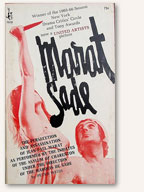
Marat/Sade

The Persecution and Assassination of Jean-Paul Marat as Performed by the Inmates of the Asylum of Charenton Under the Direction of the Marquis de Sade

A Play by Peter Weiss

Book Cover: Marat/SadeI’d heard of this play years ago, and not to put too fine a point on it, it sounds like a complete clusterfuck, and I have been curious about it ever since.

The premise is based on the historical facts that Marat was assassinated during the French Revolution in 1793, that Sade participated in the revolution and even made the memorial address at Marat’s funeral, and that Sade later put on plays with the other inmates during his internment in Charenton Asylum from 1801-1814.

In this fictionalization, Sade is producing a play about the assassination of Marat, casting the various other asylum inmates. It is quite short, just two acts that together are just 102 pages, and it starts off surprisingly funny, with sort of slapstick humor around the extremely amateur production. I was pleasantly surprised, and thus lured quite capably into the subsequent ugliness surrounding the French Revolution and Sade’s personal philosophies.

Both the revolution and Sade committed horrific atrocities, though they came from opposite justifications: the French Revolution declaring that some violence must be committed for the improvement of society (so, basically, a regrettable side effect in the search for good), and Sade declaring that the only way to understand the human condition is to explore the very worst of it (the search for evil as humanity’s defining feature). This basic disagreement is explored through debates between Marat and Sade that appear to happen outside the play-within-the-play, and possibly only occur in Sade’s head.

The back blurb advertises that “It is total theatre: philosophically problematic, visually terrifying…. The play is basically concerned with the problem of revolution. Are the same things true for the masses and for their leaders? And where, in modern times, lie the borderlines of sanity?” My main take-away, however, was to wonder how much of the political and philosophical grandstanding by Marat and Sade was purely self-serving to justify their own personal indulgences. Sade likes to rape and torture, but he wants to see himself as something greater than just a violent sociopath, so he claims that all of humanity has these same urges, but only he has the courage to explore them honestly. And, though I am more sympathetic to Marat’s ambitions, he clings to his ideal of how the revolution will be played out, with himself as the people’s savior, and any deviation from that is treason and must be eradicated violently and completely.

I would pay quite a bit to see this live, actually – the descriptions of the sets, with a rudimentary stage and props within an asylum, the inclusion of a four-person chorus to punctuate points throughout the play, and the wide variety of players, often wandering on their own would make it quite the spectacle. (I would also like to see the movie from 1967, but the library doesn’t have it, and I don’t want to swing $38 for it, which is amazon’s very cheapest offer.)

—Anna

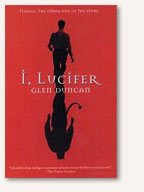
I, Lucifer

By Glen Duncan

Book CoverI actually first ran across the album of the same name by The Real Tuesday Weld several years ago, which quickly became one of my favorites, but even after I found out the album was inspired by this novel, I hesitated to read it because what if I hated it and then couldn’t enjoy the album as much?

However, it was then recommended by a commenter on io9, where I’ve gotten quite a few good book recommendations recently, so I decided to take the plunge. I figured it might be similar to Good Omens.

It isn’t really. It is darker and nastier, which, I mean, makes sense, given we are talking about Lucifer here, but most modern personifications of the Devil as protagonist aim for something a little more sympathetic.

The very basic premise is that God is willing to welcome Lucifer back into Heaven on condition that he lives out a human lifespan in a human body, without committing any mortal sins. Lucifer narrates this ordeal, and is deeply unlikable—his narration is a manic flow interrupted often by praises of sex, violence, abuse and torture. I mean, it is a good job of personifying the Devil, but it was a pain to read at times.

What really surprised me, though, was the more nuanced discussion of the somewhat problematic aspects of religion, like the balance between freewill and predetermination, an omniscient being having an adversary, and Good begetting Evil. It was disconcerting to end a paragraph about bestiality and rape jokes, and start the next one on the deeper meaning of life.

So, this is a little embarrassing to admit, but in the end, I, Lucifer, a memoir of sorts by Satan himself, talked about religion, faith, and devotion in a way that really resonated with me. I realize that this does not speak highly of me.

There is a particular line in which Lucifer scoffs at his previous life as an angel in Heaven: “He turned a side of Himself to us and from it poured an ocean of love in which we sported and splashed like orgasmic kippers, singing our response in flawless a cappella.” And I thought, if Heaven is like being a fish in an ocean of love, surrounded on all sides with love, even breathing love into your body and circulating it throughout so that there is nothing but love and warmth and light in your entire existence, well, that would be pretty nice, I think.

And if you were created in this environment and had experienced only that, ripping yourself free would leave you so wholly cold and empty and hungry, that it would be little surprise that your existence outside of God would be pure torture and the crazed search for something, anything, to fill that void.

So, in the end, I’ve been happily listening to The Real Tuesday Weld’s album all week, so no harm done, and I will say that the odd, vaudeville-style song in the beginning called “Bathtime in Clerkenwell” makes a lot more sense now.

—Anna

P.S. This book actually complements Rebecca’s Biblical reviews quite well. Lucifer has a lot of the same complaints that Rebecca has brought up, particularly about God “not playing fair” when He hardens various people’s hearts so that He can smote them all the harder later.