Mermaid in Chelsea Creek

By Michelle Tea

Book CoverWhew, this is a good book. This is how good it is – I actually started reading slower at the end to stretch it out longer.

Mermaid in Chelsea Creek is basically my favorite kind of book: metaphorical fairytale. And it is a fairy tale, but kind of a grimy one, if that makes sense. Thirteen-year-old Sophie starts getting visions of a mermaid who tells her that she is destined to save the world. Sophie, however, is your average young teenager, cranky, stubborn, and self-centered, trying to figure out her place in the world and her relationship with the people around her. She lives with her overwhelmed single mother in the economically struggling city of Chelsea, MA, where everyone seems to be hanging on by a thread.

It truly is this real-ness where the book really shines. The titular mermaid just puts a mystical filter over the growth every teenager must go through, and how difficult it can be even if you don’t have a grand prophesy to fulfill. Even the various magical creatures are trying to find their places in a decreasingly magical world. The themes of how full of pain and anger and sadness the world is, and how easy it can be to give up in the face of it all, but also how important it is to fight it with kindness and understanding, in whatever small ways are available to you — well, those struck a cord with me right now.

The mermaid is the most fantastical character, for sure, but the pigeons are the best, which is why they are on the cover. I hate to even mention anything that might make someone hesitate to read this, but I do feel that I have to extend a couple of warnings: there is some animal harm, which is pretty devastating, of course, and the book ends on an utter and complete cliff hanger.

The one problem with metaphorical fairy tales, if it can even be considered a problem, is that with things like cliff hangers, you never know whether it means there will be a sequel or if it just serves to show that there are no true endings where everything gets wrapped up. I’m okay with that, actually, but I’m rooting for a sequel because I would love to read it. (Edited to add: there is a sequel – Girl at the Bottom of the Sea comes out next year!)

Incidentally, the hardcover edition is published by McSweeney’s, and is a gorgeous volume, with an embossed cover, thick paper, and lovely line illustrations.

— Anna
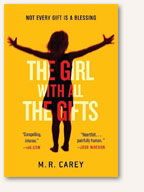
The Girl With All The Gifts

By M. R. Carey

Book CoverI’ve only paused in working my way through the Flavia de Luce series, which I’m continuing to love, because a reserve that I’d placed a while ago at the library finally came in. I hadn’t intended to find an appropriately spooky book for Halloween, either, but I guess things just aligned that way.

io9 gave The Girl With All The Gifts a raving but very coy review. Having read Carey’s other novels, I was willing to take the plunge on this one without more detail about the book itself. This novel has a similar setting as his others, of a dystopian London, but ratchets up the suspense significantly. This is due in large part to the truly excellent characters. I found some of Carey’s previous characters a little cartoony, but his characters here are very real. The novel shifts viewpoints between the various characters, so the reader gets wildly different perspectives on the same situation. Because there is no objective voice, I found my judgments of characters and situations constantly evolving.

The Girl With All The Gifts opens with a strange 10-year-old girl, locked in a small cell in an underground bunker, along with dozens of other children, who are delivered to and from a classroom each day under armed guard. This is all she (and the reader) knows, and while she doesn’t care for the guards, she loves her teacher and is not unhappy.

The book slowly expands from there, with the multiple perspectives helping the reader put the pieces together, which is half the fun, so I certainly don’t want to spoil it here.

In lieu of a longer book description, here’s another Halloween recommendation. I decided that I couldn’t stomach another season of American Horror Story, so to fill the void, I decided to watch HBO’s Carnivale, which I’ve been meaning to watch for years. And it is exactly what I wanted: suspenseful and creepy without being gross. Also, I was congratulating myself on being so smart to recognize all the religious symbolism in the first episode, before I saw how heavy they were hitting in the second episode, so there’s that.

—Anna

Halloween ComicFest

ComicFest 2014I did not know this was a thing until yesterday evening, but now I’m all pumped to go tomorrow: apparently, in addition to Free Comic Book Day in May, comic stores have Halloween ComicFest, where they offer free Halloween-themed comics! I don’t actually have anything to add to that: Halloween! Free comic books! (Okay, I’ll add two things: one of the free comics is done by Terry Moore, who did (does?) Strangers in Paradise, and one is done by Loeb and Sale, the team that created Batman: The Long Halloween, both series I’ve very much enjoyed.)

The Flavia de Luce Series

By Alan Bradley

I read a recommendation for Alan Bradley’s Flavia de Luce mystery series online and was intrigued by the idea of an 11-year-old girl detective in a small British town in the 1950s (seriously, who wouldn’t be?). Reading some background on the series before diving in, I also learned that the author wrote his first book, the first in this series, at the age of 70, which is just very encouraging to people who haven’t quite found the time to pursue their passion yet. Of course, he’s had to spend years now answering why a 70-year-old man chose an 11-year-old girl as his protagonist, which has got to get a little tiresome, but I thought his answer was a good one: he wanted his protagonist to be someone who is almost invisible in society, so is able to go unnoticed in pretty much every situation.

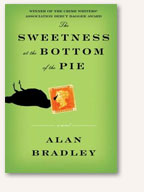
Book Cover: The Sweetness at the Bottom of the PieAnyway, I started with the first book, The Sweetness at the Bottom of the Pie (I love his titles), and it was an utter delight! The mystery is a little obvious, but I was much more willing to forgive Flavia for not putting the pieces together much sooner, especially since a great deal of her time is spent trying to disrupt her family whenever possible. Her family consists of her emotionally distant widowed father and two older sisters banging around in their centuries-old ancestral home, and it is just classic British flakiness.

The author is maybe a little heavy with the similes at times, but though it sometimes distracted me, it was inoffensive overall. A sign of my advancing age may be that I often sympathized with the poor inspector who was just trying to solve a somewhat unpleasant murder and everywhere he turns, there’s a small girl underfoot, certainly quite bright, but still a very young child nonetheless. I struggle a bit to describe how well I think the author describes Flavia’s brilliance while also keeping her clearly quite young.

The second book, The Weed That Strings the Hangman’s Bag (seriously, such fun titles!), however, has a passage in it that I think really showcases the balance and which I particularly loved. I’m including it after a page cut, not because it has spoilers (though it does spoil Madame Bovary, so take that caution I guess), but so that it doesn’t fill up the entire home page: Continue reading

Suddenly Last Summer

By Tennessee Williams

So, I watched “Suddenly Last Summer” the other night – I’d been meaning to watch it for a while because what a cast! Katherine Hepburn! Liz Taylor! Montgomery Clift! Also, what a plot – psychosis, lobotomies, and cannibals! I had no idea how all of this could fit into one two-hour movie, and I’m still not entirely sure, actually.

My first impression (spoiling the big reveal, but you’ve had over half a century to check this one out) was that this was one of the most homophobic movies I’ve ever seen, but then I was confused because the original play was written by Tennessee Williams, who was openly gay himself, and though he clearly had a wide variety of issues, I never thought his sexuality to be one of them. (It turns out I may have been wrong about this, actually.)

There was another, subtler theme of gods and sacrifices running through the play, though, and I wondered if that was more prominent in the original version, and a homophobic Hollywood played up the homosexual angle instead. All of this to say that I checked out the one-act play to see for myself.

So, I remain a bit confused. It is not wildly different from the movie. The first part is pretty much a monologue by the mother (Katherine Hepburn’s character), and it showcases Williams’ trademark Southern mother – overbearing, out of touch, and clinging to old-fashioned social mannerisms. There are some hints that Williams is also criticizing some artifice in the gay lifestyles of the time, though I haven’t gotten to the worst part yet (the end). The lobotomy aspect was rolled out a bit more subtly than in the movie (which wouldn’t have been difficult, since the movie opens on a lobotomy procedure), and is more conflicted about the process than the movie projected (the adulation of the lobotomizing doctor in the movie made me a little uncomfortable, as well).

The second part is mostly a long monologue by the cousin (played by Elizabeth Taylor), and this is where the most problematic parts of the movie come in, with her exposing her cousin’s homosexual and promiscuous lifestyle and how it ultimately lead to his downfall. In the end, I guess I would say that the movie switches the priority of themes from the book; the theme of a sacrifice-demanding god is somewhat more prominent than homosexuality in the written play. Though because the play is really just two monologues strung together by a bare minimum of structure, I would say that this is more of philosophical and/or psychological study than anything else, really. I’m still somewhat baffled by it all, but after doing some brief online research, it looks like I’m in good company; this play is still quite the cinematic controversy. (Also, the contemporary review of the file is a hilarious panning!)


Mike Mignola Graphic Novels

Mike Mignola is most well known as the creator of the Hellboy series, which I find a little too silly for me. However, I really admire the artist that partners with him on the inside pages (Mignola himself illustrates most of the covers and I like his style, too). So, I was interested in checking out some of his non-Hellboy work. I previously read, hugely enjoyed, and reviewed Baltimore Volume 1: The Plague Ships here, and just recently remembered to track down the now-released sequels.

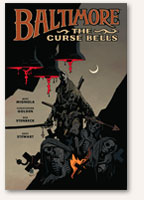
Book CoverBaltimore Volume 2: The Curse Bells

This volume goes a bit darker than the previous one, exploring how men can become monsters themselves through their obsessions. I found it gripping, but not exactly pleasant to read. What I did enjoy, though, was that the story expands more on the alternate history of this world, confirming that it is set just barely post-WWI, with foreshadowing of WWII. It also has vampire nuns.

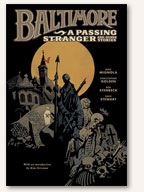
Book CoverBaltimore Volume 3: A Passing Stranger and Other Stories

I was a little hesitant over this one because short stories can go either way, but I really liked it. Mignola uses the shorts to really focus on the characters themselves. We get backstory on two main villains from both previous volumes, and quite a nice look at Baltimore’s struggle to stay moral in his own obsessive quest. It made some of the ickiness from volume 2 more palatable.

Book CoverThe Amazing Screw-on Head and Other Curious Objects

This book is very odd. I believe it is really just Mignola playing around with stories and drawings that he knows won’t hold up to a full graphic novel treatment, but he is so successful that the publisher figured fans would probably be entertained. I would agree, too, that this is probably just for the true fans that want a comprehensive collection of Mignola’s works. The titular Amazing Screw-On Head is literally a sentient head that can be screwed onto a variety of mechanical bodies and does sort of vague battle in service of President Lincoln. Even the backpage blurb didn’t seem quite what to make of it: “If you read only one comic about severed robot heads fighting…I dunno, some damn thing or the other at Abraham Lincoln’s behest, that comic should be The Amazing Screw-On Head.” —Comic Book Resources.

I will say that my favorite vignette in the collection was The Magician and the Snake, written by Mignola’s seven-year-old daughter. It was no less cohesive a story than the rest, and had a very charming description of love and friendship that continues even after death. So, I guess what I am saying is I can take or leave Mike Mignola on this book, but I quite recommend Katie Mignola.

Book CoverWitchFinder: In the Service of Angels

Mignola is back to what I like best: supernatural period pieces. WitchFinder features Sir Edward Grey, recently knighted by Queen Victoria for hush-hush deeds done in service of the crown. In this volume, though, he is tracking a demon brought out of the excavation of an ancient Egyptian tomb and made corporeal in London.

It has a similar feel to Baltimore, though a different historical period and Grey is different enough in character (not quite as hardened and still able to be smitten by a comely medium) that it is not simply a retread. The illustrations are lovely, as usual, and the story interesting, but the pacing was a bit slow. It ends a bit abruptly with only partial resolution, and though there is a second volume out, I’m not sure I’m going to follow up with it. (Except, that upon further research, i.e. amazon description, the second volume takes place in the American West and I love a wild west story.)

—Anna

Manhood: How to Be a Better Man – Or Just Live with One

By Terry Crews

Book CoverI’ve been a fan of Terry Crews since I first saw him as the dad on “Everybody Hates Chris.” In fact, he did such a good job of inhabiting the overworked and often exhausted character that I was surprised to learn later that he is a body builder and ex football player. When I heard him interviewed on NPR in promotion of his autobiography/guidance book, he was just so charming that I was immediately interested in the book.

His writing is as humorous as his acting, but what really surprised me was his complete openness and honesty. He is upfront and unflinching when examining truly vulnerable things in his life, like what caused him to wet the bed until he was fourteen, and what led to a decades-long addiction to pornography that he only recently got help for. The real eye-opener for me, as a woman, was his discussion of the stresses that our culture puts on men. Because being scared or sad is considered weak in a man, he felt like his only outlets for these emotions were anger and aggression.

Crews writes with a sincerity that occasionally came across as oddly childish to me, and then he’d catch me off guard with something really funny in exactly the same tone, and I’d wonder, “does he even realize that he’s being funny?” But, of course he does; he’s a master comedian.

Some additional take-aways:

  • The NFL is crazy dysfunctional. Like, take every horrible work story you’ve ever heard and bundle them all up into one entity, and it would be the NFL.
  • Terry Crews has had to pull himself up by his bootstraps a shocking number of times. Every time I thought “oh, this is where his success began,” it would all crumble and he would have to start over again from scratch.
  • The person who most deserves to reap the rewards of Crews’ current success is his unbelievably patient and supportive wife of over 20 years.

To end this review on a more superficial note, I think the cover designer did Crews a real disservice. I was a bit embarrassed carrying it around in public, so I can’t imagine that the young men who could really benefit from his advice would love to be seen with it.

—Anna

The Girls at the Kingfisher Club

By Genevieve Valentine

Book CoverI’ve mentioned before that I’m a big fan of Genevieve Valentine. I love both her blog and her fictional writing, but am continually surprised by how different they are. She is so funny on her blog; her recaps of the television show “Penny Dreadful” were as much a delight as the show itself. Her books and short stories, however, are almost unrelenting melancholy. Her novels are not hugely long or densely worded, but she somehow gives everything a sort of portentous double-meaning which gives the narratives a heavy tone. It is such a vague feeling in the text that I’m struggling to describe it.

Anyway, The Girls at the Kingfisher Club is a retelling of the folktale of the twelve dancing princesses, set in New York City during Prohibition. (The titular Kingfisher Club is the dancing girls’ speakeasy of choice.) The Twelve Dancing Princesses was not a favorite story of mine as a kid, so I only vaguely recalled it. What is just sort of casual misogyny in the original story (of course the king locks up the twelve princesses in a tower – that’s just what you do with princesses in fairy tales), gets fleshed out here into true cruelty in the utmost neglect in a real-world setting. This builds up a strong sense of suspense throughout the novel, as the consequences are suddenly more real.

It made me cry several times in the privacy of my home, but it also, embarrassingly, made me laugh out loud on the metro.

—Anna

Rose Under Fire

By Elizabeth Wein

Book CoverShortly after Kinsey notified us all about the sequel to Code Name Verity, I checked out Rose Under Fire, with some trepidation, I have to admit. Code Name Verity was excellent, but also completely devastating in parts, and Rose Under Fire had the potential to be even worse. The majority of the book is set in a Nazi concentration camp for women, with extra focus given to the victims of the ‘medical’ experiments. I just wasn’t sure I could take it.

However, Elizabeth Wein is a genius and knows exactly how to tread the line. Most of the book is mercifully told in flashback, so readers can continually reassure themselves that at least these few characters have necessarily survived. This doesn’t mean it isn’t heartbreaking, of course; just not unbearably so. I would even say, all things considered, that overall it was more upbeat (not the right word at all) than Code Name Verity. (It also is not a direct sequel, per se; it has some shared characters, but features a newly introduced main character.)

Several weeks later, I followed this up with watching “Judgment at Nuremberg,” a 1961 film recounting one of the trials at Nuremberg, this one against four judges for crimes against humanity. Spenser Tracy stars as the retired American judge who agrees to oversee the tribunal for this trial, and wrestles with his own conscience in trying to reconcile the crimes that were committed in the past with the current devastation of the country.

The movie explores to what degree individuals are responsible for the actions of a government. Outside of the courtroom testimony, some of the more painful scenes are of regular citizens looking dazed and insisting they had no knowledge at all of the actions of the Nazi party. It inspires an unsettling mixture of pity and anger in both the judge and the viewer, and raises tough questions without easy answers. It was a good companion to “Rose Under Fire,” and now I’m ready to turn to some lighter books and movies.

—Anna

Queen Victoria’s Book of Spells

Edited by Ellen Datlow and Terri Windling

Book CoverThis anthology is collected by the same editors and many of the same authors as Teeth, which I read and reviewed previously. It is described on the cover as “an anthology of gaslamp fantasy,” and having the setting be the common factor instead of the characters allowed for a greater range in the stories, which I appreciated.

The Victorian Era, too, is an excellent setting to pick, since so much was going on! There was the very first world’s fair, an explosion of technology, science, and manufacturing, and a return to romance in the arts. It was an era of lots of contradictions, as well: most well-known for extreme wealth, it also had predominant extreme poverty; the British Empire was both strongly xenophobic and driven to colonize; and Queen Victoria herself was both a pretty and lively young girl, and a solemn and joyless widow.

Though, once again, I checked out the book for the short story by Genevieve Valentine, I was pleased that the anthology also included Elizabeth Wein and Caroline Stevermer. My favorite stories ended up being “The Governess” by Elizabeth Bear, in which a governess takes a position in a very troubled household, and “Phosphorus” by Veronica Schanoes, about the strike of the women who worked in the match factories. Don’t those two alone reveal the wide scope of the book?

Can I also describe how ridiculous I can be? I had always had a vague feeling that I didn’t care for Elizabeth Bear, because I believed that she had written Clan of the Cave Bear (because “Bear”) and/or Women Who Run with Wolves, or some amalgamum of both books that only exists in my head. In addition to the fact that Elizabeth Bear did not write either of those books, I have not actually read either of those books, or any books that Elizabeth Bear has actually written. No reality will keep me from my pointless prejudices!

— Anna