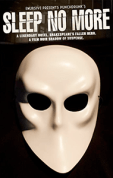
 I’ve been reading a lot of books previously reviewed by Kinsey and Rebecca on this blog, so haven’t had much to post about, but I’m going to piggyback on Kinsey’s review of a play, and tell you about a performance I saw on a recent work trip to New York City.
I ran across Sleep No More when looking for a hotel to book near the training session in the Chelsea neighborhood, and Google lists The McKittrick Hotel as sleeping quarters, when in fact it is an elaborate set piece, in which the performers travel through the various rooms while the audience follows. Sleep No More is described as a noir-style take on Macbeth, which are two of my very favorite things, so I was pretty quickly sold on it, though it took me a bit longer to pull the trigger on the $85 ticket price.
My general impressions:
When I was waiting in line, a couple of teenagers behind me were psyching themselves out, wondering how scary it would be and if they would scream, and I was annoyed at them for treating it like a haunted house (this comes back to me later).
All audience members are given white masks (not unlike the Scream mask) that we must wear throughout the performance, and we must not speak. I was first let into the space, masked, with maybe 5 or 6 other audience members and we sort of wandered around empty rooms for a while. I had a sudden fear that I would manage to go through the entire space and manage to somehow miss any live performance, just because that seems like the sort of idiotic and embarrassing thing that would happen to me. I was trying to convince myself that I would be satisfied with just how cool the various room settings were, but I have to admit that I was relieved when I finally saw a performer.
Once you have run across one performer, they will usually lead you to others, and you can chose to stay with your original or switch off with a new one. I found Macbeth himself first, and then Lady Macbeth, for the dramatic scene in which she coaxes him to kill the king and become king himself. When Macbeth ran off set, I decided to stay with Lady Macbeth, and only realized later that I’d missed the killing of the king.
However, I actually ended up in the same scene again with the Macbeths, probably about an hour later, so I followed Macbeth this time, and got to see the pivotal death scenes of both Duncan and Banquo. (Though I hung out for a while in the graveyard set, I never got to see the three witches, who I was sure would eventually appear.) I also got to watch a spooky tailor stitch up the worst seam I have ever seen in my life. I had a small impulse to try to intervene, at least with the sewing itself.
Though Sleep No More is described as a play (or immersive event or whatever), it is really a dance performance. The actors do not speak, but rather have highly physical choreography they perform. (Also, audience members are never pulled into a participatory role, so you can be reassured on that point, if that’s not your thing.)
So, it was very novel and entertaining, but I had a realization about an hour in that really made the performance for me. There were probably about a hundred or two masked audience members wandering the three (or four – it gets a little confusing at times) stories of the hotel in all, and in scenes where there are multiple performers interacting, all of the audience members following each one all combine into quite a crowd of blank white faces drifting about and coalescing around the various characters. It really did start to seem exactly like a haunted house, only you, the audience member, are one of the ghosts.
You and the others sort of drift aimlessly around with only each other, who you cannot speak to, and as soon as any “live” character appears on the scene, you all immediate glom onto the person, surrounding them when they are still and trailing after them when they are moving. In fact, for a couple of scenes, characters had to sort of gently wave ‘ghosts’ out of their way, which they did very professionally, exactly as one would sort of wave away a mist or cobweb.
Once this occurred to me, the whole thing took on a more delightfully spooky dimension. Seriously, how many times in your life will you be able to experience being the one haunting an old hotel? This works perfectly for the story of Macbeth, too, which is all about hauntings, both literal and of the conscience.
One caveat to the whole thing, though: the experience itself is a lot of fun, but it is all very scattered and nonlinear to the extreme, so if you prefer more plot-driven theater, this might not be for you. I knew beforehand that it was loosely based on Macbeth, which is my favorite Shakespeare play and one I’m fairly familiar with, so I recognized some scenes, force-interpreted others, and was completely puzzled by still more. (The inept tailor was given a tiny rat skull, which made him despondent? I don’t remember that from Macbeth.)
—Anna
 This book was way more depressing than I’d anticipated, and I already knew it was called The Good Death. Author Ann Neumann was inspired to research and write this book after she spent a year caring for her dying father. After he passed, she wondered whether he’d had a ‘good death,’ and what that even means in our world. I was interested to read it, of course, because I have some questions about that, myself.
 On a more cheerful note, I am completely entranced (possibly to an unhealthy degree) by the
  Whew, this book. I’ve been reading The Book of Strange New Things off and on now for the past two months. The very basic, ridiculous-sounding premise is that a minister is sent to a newly established human colony on Mars in order to bring Christianity to the native martians. I had thought that this interesting combination of science fiction and religion might be a good Christmas present for my dad, who is interested in both, but I also thought that I better read it myself first since I’ve had bad luck in the past giving unread books to people.
 This is a short book of autobiographical essays on race by a colleague of my mother’s. I picked up her copy while visiting over Christmas, so I have no idea how widely available it is, but I highly recommend it. Davis has a fascinating way of breaking down extremely complex and emotionally-charged issues of race into underlying theories of causes that can be more directly addressed. He calmly and clearly lays out factual counter-arguments to many of the arguments that, per the title of this book, attempt to blame black people for their own social inequality.
 This book should have been everything to me – a spooky circus and a sorcerous battle set in the Victorian Era – but it was just so damn boring. It started strong with the hoary old magicians selecting unaware students to continue their contest of skills, and then building the titular circus to serve as the staging ground. Once the circus is up and running with the young magicians showing off their respective skills in increasingly elaborate exhibits, the novel really bogged down in endless descriptions of amazing and whimsical spectacle.
 I would never have picked up this book except that one of my favorite blogs,
  This book is like if we got the stories of some of Buffy’s classmates at Sunnydale High – there are terrible, supernatural things happening, but there’s nothing they can do about it, so it is mostly in the background of their everyday lives. I don’t normally like stories about non-fantasy teenagers (even when I was a teenager I couldn’t really relate), but this novel is just so well written!
 I’ve returned to apocalypses, this time with vampires! The Passage is basically the opposite of
  Things…don’t go well in The Twelve. Even though there is a third book due next spring, I wasn’t convinced that anyone was going to survive this one. While some do, humanity itself has gotten even worse, so this book has less of the small hopeful details of the previous book, while it ups the game on the gritty ugliness.
 I first heard about this novel on NPR and was intrigued by reading a novel about Sherlock Holmes’ older (and canonically smarter) brother and, quite frankly, by reading a novel by one of the greatest basketball players ever. In the NPR interview, Abdul-Jabbar says he’s been a lifelong fan of the Sherlock Holmes stories, and it really shows in the details of the novel.
 I don’t even remember what internet rabbit hole led me to
  Biblio-therapy