By Zen Cho
This has been a trying couple of weeks – I’ve been obsessively reading twitter and facebook until I can’t stand it anymore, and then I read fiction until I can’t stand being away from social media. Zen Cho, however, has been a real comfort during these times, though.
 The novella The Perilous Life of Jade Yeo features a Malaysian woman trying to make a living as a journalist in Victorian-era England. It is short and funny and touching, all told through her journal entries. It just felt very much like a story by a woman for other women.* The male characters, both good and bad, are only given context in relation to Jade, and the story focuses primarily on her growth as a young adult trying to establish her sense of self. So, this was extremely comforting in these worrisome times.
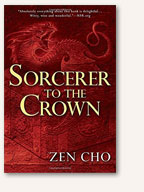 Sorcerer to the Crown, the full-length novel, starts slowly and in very high-fantasy fashion, set in a magical version of Regency-era England. It reminded me almost immediately of Jonathan Strange and Mr. Norrell, but luckily it picks up the pace much more quickly. Zacharias Wythe, as a very young boy, proves his extraordinary magical ability in front of a large panel of sorcerers, who promptly all lose their shit. This is not because Zacharias shows such promise so early, but rather because he is a freed African slave. The lead sorcerer adopts him and trains him to be his successor as Sorcerer Royal, the position he holds at the time the book.
A large contingent of white sorcerers actively work against him, even against their own self-interest, solely in order to oust him from his position by spreading outrageous rumors and innuendos. As the story revolves around an extremely thoughtful and conscientious black man trying to navigate the world of magic through difficult times, while surrounded by white men who are actively rooting for his failure, it became much less of an escapist fantasy.
Zacharias then runs across a young woman who shows strong magical abilities, and decides to train her, in the face of all traditional lore saying that magic is beyond women’s understanding. Reading about this black man conquering his enemies and silencing his naysayers, while working with a woman to do the same with hers, just about broke my heart. We didn’t get the ending we deserved, but at least this fictional world did.
 *If I can be excused a diversion for an additional recommendation – a few months ago I saw “The Dressmaker,” and I absolutely loved it! It is an Australian film that didn’t get a lot of showings, even though it stars Kate Winslet and Liam Hemsworth. The preview looked amazing to me – a haute couture dressmaker has to move back to her very rural Australian town in order to take care of her elderly mother – but the reviews were mixed. The negative reviews all tended to revolve around uneven storytelling and shifting mood, and I started to formulate a theory that this movie might be telling a story in a more traditionally female way, one that focuses on relationships and character growth, rather than a single-trajectory action sequence. Seeing the movie absolutely confirmed that for me, and it felt amazing to see a movie that was so clearly by women about women and for women.
 Kinsey set me up on Twitter a few years ago, and I’ve become quite the addict since. I follow a whole bunch of comedians, who then follow each other, so I’m not even sure how I found all of them.
 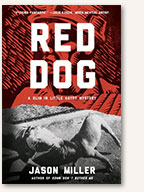 Miller significantly upped his game with this sequel, with a plot that starts with a missing dog, and spirals out into a storm of dog fighting, gun running, and white supremacists. The characters are where Miller really shines. I had some trouble following all the characters, but that is absolutely my fault as a reader and not Miller’s as the author. I read a lot of “tough guy” books and even though I love them, I still get tired of the tough-guy dialogue, and Miller’s dialogue surprises me over and over, and makes me laugh.
 I wasn’t going to review this book because it is the third in a trilogy in which I’ve already discussed the
 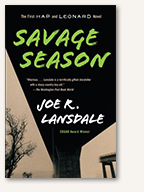 A few weeks ago, everyone on my twitter feed was mocking
 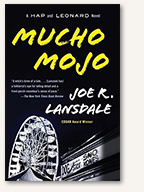 Unfortunately the sequel takes all the things I didn’t like so much in the first novel and hits them even harder. Lansdale takes some astoundingly racist rhetoric, about systematically oppressed people just victimize themselves with their own defeatism, and puts it in the mouth of Leonard while Hap just sort of goes, “well, I don’t know about all that…”
 A few weeks ago, I ran across a discussion online of fantasy casting for a hypothetical Peter Wimsey movie, and the comments were pretty divided on whether Tom Hiddleston would make a good Wimsey. The “pro” side was, of course, he’s just so charming! The “con” side was, but isn’t he a little too handsome? And, I’m here to say that I don’t think so! After seeing him blonde in The Night Manager, he looks kind of like a silly doofus, which is pretty much perfect for Wimsey.
 I’ve been looking forward to the tv show “Preacher” for a while before it premiered last month on AMC. I’d never read the comic book, but I think Dominic Cooper is extremely handsome and just needs to be in more shows and movies in general.
 For people unfamiliar with the basic premise, Jesse Custer is a preacher in a small Texas town with a dwindling faith and congregation. In the middle of a lackluster sermon, he gets struck by a supernatural entity, which bestows on him the Voice of God, allowing him to command absolute obedience. Any person’s use of this power is clearly problematic, and sets Jesse up as a pretty classic anti-hero. Rebecca pointed out that this is the precise power abused by the terrifying villain Kilgrave in “Jessica Jones.”
 All three of us blog writers went to go see the third Captain America movie together, and I have thoughts. Actually, I had thoughts (concerns) before we even went. I didn’t follow the Civil War event in the comic books, but I knew the basic gist is that there is a growing political movement for putting superheroes under some kind of government control, and the Avengers become split between Iron Man supporting that movement, and Captain America against it.
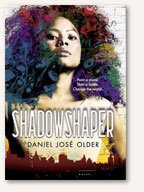 This is the third book from the
  So, I could absolutely see why this is Tumblr’s cup of tea – it is feminist, queer, violent, and bawdy – but it just wasn’t quite my thing. I think I’m a bit old for it, honestly. The titular Rat Queens are a diverse group of mercenary women, and what the comic does especially well is highlighting the distinct personalities and backgrounds of each of the four women, and their varying relationships with each other. In the collected first volume, they and several other mercenary groups are offered a quest as an alternative to jail time for a bar brawl that got out of hand.
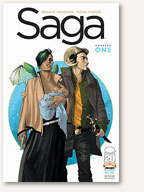 Saga, on the other hand, was immediately engrossing. It opens with an extremely rustic birth scene, and unfolds from there, moving forward with the gripping plot and filling in the backstory as it goes. Our two new parents are such a hopeful, almost innocent Romeo and Juliet pair, though with much more personal agency than the Shakespeare couple, that I was immediately rooting for them.
 Biblio-therapy