By Joan Lindsay
 I took a rather winding road to get this book: Nicole Cliffe, who’s newsletter I’ve recommended before, linked to a 2018 list of the 100 most influential horror movie scenes. For the longest time, I thought I didn’t like horror, since I don’t particularly like the slasher movies that were the fad when I was a teen. However, I love both old-school Hitchcock suspense and our current heyday of psychological horror, and I found the evolution of the horror genre in the article fascinating.
Anyway, the description for the film version of Picnic at Hanging Rock made me laugh: “notable for the absence of violence or even a conventionally advancing narrative.” As my friends and family can attest, I have seen (and imposed on other people) my fair share of movies lacking “conventionally advancing narrative.” I don’t have as much patience for them as I used to, so wasn’t super interested in seeing this movie, but when Bookbub recommended the novel to me the next day, it felt like fate.
And I absolutely loved it! Four schoolgirls wander off from a picnic party to get a closer look at the titular Hanging Rock, and only one returns, hysterical and incommunicative. The impressive thing is that we, the reader, are with them the whole time, too (or at least with the returning fourth girl). We ‘see’ the three girls walk deeper into the rock of their own volition, while the fourth seems to just freak herself out and run away from them. She can’t describe what happened because nothing did happen, and that’s what’s so unnerving!
There is no act of violence or even maliciousness. For a novel about the disappearance of schoolgirls, it is almost unbelievably serene. After the build up to the disappearance and then the subsequent panic of the search, the novel deals almost entirely with the ripple effects, both good and bad, this one event has on the details of daily life for the surrounding characters. It reminded me quite a bit of On The Beach, another Australian novel I loved and that focuses entirely on mundane details during a cataclysmic event.
 We finally bit the bullet and got Amazon Prime in order to watch “
 The novella The Perilous Life of Jade Yeo features a Malaysian woman trying to make a living as a journalist in Victorian-era England. It is short and funny and touching, all told through her journal entries. It just felt very much like a story by a woman for other women.* The male characters, both good and bad, are only given context in relation to Jade, and the story focuses primarily on her growth as a young adult trying to establish her sense of self. So, this was extremely comforting in these worrisome times.
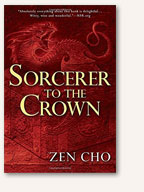 Sorcerer to the Crown, the full-length novel, starts slowly and in very high-fantasy fashion, set in a magical version of Regency-era England. It reminded me almost immediately of Jonathan Strange and Mr. Norrell, but luckily it picks up the pace much more quickly. Zacharias Wythe, as a very young boy, proves his extraordinary magical ability in front of a large panel of sorcerers, who promptly all lose their shit. This is not because Zacharias shows such promise so early, but rather because he is a freed African slave. The lead sorcerer adopts him and trains him to be his successor as Sorcerer Royal, the position he holds at the time the book.
 *If I can be excused a diversion for an additional recommendation – a few months ago I saw “The Dressmaker,” and I absolutely loved it! It is an Australian film that didn’t get a lot of showings, even though it stars Kate Winslet and Liam Hemsworth. The

 Biblio-therapy