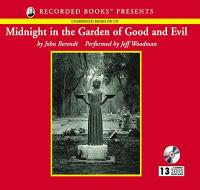
Midnight in the Garden of Good and Evil by Berendt

Midnight in the Garden of Good and Evil
by John Berendt
read by Jeff Woodman
written 1994, read 1996

I remember really enjoying this book back when I read it when it was first published but since I recently listed to Brendt’s next book City of Falling Angels, I realized that I couldn’t actually remember any of the actual details about this book, so I should listen to it next. This is his more famous/successful book that got turned into a movie released in 1997, which I also watched for the first time this week.

This book is set in Savannah, Georgia in the 1980s, and it’s very much a story of a time and a place as much as a story of the characters. It’s more or less nonfiction, ie, the people are real and the events are real, but Berendt in his narration plays fast and loose with his own position in the story and exactly what order the events happened in. There’s an extremely idiosyncratic cast of characters and a city that’s caught up in it’s own long history as an old Southern city with an ingrained concept of proper ettiquette, a strict racial divide and only the beginnings of gay pride.

The book is an introduction to a little-known city filled with peculiar but fascinating characters and a culture that’s developed from being caught up in it’s own history, filled with fancy manners, warm welcomes, ingrained exclusions, endemic violence, and ruthless social standards. Some of the main characters include: Joe Odom is an extremely charismatic southern gentleman who is a hub of society despite being a perennial conartist. The Lady Chablis is an extremely beautiful and outgoing black trans showgirl / dragqueen who loves making an impression and leaving chaos in her wake. Jim Williams is a rags-to-riches antique dealer who believes in psychic powers, puts on the most elaborte Christmas parties in the city, and is surprised to be charged with murder when he shoots and kills his much younger, male hustler lover.

To the extent that there’s a plot, the book covers the four trials for murder of Jim Williams, as he’s repeatedly found guilty and appeals. What the truth is, is very much in doubt. What the book tells are the many stories that are recounted, and the many characters who may or may not (and many are not at all) impacted by those cases.

It’s a fascinating and fun book, and I do recommend it, but I also think City of Falling Angels was better.

The movie, on the other hand, was rough: the scriptwriter took a meandering set of character studies and nearly a decade of events and tried to shoe-horn them all into a standard Hollywood plot template complete with romantic secondary plot. While it was full of cameos from the real people playing themselves, it was the professional actors who gave the most wooden performances. It was kind of shockingly bad. It did make me think that the time might be ripe for a remake as a mini-series.

Hamlet

by The Royal Exchange Theater (on Kanopy)

I want to expand the scope of reviews on this site for a few reasons: 1) I have cut all my paid streaming subscriptions because fuck them; 2) I currently only stream on Kanopy through my library, which seems relevant to this site; and 3) I just watched the Royal Exchange Theater production of Hamlet starring Maxine Peake, and it is intense!

First of all, it is over three hours long, so I watched it over a couple of nights. It has a super pared down set, which I imagine was really intimate in person, but I worried the effectiveness was getting a little lost on the small screen. In the end, though, the acting, Peake in particular, is so combustive that it all hits stronger than any I’ve seen before.

Peake’s performance feels like the dark side of Mary Martin’s famous Peter Pan. With her blonde pageboy cut, Peake captures true teenage dirtbag, making her Hamlet an absolute disaster of a person. Most performances of Hamlet elevate it to an artistic but fairly straight-forward tragedy. Peake’s Hamlet is a very young man in a horrifying situation making everything much worse by his poor judgment and resulting terrible behavior.

I really love Shakespeare performances, but it has been too long since I’d seen one that felt like it brought a fresh approach to the text (shout out to Scotland, PA, one of my favorites, Rotten Tomatoes be damned). This one blew my hair back in a way that I expect was similar to the audiences at the Globe seeing Hamlet for the first time. It wasn’t always a fun experience (Hamlet really can be such a brat), but I was enthralled!

A Monster Calls

Around this time last year, I mentioned that I had enjoyed the Patrick Ness book A Monster Calls. I didn’t go into a lot of detail in that post, but the book uses Ness’s text and beautiful black and white illustrations by Jim Kay to tell the story of a thirteen-year-old boy whose mother is clearly dying (but won’t admit it) and who conjures a monster from a tree outside his window. The monster comes to him at night and tells him stories that ultimately help him process what is happening. I did like the book, although it was a little middle reader for my taste and I’m not a huge fan of heavily illustrated books.  But Anna and I recently saw the movie version released right before Christmas, and it was AMAZING. In fact, I liked the movie much more than the book. Why? A few factors:

The illustrations in the book were lovely, but as someone who is way more into the text, I mostly glanced at them quickly and moved on. The movie does an amazing job of recreating the pictures so the movie has the same overall feeling and some of the same specific imagery. But it’s all alive and moving and in color and really striking.

In the book, the stories that the monster tells the boy were fine, whatever, I read them, they seemed just sort of like morally-ambiguous fairy tales. But in the movie, the stories within the stories are told through colorful watercolor illustrations that you watch appear on screen. They’re just lovely and made me pay attention to the stories in a way I hadn’t in the book.

The acting is truly wonderful. Liam Neeson is the voice of the monster, and his portrayal made the monster seem less like an arbitrary tree man and more like a force of nature that cared about what happened to the boy, even if it couldn’t change anything. (Liam Neeson also appears in the movie for two seconds as a character in a photograph, which I thought added a nice layer). And Felicity Jones made the mom seem sick and in denial, which was most of what came through in the book, but also fierce and funny and real. The boy was also great, and Signourney Weaver is in there too, and the specificity of the performances added to my experience.

A warning: I am not a big movie crier, and there was much crying here. As in, you could hear everyone in the theater around us crying and Anna and I both made use of the napkins I had gotten for my popcorn. But it didn’t feel like despondent crying, more like cathartic, hopeful crying. I also saw Manchester by the Sea recently, and when it was over I remember feeling dull and heavy, even though it was a beautifully-made move. This one felt more like waking from a dream. Which is not what I want every day, but was definitely worth it in this case.

Sorcerer to the Crown

By Zen Cho

This has been a trying couple of weeks – I’ve been obsessively reading twitter and facebook until I can’t stand it anymore, and then I read fiction until I can’t stand being away from social media. Zen Cho, however, has been a real comfort during these times, though.

jade-yeoThe novella The Perilous Life of Jade Yeo features a Malaysian woman trying to make a living as a journalist in Victorian-era England. It is short and funny and touching, all told through her journal entries. It just felt very much like a story by a woman for other women.* The male characters, both good and bad, are only given context in relation to Jade, and the story focuses primarily on her growth as a young adult trying to establish her sense of self. So, this was extremely comforting in these worrisome times.

sorcerer-to-the-crownSorcerer to the Crown, the full-length novel, starts slowly and in very high-fantasy fashion, set in a magical version of Regency-era England. It reminded me almost immediately of Jonathan Strange and Mr. Norrell, but luckily it picks up the pace much more quickly. Zacharias Wythe, as a very young boy, proves his extraordinary magical ability in front of a large panel of sorcerers, who promptly all lose their shit. This is not because Zacharias shows such promise so early, but rather because he is a freed African slave. The lead sorcerer adopts him and trains him to be his successor as Sorcerer Royal, the position he holds at the time the book.

A large contingent of white sorcerers actively work against him, even against their own self-interest, solely in order to oust him from his position by spreading outrageous rumors and innuendos. As the story revolves around an extremely thoughtful and conscientious black man trying to navigate the world of magic through difficult times, while surrounded by white men who are actively rooting for his failure, it became much less of an escapist fantasy.

Zacharias then runs across a young woman who shows strong magical abilities, and decides to train her, in the face of all traditional lore saying that magic is beyond women’s understanding. Reading about this black man conquering his enemies and silencing his naysayers, while working with a woman to do the same with hers, just about broke my heart. We didn’t get the ending we deserved, but at least this fictional world did.

the_dressmaker*If I can be excused a diversion for an additional recommendation – a few months ago I saw “The Dressmaker,” and I absolutely loved it! It is an Australian film that didn’t get a lot of showings, even though it stars Kate Winslet and Liam Hemsworth. The preview looked amazing to me – a haute couture dressmaker has to move back to her very rural Australian town in order to take care of her elderly mother – but the reviews were mixed. The negative reviews all tended to revolve around uneven storytelling and shifting mood, and I started to formulate a theory that this movie might be telling a story in a more traditionally female way, one that focuses on relationships and character growth, rather than a single-trajectory action sequence. Seeing the movie absolutely confirmed that for me, and it felt amazing to see a movie that was so clearly by women about women and for women.


Captain American and Black Panther

Captain America: Civil War

Marvel-Civil-WarAll three of us blog writers went to go see the third Captain America movie together, and I have thoughts. Actually, I had thoughts (concerns) before we even went. I didn’t follow the Civil War event in the comic books, but I knew the basic gist is that there is a growing political movement for putting superheroes under some kind of government control, and the Avengers become split between Iron Man supporting that movement, and Captain America against it.

I think it is a nice touch to make the most outwardly patriotic character still have concerns about political overreach, but I simply couldn’t wrap my mind around how Tony Stark, who wasn’t even willing to register his mechanical suit with the government in the first Iron Man movie, would take a pro-registration stance. In fact, I’d always thought Tony Stark sort of represented the classic Republican stance of financial independence, corporate freedom, and small government. It made me wonder if this movie would actually be a bit of a commentary on how the Republican Party itself has shifted in ideology.

And, then I saw the movie, and I’m even more confused. I wish I could have taken notes in the theater because I vehemently disagreed with basically everything that any of the characters said, and now I can’t actually remember any of the arguments. However, when trying to write this up, I tracked down some of the transcribed argument, and reading it didn’t make any more sense. It felt a little like when I was reading Atlas Shrugged, and the supposed ‘liberal’ characters made bizarre straw men arguments that I’d never heard an actual liberal make.

After much discussion with Rebecca, I think I have a basic grasp on the two sides, boiled way down and largely guesstimated from some very overwrought dialogue (clearly, this includes spoilers, but only for the most stupid and boring parts of the movie): Continue reading →