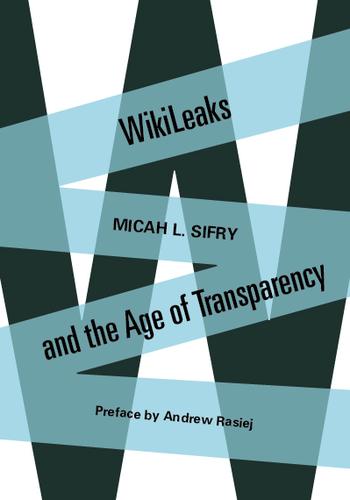
WikiLeaks and the Age of Transparency by Micah Sifry

WikiLeaks and the Age of Transparency
By Micah L. Sifry
2011

This is a fascinating read which is correctly introduced as being a presentation on information transparency from a guy with a highly pro-transparency bias. It’s not a manifesto, per se, but there’s no real attempt to present a balanced discussion of the issues or present even a straw target of the counter arguments. Instead, there are a lot of examples of both successful and failed attempts to achieve transparency in government and reporting. Examples come from the United Kingdom, the United States, various countries in Africa and in Europe.

Sifry is describing the world of information and of government responsibility as he sees it and I think it’s a very useful perspective to understand. I even agree with him to a large extent. Not completely though.

The title is also a bit misleading. I had originally intended to read it to gain an understanding of WikiLeaks specifically. I’d only vaguely followed the WikiLeaks situation in the news and want to know more. In this eight-chapter book, however, only the first and last chapters are actually about WikiLeaks. The majority of the book provides a much broader presentation on information transparency in general.

It was an engaging and informative read. I recommend it to anyone who is interested in politics, or journalism, or just information issues in general. It is, however, very subject specific so if you aren’t interested in the subject, it’s unlikely to transcend that disinterest. Since I find the subject fascinating, it was a good book and well worth reading.

Slaughterhouse-Five

By Kurt Vonnegut

Banned Books Week 2012Book cover: Slaughterhouse-FiveWhen I decided to read Slaughterhouse-Five for this year’s Banned Books Week (and the couple weeks following, as well, apparently), I was a little baffled that I hadn’t already read any of Vonnegut’s books because I like science fiction and I’ve had Vonnegut recommended to me multiple times. I even vaguely recalled meaning to read some books but never getting around to it.

Then, I got a couple of chapters in, and remembered that I hadn’t just meant to read his books before, I’ve actually started several of his books in the past, and put them down again. I just cannot get started into Vonnegut’s books, which is so frustrating because I really enjoy both sci-fi and social satire, and he is a king of both. So, I bring you this review in three Acts: Dismissiveness, Grudging Respect, Zealous Appreciation.

Act I: Dismissiveness

I spent roughly the first half of the book trying to put my finger on the problem. It isn’t as though I especially disliked it or thought it was a bad book; I just felt that I didn’t totally get what he was trying to say and that his writing style wasn’t one that speaks to me. When Tom asked if I was enjoying it, I had to admit that I wasn’t, and when he looked a bit disappointed, I followed up by saying that I thought it was a little too philosophical for me, like Vonnegut is communicating a theory about life, instead of sharing a concrete facet of life, and I get impatient with that. Tom nodded, because he has despaired of my disinterest in philosophy before, but I continued to mull over my answer.

And I think it was something even further, that his people weren’t interesting to me as characters. That they seem more like placeholders in his philosophical argument; their actions only serve to augment the message of the book. So, I didn’t have any vested interest in the future of the characters, which is especially true in this non-chronologically-linear novel where the future is all spelled out early on, and even the characters in the book don’t have much interest in it, either.

Acts II and III with spoilers and excerpt after the break…

Continue reading

Every Day

As with Gone Girl, I feel like I’m making a fairly unoriginal recommendation here, but Every Day by David Levithan is so good that I will be the latest in a long line of people saying how awesome it is. In fact, when Anna and I saw John Green speak recently, he even specifically recommended this book to the audience. (He and Levithan wrote another awesome book together called Will Grayson, Will Grayson, so they’re clearly friends, but it’s a good recommendation nonetheless.)

Okay, stay with me here, because this is going to sound odd. Every Day is about a teenager who wakes up every morning in the body of someone else. Sometimes it’s a boy, sometimes it’s a girl, but it’s always a teenager, and always someone within a few hours of the person the day before. On one day the main character (who has no name and no gender) falls in love with a girl, and after a lifetime of floating through bodies without leaving a trace, there is suddenly a reason to try to take control and get back to this girl.

Now, this sounds pretty high-concept and I held off reading this book for a while–it sounded sort of overdone and like it would be a slog. But the writing is clean and elegant, and the conceit of changing bodies every day comes to feel normal very soon, allowing the reader to focus on the story. Levithan not only makes his central idea functional, but by the end of the book it seems almost normal–plausible, even.

It’s not a cheery book–I’m going to call it “tinged with sadness”–but it’s both a good story and an impressive feat of writing. Made even more impressive because reading it doesn’t feel like it takes any effort at all.

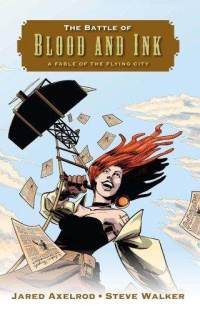
The Battle of Blood and Ink by Axelrod and Walker

The Battle of Blood and Ink: a Fable of the Flying City
Jared Axelrod and Steve Walker
2012

This book has my qualified approval. Without the time (or ability to concentrate) for reading a full book, I recently read a graphic novel instead. Given the adage “a picture is worth a thousand words,” if all of your descriptions can be replaced by images, a graphic novel can be read a whole lot faster than a traditional novel and in fact I read The Battle of Blood and Ink in about forty-five minutes.

On the up-side, it was wonderful to just relax with a book and this one had fun characters and interesting intrigue and really beautiful illustrations. The art is both lovely and lively and was what first attracted me to the book. Then, the characters drew me in, as well as how the authors addressed moral issues regarding ethics versus pragmatics and personal versus political responsibility. It was both beautiful and interesting.

The story is about a woman, Ashe, who grew up as a street kid on a flying city and now makes her living printing a newsletter regarding city events and happenings. The city is a place of wonder, but from Ashe’s perspective, we see some of the gritty underpinnings of how things actually work, and so too does her readership. This gets her into trouble with the city ruler and events progress. Since the role of information and censorship are currently particular interests of mine, this plot was just right for me.

On the down-side, the climactic scene relies on a lot of world building that wasn’t actually presented previously in the book. Given the setting is a flying city, the universe is obviously a science-fiction/fantasy one, but the physics of the world isn’t really explained at all, and the climax depends on certain premises that I hadn’t expected.

Having read and enjoyed the book but feeling a bit bemused by the ending, I discovered that the book was intended as a stand-along sequel to a set of 44 online pod casts (i.e., audio recordings). I listened to the first two of them and was not nearly as impressed by them as by the graphic novel. The world building issues may or may not be addressed in these pod casts, but of the two that I listened to (each about 15 minutes), both times the speaker rambled for a significant period of time before getting to the story and then the story was filled with poorly written descriptions that were much better presented as images in the graphic novel.

So, on the whole, while there are serious flaws in this graphic novel, it’s still lovely, fun, interesting, and well worth the half-hour to an hour that it would take to read. If you want to get a taste of it, the first twenty or so pages are available online.

The Paris Wife

by Paula McLain

Book Cover: The Paris WifeLet me preface by saying (with more than a hint of embarrassment) that I was an English major in college, yet have not read Ernest Hemingway. However, it served me well in the case of reading The Paris Wife. It was through the eyes of his first wife Hadley Richardson, in this historical nonfiction account, that I learned about Hemingway’s years in Paris as he established himself as a novelist.

The story read beautifully and the characters were well developed. During their time in Paris, the Hemingways befriended ‘characters’ that could practically write themselves—from well-known literary figures like Gertrude Stein and F. Scott Fitzgerald to avant-garde socialites to liberated women with big careers at companies like Vogue. Some of these characters were in fact the inspiration for Hemingway’s The Sun Also Rises. Yet Hadley’s perspective is nonetheless insightful. Although she ran with Hemingway’s various crowds, she seemed to be on the outside looking in. While the rest of the group played partners in crime, she observed their behaviors and shed light on their vivid energy and silly flaws.

What I found myself continually intrigued by was the extravagance of their lifestyle—considering the fact that Hemingway was a “struggling artist” who barely got them by with his correspondent side gigs. They had a cook, and then a nanny after their son was born. They traveled extensively in Europe and for long periods of time. They had elaborate cocktail parties in Spain during the Running of the Bulls (apparently financed by a richer member of the group).

I know for many Hemingway’s reputation precedes him. In The Paris Wife, he is depicted as a bold man with a big ego. But with Hadley as the storyteller, you also witness tender moments between the two of them. Unfortunately in the end though, you see how his growing pains as a literary star did damage among his close friends, circles of friends, and most sadly, his devoted wife and their son. As he followed his latest fancies without the worry of leaving a detrimental trail behind, I did have to remind myself that it was the 1920s, and therefore not so easy to fault Hadley for being such a devoted wife no matter what he was up to.

With this book now behind me, the fact that I have not read Hemingway makes it a simple choice of what to read next. Up first are A Moveable Feast and The Sun Also Rises, two books that reflect this time in his life. I am curious to experience his prose, but even more so, his perspective.

—Christine, contributing author

Attachments

I’ve mentioned Linda Holmes of NPR and the fabulous Pop Culture Happy Hour podcast here before–both the blog and the podcast are wonderful places to hear intelligent talk about movies, TV, music, other podcasts, and all sorts of other good pop culture-y things. I wouldn’t have said that they talked about books that much, but I’ve gotten a couple of good recommendations from them lately. Gone Girl was something I was probably going to read anyway, and their recommendation just encouraged me, but I would never have found Attachments without Linda’s recommendation on a recent episode, so I am passing it along.

Written by Rainbow Rowell (who has maybe the best author name ever), it’s the story of a guy working in IT at a small-town newspaper during late 1999. His job is to read the employee emails that have been flagged as inappropriate content and issue warnings to the employees, but he finds himself so interested in the emails that two women at the paper are exchanging that he can’t bear to stop them. In fact, he finds himself falling in love with one of them–but can anything ever come of a relationship with such a beginning?

Does that make the book sound creepy? It’s not at all, it’s sweet! The main character knows he’s in a potentially creepy situation and spends a lot of the book trying to figure out how to make it less so. And the emails between the two women are fun, and give the book a very epistolary feeling. Plus, all the references to Y2K are sort of charmingly retro. Remember when were so worried about that? Remember when email was so new and fun? I would describe this book as light, but thoughtful–it’s a sweet romance, but the lives of the people involved feel very real and important.

So at this point, I’ve got a 100% satisfaction record with Pop Culture Happy Hour recommendations and I will do whatever they tell me to do. (But even they can’t make me read comic books.)

Things I Learned at the National Book Festival

National Book Festival 2012This weekend, I went with Kinsey to the National Book Festival on the National Mall, and it was an awesome conglomerate of book lovers! We went to hear John Green, Patricia Cornwell, and Lois Lowry speak, and it was fascinating listening to them discuss their various approaches to writing and relationships with their books, because they really were widely different (and I’d like to encourage Kinsey to comment or post with her reasons for wanting to hear Patricia Cornwell speak, because they are very amusing).

Five things I learned at the National Book Festival:

  • If I listen to an author talk about a book for long enough, I will want to read that book.
  • Authors really appreciate libraries and librarians, which I had sort of wondered about since it conceivably cuts into revenues.
  • Having an author talk about a fictional character as a separate, independent entity makes me a little uneasy.
  • There are lots of ways to ask the infamous question, “where do you get your ideas?” (but the answer is always a variation of “beats me”).
  • All spouses of authors deserve our respect and sympathy.

I also was embarrassed to realize that the one-year birthday (September 17) of this blog had blown right past without me realizing it, so happy belated birthday, Biblio-therapy!

This was brought to my attention at the booth for Banned Book Week, which is also coming up (September 30-October 6, 2012), and which was our first collection of themed blog posts. For many years, I have been fielding many, many recommendations for Kurt Vonnegut, and have been slightly ashamed that I haven’t actually read any of his books, so I may pick up the frequently banned Slaughterhouse-Five in honor of Banned Book Week. It appears to have been most recently banned in 2010 because it “glorifies drinking, cursing, and premarital sex,” all of which I am very much in favor of, so it might be a good pick for me. However, I have a couple of other books on my list, as well, so I guess I’ll see how I feel next week and surprise you!

—Anna

Most Awesome Things I Saw On the Internet This Week

No book review today, although I’m working on a post about Tana French because I just finished her latest and thought it was amazing. But I did want to quickly share the two greatest things I’ve seen online this week.

First, another book review blog that has the BEST NAME EVER: Clear Eyes, Full Shelves. The best, right? (If you don’t get it, you need to go watch yourself some Friday Night Lights.) I am both mad that I did not think of this myself and admiring of them that they did. Plus, they cover YA and fantasy and have all sorts of good lists of books. And, they offer a recommendation service! You fill out a form saying what you’re looking for, and they will recommend your next book! Go check them out.
Second, I must have seen this in twelve places on the Internet today, but I need to do my part to make sure no one misses this genius cartoon. You’ll want to devote some time to this one–once you start clicking and dragging, it just goes on and on, and there seem to be endless wonderful things to find.

The Many Books of Cassandra Clare

Sometimes when I see an interesting book and realize it’s the first in a series, I feel overwhelmed by the task in front of me and don’t even both starting. Too many pages! Too much commitment! So I understand that recommending two interconnected series of seven books (so far!) is dicey. But don’t panic! Cassandra Clare’s Mortal Instruments series will not be a weight upon your reader’s conscience. This series just makes me happy, because I know I can count on more books coming.

City of Bones, the first book in the series, tells the story of Clary, a New York City teenager who finds out that she’s actually part of a world of demon hunters and vampires and werewolves, etc. I know there are a million young adult books out there with this same basic plot, but Clare creates a very detailed world and whole giant cast of interesting characters. There’s passionate teenage love, parents who don’t understand, fairies who strike bad bargains, a magical city in another dimension, secret governments, warlocks–it goes on and on. I don’t necessarily think the characters are that realistic (they really don’t read like teenagers to me) and the books aren’t going to offer tremendous insight into the problems facing our world now (for that, go read Bitterblue). But they’re fun and dramatic and surprising and engaging and ultimately satisfying.

There are five Mortal Instruments books so far, and clearly at least one more coming. I initially said that there are seven because Clare has started a second, companion series, set in the same universe but 100+ years back in Victorian London. The Infernal Devices has two books so far and I think I might actually like it better that the modern day books right now (but I am a sucker for period stories set in England). So please give Cassandra Clare a chance, starting with either City of Bones or Clockwork Angel. If you don’t like the first, you don’t have to read any more because they’re very similar. But if you like them, just think–you won’t have to worry about having something fun to read for many, many hundreds of pages. They’re also in the process of making the first one into a movie and I’m pretty sure they’re going to position it as the new Hunger Games, so just think how ahead of all the teenagers you will be!

Rosemary and Rue

By Seanan McGuire

Cover Image: Rosemary and RueRosemary and Rue…isn’t terrible. It is one of those books that is perfectly serviceable, but also demonstrates how difficult writing really is. I joke about my fantasy ‘trash’ books, but the truth is that my favorite authors manage to create empathetic characters in a relatable world, even when that world is so crawling with vampires, werewolves and fairies that it bears very little resemblance to the real world. They make it seem so effortless and natural that I can laugh off the books as ‘trash,’ until a book like Rosemary and Rue reminds me how much skill really goes into writing fantasy by showing me the pitfalls that other authors have avoided.

In case I haven’t damned it enough with the faintest of praise, Seanan McGuire writes like I would, constantly having to remind the reader (and possibly herself) of the perimeters of the supernatural elements of her world, that amateur error of telling (over and over) instead of showing. Unfortunately, even the telling often contradicted itself, to the point where I seldom fully understood what was going on in the plot. Some examples after the spoiler cut:

Continue reading