Oscar Wilde and Walt Whitman

This is going to be a super brief post, because it’s essentially a single link out to someone else’s article:

I got linked this article some time back, and I have no idea why I didn’t post a link here immediately, but I happened to mention it this afternoon to Anna and she assured me that it needed to go up, pronto. Thus, I give you:

Literary Trysts It Gives Me Great Joy To Think About: Oscar Wilde and Walt Whitman
by Mallory Ortberg
the-toast.net
September 17, 2013

Because mine is an evil and a petty mind, suitable more to wallowing in the sordid sexual goings-on of literary giants than in reading their work, I take every opportunity I can to inform people who may not have known that Walt Whitman and Oscar Wilde almost certainly had sex in 1882.

You are either the kind of person to whom this matters a great deal, or the kind of person to whom it matters not at all. To the latter I say: yours is the narrow road and the straight, and I extend to you a hearty and fulsome handshake, as well as my sincerest wishes for your continued good health. To the former I say: Want to hear about the time Walt Whitman and Oscar Wilde (probably) hooked up??

(For more, click the link that is the whole excerpt, and it will take you to the original article.)

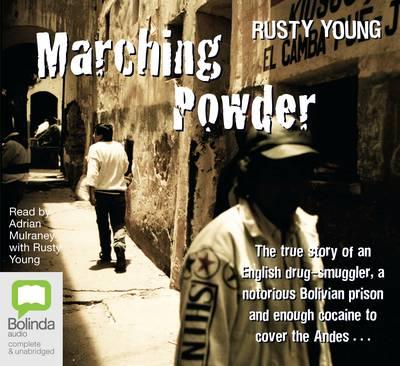
Marching Powder

marching-powderMarching Powder
By Rusty Young
Read by Adrian Mulraney
2003

This was a fascinating book, but, once more, this was a book that I would not have managed to get through in anyway other than an audiobook. Even as an audio book, I almost quit it multiple times.

It’s essentially the memoirs of Thomas McFadden, a young British drug smuggler, about his years in Bolivia’s San Pedro Prison. I say “essentially” because I’m a bit unclear on why this book isn’t listed with two authors: it’s written in the first person and there are direct descriptions of how Rusty came to the prison and recorded McFadden’s story on audio cassettes.

The hardest part of getting through this book is that there was no one in the book that I liked. There were better and worse people. And there were definitely situations that no one should have to live through, no matter how nice or not they are, but being a victim doesn’t always make a person innocent. I went into this book knowing it was about a prison and a drug smuggler, but he’s described as being very personable, and I guess he is? But it came across to me as a highly manipulative, almost psychopathic type of personability where I couldn’t actually feel a connection and, through his recounting, couldn’t feel a connection to anyone else, either. As the book described actions, reactions, and motivations, I found myself just generally disliking both Thomas (the narrator) and Rusty (the author) and most of the other people too, regardless of whether Thomas was trying to present them in a good or bad light.

Surprisingly, while the people made the book difficult to get through, the events recounted were not as difficult. I’d gone into this book prepared by Hollywood and stereotypes to hear the conditions of a third-world drug prison (ie, awful, awful, awful conditions). I was surprised that while, yes, at some points in time and in some circumstances, it did live up to those expectations, at other times and in other situations, the prison as a whole acted more like a small city-state with strict immigration laws: ie, you couldn’t leave, but it wasn’t a half-bad place to settle down, start a business, and raise a family.

The corruption described is so prevalent that the it struck me that this wasn’t a corrupt justice/prison system at all, but was something entirely different, merely masking itself to the outside eye as a justice/prison system. It seemed like more of a state-run hostage business or some other money-making scheme that I don’t quite understand, but certainly wasn’t interested in either justice, rehabilitation, or even punishment. This is not is a justice/prison system marred by corruption, because the corruption has taken over. The corruption is so prevalent that it creates it’s own structure, completely replacing the structure that might otherwise have been there.

I’ve been trying to think of a good simile and the best I can come up with is that calling this part of a justice system with some corruption would be like calling a fishing net a sailboat sail with some holes. They can’t really be compared.

To sum up, I’ll steal Kinsey’s three-word review style and say, this book was: informative, interesting, off-putting.

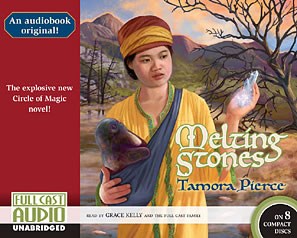
Melting Stone

Melting-Stones-Tamora-Pierce-unabridged-compact-discs-Full-Cast-Audio-books-MMelting Stone
By Tamora Pierce
Full cast audio
2007

This was interesting.

Tamora Pierce was a guest speaker at the National Book Festival this year and I was delighted. I was also somewhat shocked that the line to get a book signed by her started forming in front of the signing tent at least an hour before she gave her talk at a completely different tent, and several hours before she would start signing anything.

I’m pleased that she’s popular, but I think the kids in that line made a mistake in going for a signature rather than listening to her speak. She’s a wonderful and witty speaker, with a certain acerbic quality that I enjoy. Seeing her at the festival was also my first notice that her next book has come out: Battle Magic.

I put a hold on it at my local library and checked out Melting Stone.

I grew up reading Tamora Pierce and I still love her books, but I hadn’t gotten around to reading Melting Stone, in large part because it was a born-audio book. While it also came out in traditional book format, that was only after it was published as a full-cast audio-book: meaning each character was voiced by a different voice actor and some sound effects were included, too.

This is not the only thing that’s unusual about this book.  The main character, Evvy, was first introduced in a different book, Street Magic. Street Magic, in turn, in the second book that focuses on the character of Briar Moss. Both of those books focused on Briar Moss are single parts in four-book series. Melting Stone also references a lot of events that happen in Battle Magic, a book that was only just published recently in 2013, some six years later. It’s hard for me to tell exactly, given that I know this book series quite well and for some time, but I think this book was intended to be able to stand alone and even introduce the universe to a new generation of readers, who can then go back, if they’d like, and read the backstory of the original books, but don’t have to if they don’t want to, and can continue to read future books as they come out.

Anyway, it was fun, even though it was also intended for a younger audience even than most of Pierce’s books. As Kinsey noted in her last post, we all like reading YA fiction, but generally the audience of those books are teens or the particularly precocious, and the intended audience for this book was more elementary school.

One of the things I love about well-written fiction is that it’s often also well-researched and you can learn a fair bit of non-fiction facts along with enjoying a story with characters and plot-arch. This book, in particular, I thought did a good job of including some basic geology for kids.

So while I enjoyed the story and the characters, I was mostly interested in my own meta analysis of this book. Are audiobooks really becoming more mainstream and standard? Regardless of format, it’s rather brilliant of Pierce to break up the continuity a bit in order to bring in a new generation of kids. I wonder: are there people out there who grew up reading her books who are now introducing them to their own kids?

YA Book Battles and Sad Holiday Movies

It’s pretty clear that all of us here on Biblio-therapy are big YA fans–we may read and review other things, but we always come back to YA. Which is why we were so excited when Friend of the Blog Hannah pointed out Entertainment Weekly’s “What is the Best Young Novel of All Time” bracket game! You can see the complete bracket here. (And boy, do I love a good bracket–the bracket episode of How I Met Your Mother is one of my favorites. “I was there! Trust me! It’s Dead Baby!”) Voting started Monday so we’ve missed Round 1, which is probably all for the best because there were a few choices that seemed impossible. Anne of Green Gables or The Hobbit? I Capture the Castle or The Catcher in the Rye? Harry Potter or Holes? The Fault in Our Stars or Code Name Verity? I’m not sure what I would have done! (Okay, actually, most of those decisions are pretty easy: Anne, Castle, and Harry. But I am torn on the last one. Verity, I think, but I might have to read them both again before I felt truly comfortable with that decision.)

I’m going to keep an eye on the EW website for a while now, because I am looking forward to voting in the next rounds. But I do have one complaint (aside from the whole how-can-one-possibly-vote-on-art thing): some of these books are not YA. I understand that the lines can be a bit blurry, but in some cases, there is no blur involved. Dune is not and never was a young adult book. The Princess Bride? The House on Mango Street? Not young adult. And Prep? Just because a book is about teenagers does not mean it was written for teenagers. Plus it goes the other way, too–The Invention of Hugo Cabret is a straight-up kids book, and seems overmatched in this field.

EW did get it right by including The Book Thief, though, which is one of my favorite YA books ever. And last week I actually had the opportunity to see the new Book Thief movie (officially opening tomorrow). There are so many good things about the movie–all of the actors are just wonderful, especially Geoffrey Rush and Emily Watson as the main characters adoptive parents. And the whole thing has a beautiful look. But I wish they had been able to use those same people and sets and costumes and make a six-hour miniseries instead of a two-hour movie. The Book Thief is a long, complicated story, and so many things that had so much meaning in the book were brushed by in the movie because there simply wasn’t time. I am not one to get huffy about film adaptations of books–I tend to like seeing how the shift in format is made–but for me the movie had much less impact than the book. But then, the friend I was with who didn’t know the story, and who is not an overly emotional sort, started sobbing about halfway through the movie and never stopped, so maybe I’m a bad judge. There are a lot of lovely things about the movie, so I hope it does well in theaters. And I hope it inspires more people to go read the book, which is truly stunning.

Nonfiction Graphic Novels

I previously read Pyongyang and Shenzhen by Guy Delisle, and really enjoyed them, and when I saw that he also had books on Jerusalem and Burma, I was very interested in reading those, as well. I was living in Boulder at the time, though, and the local library didn’t have copies, so I backburnered it and of course forgot about it until a couple of weeks ago, when I thought to try my new library system, which happily had both! Jerusalem was available first, and when I went to go pick it up, I browsed the other offerings in the adult travel graphic novel section (a small section, certainly). I picked up Joe Sacco’s Palestine and Waltz with Bashir: A Lebanon War Story as well.

Being your typical clueless American, I hadn’t quite put together that all three books were pretty much talking about the exact same region. I had just figured that I am generally sort of confused over issues in the Middle East, and perhaps a graphic novel or three would be able to break some of the issues down in a way that I could understand. If libraries weren’t stringently against keeping rental records (for exactly this reason), I’m sure I’d be on some list somewhere.

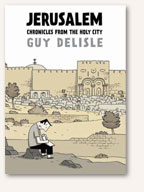
Jerusalem

By Guy Delisle

Book cover: JerusalemJerusalem is about twice as long as Delisle’s previous books, which is explained toward the beginning when he describes how he and his family are moving to Jerusalem for an entire year for his wife’s work for Doctors Without Borders. By this point, he has made enough of a name for himself as an author that he is spending the year solely working on this graphic novel, while also taking care of the children and doing the occasional lecture.

Delisle’s style is quiet and nonjudgmental. His strength as an author and illustrator comes from showing the reader these foreign cultures through his eyes as a traveling Westerner (he’s French Canadian), so it feels very personal. Several times, I laughed out loud, which is somewhat unusual in a visual media such as graphic novels, and two specific pages related to the other two authors of this blog: 1) Kinsey, apparently you are not alone in playing the game “Hipster or Priest”, and 2) Rebecca, I believe you, too, own some of the Helsing manga?

Like his previous books, this one focuses primarily on his own small, daily experiences trying to navigate a new culture, only referring to more global politics when it touches on him directly. For instance, a recurring theme throughout the book is him attempting and failing to get permission to travel into Gaza to lecture at a university there. In fact, after his fourth and final failure, he wonders if perhaps he is being mistaken for Joe Sacco, a reference that pleased me since I was reading his book next.

Palestine

By Joe Sacco

Book Cover: PalestineI have to admit that after Guy Delisle, Joe Sacco came as a bit of a shock and I was initially quite turned off. Like Delisle, Palestine is an autobiographic account of Sacco’s experience in Palestine, but where Delisle is quiet and personable, Sacco is loud, crude, and in-your-face. He is very clearly influenced by the R. Crumb school, which is not my favorite either, and I found his bold lines and clustered text boxes aggressive and claustrophobic. Sacco portrays himself as a bit of an asshole, self-centered and cowardly, and I initially took his word for it, but slowly began to think it is defense mechanism on his part, protecting himself emotionally from so many needy people that he is not in a position to help.

What finally sold me on the book is the sheer amount of information he has managed to pack into it. While I enjoyed Jerusalem more, Palestine gave me a much better understanding of the current situation, and the history that brought about it. As the title might reveal, the book is very much in support of an internationally recognized Palestine, which is not a perspective we hear much here in the United States, and it seems to me that it is an important perspective to hear.

Once I got over my initial bias, too, I started to notice that Sacco is a beautiful illustrator when he wants to be, drawing very detailed and delicately inked vistas depicting the scope of the conditions in the settlements.

Waltz with Bashir: A Lebanon War Story

By Ari Folman

Book Cover: Waltz with BashirI had initially picked this one up because the illustrations are beautiful, like little paintings in each panel. I was not real clear on where Lebanon is (I may or may not have thought it was in South America, the Texas public school system at work.) I had certainly never heard of Bashir before.

It turns out Waltz with Bashir was actually an animated film first (you can see the trailer here) and the graphic novel is made up of frames from the film. It also turns out that Lebanon is just above Israel, and Waltz with Bashir centers around the Israel Defence Force’s invasion of Lebanon. I figured that after the previous two pro-Palestine books, this would be my Israeli perspective.

The book (and film) is an autobiographical account of Folman attempting to recreate memories of his experience as a young soldier in the Israel Defense Forces during the 1982 Lebanon War, when Israel invaded Lebanon in order to install a pro-Israeli Christian government headed by the titular Bashir Gemayel. Folman knew that he had been stationed near the horrific Safra and Shatila Massacre (Christian soldiers under Israeli protection slaughtered between 762 and 3,500 Palestinian and Lebanese civilians), but had no memories at all of that time or place.

A friend of Folman’s, also stationed nearby, began having nightmares 20 years later, which inspires Folman to begin to dig into his own past. Clearly, it is not a happy book, and it, too, is quite critical of the Israeli military, so I am three-for-three on the pro-Palestine front. (If anyone wants to recommend a solid pro-Israel book on the subject, I’d be happy to check it out, though I’d prefer a graphic novel, clearly.)

Which brings me to my conclusion: while nonfiction graphic novels seem a little odd at first, they are palatable media for communicating very complex and charged information. There is no way that I would read a multi-hundred-page book, or even a dozen-page article, on the Israel/Palestine issue, but I happily and quickly ran through several hundred pages of these three comic books combined. They only made me marginally more informed, but they made me a lot less ignorant, if that makes sense. I don’t think that I could instruct someone else on the nuances of the various issues, but I know enough now not make pat judgments, either.

Burma Chronicles

By Guy Delisle
Book Cover: Burma ChroniclesDelisle’s Burma Chronicles came as a welcome relief after the building heaviness of the Israel/Palestine books above, though it is also Delisle’s most political book. He still writes very much in his first-person perspective, but Burma (or Myanmar, depending on your politics) has such a restrictive government that it interfered quite a bit in his daily life. Burma Chronicles takes place after Pyongyang and Shenzhen, but before Jerusalem; Delisle, his wife, and their infant son travel to Burma for his wife’s work in Doctors Without Borders. For the nine months that they are there, Doctors Without Borders attempts to reach outlying minority groups, with the government blocking their efforts until they eventually pull out altogether. This book highlights Delisle’s main charm for me: at the same time as he lightly touches on global politics, he shows us individuals in a very real light, so it becomes easy to look past the cultural differences and see the basic humanity underneath it all.

—Anna
The Shining Girls

As if the sudden chill in the air, the changing leaves, and the dark evenings weren’t enough to convince me that fall is officially here, my apartment building decided to get in on the action this week by setting up an ENORMOUS inflatable grim reaper in the lobby. It’s just decoration for the annual Halloween party, but it looms over you in an ominous way when you’re checking your mail. And speaking of things that kind of freak me out, The Shining Girls by Lauren Beukes is an excellent book to read to get you in the Halloween mood by scaring the bejeezus out of you.

Serial killers and their victims may seem like well-covered material, but this version has a twist–the killer has found a house in Chicago that allows him to travel through time, killing women in Chicago throughout the 1900s. But one of his planned victims survived, and she’s on a mission to figure out who attacked her, no matter how strange the answer might be. The action alternates between the killer and the survivor, and the tension builds as their stories converge. And the occasional chapter following one of the doomed women feel like tiny historical fiction stories, providing snapshots of life at various points in the twentieth century.

There are a lot of things that make me want to recommend this book, including a compelling mystery, a kick-ass female lead character, and a compelling first-person view inside the mind of the killer. But it is a very dark, very creepy, and at times hard to read–I had to stop reading it right before bed because it was giving me nightmares. Also, something bad happens to a dog. But if you’re looking for something to scare you a bit, this is a solid bet.

Kinsey’s (Approximately) Three Word Review: Criminal Minds meets Quantum Leap

You might also like:  Any of the mysteries by Tana French or Gillian Flynn–I know I recommend these two all the time, but they have a similar feeling. And Never Let Me Go by Kazuo Ishiguro has a similar mystery combined with a slightly different universe than ours.

Sin City Series

By Frank Miller

So, after reading Frank Miller’s A Dame To Kill For, I rewatched the movie “Sin City” and then decided to read ALL the Frank Miller Sin City graphic novels. I went on a wild reserving spree at the library; the library rental system just sort of lists “Sin City Frank Miller” for each of the volumes, so I had to do scattershot holds on all the books. I ended up reserving multiple copies of some volumes and no copies of the first volume until about a month after all the rest. So, I’ve been reading them as they come, completely out of order, but I’m going to quickly review them all in order here.

Quick caveat upfront: Frank Miller is not to everyone’s taste, so while I love the comics, I can’t indiscriminately recommend them to everyone. If you don’t like broad noir stereotypes and ultra violence, it doesn’t matter how well it is done, this is not going to be for you. For the rest of us, here’s my rundown, with semi-spoilers (revealing a character is in volume 5 sort of spoils that he doesn’t die in volume 4, I guess? Although, actually, only sort of. I was reading them out of their published order, but the volumes weren’t written in strictly chronological order, either):

Volume 1: The Hard Goodbye

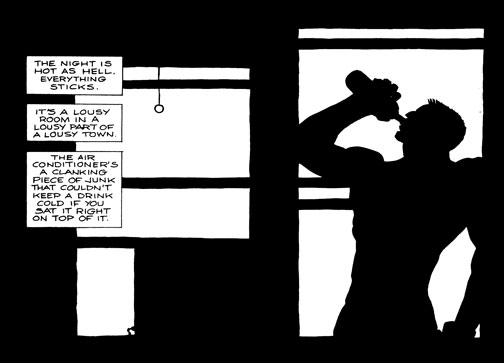
The first panel of the book and the series:

First Panel: Sin City

It doesn’t get more classically noir than that. Most noir mysteries are sweltering hot; sometimes they are bitter cold, but mostly roasting. Reading this issue last, I can tell that it was Frank Miller’s first (he is still finding his style for this series) and I can understand why it made such a splash in the comic book world. Everything is just so in-your-face: the violence, the machismo, the sex – I think it was probably unlike anything else people were reading at the time.

Book Cover: Sin City Volume 1

The Hard Goodbye is Marv’s (Mickey Rourke) story from the “Sin City” movie, the plot line with the most action but the least explanation, so I was happy to get more of the backstory this time around. With a couple of well-placed lines, The Hard Goodbye also gives a very quick overview of the origins of Sin City itself, which was most welcome after reading the other six volumes. At the end of this volume, too, I realized that The Hard Goodbye bookends at least several other volumes, with several of the subsequent volumes occurring to other characters within the span of time of this volume.

Volume 2: A Dame to Kill For

Previously read and reviewed here, inspiring this extended post.

Volume 3: The Big Fat Kill

Book Cover: Sin City Volume 3

The Big Fat Kill is Dwight’s (Clive Owen) story, starting with him in Shelly’s (Brittany Murphy) apartment while she argues with her ex-boyfriend (Benicio Del Toro). I kept thinking that I had already read this one, but then realized that it is literally the same as the movie, frame by frame, line by line. It’s really quite impressive.

It also made me appreciate the movie even more. By entwining volumes 1, 3 and 4, they made for a diverse group of characters and quick pace that the original comics seem to lack a bit in comparison.

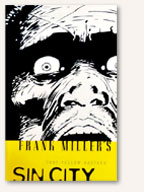
Volume 4: That Yellow Bastard

Book Cover: Sin City Volume 4

That Yellow Bastard is the Bruce Willis/Jennifer Alba story line from the movie. This is probably the most…problematic of the Frank Miller stories (and that is saying something). Spoilers for both the book and the movie, of course:

Continue reading

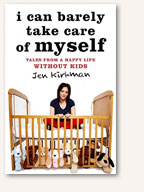
I Can Barely Take Care of Myself: Tales from a Happy Life Without Kids

By Jen Kirkman

Book Cover: I Can Barely Take Care of MyselfSo, I struggled a bit writing this review because this is a book-reviewing blog, not an autobiographical blog. But, clearly, I didn’t just pick up this book out of the blue, thinking, boy, I’d like to read more about comedian Jen Kirkman’s personal views on pregnancy and childhood.

Much like Kirkman, I have never felt a strong desire for children or even envisioned children in my future. Also like her, I have been told by people older than me, in very decisive tones, that I will change my mind when I get to be that age, and I guess I sort of believed them. I knew that I didn’t want children at the time, but accepted that I could change my mind (I’m a big fan of spinach now, and I wouldn’t have anticipated that when I was a kid, so, sure, tastes change) and that would be fine.

However, if I may put this delicately, I’ve come to the age, where perhaps sooner rather than later is a good time to plan for children, and I have experienced no change in my feelings. This really does seem to be a somewhat shocking aberration in our current society, and I thought it would be comforting to read someone else’s struggles with the same outlook.

So, I approached this book wanting a philosophical discussion on what it means to be a woman in our society who simply chooses not to have children. I was slightly disappointed right off the bat because it was no different than many other comedic memoires I’ve read, an overview of her childhood and young adulthood and what drew her to comedy; she’s funny and an engaging author, but it wasn’t what I was looking for in this particular book. About halfway through, though, she really delves into the subject of not wanting kids and her immediate surrounding’s reactions to that, and it was exactly what I wanted. I even understood that she had to set the stage before: that she was a normal kid, from a loving, intact family, with siblings who have happily chosen to have kids. There is no childhood trauma to be used as an excuse, and her lifestyle choice cannot be called a symptom of anything.

The most important thing that came out of the book for me is that she doesn’t ever explain exactly why she doesn’t want children, and I believe the truth is that she can’t. I certainly couldn’t, either. Can parents truly describe why they wanted children? I get that there are concrete reasons; I have concrete reasons, too, for not wanted children, but they aren’t really the whole story, or even most of it, are they? It is simply something deep down inside you that desires something, or does not. I have a million reasons why I don’t want kids, but reading this book helped me come to the understanding that they are all just extraneous excuses and it all boils down to the very basic truth that I simply don’t want them.

I have had various conversations about it with family, friends, and acquaintances, and found them all to be much more accepting than the conversations that Kirkman relates. Towards the end of the book, she goes on a bit of a screed about parents wanting to push everyone else to be parents, too. For me, though, reading this book made me more comfortable with my choice, but also more comfortable with people who chose to have children, as well. If my choice to not have children is deeply embedded in who I am (and it is), then their choice to have children is, too, and that is certainly something to respect and admire.

—Anna

P.S. – Jen Kirkman wrote a short column for Time Magazine, giving a brief overview of her book here.

P.S.2 – Jen Kirkman was also featured in the Boston episode of Drunk History, which I just love and you should definitely watch (but not at work)!

P.S.3 – A few days after reading this, I had a super realistic dream that I was pregnant and it was awful. Even in the dream, I thought “how ironic that after coming to a comfortable acceptance of not wanting children, now I will have one for the rest of my life.”

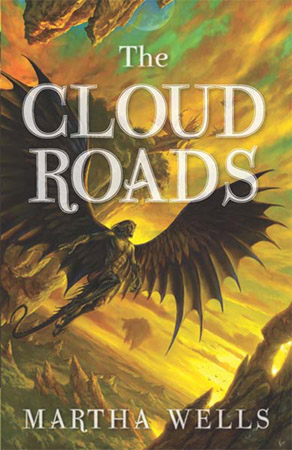
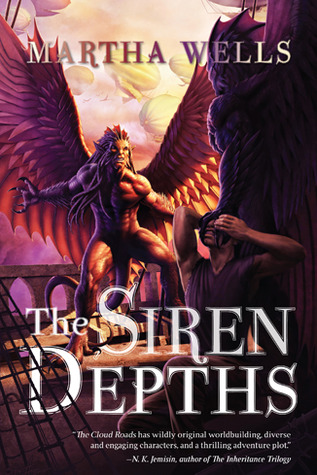
The Books of the Raksura

The Books of the Raksura
By Martha Wells

Raksura_TheCloudRoadsThe Cloud Roads
Feb. 2011

Raksura_TheSerpentSeaThe Serpent Sea
Jan. 2012

Raksura_theSirenDepthsThe Siren Depths
Dec. 2012

Please, please, let there be more coming soon!

So I started reading The Cloud Roads on the recommendation of an online friend and thought it was decent but not fabulous. My ambivalence was mostly due to the fact that most of what should have been unique about the world building, I’d seen before in either George Lucas’ Star Wars or in Bujold’s Sharing Knife series.  The characters seemed a trifle flat, although nothing out of the ordinary when the focus is on world building. The plot and character interactions were still fun, and I enjoyed it enough to check out the second book.

Half way through the second book, I put a request in at my library for book three. Then I finished book two, which ended perfectly satisfyingly with no cliff-hanger in sight, and yet I still desperately wanted to see more of these characters and this world, both (all?) of which had finally come into their own.

And then the third book was just as awesome as expected. Awesome!

And now I want more, more, more!

Anyway: the world Wells created is a complex one with an unknown number of sentient species all living in their own communities and groups, but also very much interacting. The bar in Star Wars, where Luke and Kenobi meet Han Solo would not be out of place in one of this world’s cities.

Our main character, Moon, is introduced while living with yet another group of people, trying to fit in with a species not his own. The trouble is that Moon doesn’t know what species he is. He lived with only his mother and siblings before he was able to care for himself, and they all died when he was still quite young.

In The Cloud Roads, the first book, Moon discovers his own people. Or rather, he is discovered by his own people. In The Serpent Sea, Moon settles in and finds his place among his own kind. And in The Siren Depths the comfort that he has found is challenged.

One of the things that particularly impresses me with Wells is the way she introducing the reader to a person and a culture who are decidedly not human and yet are completely sympathetic. Each book adds more layers of complexity and subtlety over the cultures and individuals, making them increasingly enthralling. I also love the way Wells plays with gender roles and how societal expectations vary from society to society and how even societies with established hierarchies always have to deal with a few exceptions. And Moon, as both our main character and an outsider to all societies, gives the reader a wonderfully bemused perspective on it all.

If you want a taste of these books, the first chapter of each book is available online. In addition, Wells has posted a short story, The Forest Boy, which shows Moon as a kid, before the start of the books.  (She also has other short stories and missing scenes posted, but the others should wait until you’ve caught up to those events in the books.)

Overall, they’re just kind of adorable books with wonderfully nuanced takes on some standard tropes. And I really hope there’s more soon.

Predictably Irrational

Predictably IrrationalPredictably Irrational: The Hidden Forces that Shape Our Decisions
by Dan Ariely
2008
read by Simon Jones

I took a couple of courses in grad school about the information business, which is a growing industry that deals with the interesting paradox of having to use information as both a marketing tool and a product. It’s fascinating and complex, but was also my first introduction as an adult to standard economic theory.

Both my immediate and ongoing reaction is: standard economic theory is idiotic. It’s just blatantly false, based on two assumptions: 1. All decisions made by individuals are rational. 2. All those rational decisions are made with the primary goal of increasing that individual’s personal financial wealth.

Standard economic theory has a real hard time trying to explain nonprofits. Or, you know, families and friends.

Ariely is one of the active researchers opening up a new field of study: Behavioral economics. This is a field that comes out of psychology more than economics, and it looks at how people actually make decisions. (And is something of a balm to my soul after trying to comprehend what regular economics think.)

How do biases work, or habits form? How do our decisions change when we have an audience or not? Rather than always acting rationally, how do we rationalize some of our less acceptable behaviors?

He studies this, and he does so through a series of small experiments. (His students at MIT should really have started to be suspicious of some of his odder requests.  And I imagine the neighborhood kids roll their eyes at this point.)

It’s an excellent book, with a great deal of humor to it, but also caused a certain amount of introspection as I thought about how I make my own decisions, and a certain amount of horror, given the current political state of my country, in regards to how politicians make their decisions.

I highly recommend this book. My three word review: funny, fascinating, and important.