The Bible: Kings 2

And here in Kings 2, we continue the rundown of the various kings of Israel and Judah, along with their rather fraught relationships with the kings of Moab, Egypt, Syria, Assyria, and Babylon, plus a note on how God is judging them (hint: mostly sinful.)

Once more, the chapters that discuss the various kings of Israel and Judah generally end with the direction that more information about that king is available in The Annals of the Kings of Judah, or The Annals of the Kings of Israel.

Also the prophet Elisha gets a lot of stories:

Chapter two: A chariot of fire comes to take the prophet Elijah bodily up to heaven. The devoted assistant/apprentice Elisha becomes an even greater prophet (and sends bears to kill 42 men who mocked his bald head. – Kings 2 2:23)

Chapter four: Elisha is a prophet and, among other miracles, raises the dead.

Chapter five: Elisha cures a leper but refuses a reward. His assistant Gehazi sneaks around in order to con the reward out of the former-leper, and Elisha curses Gehazi with the leprosy himself.

Chapter six: Elisha spies on the Syrian king via prophesy and then leads a troop of Syrian soldiers intent on kidnapping him to Samaria, has them given the food and water offered to prisoners of war and then sent on their way back to Syria.

Chapter seven: Elisha breaks a siege by scaring away the Syrian troop besieging Samaria to the extent that the troops even leave all their supplies behind and the starving Samarian residents feast, except for an unbeliever who gets trampled to death.

Chapter thirteen: Elisha dies an old man and is buried, but later some Moabite bandits went to bury one of their own dead in his tomb, but as soon as the dead bandit came in contact with Elisha’s bones, he came back to life. Wowza.

As for the rest, there’s a continuation of the various Kings, each of which have their own stories that mostly involve being invaded by various other kings.

Kings of Israel

  • King Ahaziah (son of King Ahab, fell off a porch, broke his leg, and died) (sinful)
  • King Jehoram* (son of King Ahab, brother of King Ahaziah) (sinful)
  • King Jehu**** (son of King Jehoshaphat of Judah) (sinful)
  • King Jehoahaz (son of King Jesu) (sinful)
  • King Jehoash + (son of King Jeheoahaz) (sinful)
  • King Jeroboam II *****(son of King Jehoash) (sinful)
  • King Zechariah (son of King Jeroboam II, king for only six months before he was assassinated by Shallum) (sinful)
  • King Shallum (king for only a month before he was assassinated by Menahem)
  • King Menahem (sinful)
  • King Pekahiah (son of King Menahem) (sinful)
  • King Pekah (assassinated King Pekahiah) (sinful)
  • King Hoshea (assassinated King Pekah) (sinful)

King Shalmaneser of Assyria invaded in King Hoshea’s seventh year. Three years later, Samaria is conquered and the people of Israel are taken from the land (due to their sinfulness). This happens in the sixth year of King Hezekiah of Judah.

And thus ends the Kings of Israel.

Kings of Judah

  • King Jehoshaphat
  • King of Joram* (son of King Jehoshaphat) (sinful)
  • King Ahaziah (son of King Joram) (sinful)
  • Queen Athaliah ** (mother of King Ahaziah) (unstated)
  • King Joash *** + (son of King Ahaziah) (virtuous but also sinful?)
  • King Amaziah (son of King Joash) (mostly virtuous)
  • King Azariah (aka King Uzziah?) (son of King Amaziah) (mostly virtuous)
  • King Jotham (son of King Azariah) (mostly virtuous)
  • King Ahaz (son of King Jotham) (sinful)
  • King Hezekiah (son of King Ahaz) (virtuous)
  • King Manasseh (son of King Hezekiah) (extremely sinful)
  • King Amon (son of King Manasseh) (sinful)
  • King Josiah (son of King Amon) (extremely virtuous)
  • King Jehoahaz (son of King Josiah) (sinful)
  • King Eliakim aka King Jehoiakim (son of King Josiah, puppet to Pharoah Neco) (sinful)
  • King Jehoiachin (son of King Jehoiakim) (sinful)
  • King Mattaniah AKA King Zedekiah (uncle of King Jehoiachin, puppet to King Nebuchadnezzar of Babylon) (sinful)

Judah is essentially destroyed after King Mattaniah attempts to rebel. All the remaining population left for Egypt as refugees. Some 37 years after King Jehoiachin is dethroned and replaced by King Mattaniah, the new king of Babylon, King Evilmerodach releases Joehoiachin from prison, gives him a regular allowance and a seat at the table of kings.

And thus ends the listing of the Kings of Judah.

Summary: There are a lot of Kings of Israel and Judah, most of them were sinful, but they each get little stories of their lives and troubles. It’s kind of overwhelming as the two sets of kings are tracked in relationship to each other.

Moral: Punishment is coming. It doesn’t matter if you weren’t aware you were sinning, and apologizing might postpone the inevitable a generation or more, but punishment is definitely coming.

* The edition I was using of the Living Bible actually had several typos here and confused King Jehoram with King Joram and it made a confusing situation even more so. I cross-checked with a copy of the New English Bible to figure out who’s who.

+ The edition of the Living Bible also uses Joash for both King Joash of Judah and King Jehoash of Israel. Trying to figure out who’s doing what is incredibly frustrating.

** When she learned of her son’s death, she had all of his sons (her grandsons) killed, so that she could rule instead.

*** He was hidden in a temple as an infant and raised there in secret for seven years.

**** This was a crazy drive-by anointing. Elisha tells one of his younger prophet students to go get Jehu away from his friends, dump a bottle of holy oil over his head, tell him that he’s been chosen as the new king of Israel, and then the young prophet needs to run for his life to avoid being killed in the fallout. (chapter 9).

***** Kings 2 14:25 references the prophet Jonah (son of Amittai) the prophet from Gathhepher. Jonah apparently saw the various failures of King Jeroboam II. Was this the Jonah of Jonah and the whale? I have no idea.

Next up: Chronicles I

For a quick laugh: 3 Fanfiction plus 1 Nonfiction

It’s been a while since anyone’s posted, so I’m going to recommend four short stories that are crazy good for a laugh. Two of them are so short that they don’t even have titles, but still, go read them!

LINK for FIC
by kyraneko

Fandom: crossover between State Farm Insurance Commercials and All State Insurance Commercials

Original Inspiration for Fic: “Like a good neighbor, State Farm is there” we chant, and another agent appears in the pentagram. He screams. The Dark Lord feasts tonight.

LINK for FIC
by paginationline

Fandom: Marvel’s Avengers comic books

Original Inspiration for Fic: “Clint.”
“I know—“
“You have the army after you and no health and you’re falling out of a crashing plane.”
“I know, Nat—“
“It’s a bass fishing simulator, Clint.”
“I know! It just—it just happens!”

LINK for FIC: Your Highnessness
By shadydave

Fandom: crossover between Guardians of the Galaxy and Jupiter Ascending

Summary: A long time ago, in a galaxy far, far a—
Yeah, I know that’s not when it happened, but that’s how you start this kind of—
I don’t know, do I look like George Lucas?
No, he made the movie. No, it doesn’t have Kevin Bacon. Not everything has Kevin Bacon!
Of course it’s still good!
Fine, you dicks. If you think you know better than one of the greatest stories of the human race:
A short time ago, in this galaxy…

LINK for FIC: So I used to be a martial artist
By textuallyaroused

Fandom: nonfiction, autobiographical

Example paragraph: Now, Sensei Diven was not a stupid man and he hated high-ranking kids that showed a bad attitude. This kid had a bad attitude. So he must have seen the evil gleam in my eye from a mile away and decided it was time for a little improvisation.

Non-Post-Apocalyptic YA Omnibus

We are big fans here at Biblio-therapy of YA books, and we’re big fans of sci-fi/fantasy/urban magic/werewolves and vampires/teenagers living in a post-apocalyptic wasteland books. And after The Hunger Games, the publishing industry turned out so many YA fantasy novels that you could have used them all to build a compound to protect yourself from the inevitable zombie hordes. There’s even a parody Twitter account–Dystopian YA Novel, brought to you by them same writer as the genius Guy in Your MFA account that Anna mentioned recently–gently mocking some of the Katniss stereotypes that have popped up. I have read many many many of these books, and the recent Divergent movies have reminded me of my love for world problems that can only be solved by teenagers. But sometimes you don’t want to read about the savior of the remains of the human race and her love triangle, you just want an old school YA romance book. I’ve recently read three YA books that are, well, it’s not fair to call them simple, because they’re all well-constructed, thoughtful books, so let’s say straightforward. Teenage boys and teenage girls and high school and parents and all that stuff we’ve all dealt with, minus any future overlords or factions or teenage warriors.

How To Love by Katie Cotugno tells the story of Reena and Sawyer, long-time family friends, who get together in a terribly romantic fashion, but she gets pregnant, and he leaves homes without realizing that she’s having the baby. Two years later he shows up again–how will Reena and Sawyer and their complicated, prickly families put all these messy pieces back together? (The story moves around in time, so this isn’t really spoiling anything.) My favorite thing about this story is that it would be very easy for the book to be judgmental about Reena getting pregnant as a teenager. And there are characters who judge her for it, and she sometimes judges herself, but the book itself is very neutral and (thankfully!) does not turn into an anti-teen pregnancy PSA.

Althea and Oliver by Cristina Moracho first won my love by being set in the mid-1990s, time of my youth. But that’s really secondary to the plot, about two childhood friends who might be moving towards more. There’s a whole thing where Oliver has a weird sleep disorder, and Althea might have another boyfriend, but their relationship is the heart of the book and it rings true. Althea and Oliver also both feel real, while at the same time being unlike other teenager characters I’ve read.

Finally, All the Bright Places by Jennifer Nevin is the book I am wariest of recommending for a couple of reasons, but I’m including it because I’ve kept thinking about it days after finishing. This is another boy-meets-girl story, but it starts out from a darker place that you might expect and doesn’t get much brighter, despite the title. The point of view alternates between high-school students Violet and Fitch. Violet, in particular, came across as a very cool girl I would like to be friends with, and the politics of high school were felt painfully accurate. But I also found the character of Fitch unbelievably annoying–like, every smart-ass guy I have ever hated all rolled into one. I also hesitate because something happens at the end of the book that I found very upsetting. I know not everyone is a delicate flower like I am when it comes to books, but I hate to recommend something that will be disturbing to readers. I don’t want to give away any critical elements of the book, but if anyone wants more spoiler-y details, I’m happy to be more specific in the comments. So, as long as you’re prepared for things to turn a bit dark and Afterschool Special, the writing and characters definitely stand out.

I should say here that all of the books get pretty R-rated. Characters have sex. I mean, I’d rather my hypothetical children read any of these well-written, full-of-heart stories than Twilight or the Sweet Valley High books that I read as a kid. But I probably wouldn’t give these to any of the children I know without making sure their parents had read them first.

Finally, have you read Eleanor and Park by Rainbow Rowell yet? If you haven’t read Eleanor and Park, go start your YA reading with that, since it remains one of the best things–YA or anything else–that I have read in years.

The Darkest Part of the Forest

darkest partThe Darkest Part of the Forest
By Holly Black
2015

Since I really enjoyed The Coldest Girl in Coldtown, I started paying more attention to Holly Black. This book didn’t hit me quite the same way, but it is still a fun read. There’s something really pleasing about her heroines in both books: they know what they want and they go after it. Even when they flounder about a bit, there’s a certainty to them that I like.

Hazel, the main character here, occasionally (okay, more than occasionally) makes idiotic decisions, but she does so with a purpose. It’s always understandable and I’m often left wondering if maybe she’s right. And when she’s wrong, she acknowledges it, which is another rare and attractive quality. I didn’t feel much of a connection with Hazel (it’s possible I’m aging out of YA, at least a little bit), but I liked her.

The book also provides an interesting look at how easily some pretty horrific things can be normalized such that both the characters in the book and the reader reading the book don’t think too much about it… until someone points out that, wait, no, what you had been accepting for so long is actually not acceptable.

Only the most obvious example of this is how cruel, tricky and magical the fae are, but also how accepted they are in the town of Fairfold. They’re a dangerous and disturbing part of life in this town. People just carry on… until they can’t anymore.

The Bible: Kings 1

This book is literally a listing of the various Kings of Israel. This is clearly a summary of events and many of the chapters end with a citation: For more information about King [whatever king this chapter discussed] see The Annals of the Kings of Judah, or The Annals of the Kings of Israel. These are apparently both lost books, with no known copies still in existence.

Anyway, at the start of this book, King David is old enough that it is time (again) for his sons to fight over the succession.

King David’s son Adonijah apparently decided that it was better to ask forgiveness than permission and went ahead and arranged his own coronation. (With Joab’s support, too!) With some prompting from his wife, Bath-sheba, King David immediately arranges for the officially recognized coronation of their son Solomon.

King David dies but not before reminding Solomon of all the betrayals he (David) suffered and all the people he (David) promised not to kill, but reminded Solomon that those promises would not bind him (Solomon). Thus there’s no surprise that Solomon starts off his reign with ordering a variety of deaths (chapter 2). After that, Solomon prays for the wisdom necessary to rule the land, which God grants (chapter 3).*

After some talk about how wise King Solomon now was, there’s a lot of description of the temple he has built to hold the Ark of the Covenant. It was built with much cedar wood (as a gift from King Hiram of Tyre) and gold and brass in a very specific design (chapters 5 thru 7) and then consecrated with much worship and sacrifice** (chapters 8 and 9).

Chapter 10 is about Solomon’s wealth and Chapter 11 is about his virility with his 700 wives and 300 concubines. However, it also talks about how he let some of those wives worship gods who were not the one God and thus he sinned started a pattern of sinful behavior in the line of kings. God decides that in punishment, Solomon’s son would only rule over only one of the tribes of Israel and be king in Jerusalem, while a man named Jeroboam would rule over the remaining ten tribes as king over Israel.

The next eleven chapters (chapters 12 thru 22) list the various kings who ruled and the ways in which they variously offended God and tried to kill one another.

Kings of all Israel:

  • King David
  • (King Adonijah, son of King David – had himself anointed king without his father’s blessings)
  • King Solomon (son of King David) (sinful)
  • King Rehoboam (son of King Solomon)*** remained king of the tribe of Judah

Kings of Judah:

  • King Rehoboam (sinful)
  • King Abijim (son of King Rehoboam) (sinful)
  • King Asa (son of King Abijim) (faithful)
  • King Jehoshaphat (son of King Asa) (faithful?)
  • King Jehoram (son of King Jehoshaphat) (unstated)

Kings of Israel (minus Judah):

  • King Jeroboam (sinful)****
  • King Nadab (son of King Jeroboam) (sinful)
  • King Baasha (having assassinated King Nadab) (sinful)
  • King Elah (son of King Baasha) (unstated)
  • King Zimri (having assassinated King Elah) (sinful)
  • King Omri (having defeated General Tibni the other claimant after King Zimri’s suicide) (even more sinful than Jeroboam!)
  • King Ahab (son of King Omri) (even more sinful than King Omri!)*****
  • King Ahaziah (son of King Ahab) (sinful)

While there’s all sorts of civil unrest within each of Judah and Israel as well as between them, there’s also all sorts of conflict and temporary alliances with the various kings of Syria.

And thus we are through Kings 1 and thus on to Kings 2.

Summary: There have been a lot of kings of Israel and Judah and most of them have been sinful. Most of the sins, however, have had to do with allowing the worship of idols rather than regarding their tendencies towards killing one another.

Moral: There’s a lot of sinning going on here, but punishments for those sins is largely hit or miss.

* Chapter 3 contains the famous story of Solomon’s wisdom in which two mothers are claiming an infant child is theirs. King Solomon orders the baby to be cut in half so that they can each have half. The woman who protests that decision is identified as the actual mother. Given Solomon’s recent history, it’s no surprise that the two women involved absolutely believed that King Solomon would be more than willing to cut a baby in half.

** 22,000 oxen and 120,000 sheep and goats were sacrificed at the temple over the course of 14 days. This comes to a bit more than 7 animals killed every minute for 14 days. Oof.

*** The people of Israel asked King Rehoboam to be a kinder taskmaster than his father, to which he responded along the lines of: you only thought you had it bad under Solomon. I’ll work you to the bone and whip you till you bleed. They decided not to accept him as their king after all.

**** King Jeroboam didn’t want his people going to Jerusalem to worship since King Rehoboam remained king of Jerusalem even after Jeroboam took over the remaining ten tribes. Thus, Jeroboam made a bunch of local temples with local priests for his people to worship at and thus horribly offended God. For a while, Jeroboam is the benchmark for the sinfulness of all other kings.

***** King Ahab was so wicked that he gets chapters 17 thru 22 to recount some of his evil deeds which include marrying Jezebel and worshiping Baal. The prophet Elijah comes in here to, first, announce the coming of a drought and, second, to demonstrate the non-existence of Baal. He also arranges the slaughter all 450 of the prophets of Baal, who had been under Jezebel’s protection. Eventually, Ahab was so terrified of a prophesy Elijah made that he rent his clothing, fasted, and wore sackcloth, such that God decided to punish Ahab’s children instead of him.

Next up: Kings 2

Twitter links

I’m currently reading a couple of Kinsey’s recommendations, so in the meantime, I thought I’d pass along a couple literature-related twitter feeds for recommendation:

Guy In Your MFA (@GuyInYourMFA)

Profile summary: “Two re-writes away from finishing the Great American Novel. Maybe about a 20-something in Brooklyn?”

Laugh at this guy, so that you don’t kill the actual guy in your MFA (or writing group).* Also, at www.guyinyourmfa.com, if you aren’t into Twitter. He has a buzzfeed quiz on how many books by white men have you read, and for the first time, I was proud to have read as few as I had.

The Worst Muse (@WorstMuse)

Profile summary: “No, seriously, go for it. It’ll be a bestseller.”

A long and hilarious list of what not to do in your writing.

—Anna

*Or the guy just this morning holding up the line at Starbucks while he explained to the baristas that he is a Writer (emphasis his) and so really pays attention to people and conversations and cultural transitions, and used that as an excuse to inquire into all of their ethnic backgrounds in a really uncomfortable way.

The Bible: Samuel 2

It’s been a while since my last Bible post, but I am determined to get through the whole thing, even if there is no way I’ll manage my original finish-it-in-a-year goal. (It seemed so easy at the time!) Anyway:

Apparently the reason why there are two-part books in the bible sometimes (Samuel 1, Samuel 2; with Kings 1, Kings 2 and Chronicles 1, Chronicles 2 to come) is because these books were too long to be written on individual scrolls as they originally were. These books are literally scroll 1 of the text and scroll 2 of the text, separated into two parts for practical convenience rather than from narrative intent. This explanation helps a lot with understanding the naming conventions because by the time we get to Samuel 2, the character Samuel is dead some chapters back.

In Samuel 1, we are introduced to David as the plucky rebel who is gets quite the reputation for defeating enemies and surviving assassination attempts by King Saul, and being generally much beloved by the populace.

In Samuel 2, David is now king and it’s maybe a lesson that plucky rebel types do not necessarily make the best kings. In particular, the king in these circumstances (intermittent civil war and periodic invasions) needs to be fairly ruthless (according to his advisers.) If he’s not willing to kill potentially traitorous friends and family, then his advisers are more than willing to do so in his stead and against his wishes.

At this point we’ve got an emotional king who will dance lasciviously in the streets when he’s happy (chapter 6), rend his clothes and refuse to eat when sad (chapter 12), and willing to send a soldier on a suicide mission so as to marry the widow (chapter 11). He’s supported by Joab, a politically practical and ruthless adviser more than willing to kill people with whom the king has already promised peace. The neighboring kingdoms are understandably wary.

Also, King David’s son Absalom tries to take over, and part of this is sleeping with all of his father’s wives. Urg. There is much conspiring by various individuals on both sides. King David, however, manages to send out his army to fight Absalom’s army while also instructing his army to be gentle with his son.

So King David’s army manages to defeat Absalom’s army and find Absalom* but then sort of wander around wondering what to do about the guy who just lead an unsuccessful rebellion but who their king wants treated gentle. Joab pulls out his daggers and kills Absalom where he hangs (chapter 18). Then Joab rides back to Jerusalem, where King David is in deep mourning for his son Absalom. Joab tells him that David is going to stop that mourning, get up and start celebrating with the returning troops or Joab is going to be leading the next rebellion. King David hops to it (chapter 19).

Anyway, civil unrest and external warfare continues, and King David sings a song of praise for the lord that is particularly questionable given the juxtaposition with actual events.

Plus, in chapter 24, David decides to hold a census, Joab argues that counting the population is an insult to God, and God is so incensed by David’s decision to go ahead that he sends a plague to kill 70, 000 men over the course of three days. David builds a special alter to the Lord and the plague finally stops.

Summary: David makes for a wishy-washy king and there is a bunch of civil unrest.

Moral: I don’t even know.

* Absalom managed to ride his mule under a tree, get his neck caught on a branch, and have his mule wander off without him. He’s just sort of swinging there trying to get down while his father’s army wonders what to do about him. Hahahaha!

Next up: Kings 1

Fresh Off The Boat

By Eddie Huang

Book Cover: Fresh Off The BoatEddie Huang is funny and smart and has a really interesting story and perspective on life, but he’s also kind of an asshole.

He wrote his memoirs a couple years ago, which inspired a new sitcom just this season. Reading a review of the sitcom, I figured the book would be an interesting account of a first generation American’s experience. And it is. What it doesn’t really seem to be is material for a sitcom. As I got further in the book, I was more and more confused about how on earth they were going to make this family-friendly. Like, Huang’s family is all sorts of crazy, with some serious abuse problems to boot, and Huang has more than a few thug tendencies.

A lot of the story has been left out of the sitcom, naturally, but some has just been cleaned up. In one episode, the grandma teaches Eddie’s little brothers to play poker and promptly fleeces them of all their toys. It is a cute scene (my favorite part is when they appeal to their mom to get their toys back, she solemnly tells them that their grandma won them fair and square), but the reality is that Huang’s grandma had a gambling addiction that impoverished her husband and son.

Huang talks a lot about how meaningful he finds hip hop and the hip hop culture. I hadn’t ever thought about it like this, but he says that growing up in a chaotic and abusive household (his parents went far past the point of just being traditionalist; the children’s school reported the family to child protective services), the rhetoric used in hip hop about hard living on the streets gave him a frame of reference for his abuse at home. So, I found that to be a very interesting perspective, if not one that I could always understand.

Sports, basketball in particular, are also an important part of his life, and he discusses that at length, as well. Again, interesting, but not much relevance to my own experience.

What I could really relate to, though, was when he starts talking about food. He describes wanting to make a traditional American Thanksgiving (amusingly, his mother turned her nose up at most American food, but became a fan of green bean casserole), and watching a bunch of Food Network for research before settling on a combination of brining and infused herb butter under the turkey skin, which almost exactly replicates one of my first Thanksgivings on my own.

It is also through cooking that he was able to create his own identity and find a place in society that he was comfortable with, after many, many years of acting out. Similar to other memoires I’ve read by people in their 30s, relating their road to eventual success, the vast majority of the book is spent on the early struggles, with the success sort of just coming together at the end. I guess I’d prefer a somewhat later memoir that gives a little more attention to maintaining the point of success once it has been achieved.

—Anna

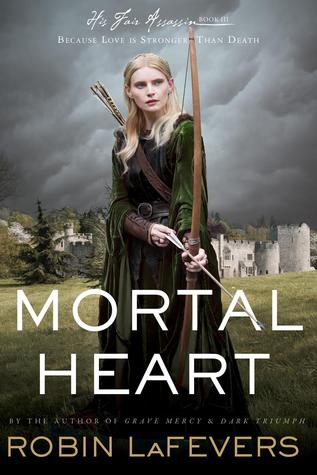
Mortal Heart

MortalHeartMortal Heart
by Robin LaFevers
2014

I started reading the His Fair Assassin trilogy after Kinsey reviewed the first book, and since Anna reviewed the second book, it seems fitting that I review the third book.

This is a fun series and I enjoyed all the books, each of which focuses on a different main character. However, of the three main characters, Annith, the focus of Mortal Heart is the one I find the most annoying. For all her capabilities, she’s really extremely naïve, especially given her history. I continually reminded myself that she was just 17 and a lot of people are gullible at that age. As the book progresses and there are plots and reveals, I would routinely see the issue significantly before the main character even though we’re seeing the same evidence. I also felt a bit of a letdown at the end because I saw a potential way for one of the plot arcs to be resolved in a really fabulous way and instead it was sort of semi-resolved in an okay way.

One thing I really enjoyed about this book was the look it gave into what the other eight gods of the old religion have been up to and how their chosen people are marked and what they do with them.

While the grand political conflict seems to have mostly worked itself out over the course of the three books, what happens next regarding the actual convent of assassin nuns is left so very open-ended that it makes me wonder if there might be a fourth book in the planning stages. I haven’t been able to find any mention of one though.

It was an okay book, but I did like the previous ones in the series a lot more. If there is a fourth book, though, I’ll definitely read it to see what happens.

Thug Notes

Like Anna, I’m a bit embarrassed to make this next recommendation during Black History Month because while this is awesome and by black creators and celebrating black culture, it shouldn’t be restricted to just the one month. This isn’t just awesome within the context of black culture, it’s just plain awesome.

Thug Notes is a YouTube series of videos and it is AWESOME! And I really wish it had been available when I was in high school. These videos take classic books and, in about 5 minutes each, summarizes the plot and talks about the main literary analysis.

  • Great Expectations, which I slogged through in high school and just got entirely bogged down in the details, laid out nice and neat in 5 minutes.
  • Lord of the Flies, which I never managed to get past the first page of, broken down for me and presented.
  • Pride & Prejudice, which I have read way too many times and absolutely love, getting shown in a new light that I hadn’t noticed before.

What makes them particularly funny is that they’re all narrated by Sparky Sweets, PhD, coming at you from the Houston Rap subculture and he is keeping it real about what these homeboys of literature are up to, from a set straight out of Master Piece theater with all of its proper British overtones.

The implied culture clash is hilarious mostly because no clash is ever actually realized. As Jared Bauer, one of the creators, says:

The idea behind Thug Notes was always that ‘the joke is that there is no joke…’ because the analysis is just so accurate and so smart.

There are 64 of them (so far) and they are just brilliant. Go check them out!