Reading about Race

More and more, I think the best way that a white person can be supportive of the ongoing civil rights battles is to shut up* and just listen (and read) as much as possible to understand what is really going on in a side of society that we too often overlook. I’ve read a few very powerful articles online that I want to recommend; they are not easy reads, but they are really important.

First, Carvell Wallace’s Letter To My Mother After Charleston on The Toast really brings home how pervasive violence against people of color is and how dismissive it is to try to frame the massacre of the Mother Emanuel 9 as a one-off act by a psychopath, as many media outlets are doing.

For those few who don’t know, the South Carolina state flags were lowered to half-mast after the massacre, but the Confederate flag continued to fly at full-mast. The call to remove the flag from all government sites is overwhelming, and you can join over 500,000 signatures on MoveOn.

In the discussion about the Confederate flag, The Washington Post published Five Myths About Why The South Seceded, and debunks the argument that the Confederate Party seceded over states’ rights, taxes, or really anything other than slavery.

Our position is thoroughly identified with the institution of slavery — the greatest material interest of the world,” proclaimed Mississippi in its own secession declaration, passed Jan. 9, 1861. “Its labor supplies the product which constitutes by far the largest and most important portions of the commerce of the earth. . . . A blow at slavery is a blow at commerce and civilization.

Expanding on The Washington Post’s article, The Atlantic published What This Cruel War Was Over, using the Confederacy’s own words to prove that their flag symbolized exactly what Roof claimed in his own manifesto. The quotes are appalling to the extent that I began to feel physically ill. From Mississippi** Senator Albert Gallatin Brown in 1858, orating on US expansion into Central America:

I want Cuba, and I know that sooner or later we must have it. If the worm-eaten throne of Spain is willing to give it for a fair equivalent, well—if not, we must take it. I want Tamaulipas, Potosi, and one or two other Mexican Stats; and I want them all for the same reason—for the planting and spreading of slavery.

And a footing in Central America will powerfully aid us in acquiring those other states. It will render them less valuable to the other powers of the earth, and thereby diminish competition with us. Yes, I want these countries for the spread of slavery. I would spread the blessings of slavery, like the religion of our Divine Master, to the uttermost ends of the earth, and rebellious and wicked as the Yankees have been, I would even extend it to them.

I am ashamed that while I had understood that slave holders viewed slaves as less-than-people and that ownership of them was their right, reading in their own words that they viewed slavery as a cornerstone of civilized society and even a religion to be evangelized boggles my mind. It is disgusting and disturbing, but still better to know the truth than cling to ignorance.

—Anna

*Ugh, this is so difficult. I mean, of course, add your voice to mass protests and such, but there is a real tendency for white voices to try to direct the messaging and that needs to stop.

**Not to single out Mississippi, since there are truly wretched quotes from all the Confederate states, but also to quote Nina Simone: Mississippi Goddam
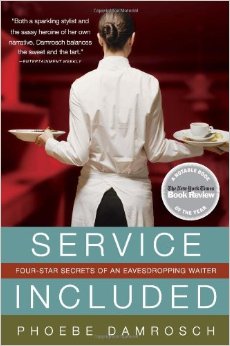
Service Included by Phoebe Damrosch

ServiceIncludedService Included: Four-Star Secrets of an Eavesdropping Waiter
by Phoebe Damrosch
2007

The subtitle is misleading: while there was one chapter that told some stories about some of the wacky customers, the focus was really on the professional (and sometimes personal) life of a high-end waiter. It’s fascinating. It’s eye-opening, nonfiction, and really makes me reassess my experiences at various restaurants. I don’t tend to go to the high-end restaurants like Per Se, where Damrosch worked, but I imagine much of the same structure is true in a watered-down fashion in other restaurants.

Also, the food descriptions are mouth-watering. Even when the descriptions were of food that I don’t generally care for, wow, I wanted to try them out because it sure sounds like this place would be doing them in a way that all people would like. I want to try these dishes! And I really want to visit Per Se to experience them.

I could have done without the sections focused on Damrosch’s adventures in dating, but it was still well written with humor and humility. I just found it somewhat soap-opera-like and an unwanted break from the intricacies of the high-end service industry. It’s possible and even likely that other readers will enjoy those sections, though.

I still don’t understand the interconnected budgets of the restaurant, the service staff, and New York living, but I assume it’s all based on the incomes of the regular clientele who apparently might spent $20,000 on dinner. (After reading this book, I looked up the Per Se website and confirmed that a regular dinner without wine is a fixed price of $310, which is within the realm of possibility if I save, in contrast to the $20K that is just not.)

Damrosch also includes tips on how to interact with service staff, most of which I already knew, and some of which I (rather embarrassingly) did not.

Anyway, this is a fabulous book and I definitely recommend it.

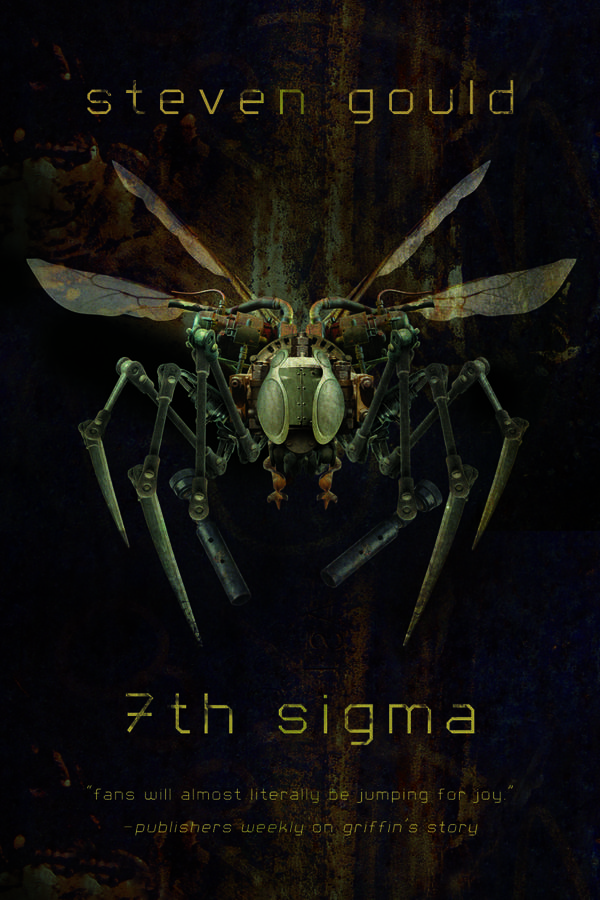
7th Sigma by Steven Gould

7thSigmacoverart7th Sigma
by Steven Gould
2011

This was a fun and interesting science fiction book that was mostly a character study, with the science fiction largely a backdrop for the Wild West atmosphere. Most of the chapters are essentially stand-along short stories about what our main character, Kim, is getting up to.

In many ways, this book reminded me of Zenna Henderson’s The People series, what with the mixture of high-tech knowledge and low-tech life and the overall theme of people being people. Much more blatantly, the story is also heavily influenced by, or possibly a re-write of, Rudyard Kipling’s Kim. It’s been a while since I read that and don’t particularly remember it, but I do think they suffered the same issue: Kim as a child is adorably precocious; Kim as a young man is somewhat irritatingly perfect.

Luckily, as Kim grows older in 7th Sigma, the world building also begins to expand, so it balances out and I enjoyed the book as a whole. I do wish there were more, because the world building was pretty fascinating and I wanted to see the implications of one of the final reveals.

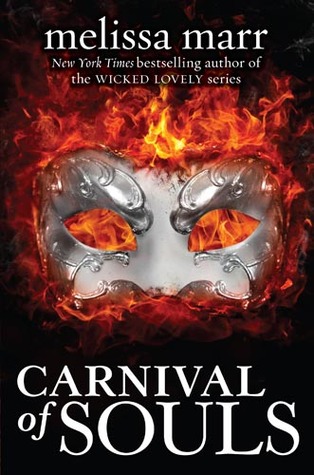
Carnival of Souls by Melissa Marr

carnival-of-souls-melissa-marrCarnival of Souls
by Melissa Marr
2012

I picked this up randomly at the library because I remembered enjoying Marr’s previous book Wicked Lovely. And Carnival of Souls was fabulous to begin with. And then it got really kind of skeevy. And then it ended abruptly without any resolution.

I assume there were plans for a second book or two in this “series” but really it should be another part or two in this book. (Instead, there was apparently a reprint of the same book with a different title, Carnival of Secrets.)

Things this book does really well:
The characters are all full characters such that even when they consider each other their enemies, the reader is left rooting for each of them and not sure what to do about the conflicts between them. Because they’re all trying to survive in a really rough world!

On a related note: the world-building in which there are witches and daimons (and humans, but they hardly matter) and they hate each other. They each think the other are dangerous creatures that need to be put down, and you can see the point of view given that there are protagonists on all sorts of sides within this conflict.

Thing this book does not-so-well:
Keeping me rooting for all the protagonists. I started out really rooting for all of these characters, and understanding why they’re making some pretty messed up choices given the situations they’re finding themselves in. But as time goes by and they keep on making ever more horrible decisions for poorer reasons, I lose a fair bit of respect for a lot of them.

Thing this book does terribly:
Come to any sort of resolution. The book ends on a big reveal, but it’s the kind of reveal that generally acts as the turning point of a book rather than the conclusion. About 50 pages before the end, I was already getting suspicious because Marr kept on adding complexities rather than even advancing the timeline such that a resolution was possible. This is something that I generally see in long but unfinished fanfic, but didn’t expect in a published novel. It was annoying. This was essentially half a book and doesn’t stand on it’s own.

Disappointing given how much I was enjoying it to begin with.

The Martian

Sometimes you want to read a carefully-crafted literary masterpiece, where each sentence is like a tiny poem, where you find yourself going back to re-read passages just to enjoy the language. If that’s what you’re looking for, let me suggest that you pick up All the Light We Cannot See by Anthony Doerr or The Bone Clocks by David Mitchell. But sometimes you’re sick of depressing, heavy prose and you just want to read something FUN and AWESOME that makes you stay up reading until 2:00 in the morning because you absolutely have to know what happens next. In that case, go find The Martian by Andy Weir.

Part of the fun of the story is not knowing what’s coming next, so here’s all I’ll say about the plot: Mark Watney is an American astronaut on mission to spend two months on Mars. But six days into the mission a disastrous series of events leaves him stranded on the surface. He’s alone, NASA thinks he’s dead, he has no way to communicate with Earth, and both his air and food are limited. What’s he going to do? The author prided himself on being as accurate as he could be (in a book about people on Mars, anyway) so there’s a lot of very technical discussion–not science, exactly, more like engineering–and, I’m going to be honest here, a lot of math. But it was easy to skim over the various calculations of air volume and explanations of how things work and focus on Mark himself, a resilient, resourceful smartass who you start rooting for immediately.

Andy Weir has gotten all sorts of press for the Cinderella story of this book–he initially published the book chapter-by-chapter on his website, then self-published on Amazon before getting picked up by a publisher and getting on all the best-seller lists. And the book somehow feels like a self-published serial story, but I don’t mean that in a bad way. The plot moves like a freight train, and Mark has a very clear, strong voice. I am not sure whether Weir’s going to be able to follow this one, but I had lots of fun reading The Martian more than anything I’ve read in a long time.

Kinsey’s Three Word Review: Completely un-put-downable fun.

You might also like: Space movies! Specifically, Apollo 13 and Gravity, which are both more like this book than anything else I can think of. And, in fact, The Martian is going to made into a movie starring Matt Damon, who is exactly who I would have picked to play the smart and likable main character.

Special Father’s Day Alert: Is your dad as impossible to shop for as mine? If you’re also at loose ends for a Father’s Day gift, consider The Martian! While I loved this book, it also struck me as a very Dad Book. I am aware that dads are different, but mine is getting a copy of this because it is perfect for him–science-y, funny, space-y, guy-ish, full of problems to be solved, etc. Very Dad.

The Hillywood Show musical parodies

Since I’ve spent the last few weeks (months?) re-reading old favorite books and a series of pretty amazing, incredibly long Star Wars alternate universe epic fanfics that I’ve got no idea how to review, I don’t have any new books to review here. But I do have a fun series of links to give, because if you don’t know about The Hillywood Show already you should be introduced to it pronto.

The Hillywood Show was created by sisters Hilly and Hannah Hindi and they make extremely elaborate video parodies of blockbuster films using famous songs.

At the moment, there are 20 parodies, and 20 behind-the-scenes videos (which are well worth watching).

While I absolutely recommend them all (there are three for Harry Potter, five for the Twilight series, two for Lord of the Rings, and bunch of others), the one I just found today that inspired this post is:

The Supernatural Parody
(using Taylor Swift’s Shake it Off)
along with the Behind the Scenes on making the video.

One I ran across some time back and only now realized that it was by the same group:

The Doctor Who Parody
(using Rocky Horror Picture Show’s Time Warp)
along with the Behind the Scenes on making the video.

These are really just brilliant. Go check them out either on their own website or on YouTube.

Daughter of Smoke and Bone

By Laini Taylor

Daughter_of_Smoke_and_Bone This is a little embarrassing. Kinsey has recommended this book multiple times on this blog, and even gave me a copy, but it took me three tries to get through it. It is actually very good, but it starts with some of the most Mary Sue you’ve ever read. Our heroine, Karou:

  • Is 5’ 6” but seems taller because of her willowy ballerina’s build, with slender neck and long limbs
  • Has long hair that grows out of her head a bright blue
  • Has a gorgeous, older ex-boyfriend, who wants to get back together and over whom all the other girls sigh
  • Attends a high school for the arts in Prague, where she paints such imaginative images that all of the other students gather around each morning to see her daily sketchbook

Multiple times, I gave up in the face of such blinding impressiveness right off the bat. I couldn’t imagine what else the author had left to unveil down the road, and I wasn’t sure what she could do to make me actually like Karou. It turned out that her being attacked by a killer angel did the trick!

So, once I got over sulking over the heroine, I was intrigued by the very unusual hidden world that slowly reveals itself over the course of the book. And while I stayed a little aloof from Karou herself, I was charmed by the wide variety of other characters. For people who don’t have as big an issue with Mary Sue-ism as I do, I can unreservably recommend this book; for those that do, I still recommend the book, actually – I did eventually enjoy the whole story, though sort of grudgingly throughout, and I admit that was entirely due to personal bias.

—Anna

DC Noir

Edited by George Pelecanos

Book Cover: DC NoirI’d checked this book out way back in Boulder, when we were first thinking of moving to DC because I thought it would be a fun introduction, but then I got busy with all the moving stuff. However, now I’m feeling pretty DC noir myself, so I figured I’d give it another go.

This is part of a whole series of [City] Noir books, so if noir mystery is your thing, you might want to check whether the Akashic Noir series includes your city (there is an incredibly wide range of cities, and not just confined to the US, either).

I’ve complained before about authors not getting “noir” quite right, thinking you can just slap on a bunch of the more obvious earmarks, but reading these stories helped me refine my thoughts on it. Too many people think that noir is about how horrible people can be to each other, but in really good, nuanced noir, it is about how decent people struggle to stay that way in a general horrible world. So, while there are very often horrible people in noir, they are usually side characters and may well also be originally decent people who have failed in their own struggle. Of course, making a whole universe that is generally grim and destructive is a lot more difficult than just throwing some unexpected murderers in there, and that’s why noir is a true art form.

Some of the stories here got it and some didn’t; while I would say that the ones that missed the mark outweighed the one that just got the true noir feeling, those with the right feeling were awfully good (though depressing, of course).

The stories were set in a wide range of different neighborhoods, and while there’s a few set in wealthy neighborhoods, most are set in the poorer ones. (And, as a sort of funny aside, I’m currently apartment hunting once again, and thought I’d found a very reasonably priced townhouse until the neighborhood it was in showed up in one of the stories here. When I texted Kinsey, just to confirm my suspicions about the neighborhood, she just texted back “NO.”)

Anyway, the stories also spanned different time periods, which threw me off sometimes – a lot of them, of course, wanted to focus on DC’s most crime-ridden times, and some of them were sort of indeterminate. One of the stories began with riots caused by a black cop shooting a handcuffed Hispanic suspect, and except for the respective races, that seemed very current. My favorite story featured one of the more radical black power movements taking on the mob in the 60s.

Only one of the authors in the collection is female, and only two of the stories had a female narrator, which was a bit of a disappointment. There is a DC Noir 2, though I think I may instead want to check out some of the other cities, possibly Dublin Noir, since that sounds pretty interesting.

—Anna

Being Mortal

By Atul Gawande

Book Cover: Being MortalI wish this book had been written two years ago.

My mother told me recently that when Thomas was ill, it was very clear that I was in denial, much more so than Thomas himself. I wish so much that any of the many doctors and nurses had broken through my denial to force me to face the reality, but I can only be so mad at them because maybe some tried but just couldn’t reach me.

This book is all about how important it is to face the end our lives, whenever that time comes, honestly and directly, and offers suggestions for easing the fear and pain at the end for ourselves and our loved ones. Gawande talks very openly about how difficult this can be for both the patient and the physician, and his own failures and successes as both a patient and a physician. (Some of the many anecdotes in the book are about his family coping with his father’s terminal illness and eventual death.)

So, the subject matter is upsetting at some times and comforting in others. He reveals ways in which the medical and elder care industries have disconnected from treating actual people – with much higher priority being given to longevity over quality of life. He also showcases some incredibly innovative solutions that are currently being attempted, with some very funny stories about the trial and error process, including a delivery of 100 cageless parakeets in one instance (this turned out to be a success).

All in all, Being Mortal is just an incredibly important book. I am quickly turning into an Atul Gawande fanatic because I remember feeling the same just after reading his earlier book, The Checklist Manifesto. He has this way of taking material that should be incredibly boring or unpleasant to read about and approaching it through a very human way that makes it easily accessibly and engaging.

—Anna

Kindred

By Octavia Butler

Book Cover: KindredBefore reading Kindred, Connie Willis’ Doomsday Book was the most painful time-traveling book I’d read, but boy does Kindred blow it out of the water. (I’d also previously only read one book by Octavia Butler, Fledgling, considered by herself and everyone else to be her ‘lightest’ book by a long shot.) The basic premise of Kindred is that Dana, a young African-American woman from contemporary times (1970s, when the book is written), is pulled back to a slave plantation several different times in the early 1800s in order to save the life of the plantation owner’s son.

I think we can all acknowledge that the current news has made it increasingly clear that there is a white world and a black world in our country, and even sympathetic whites can’t understand what it is like to live in the black world. Reading Kindred shares some of the sense of what it must be like, though: for every interaction with a white person, even one trying to be kind, to have the possibility of death hanging over it. I was so scared for Dana all the time, and the tenseness of reading the book was exhausting, and about halfway through, I realized that this tenseness and exhaustion is not something confined to the antebellum south at all. So, while it was painful to read, it is also incredibly important, and I was so grateful to Butler because I can’t think of another author that could have communicated this feeling to readers so well.

The kind of funny thing about it, though, is that there are really three time periods: the 1810s, the 1970s, and 2015 for me, as a reader, so there’s that layer on top. Sad to say there doesn’t seem to be a huge difference in race dynamics, but the gender dynamics of the 1970s were occasionally different enough to give me pause, though that was more towards the beginning of the book when she and her husband were confused about what was going on.

It felt like it ended a bit abruptly, but I think that is more a testament to Butler’s writing than anything – I was so deeply involved in the story that coming to the end would have felt jarring no matter what the ending was. I will give this very minor teaser spoiler for people who might be hesitant about the book: it doesn’t end nearly as badly for Dana as I’d expected it to, given that the very first sentence in the book is “I lost an arm on my last trip home.”

—Anna