Gods’ Man by Lynd Ward

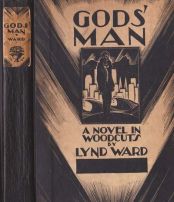
Lynd_Ward_(1929)_Gods'_Man_coverGods’ Man: A Novel in Woodcuts
by Lynd Ward
1929

I ran across a reference recently to the wordless novel as a genre that flourished in the 1920s and 1930s. Somehow, I had never run across this before (although I have a couple of picture books that are completely wordless and are awesome) so I decided I needed to check it out. According to Wikipedia, Gods’ Man is one of the preeminent examples of the genre, and I can absolutely see why.

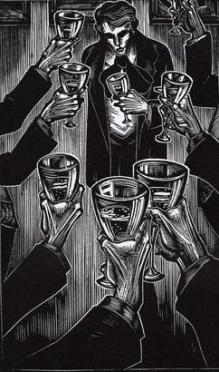
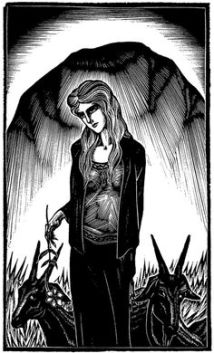
The illustrations really are gorgeous. Some examples are:

Gods_Man_sun_image and Lynd_Ward_(1929)_Gods'_Man_-_surrounded_by_wineglasses

lw_gm025 and lyndwardwife

Just really gorgeous.

The story line is… very 1920s-1930s. A young man, an artist, comes from over the seas to the big city. He’s a kind soul who the fat cats of the city toast and celebrate. He falls in love, but she loves only money! He is distraught and sinks into despair, and is finally chased out of the city, barely making his escape. In the countryside he finds a wonderful woman who nurses him back to health and is all that is wonderful. They are very happy together, except there is no escaping the evil of the big city and all things must end (in a very melodramatic way).

I highly recommend it.

I also think it’s particularly funny that the only words in the entire book (aside from the various title pages), is the name of the inn where our protagonist stays when he first arrives in the city. The sign is legible and reads: “Slink Inn Eat” (Hahahaha!)

I think I like the genre overall. The other wordless books I have are Zoom by Istvan Banyai, which is bright and modern and surreal, and Christmas! and Rain, both by Peter Spier, which are sweet and adorable and heartwarming. I love them all.

Very specific murder mysteries

I haven’t felt like reading anything new lately, so I’ve been dipping back into the well of old loved British murder mysteries. Seriously, there is not much that is more comforting than genteel aristocracy studiously talking around brutal murders.

'Coriolanus' play after party, London, Britain - 17 Dec 2013A few weeks ago, I ran across a discussion online of fantasy casting for a hypothetical Peter Wimsey movie, and the comments were pretty divided on whether Tom Hiddleston would make a good Wimsey. The “pro” side was, of course, he’s just so charming! The “con” side was, but isn’t he a little too handsome? And, I’m here to say that I don’t think so! After seeing him blonde in The Night Manager, he looks kind of like a silly doofus, which is pretty much perfect for Wimsey.

Tidus for dream-celebs.com

His love interest Harriet Vane is a trickier casting, since she’s first introduced as she is being charged with the murder of her lover. She is clearly as clever and witty as Wimsey, but is also understandably melancholy and a bit hostile initially. But then I had an epiphany that it couldn’t be anyone but Eva Green, and wouldn’t she be a phenomenal Harriet Vane! Also, doesn’t Green deserve a nice mannered storyline where she isn’t brutalized at any point?

Gaudy Night Strong Poison
Clouds of Witness

By Dorothy Sayers

So, after having settled the casting to my satisfaction, I decided to reread Gaudy Night Strong Poison, the novel in which Wimsey sets out to prove Vane’s innocence, having fallen in love with her at first sight on the witness stand. It is very silly but also truly romantic. However, there is another romance that happens very much in the background that I just love more: Peter’s sister, the Lady Mary, is in love with a middle-class policeman who doesn’t feel that he has the social status to propose.

I then went back and read Clouds of Witness, the book before Gaudy Night Strong Poison, in which Mary and Inspector Parker first meet, upon the suspicious death of Mary’s fiancée. Even in this novel, the romance is kept coyly in the background, with the reader discovering it through Lord Peter’s discussions with his sister Mary and Parker, a personal friend. So, I was frustrated in my search for class-crossed lovers after all.

The Cater Street Hangman

By Anne Perry

Then, I remembered that Anne Perry has a whole series set in the Victorian Era in which a woman of leisure falls in love with a policeman. In the first book, The Cater Street Hangman, central protagonist Charlotte lives with her well-off family in an upper-crust neighborhood. A series of stranglings, first of a couple of servant girls and then of the daughter of a neighbor, shock the entire neighborhood and bring the police to investigate. The lead investigator, Thomas Pitt, is well educated but still clearly working class, but he inspires Charlotte to challenge her assumptions about class and society as a whole. And of course, they fall in love, solve the crime, etc.

Upon my second reading, the focus on the constraints laid on the strict class system and the extremely complex set of manners that reinforces it reminds me quite a bit of Jane Austen. Charlotte and her sisters especially reminded me of Pride & Prejudice, though Perry does not have Austen’s wit and the book is very much not a comedy. It is still a very good book, of course, but more intense than I was looking for at this particular time, so my search of witty cross-class romance-mysteries continues.

—Anna

Every Heart a Doorway

I first started following Seanan McGuire on Twitter when someone linked to her hilarious series of tweets about an owl in her yard. It wasn’t until I had already seen about 100 pictures of her cats that I realized that she was an author that we’ve actually reviewed here on the site. Back in 2012 Anna thought that Rosemary and Rue was hit or miss, but I quite liked her latest, Every Heart a Doorway.

I think I was won over just by the concept: it’s a murder mystery set at a boarding school for teenagers who found doors into magical fairy realms as kids, but are now stuck back in the real world. I mean, that’s great, right?

I actually agree with what Anna said in her earlier review of McGuire’s writing:  occasionally things felt a bit forced, almost like I could see the author saying, “And now I will do this.” But this is really a small complaint. The premise is great, there were fabulous details about the various fairy realms one might wander into, and the whole story had a sense of creepiness that was delightful. The reader sees the action through the eyes of the main character, who had spent her time away in a world of the dead, and her desire for quiet and stillness infuses the book in a wonderful way.

This is just a quick little story, really like a novella, so there’s not a whole lot more to say. Except that this is well worth your time. Also, isn’t Every Heart a Doorway just the best book title? It’s like a line of poetry I want to recite over and over.

Kinsey’s Three Word Review: Fairy tale aftermath.

You might also like:
 The Scream movies, or Buffy the Vampire Slayer, or possibly Wicked? That seems like an odd selection of media, but my favorite thing about Every Heart a Doorway was how it used the tropes of fairy tales and made them part of the story, which all of those other things do (in their genres) as well. Although in tone and length, this felt an awful lot like The Ocean at the End of the Lane.

The Bible: Esther

I read a YA novel based on this story back in grade school (High school? Middle school?), but let this be a friendly reminder that the Bible is not a book intended for young adults with modern sensibilities, and those YA books are to this as Disney fairytales are to Grimms’ fairytales.

In the story, as I originally learned it, the king’s advisor Hamann slandered the Jewish people to King Ahasuerus, who agreed that they should all be killed. Meanwhile the beautiful Jewish maiden Esther married the king, begged for her people to be spared, and revealed Hamann for a slanderer at the same time. The Jewish people were spared, Hamann was cast from favor, and King Ahasuerus and Queen Esther lived happily ever after.

So, you know, aside from King Ahasuerus’ genocidal tendencies (a rather big aside, in my opinion), a relatively benign YA plot.

Of course, then we get to the source material here, and wow were there some details that were left out.

So, first of all, King Ahasuerus had cast off his original queen, Queen Vashti, because she refused to obey him when he was drunk and wanted her to strip in a public gathering so he could show off how beautiful she was. In response to her refusal, she was cast off and he had all the beautiful young virgin girls* in the land to be brought to him so that he could sleep with one each night and then keep them isolated in his house of wives ever after and never see them again.** There were a lot of girls in the running, though, because it took more than a year for the king to get to Esther.

During that year, Esther courted the favor of the king’s chamberlain who gave her preferential treatment and told her how to seduce the king in turn, such that her night with him pleased him so much that he declared her queen in Vashti’s stead.***

Meanwhile, Hamann is the king’s advisor who’s way too full of himself and decided that Esther’s uncle Mordecai**** hadn’t bowed low enough to him when they passed on the street, and thus Mordecai and all of his people should be killed. The king is apparently too taken with his stream of wives to care about things like statescraft or genocide, so essentially tells Hamann to do whatever he wants. Hamann immediately creates a proclamation that all the Jews are to be killed and their possessions stolen on the thirteenth day of the twelfth month.+

Now, there’s a whole complicated subplot going on between Mordecai and Hamann, but honestly it fits in pretty well in a YA book because it is just that type of juvenile dispute about showing the proper deference and refusing to bow down, etc, except with threats of death and genocide.

But meanwhile, Esther risks being killed for interrupting the king in order to invite the king and Hamann to a fancy dinner. She survives and the king is delighted.++ The first dinner party goes so well, that the king asks Esther what she would like as a boon? She says a second dinner party and the king is once more delighted. The second dinner party is also wonderful and the king again asks what boon he can grant her and this time she’s like, you can save my life and the lives of my people.

The king is horrified that anyone has threatened to kill Esther, his favorite wife, and her people. She directs him to Hamann as the threat.+++ Hamann begs Esther for mercy, but the king sees Hamann near Esther and thinks he’s trying to rape her and has him immediately executed on the gallows Hamann himself had prepared for executing Mordecai. It’s all very dramatic.

However, while all of these events took place in the third month, Hamann’s proclamation about the genocide scheduled for the twelfth month have already gone out. But rather than rescind that proclamation++++, King Ahasuerus was apparently the type who would have enjoyed watching The Purge movies because he makes a second proclamation saying that on the same day that the people were supposed to kill the Jewish people, the Jewish people are granted the right to gather together and kill any of their enemies and take all of their possessions. So, essentially a free-for-all of death and theft on the thirteenth of the twelfth month.

The king asked if Esther wanted anything else and she asked for a second day for the Jews to kill their enemies, plus could all of Hamann’s ten sons also be killed specifically? The king was like, okay.

So the fourteenth of the twelfth month was also a bloodbath, while the fifteenth was feasting and celebration.

And thus the annual celebration of Purim, for surviving Hamann’s plot. And Mordecai goes on to take Hamann’s place as a high counselor and everyone is all very happy.

The End.

Summary: Hamann manipulates the king into ordering the genocide of the Jewish people, but Esther manipulates the king right back into killing Hamann and allowing the Jewish people to kill their enemies.

Moral: Kings can be super easy to manipulate but you’d better be on your guard against someone else manipulating your same king?

* I can only assume that a lot of beautiful young girls heard this proclamation and had an sudden interest in having sex, pronto, with someone in their home villages.
** It’s kind of super similar to Sheherazade’s story, except without the actual death threat to the new brides. Just a single rape-night and then eternal isolation and captivity. So, there’s that.
*** This is a triumph, in case your wondering if it’s actually a good thing or a bad thing.
**** Not that anyone knows that Mordecai is Esther’s uncle, because who would care about keeping track of the relatives of that many wives.
+ I feel like there are practical problems with making a public proclamation that whole communities of people are to be slaughtered on a specific day in the future. Like, I realize it’s important for the death squads to have time to prepare, but I feel like it’s a bit much to expect the intended victims to just accept that their fate is sealed because the king said so.
++ Maybe none of his other wives invite him to spend extra time with them just because he keeps on threatening to kill them? So he’s very flattered that this beautiful woman is interested in him.
+++ Very politically stated, in my opinion, since it was the king himself who gave Hamann the right to threaten them.
++++ I’m actually not sure if it was possible for a proclamation to be rescinded. It might have been that once it was made permanent record, that was it, to avoid confusion with knowing if an official document was valid or not. It might always be valid.

Next up: Psalms

Zoella’s Book Club

Recently I’ve been telling people that I should give Twitter 101 courses, because I love Twitter and I do a good job of explaining what it is and how to use it to people who are baffled by the very concept. But YouTube is like a 200-level course–I just barely understand it myself, I’m not sure I could explain a thing about it to anyone else. I’m not talking instructional videos or Carpool Karaoke, I mean vloggers and YouTube celebrities. It is a weird concept–people, just, like, talk about their lives? Online? And millions of people watch them do it? I have just started poking around the edge of YouTube, but I can see why people get hooked on watching these vlogs. One of the most famous YouTubers out there is Zoella, a twenty-something British girl who is known for make-up videos but whose empire has spread to novels, bath products, home goods, etc. I think Zoella’s adorable–her life might be a million miles apart from mine in every way, but I find her videos super entertaining and I actually find her makeup recommendations very helpful. And lots of other people do to, since more than TEN MILLION people subscribe to her YouTube channel.

What does this have to do with books? WH Smith, a British bookstore, decided to capitalize on Zoella’s popularity by having her select some books for an online book club that launched a couple of weeks ago. And the plan is clearly working–apparently sales of some of these books increased more than 1000% after they received her seal of approval. Zoella’s audience is heavily weighted towards teenaged girls, so when I checked out the book club selections I was expecting to see a pile of cheesy YA books. And they are mostly YA romance books, but they’re good ones! And the list includes a remarkable number of things that we’ve also reviewed here. Zoella’s eight books included Fangirl, All the Bright Places, and Everything, Everything Also included in the list was We Were Liars, which I never wrote about here but thought was really interesting. So, apparently our taste aligns very closely with hip young vloggers!

After seeing how many of the books on this list I loved, I tracked down The Sky Is Everywhere and I’ve got the rest of the books on my library list. If you’re interested in some sweet, sad, modern teen romance, Zoella’s list is pretty solid. Plus she does a really solid makeup tutorial.


Preacher

By Garth Ennis

PreacherI’ve been looking forward to the tv show “Preacher” for a while before it premiered last month on AMC. I’d never read the comic book, but I think Dominic Cooper is extremely handsome and just needs to be in more shows and movies in general.

The first episode was a fun, over-the-top mishmash of a western, gritty noir, religious horror, and violent comic book action, all of which are things I like. Dominic Cooper, playing the titular preacher Jesse Custer, was as attractive as expected. Ruth Negga plays Jesse’s ex-girlfriend Tulip, and is so witty and lovely that she steals every scene she’s in. The plot was fairly disjointed, but that’s not terribly unusual for a pilot episode, and the second episode had smoother pacing as well more Tulip, which will always be a good thing.

Preacher2For people unfamiliar with the basic premise, Jesse Custer is a preacher in a small Texas town with a dwindling faith and congregation. In the middle of a lackluster sermon, he gets struck by a supernatural entity, which bestows on him the Voice of God, allowing him to command absolute obedience. Any person’s use of this power is clearly problematic, and sets Jesse up as a pretty classic anti-hero. Rebecca pointed out that this is the precise power abused by the terrifying villain Kilgrave in “Jessica Jones.”

Anyway, I was enjoying the show enough that I decided to go back and read the comic books, written by Garth Ennis. Now, I’m a big fan of Ennis, who wrote Hitman, one of my favorite comic series, which I’ll need to review some other time, but I have not been impressed with the Preacher comic series. In the written series, Jesse is not only an anti-hero, but just an all-around dick. He has a really annoying stereotypical masculinity that is a real pain in the ass to read about. To complement this, Tulip is a whiny pushover who I have trouble even understanding, let alone empathizing.

I was complaining about this to the coworker who had lent me his Preacher comics to read, and he had an interesting theory about it. He said that he figured that Ennis was satirizing Texas good-ole-boy culture. The only problem with that is that Northern-Irish Ennis has no idea what he’s talking about. While Texas misogyny can be a real problem, it is also a lot more nuanced that Ennis shows here. But I don’t want to get bogged down in a dissertation on gender roles in Texas culture, and anyway Rebecca can speak to this much better than I can, having lived in Texas for twice as long.

The tv show also gets Texas culture wrong, though not quite as offensively, and I’m willing to overlook it in favor of the improvements in both Jesse and Tulip. However, by the fourth episode, the plot is floundering a little, and I wish they’d pick up comic’s pacing at the very least.

—Anna

The Bible: Nehemiah

Nehemiah (the character) is introduced (at the beginning of his book even!) as an Israelite serving as the cup bearer for the king of Persia. I’m not sure how one gets to be a cup bearer for a king, but it seems like a pretty sweet position, actually, since you’re essentially part of the king’s entourage without being an advisor with responsibilities other than making sure there’s always wine for the king. Thus, the king tends to really like the cup bearer.

So Nehemiah looks sad for a couple of days, the king (Artaxerxes, aka Ar’tax-erx’-es*) asks him what’s up, and he explains that he worries about how the Israelites are doing in Jerusalem. After some questions about how long a trip there and back would take, Artaxerxes gives Nehemiah funds and permission to go over to Jerusalem and check out the situation. He inspects Jerusalem (a la undercover boss) and then inspires the workers to do more. There was a wall around the city with many gates and many people working on those gates, and they’re all named in chapter 3.

In chapter 4, however, are the neighboring city-states who are a more than a bit suspicious of the Israelite refugees fortifying their town. After some escalation, the Israelites start guarding the half-finished wall, 24-7, until it is complete

Chapter 5 is anger over taxation and whatnot. It sounds all very modern, just with unfamiliar specifics. But why should we have to pay for someone else to eat? What about our children? Is this governor better or worse than the last governor? It’s possible that the reason why I have trouble tracking this chapter is that I’m so tired of the US election arguments.

Chapter 6: The neighbors really don’t like that fortified wall.

Chapter 7: Now that the wall is built, it must now be guarded. Also, time for a census: and you’d better be able to prove your decent, because at least some people were viewed with deep suspicion for claiming to be priests but unable to prove it.***

Chapter 8: Ezra**** lectures the people about the laws, but what’s particularly interesting here is that the chapter itself doesn’t recount the laws. (thank god: Leviticus and Deuteronomy and a whole bunch of other books already took care of that) and instead was like, he read the laws and the people understood them. And then everyone celebrated. Hurrah!

Chapter 9: all the children of Israel attend Sunday school and the highpoints of the entire previous portion of the Bible are recounted in 38 verses or less.*****

So, Nehemiah 9:38 gets us caught up to actual events happening now and is a summary of chapter 10, in which, sure enough “our princes, Levites, and priests seal unto [the covenant]”. I.e, a bunch of named people agree that there are certain rules of this town that everyone has to abide by, mostly involving observing the Sabbath and giving offerings to the church.

In chapters 11 and 12, the people cast lots to see who actually gets to live in the fortified and highly-regulated city. Because all the rules live there, but only one in ten of the regular people do. And we get a list of those one in ten. There’s just no escaping intermittent lists of begats.****** Also, there’s some more celebration in dedication of the city of Jerusalem.

And then in Chapter 13 hits like a load of bricks. It’s back into first person and the narrator (Nehemiah?) is dedicated to his religion and terrible for politics and economics. Keep in mind that most of God’s laws have been previously forgotten because all the Jews were scattered into other lands, and are only now returning to Jerusalem as refugees under the Persian king’s protection. So everyone is attending Sunday school to learn the rules, and the narrator learns that God doesn’t like the Moabites, but apparently the head priest had an alliance with the Moabites and had even prepared them some diplomatic chambers to stay in. So the narrator has those chambers stripped and all of the Moabite’s possessions cast out. And then he discovers that farmers and vintners were working on the Sabbath so he testified against them. And then there were merchants and sellers who sold their goods on the Sabbath so he testified against them too. And then he discovered that some people were still marrying outside of the Jewish religion and so he smote them and plucked off their hair (13:25). And he generally makes everything worse for everyone and expects praise from god for this cleansing.

Summary: These refugees have their new city with their fortified wall but they’re pretty plagued by outsiders being suspicious and insiders forcing them to obey strict religious law.

Moral: If you’re the friend of the King of Persia, you can get support in being an incredible busy-body.


* T
he King James translation uses a lot of hyphens and apostrophes in the names of various people. Artaxerxes is written as Ar’tax-erx’-es, Nehemiah, the titular character of this book, is written as Ne-he-mi’-ah. And there are plenty of other names with similar presentations: San-bal’-lat, Za’-dok, Me-ron’-o-thite, etc. I’m not sure what the apostrophe stands for, but I’m assuming at this point that the dashes are between syllables. So, it’s essentially a little pronunciation guide that also makes the names look just that much more foreign to my poor sheltered eyes. It feels very disconcerting, though, since I’d previously considered it a sci-fi/fantasy trope to make alien names using excess punctuation and random letter mash-ups. It feels very unexpected to see it happen in the Bible. From my perspective a name has a one-punctuation-mark maximum limit before it looks like it’s trying too hard.**

** If there’s any reader out there with a first name with more than one punctuation mark in it, let me know that I might learn something, but I’m going to want to know the story behind your name and its spelling.

*** They were considered “polluted” and didn’t get to eat the holy food of the priesthood unless and until they can prove they’re actually priests. (Nehemiah 7:64-5)

**** Introduced previously as the moral law scholar that the King of Persia was asshole enough to inflict upon the refugees trying to settle. Now the refugees have to try and learn and abide by all the laws of a very specific god.

***** Seriously? Yes, seriously. If you want a children’s book version of the pervious parts of the bible, just read Nehemiha 9:6-38

****** Although, kind of cool is the fact that some of the begats include professions as well as lineages (although I’m fairly sure their hereditary professions, so there’s that). The professions include, but are not limited to: those who had oversite of the outward business of the house of god (11:16), porters and keepers of the gate (11:19), singers (11:22), those given to praise and give thanks (12:24), those with the musical instruments (12:36)

Next up: Esther

The Bible: Ezra

One of my cousins recently graduated from divinity school and he recounted something one of his teachers told him that really stuck with him and now sticks with me: “when giving a sermon, hold the scriptures in one hand and a newspaper in the other.” Given the issues with racism and refugee problems I’ve been seeing in the news recently, this book is particularly on-topic, although not particularly helpful with its conclusions.

This book starts off with Cyrus, King of Persia, having an inspiration. In theory, the idea is god wants a house built for him in Jerusalem; in practice Cyrus bribes Israelite refugees to go over to Jerusalem rather than stay in Persia. And not even with his own funds, just telling the populace, they must give silver, gold, and other goods and livestock to any Israelite from Persia traveling to Jerusalem.

And then we get a massive list of who all the refugees were, where they were from, where they went, and how many they numbered. One thing about reading these books is a reminder of the sheer numbers being dealt with. We’re talking about people in the hundred and thousands and hundreds of thousands.

And then there was a bunch of celebration and prayer and burnt offerings.

Those were chapters 1, 2, and 3. In chapters 4, 5, and 6, however, we discover that bureaucracy is eternal and it turns out various other governing units are not particularly happy with Cyrus’ plan to shift refugees elsewhere, and did anyone actually have a copy of the authorizing letter Cyrus had sent out regarding building the temple? As it turns out, the answer to that last question is “yes,” and if you try to ignore it again King Darius of Persia will have your house torn down and you hung on the scaffold built in its place. So, you know, building that temple continued.

It isn’t until chapter 7 (out of just 10, in the Book of Ezra) that Ezra is introduced as a character. But he’s a scribe in the law of Moses, and under the ongoing patronage of Artaxerxes, kind of Persia.* He’s essentially sent to be a magistrate and enforce god’s law on the people of Jerusalem.

Now chapter 7 is also interesting for being written in the first person, due to most of it being a decree of Artaxerxes, kind of Persia. However, chapter 8 is also in first-person but I’m confused about who exactly it is. Is it safe to assume Ezra? Whoever it is, they gathered a bunch of people – listed in detail – to the river that runneth to Ahava and then contemplated the issue of all of them carrying a bunch of gold through a bandit heavy area. I really enjoyed Ezra 8:22, in which the narrator really doesn’t want to contact the King of Persia to ask for guards for the gold, after having spoken about how great and powerful their god is. Like, that’s just embarrassing. Hahahaha! Anyway, they split up and transport the gold in 12 packages and it all goes well.

In chapter 9, Ezra (I’m assuming) is deeply disturbed about how the Israelites continue to inter-marry and have children with the people who were already living in the lands.

In chapter 10, Ezra (we’re back to the more regular third-person narration) continues to be deeply disturbed by the Israelites having married foreigners, and gathers all the men to discuss the issue. Verses Ezra 10:18-43 list the various males who had taken foreign wives, and even had children by them. But they all promised to “put away their wives” in addition to offering a ram of the flock for their trespass. So… there’s that.

And thus ends the book of Ezra.

Summary: Bureaucracy, racism, and problems with refugees all have long and illustrious histories.

Moral: Yes, money can buy you out of troubles? (Especially other people’s money.) Don’t marry foreigners?

*I’m more than a bit confused by all the Kings of Persia (and/or Babylon – are they the same thing? Is one a subset of the other?), who I assume are ruling sequentially, but the book is a bit coy about the timeline for all of this, which is decidedly unusual, given how specific the books of Kings and the books of Chronicles were. But there are casual and mentions of King Cyrus of Persia and/or Babylon, King Darius of Persia and/or Babylon, and King Artaxerxes of Persia and/or Babylon.

Next up: Nehemiah

Eligible

As I’ve said more than once before, Pride and Prejudice is my favorite book of all time and I keep a close eye on adaptations. I may not like every version of the story people cook up, but I love weighing them against each other and seeing what tiny improvements each version can make. Just recently I rewatched the Keira Knightley movie, and while I find almost everything in that version to be not quite as good as the 1995 BBC mini-series, I was reminded that the movie does a GREAT job of using clothes and houses to really play up the class differences between the Bennets and the Bingley/Darcy crowd.

Anyway, when I saw that Curtis Sittenfeld’s latest book Eligible was a modern version of Pride and Prejudice, I was very interested. Sittenfeld is probably best known for her first novel Prep, about a girl at a New England boarding school. I actually thought Prep was incredibly grim and unpleasant to read, but I quite liked American Wife, which was an imagined, fictional version of Laura Bush’s journey to become a somewhat unwilling First Lady. So I went into Eligible fairly ambivalent about Sittenfeld and I’m still not sure how I feel, although   did enjoy the book.

There’s no point summarizing the plot–this is a very loyal retelling of Jane Austen’s classic story about the Bennet sisters, moved forward in time to modern-day Cincinnati. To be completely honest, I went into the book thinking that there was no way anything could live up the Lizzie Bennet Diaries–I LOVED that video adaptation of the story and I couldn’t imagine another modern telling matching up. But Eligible did win me over, at least a bit, as it went along.

There were a few things I thought it did really well:

  1. Sittenfeld really hit it dead on with loads of her cultural references as she moved the characters to the present day. For example, Jane is a yoga teacher, Darcy is a surgeon, and Kitty and Lydia are totally into CrossFit. Over and over again she would introduce a character with his or her modern identity and I would say, “Oh, of course! That makes total sense.”
  2. In the books, the Bennet sisters are in the 15-21 age range and most modern updates up that a bit to make everyone legal, but even my beloved Lizzie Bennet Diaries only puts the older girls in their late twenties. In Eligible, Jane is turning 40 and Lizzie is right behind her. Which is perfect! A huge part of the original story is the pressure the girls feel to get married, and that panic rings so much more true in the modern story when Jane and Lizzie are both approaching 40. To me, this was the one thing that Eligible has really added to the Pride and Prejudice oeuvre.
  3. Darcy and Lizzie came off pretty hot, actually, which doesn’t always happen.

But I have to admit that there were a few things that didn’t quite work for me:

  1. This is often a problem with Pride and Prejudice adaptations, but it takes the book a while to get going. If you’re Jane Austen, I’m happy to read a third of the book where people futz around before the love story kicks in. For other mere mortals, it means that I spend quite a few chapters being like, “Come on, come on . . . “
  2. I would say that 90% of the characters, plot, and structure of the book are straight from the source material. The characters have the same names, the chapters are structured the same ways, etc. So when she does make a change, it must mean something, right? There were two major places where Eligible diverged from the original and I am still not quite sure why. First, Wickham is split into two characters, which gives a whole new spin to a couple of key plot points and I can only assume that this is because we all have larger social networks today? Hmm. And second, this book proceeds a bit past where the original ends and . . .  again, I’m not sure I see the point.
  3. Lydia. Oooh, Lydia is problematic. In order for the plot to move along, Lydia has to do some fairly outrageous things. Jane Austen’s take seems to be that Lydia was, if not evil, certainly dumb and thoughtless; by the end of the book (200-year-old spoilers), Austen seems to have decided that Lydia has made her bed and now she can lie in it. In our previous discussions of the Lizzie Bennet Diaries, we all talked about how much we liked their take on Lydia, which made her much more sympathetic and made her actions more understandable. Sittenfeld’s Lydia is pretty much in the dumb and thoughtless mold, but the way Wickham is now handled makes the end of her story feel quite different. I don’t feel like Lydia has to be sympathetic–a big message in the story is about family loyalty, even when you might not like that family–but it was a significant enough change that it felt like Sittenfeld was trying to make a statement. And I think that statement was, even if you’re dumb and mean things might work out if you have a responsible older sister? I don’t know.

Overall, I thought Eligible was snappy and fun to read and if you’re a Jane Austen completist like I am, you’ll enjoy it. But if I am going to recommend Pride and Prejudice-inspired material to someone, this ones falls down on the list under the Lizzie Bennet Diaries, Bride and PrejudiceLongbourn and even Bridget Jones’s Diary.

Captain American and Black Panther

Captain America: Civil War

Marvel-Civil-WarAll three of us blog writers went to go see the third Captain America movie together, and I have thoughts. Actually, I had thoughts (concerns) before we even went. I didn’t follow the Civil War event in the comic books, but I knew the basic gist is that there is a growing political movement for putting superheroes under some kind of government control, and the Avengers become split between Iron Man supporting that movement, and Captain America against it.

I think it is a nice touch to make the most outwardly patriotic character still have concerns about political overreach, but I simply couldn’t wrap my mind around how Tony Stark, who wasn’t even willing to register his mechanical suit with the government in the first Iron Man movie, would take a pro-registration stance. In fact, I’d always thought Tony Stark sort of represented the classic Republican stance of financial independence, corporate freedom, and small government. It made me wonder if this movie would actually be a bit of a commentary on how the Republican Party itself has shifted in ideology.

And, then I saw the movie, and I’m even more confused. I wish I could have taken notes in the theater because I vehemently disagreed with basically everything that any of the characters said, and now I can’t actually remember any of the arguments. However, when trying to write this up, I tracked down some of the transcribed argument, and reading it didn’t make any more sense. It felt a little like when I was reading Atlas Shrugged, and the supposed ‘liberal’ characters made bizarre straw men arguments that I’d never heard an actual liberal make.

After much discussion with Rebecca, I think I have a basic grasp on the two sides, boiled way down and largely guesstimated from some very overwrought dialogue (clearly, this includes spoilers, but only for the most stupid and boring parts of the movie): Continue reading