Adult Fantasy Books Not By Straight White Men

Witchmark

By CL Polk
WitchmarkWitchmark is the first of the many library holds I put on books recommended by the Tumblr’s Adult fantasy books not by straight white men! and I’m so glad that it was the first one I read!

It is a little hard to review because it is just satisfying across the board. It has a lot of the elements of a comfort read: a common-man protagonist who must rely on his hidden magic in the face of adversity, a light romance with a charming but mysterious stranger, and a truly shocking conspiracy by a shadowy society that must be revealed to the world.

Set in fictional world, it is heavily based on post-WWI London. The metropolitan has recently been wired with new fangled electricity, and a treaty has finally brought the end to a brutal war between nations. Soldiers are returning home in mass, where our protagonist Miles does his best to hide his healing magic and personal history while working at an understaffed and underfunded veterans hospital.

The book starts off as a murder mystery, with a fatally ill man being brought to Miles by his own request, and insisting to him that he has been murdered just before he dies. This probably would have been enough to hook me, but the fantasy and romance elements are woven in so deftly that it became this wonderful amalgam of genres that made me want to read the sequel immediately (unfortunately not due out for a couple of months).

Amberlough

By Lara Elena Donnelly

AmberloughAmberlough cut a bit close to our current state of affairs, honestly. Set in a fictional world inspired by 1930s Germany, Cyril DePaul is a secret agent assigned to uncover why an extremely conservative party is winning elections despite low popularity in polls. Collusion and extortion is suspected (sound familiar?), but before he can discover anything Cyril is quickly uncovered by the wealthy industrialists that make up the party leadership, and strong-armed into betraying his employer and government.

Though I was sympathetic to his plight, Cyril is cowardly and too easily compromised. His lover, Aristide, the emcee of a popular cabaret, is vicious and self-serving, using Cyril for access to state secrets that could inform his side business smuggling. The central dancer at the cabaret, Cordelia, is drawn into their schemes, and is vapid…until she isn’t.

Which is when the book shifted for me, finally becoming more about schemes and espionage than characterizations of unpleasant people. Unfortunately, this happens almost 200 pages into the book, so it was a slow start, to say the least. And then, 100 pages later, everything goes to shit, perhaps accurate of 1930s Berlin and dare I say our current news cycle, and it becomes especially unpleasant reading.

It reminded me a fair bit of Jo Walton’s Small Change series, but even grimmer and joyless. Amberlough is well thought out and extremely well written, but I hated reading just about all of it, and felt entirely depleted after finishing it.
Agrippina: The Most Extraordinary Woman of the Roman World

Over the past few weeks, as I have been telling people how much I liked this historical biography of a Roman empress, I have gotten some very skeptical responses. And I get it–it doesn’t sound like the kind of book you might pick up for a casual read on a Saturday afternoon. But I promise, Agrippina: The Most Extraordinary Woman of the Roman World by Emma Southon is fascinating and compelling and funny and sad. Even though I knew Agrippina was not going to get a happy ending, I was still reading along as fast as I could, desperate to know what happened to this incredible woman who lived 2000 years ago.

The basic facts: Agrippina was the great-granddaughter of the emperor Augustus, and spent decades at the center of the imperial family and of Roman politics–she was Caligula’s sister, Claudius’s wife, and Nero’s mother. Her life was shot through with tragedy (imperial family disputes had a tendency to get bloody) but also with glory and ambition. Historical information about her is limited, since Roman writers only occasionally even bothered to mention women, so a lot of the book is Southon explaining what sources do mention Agrippina, and what we can assume in places where the historical record is silent. Southon (who is also lots of fun on Twitter @nuclearteeth) also does a really excellent job of both making sure that we remember that Agrippina was a real person with fears and loves and emotions, while also making it clear that Agripppina lived in an entirely different culture and time. For example, when discussing Agrippina’s first marriage, Southon talks about how disturbing she finds it that the 13-year-old bride was married to a man more than twice her age, but also makes the point that we really have no way of knowing how a Roman princess would have thought about this.

Southon is also really funny, and that’s what really makes this book stand apart. Yes, it’s a very detailed, academic history book that is rigorous in the treatment of its primary sources. But it’s also like hearing a snarky friend gossip about people you know. She calls Caligula “subtle as a brick,” says that Agrippina’s first husband was “a dick,” and is entertainingly exasperated with the Roman habit of giving everyone some variation of the same four names. It makes the book so readable, and helps bring the historical figures to life.

One final note: in the UK, where this was initially published, the title was Agrippina: Empress, Exile, Hustler, Whore which is way more fun! I guess us Americans can’t handle that level of excitement in our history.

Kinsey’s Three Word Review: Tragic, yet funny.

You might also like:  For some more educational history enhanced by dry humor, check out A Short History of Nearly Everything by Bill Bryson, or any of Sarah Vowell’s historical books–I particularly like Assassination Vacation and Unfamiliar Fishes.

Meditation for Fidgety Skeptics: A 10% Happier How-to Book
10percenthappierMeditation for Fidgety Skeptics: A 10% Happier How-to Book
by Dan Harris, Jeffrey Warren, and Carlye Adler
read by Dan Harris and Jeffrey Warren
2017

I ran across this book a year or so ago at someone else’s house and noted that it looked interesting. The  elevator pitch that originally caught my eye: it’s written by a TV news anchor who had an on-air panic attack and got into meditation in the aftermath as he dealt with his issues. So when I was looking for a good audio book to listen to on my commute, I remembered it, requested it at my library, and gave it a shot.

As it turns out, a book on meditation is not necessarily the best thing to listen to while driving. While the authors are very specific about how you don’t have to actually stop and meditate when they do through a meditation, it’s something I might have enjoyed doing otherwise. And driving along as the speaker says, “close your eyes and concentrate on your breathing” isn’t the safest way to drive, especially if I want to do so.

Also, as I should have realized from the title, I’m not actually the audience for this book since I’m not a skeptic about the benefits of meditation. I don’t care for the spiritual and transcendental elements that sometimes come along with meditation, but I’m quite well aware of the mental, emotional, and physical benefits of meditation. Sadly, there are all sorts of things I know would be good for me that I still don’t do, which is why I wanted to try this book out. But while it was a reminder that I should try to meditate on a semi-regular basis, I found a lot of the self-deprecating bonhomie humor of Harris, the primary author, not to my taste and a reminder of one more reason why I don’t watch TV news chat shows.

But it did seem like a good book for the right audience. And as an audio book it was recorded in some ways like a podcast with Harris and Warren switching off reading their sections and occasionally interacting with each other in scripted conversations. So to sum up, a relatively good book but not really my cup’a.

Halloween reading

Hallowe’en Party

By Agatha Christie

Halloween_PartyWe don’t manage it every year, but we like to read seasonal books when we can, especially spooky Halloween stories. Not especially spooky, but I was thrilled that Agatha Christie had a Halloween novel! Hercule Poirot is summoned by a friend to a small village after a young girl is found drowned in the apple bobbing bucket at the end of the village’s halloween party. This probably wouldn’t have been an intriguing enough mystery for Poirot to expend his energy in retirement on, but the drowned girl had been insisting earlier in the party that she had witnessed a murder. A known liar, no one had believed her, so it seemed somewhat reckless for the murderer to then do away with her and give her words more importance.
As with all of Christie’s mysteries, this was excellently plotted and I had only the faintest guess as to the conclusion shortly before it was revealed. Despite this, Hallowe’en Party is not one of my favorites of hers. Published in 1969 towards the end of her life, I couldn’t help but wonder she was getting cranky in an “old man yells at cloud” kind of way. There is a fairly heavy-handed theme of the degeneracy of the younger generation, with at least half a dozen of Poirot’s contemporaries mentioning the rising crime rate among youths and the misguided mercy of showing them any leniency in the justice system. Which does not read very well in today’s climate of harsh and obviously biased policing. I was concerned that the entire plot would serve as a platform for this philosophy, but fortunately, Christie was too canny of an author to fall into that obvious indulgence.

Pumpkin Heads

By Rainbow Rowell and Faith Erin Hicks

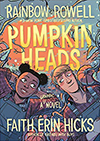
PumpkinheadsI was a little hesitant about reading this since Eleanor and Park broke me a little bit, and I wasn’t sure I was ready for any more of Rowell’s type of coming-of-age story, but this is much more light hearted! Deja and Josiah are best friends who work together at the world’s greatest pumpkin patch – I mean, there are pumpkins, of course, but there’s bumper cars, mini golf, s’mores bonfires, petting zoo animals, pony rides, corn maze, and every possible fall-season snack you can think of (and a few more)! (In the afterward, Rowell says she was inspired by some of Omaha’s excellent pumpkin patches, but that she and Hicks created their fantasy patch.)

Anyway, Deja and Josiah have worked together at the Succotash Hut (perhaps the one stop that I wouldn’t have been super excited about) for the last four years, but they are graduating high school, and going on to college, so this is their last year. In fact, this story is the last day of their last year, and Deja is determined that shy Josiah will actually talk to the girl that works at the fudge shop (yum!) that he’s been pining over from afar for the entire time.

This leads them all over the park, into and out of various hijinx, and of course they learn important things about life and themselves along the way, but with a light touch that mostly just celebrates everything fall, holidays, and friendship. Rowell’s writing is so funny and empathetic, Hicks’ art is lovely and really brought this dream park to life, and the whole thing left me feeling very warm hearted!

ComicFest_2019Also, this is your annual reminder that today is Halloween ComicFest, so if that’s your thing, see if one of your local comic shops is hosting an event here. We stopped by two of our local shops, and picked up an excess of kid-friendly comics, since we’ve found them to be even more popular with trick-or-treaters than candy.

Certain Dark Things by Silvia Moreno-Garcia

CertainDarkThingsCertain Dark Things
Silvia Moreno-Garcia
2016

This book was listed on the tumblr post Adult fantasy books not by straight white men and only realized afterwards that Anna was already reading a book by the same author. This book was summarized as “vampire noir in Mexico city.” It is really good!

It’s a vaguely futuristic dystopian world where there’s so much extreme poverty that the futuristic elements are minor flashes that just highlight how nothing has changed for the vast majority of people. It’s also a world where all the vampire legends from different lands are based on real beings, and there are ten confirmed types of vampires. It’s only been a few decades since vampires were revealed as real creatures but it’s now the norm, and the norm is that vampires run several of the major drug cartels. So in addition to the conflicts between government and drug cartel, there’s also conflict between government and vampires, between different vampire species, and between different drug cartels. And it all gets extremely messy and extremely bloody.

While the novel switches out point of view between several different characters, our main character is Domingo, a human guy in his late teens I think, who starts off feeling pretty good about himself and his place in the world: he’s got a steady income picking through trash and finding things he can sell and a place of his own in an abandoned metro tunnel. And then he sees a beautiful woman and tries talking to her and she actually acknowledges him! How lucky is he?

And just, he is kind of lucky because of all the vampires that he could have met she needs help that doesn’t involve him dying. Mostly.

It is also very much a noir. The bad guys are the bad guys because they are truly horrifically evil and the good guys are the good guys because at least they’re not as bad as the bad guys. But it’s a gritty world and no one is truly innocent. In the end everything works out in the best possible way but there’s just no real chance at a happy ending.

Actually, I take that back, spoiler alert: the dog lives. So that’s happy.

Picnic at Hanging Rock

By Joan Lindsay

Picnic_at_Hanging_RockI took a rather winding road to get this book: Nicole Cliffe, who’s newsletter I’ve recommended before, linked to a 2018 list of the 100 most influential horror movie scenes. For the longest time, I thought I didn’t like horror, since I don’t particularly like the slasher movies that were the fad when I was a teen. However, I love both old-school Hitchcock suspense and our current heyday of psychological horror, and I found the evolution of the horror genre in the article fascinating.
Anyway, the description for the film version of Picnic at Hanging Rock made me laugh: “notable for the absence of violence or even a conventionally advancing narrative.” As my friends and family can attest, I have seen (and imposed on other people) my fair share of movies lacking “conventionally advancing narrative.” I don’t have as much patience for them as I used to, so wasn’t super interested in seeing this movie, but when Bookbub recommended the novel to me the next day, it felt like fate.

And I absolutely loved it! Four schoolgirls wander off from a picnic party to get a closer look at the titular Hanging Rock, and only one returns, hysterical and incommunicative. The impressive thing is that we, the reader, are with them the whole time, too (or at least with the returning fourth girl). We ‘see’ the three girls walk deeper into the rock of their own volition, while the fourth seems to just freak herself out and run away from them. She can’t describe what happened because nothing did happen, and that’s what’s so unnerving!

There is no act of violence or even maliciousness. For a novel about the disappearance of schoolgirls, it is almost unbelievably serene. After the build up to the disappearance and then the subsequent panic of the search, the novel deals almost entirely with the ripple effects, both good and bad, this one event has on the details of daily life for the surrounding characters. It reminded me quite a bit of On The Beach, another Australian novel I loved and that focuses entirely on mundane details during a cataclysmic event.

Traffic by Tom Vanderbilt

Traffic_DSTraffic: why we drive the way we do (and what it says about us)
written by Tom Vanderbilt
read by David Slavin
2008

Since I’m listening to audiobooks on my commute, I figured I might as well listen to one about traffic patterns. This was not my best idea ever. Not only does the reader try to input emotional import into every single one of his sentences to make it sound important and high energy and highly emotional (not what I want first thing in the morning as I drive in or after a long day’s work), but it also has a tendency to tell me what the average person’s commute is like and how people with longer commutes are unhappy with those commutes. I dislike being told I should dislike something that I don’t currently dislike. Look, there are enough things in the world that I do dislike, that I don’t need to acquire more just to fit in! And yet, I start double-guessing myself: am I unhappy with my commute? Should I be? Urg.

But aside from all that, it’s still a really interesting book.

While not in specific sections, this book addresses traffic in three different ways: as a psychologist about human behaviors, as a game theorist about best options, and as historian about stories. As it turns out, I really enjoy the stories (did you know that LA traffic has a central command hub that is largely automated except for Oscar night where there are people literally manipulating the light cycles to try to get the limousines all through? Because I hadn’t and I love it!), I find the game theory interesting (when lanes merge, late merging benefits everyone, so don’t merge until you absolutely have to!), and I find the psychology really, really irritating (as stated above, I don’t like people telling me what I do or do not think, and I’m not sure whether it’s worse when they’re wrong or when they’re right.)

Overall I do recommend the book and have found that even as I waited a month or so to actually post about this, that many of the stories and concepts have stuck with me.

Gods of Jade and Shadow

By Silvia Moreno-Garcia

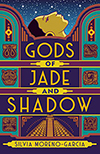
Gods_of_Jade_and_ShadowOoh, this book is so good (and how gorgeous is that cover)! It really does stand as uniquely its own, but all the descriptors I can think of are derivative of other books: it’s like American Gods but gentler, funnier, and somehow just more feminine; it’s got elements of both The Last Unicorn and The Labyrinth, a couple of my favorite pieces of media. Basically, they all have common motifs of mortals discovering the unexpected power they have to either help or resist immortals.
Set in 1920s Mexico, Casiopea is the poor relation in a wealthy family, in her own words: treated like Cinderella, but without the sweetness of character that earns Cinderella her eventual reward. She instead balances duty and resentment in a very recognizable way and chafes at her endless days of drudgery until she accidentally releases a God of Death from imprisonment. At which point, she is basically conscripted in his search for vengeance against those that imprisoned him, leading her from her small town, where her family at least was a large fish in a little pond, into progressively larger cities and exposing her to an array of beings, both natural and supernatural.

This is where it gets tricky. Our heroine is human in the most empathetic way, trying to do what is right while struggling with all the human weaknesses of anger and anxiety, while the god is charming in his own aloof, uncompromising way. The two are supernaturally connected for the duration of this quest, to the peril of both. There is a predominate theme, similar to in The Last Unicorn, of how lengthy exposure to mortals and the mortal world weakens/tarnishes immortals so that they are never as pure as they were to begin with, and that is very effective suspense for me.

A serious trigger warning, however: this is a God of Death we are talking about here, so there is plenty of death abounding, including animal sacrifice and suicide. Now both of those are things that I’m pretty sensitive to, and I was able to read it without trouble because they happen quickly and matter-of-factly instead of really delving into the gritty details, but take care.

While I was reading this, Rebecca sent me a link to a Tumblr post, which gives a variety of excellent recommendations for “Adult fantasy books not by straight white men!” The poster organized it by general tone, which is so, so useful. Under “Urban Fantasy,” one of my favorite sub-genres, she recommends a vampire noir in Mexico City by Moreno-Garcia, so that’s definitely on my to-read list!

Similarly, Rebecca then also sent me a list to “Become Very Well-Read Without Reading Anything by a Man” where you can see how many well-known (not necessarily classics) books by female authors you’ve read, and I love an opportunity to show off my reading! This was not that opportunity because I’d only read 36 out of the 250 books, but it did give me a lot of additional recommendations to look forward to!

— Anna

Bloodlust & Bonnets by Emily McGovern

bloodlust-and-bonnets-9781471178955_lgBloodlust & Bonnets
by Emily McGovern
2019

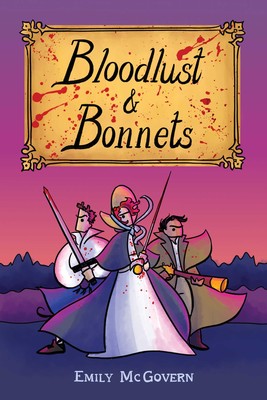
I first ran across this artist/author via her My Life as a Background Slytherin comics which are hilarious and adorable and I highly recommend. And at some point she made a four-page comic called Bloodlust & Bonnets that is hilarious and gorgeous and I also highly recommend.  This book, by the same name as that short, is a 200 page graphic novel that uses those first four pages as the prologue. (Although the art is simplified for the book version.)

For the plot: there’s an evil vampire cult! Lucy, the plucky debutant is targeted by them! Lord Byron has a magical castle! The mysterious bounty hunter Sham has secrets! Napoleon is a psychic eagle! Secret societies and blood oaths and balls and gentlemen’s clubs and turkish baths and succubi and more plucky debutants!

This book is hilarious but also I could only read it in small doses, a chapter at a time. The ongoing joke through the whole thing is just how incompetent all the characters are. Like, all of them. It’s an even playing field at least? With the possible exception of the flighty and wealthy professional widow who is not so much incompetent as she is distracted by other things… ie, potential future dead husbands. So here I am with my competence kink wondering when someone will show up with some competence and each new character is a tease because they all think they’re very capable and introduce themselves that way and they’re all so very much not. Which also makes it fit in kind of hilariously well in British costume drama style.

This is pretty much a take off of Pride & Prejudice & Zombies or Jane Slayre, with Wodehouse & Jeeves, Pink Panther, and Monty Python influences. Which all comes together to say that this book is amazing but also, wow, how are these characters so dumb and yet still walk and breath at the same time???

Fast Women by Jennifer Crusie

FastWomenFast Women
by Jennifer Crusie
2001

This was both a perfect palate cleanser after How To Be Alone and something of a direct rebuttal of it as well. Because this is definitely a romance novel, with a plot focused around two characters getting together and a guaranteed happy ending, but it’s also a remarkably nuanced look into a number of complex relationships. Fast Women is very much on the literary side of things — it deals with divorce, alcoholism, abuse, neglect, despair, and having to start over — and but is saved from that genre by maintaining a generally optimistic outlook on life. While a lot of purported ‘literature’ is unpleasant people living unpleasant lives, this book is consists of delightful people living interesting lives, but it’s no less complex or nuanced. It also has a number of ridiculous situations and conversations that had me giggling every other page.

The main character is Nell and her love interest is Gabe, but Nell has a friend group of two other women, and Gabe has a friend and business partner, and they each have a college-age kid, and each of these five characters is fully developed with their own personal issues and plot-lines.

The plot, such as it is, is an investigation that’s in large part trying to figure out what to investigate because there’s blackmail and murder and arson and theft and they’re all connected in some way, but it takes a good 400 pages for our characters to figure out how.

Anyway, it’s delightful and funny and I definitely recommend it. It’s also a reminder to me that the romance book genre is massive and contains pretty much any subgenre a person could possibly want to read.