Codex Seraphinianus

codexCodex Seraphinianus
By Franco Maria Ricci
1981

In honor of April Fool’s Day, I am reviewing the Codex Seraphinianus. No, this is not a prank or a lie, at least not on my part. The book exists. Just, well… it’s more like it’s a prank or a lie on the author’s part.

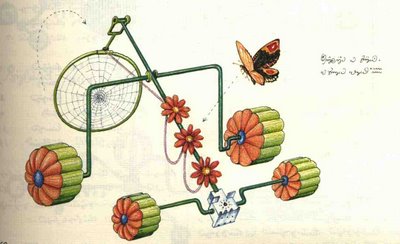
The Codex is an incredibly beautiful and extremely peculiar biology/sociology text in a foreign language. Yeah. Think on that for a bit.

Also, I recommend it.

Regardless of what languages you may be fluent in, this book is in a language foreign to you. It’s actually an alien language constructed as either a code or simply a very detailed doodle by the author, such that the written text is just as much an illustration as any of the actual color illustrations.

The color illustrations, of which there are many, are beautifully done, likely with oil pastels or some such.

codex03  codex7  codex_09

The subject of the book is the biology and sociology of an alien world… an extremely peculiar alien world, with a very complex biology. In some ways it reminds me of a steam-punk universe with cyborgs/implants/etc., except that such mechanical additions are intrinsic to the biology of the plants and animals rather than intentional additions later. (Sort of like WTF-Evolution’s even crazier, acid-tripping brother.)

In other ways it reminds me of the biology from Vernor Vinge’s A Fire Upon the Deep or Orson Scott Card’s Speaker for the Dead. Except more so than either Vinge or Card went.

It also reminds me a great deal of the Voynich Manuscript, a document that I have yet to actually see a good copy of, but which is another biology text written in an unknown language. But the Voynich Manuscript has had professional and amateur codebreakers trying to break it for nearly a century at this point and variously manage to “prove” is (a) a complex code that we just don’t have the key to yet, (b) a brand new language that would need to be translated rather than uncoded, or (c) complete gibberish that contains no meaning and can thus be neither uncoded nor translated. Its provenance is also deeply questionable. It has the potential to be (a) a secret alchemical manuscript from the 1200s, (b) a forgery created in the late 1500s and sold to Emperor Rudolf II as a secret alchemical manuscript from the 1200s, or (c) a forgery created in the early 1900s perpetrated either by or on the book dealer Wilfrid Voynich.

But back to the Codex Seraphinianus, it is vibrant and gorgeous and inspiring and confusing.

If you can get your hands on a copy, it’s a lot of fun.

Or, for a more easily accessible book, check out Chris Van Allsburg’s The Mysteries of Harris Burdick, and try to figure out what the plots are of those stories.

Redshirts by John Scalzi

Redshirts_John_Scalzi1Redshirts
by John Scalzi
2012

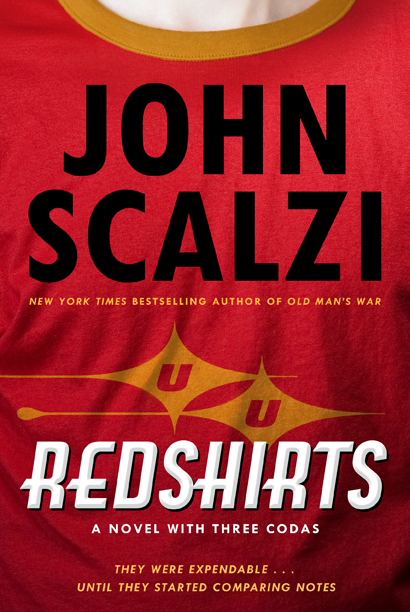
First off, this is an extremely meta novel. It doesn’t so much break the fourth wall as it goes right up to fourth wall, run tests on its density and permeability, and then proceed to report the results to the reader.

The story is set in a quasi-Star Trek universe, from the point of view of one of the ubiquitous “Red Shirts,” wondering why there’s such a high fatality rate among his compatriots and such a low fatality rate, given the exact same circumstances, among the command staff. Anyone who watched the original Star Trek series will understand why this premise made me giggle. Plus, I’d read The Android’s Dream by John Scalzi before, and it was awesomely, ludicrously hilarious.

I intended to read this as a bit of a palate cleanser to my Atlas Shrugged marathon as well as a less controversial book to take with me and read in waiting rooms. It worked beautifully for the second intent, but turned out not to be nearly as light-heartedly fluffy as I had been expecting for the first intent.

It does start out fluffy and funny. The first half was straight up silly. Then it begins to really break the fourth wall and the plot is resolved by three-fourths of the way through the book. Then the final quarter deals with the fall out. Most books have, at most, a short epilog summarizing the foreseeable future. This book, on the other hand, spends a significant amount of time confronting issues of self-agency and choice and worth.

While it’s nowhere near a perfect match, in some ways it makes an interesting compliment to the movie Inception.

It was a good book and I do recommend it, but go in realizing that it’s going to wind up more serious than it starts.

Fanfiction

productimage-picture-discover-fanfiction-today-9528Fanfiction

I have not been reading just Ayn Rand this whole time. That would have driven me completely crazy. I’ve also been reading a fair amount of fanfiction as some light-hearted, palate cleansers. I won’t be reviewing a lot of fanfiction on this site, but I do feel like I should introduce it as a genre, at least.

Fanfiction is a term that describes when fans of a particular story line decide to expand upon that story line by creating their own additions. While the practice has been going on for as long as anyone has been telling stories, the term “fanfiction” is more recent, first gaining wide usage by fans of the original StarTrek series. Now, there is fanfiction for pretty much any book, movie, tv-show, or other type of media that you can think of.

The genre lives in a bit of a legal gray zone since, if the original source is recent enough to be under copyright, then such stories and pieces of artwork are potentially infringing on that copyright. However, fanfiction is generally not produced for commercial gain, reading it comes with the expectation of prior consumption of the original source, and no case of fanfiction has ever been judged in a U.S. court. Published authors vary between actively promoting fanfiction based on their works and actively discouraging it.

As a genre like any other, it also ranges wildly in quality, from extremely shoddy works to amazingly spectacular masterpieces. The amateur nature of the genre allows writers to push at boundaries and experiment with ideas and characters in a way that publishing houses discourage. The online community is well aware of the way they are pushing boundaries, and compensates for it by generally beginning any story with a summary and a series of warnings. These warnings will let you know what source materials (AKA “canon”) you are expected to already know, what characters the author will be using, what romantic relationships will be included, what levels of violence and or sexual content will be included, and any events that readers might have problems with. Fanfiction writers write for fun and readers are expected to approach it for fun, too: use the warnings to read what you expect to enjoy and avoid what you expect to dislike.

The genre as a whole is a living demonstration of the multi-worlds theory: anything that could potentially happen in any universe or with any character, can be written and read with fanfiction. I love it.

Rather than just find fanfiction at random, your best bet is to follow recommendations and browse friends’ bookmark lists. The two biggest online fanfiction compendiums are Fanfiction.net and Archive of Our Own, both of which include reviewing and bookmarking functions.

Here are some good introductory fanfiction stories (ie, fun, short, not too different from their original source material, and no necessary warnings):

Flying Monkeys
by Thimblerig
It can be read on Archive of Our Own.
To understand what’s going on in this story, you should have watched the Marvel movie The Avengers.

The summary is:
The inevitable, horrifying debrief.
“Is this some kind of hobby for you? Planning our imminent destruction?”

The reason I like it is:
First, it’s hilarious. Second, it creates a series of scenes for after the events of the movie, about Clint Barton being debriefed from his time as a mind controlled slave of Loki. The author uses a rich universe and makes it just that much richer by showing some details that just couldn’t have fit into the movie.

Prediction, Protection
By Icarus_chained
It can be read on Archive of Our Own.
To understand what’s going on in this story, you should have watched both the current TV show Person of Interest and the 1990s TV show The Pretender.

The summary is:
Harold was a failed Pretender experiment. Years later, Jarod tracks him down. What follows is a somewhat tense negotiation.

The reason I like it is:
This story uses some background from The Pretender to explain a mystery in Person of Interest. This story makes a connection between these two unrelated universes and asks what if they are the same universe.

Food for Thought
By Ruth Stewart
This can be read on Fanfiction.net (as plain text) or on Livejournal.com (as an entire fake livejournal account, completely with many illustrations.)
To understand what’s going on in this story, you should have read C.S. Lewis’ Narnia series.

The summary is:
A modern teenage girl goes into the Wardrobe, meets Aslan, and learns an important lesson that does not include falling in love with a King.

The reason I like it is:
This is an outsider’s perspective on Susan Pevensie’s life. Susan has died and her grandson and great-granddaughter have come to sort through her belongings. This story is written as a series of blog posts by her great granddaughter, learning about Susan’s life from the records she left behind. This author does an amazing job of researching and then showing recent British history.

Day One
By Zee Viate
This can be read on Fanfiction.net.
To understand this story, you should have watched the TV show NCIS.

The summary is:
The night DiNozzo and Gibbs first met.

The reason I like it:
I stopped watching NCIS around season 7, because the characters were going in directions that I didn’t care for, but this is a look back at young Tony DiNozzo and Gibbs before he knew him, and it reminded me why I loved this show so much for so long.

Followers of the Carpenter
By PaBurke
This can be read on Fanfiction.net.
To understand this story, you should have read book eight of The Dresden Files by Jim Butcher and watched the TV show Criminal Minds.

The summary is:
A serial killer moved to Chicago and followed his normal MO, but this time, he bit off more than he could chew.

The reason I like it:
There’s something wonderful about an outsider’s perspective on some of the characters and events of urban fantasy novels.

Five Scenes Over a Goban
By Opalish
This can be read on Fanfiction.net.
To understand this story, you should have read the manga or watched the anime Hikaru no Go.

The summary is:
Ichikawa laughs until she chokes, and Akira suddenly understands why Shindo spends so much of his time yelling at people to stop hitting him already.

The reason I like it is:
I just love these little looks at how these characters view and interact with each other. This is a peak at everything that made me love these characters in the first place. There isn’t any plot arc, but just some fun character studies.

Evening Encounter
By Maeniel
This can be read on Fanfiction.net.
To understand this story, you should have read the manga or watched the anime Rurouni Kenshin.

The summary is:
Okita’s heading home at the end of the war and encounters a certain redhead. What do they say to each other?

The reason I like it:
In the series, we don’t get much of a look at this time period in Kenshin’s life, but it’s a major turning point for him, and seeing him in this time really shows off his thoughts. Plus, it also develops Okita, who is given very little attention at all in the series, and creates a connection between the fictional series and the real history of the time period.

Kurt Vonnegut short stories

KVonnegut3Kurt Vonnegut
1922-2007

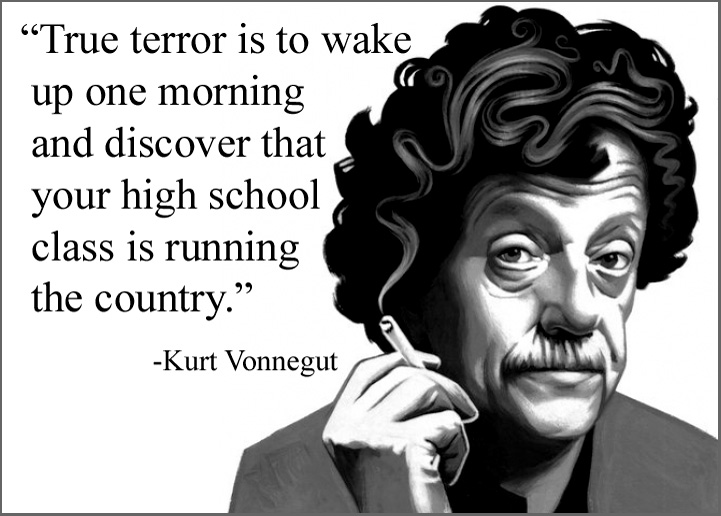
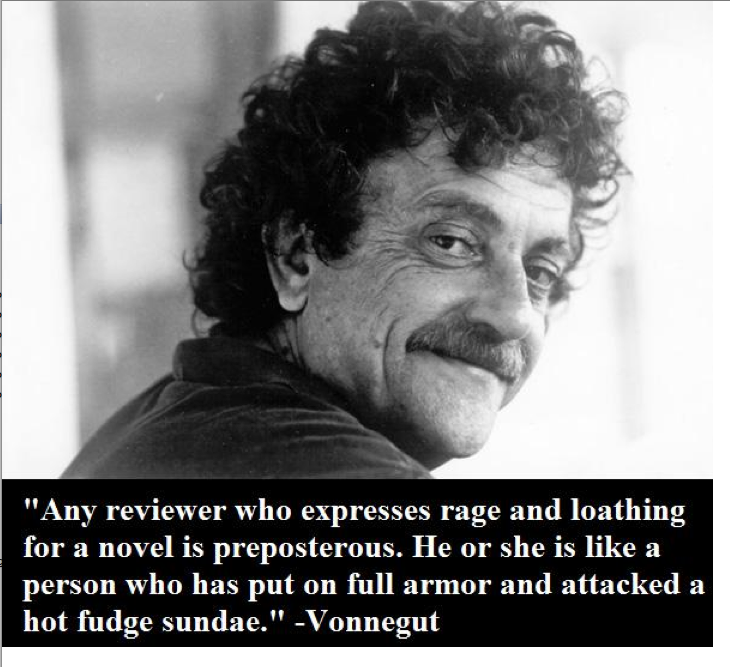
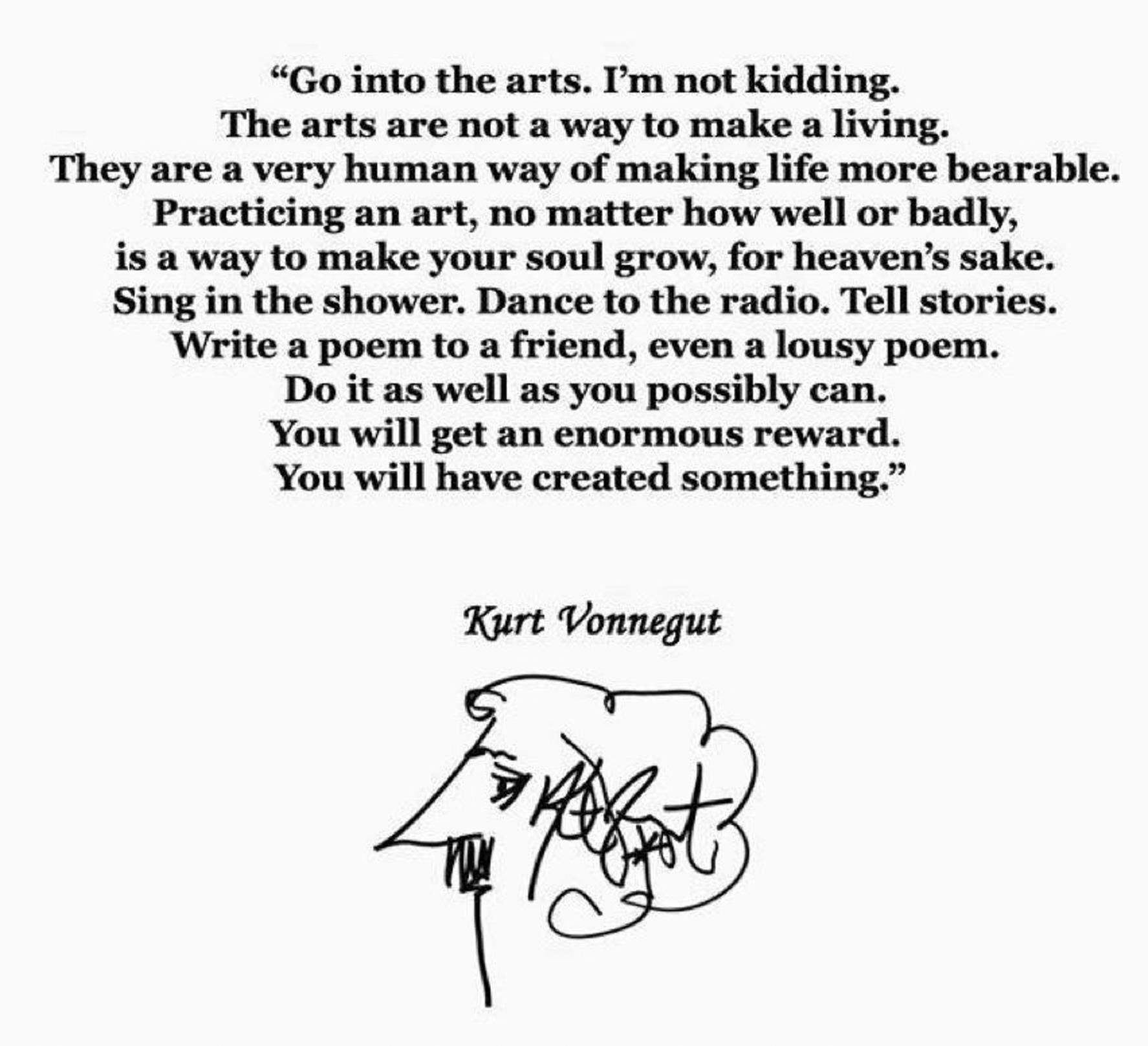
I have mixed feelings about Kurt Vonnegut. I think he has some extremely important ideas in his writing and I know he’s deeply affected a lot of people, but I don’t actually care for most of his writing. He’s still worth reading and I was thinking about him yesterday while I was reading my daily quoto of Ayn Rand (25 pages per day, five days a week.) Despite making a comparison between two authors without having actually read all that much by either, I think they have many similar points of view and many similar styles. But Vonnegut not only writes much shorter books and even short stories, I think he also has a more nuanced sense of people.

He makes many of the same arguments that Ayn Rand does, about the importance of individuality and personal achievement, about rebelling against totalitarian societies, but he also goes on to talk about the importance of working to make the world a better place, if only because it is the world you live in and there’s no opting out.

Anyway, some of his short stories can be found online.

The story that I was particularly reminded of was “Harrison Bergeron.” This story talks about equality and the importance of realizing what exactly you want to be equal. As a die hard liberal, I think everyone should have equality in opportunity. In contrast, the idiot liberals in Harrison Bergeron (and in Atlas Shrugged) seem to be arguing for equality of results. This is an extremely important distinction. Not everyone should be paid the same amount or receive the same amount of accolades. Not everyone is a winner. But everyone should be a contestant. Everyone should have the opportunity to try.

Another of his stories, one that I actually really enjoy, is “Report on the Barnhouse Effect.” While this story also deals with the individual’s ability to achieve great things and to effect the world as a whole, it’s also about taking personal responsibility for the world as a whole, and even the possibility of (as Tony Stark says) privatizing world peace. Privatizing world peace is not something I would approve of in the real world, but it sure makes a good story and I do like the look at personal responsibility on a global scale.

KVonnegut

vonnegutTerror1  KVonnegut2

Kurt-Vonnegut-Quotes-3  kurt_vonnegut1

Lincoln’s Dreams

By Connie Willis

Book Cover: Lincoln's DreamsSo, with all the movies about Lincoln cropping up (I’m counting Lincoln and Abraham Lincoln, Vampire Hunter as ‘all the movies’), I was inspired to reread Connie Willis’ Lincoln’s Dreams, which I’d only read once many years ago.

It is a bit of a mess, I’m afraid.

It also turns out to be just the second novel she wrote, which explains a lot.

There are four central characters to the book, and while there are other peripheral characters coming in and out of scenes, the whole book focuses on the tension between these four: an author writing a novel about the Civil War, his research assistant, a young woman having persistent dreams about the Civil War, and her doctor, who is also the old college roommate of the research assistant.

(With the limited characters and settings, it occurred to me that this could actually be made into an interesting stage play, though the script would definitely need some tightening-up. This is the one nice thing I’m going to say about it.)

Actually, one more compliment: each chapter begins with a piece of trivia about the Civil War, and the research assistant describes more within the chapters. For those readers like me who want a lot of narrative with their nonfiction, this is the most palatable way to take in Civil War facts. (I also know from Connie Willis’ other books that she is extremely interested in history and does meticulous research for her novels, so I trust her historical accuracy.)

Okay, now on to the savaging. About a third into the book, I started noticing that the single female character didn’t have very many actual lines, and when she does speak she is often interrupted or instructed by a male character.* The woman is pretty much the central character, around which the three male characters orbit, so it took me longer than it should have to notice what an extremely passive character she was, really more of a target for the male characters’ expressions of emotion than a character in her own right. Even the final climax of the book, in which the cause of her dreams is discovered, supports the idea of her as a vessel to be filled with male ideas rather than a fully functioning person.

From reading Willis’ other books, I trust that she was actually doing this on purpose, and making a commentary on how, by trying to protect people we care about, we can end up marginalizing them, and thus doing more harm than good. It ends up being kind of a pat observation, though, and is not sufficiently explored enough for me. I have to admit that I might be being a bit unfair to Willis, though; I find that I am judging her early books in comparison to her later books, and then criticizing them for not being nearly as good.

The final thing is, though, that I would actually continue to recommend this book to people. Certainly not as an introduction to Connie Willis (for that, read To Say Nothing of the Dog), and not even as a good read, necessarily, but definitely a book that gives a different and interesting viewpoint of the Civil War and even wars in general, and for that I still consider it completely worth-while.

—Anna

*This is becoming a bit of a bee in my bonnet, actually. I’ve just recently started noticing that female television pundits get interrupted and talked over a lot more than male pundits. I know that shouldn’t surprise me, and it doesn’t, really; it just makes me really mad at how blatant it all is.

Captain Vorpatril’s Alliance by Bujold

Captain Vorpatril AllianceCaptain Vorpatril’s Alliance
by Lois McMaster Bujold
2012

This is an excellent fast-paced romantic adventure comedy. I sped through it in two days and kept giggling to myself. It just leaps from one ludicrous situation to another and yet, the plot still tracks beautifully. I can see why and how these situations came about, and I can also see why and how these characters managed to get themselves into these situations, even if I want to slap them upside the head for doing some of the things they do.

Interestingly, it takes place prior to Cryoburn, which might explain why Cryoburn made so few references to off-planet events in general, less to avoid spoilers than to avoid a sense of WTF?.

There’s an elopement with the use of a box of instant groats, a 100-year-old buried treasure, a 30-year-old hidden bomb, a handful of beautiful ladies (all of whom are extremely wily), a handful of wily men (many of whom are extremely beautiful), cross cultural laws and smuggling rings and bounty hunters. And, in the middle of all of this, is Ivan Vorpatril, who has, much to his dismay, lots of experience regarding such insanity.

In previous books in this series, Ivan generally gets drawn into his cousin Miles’ crazier plots despite his own efforts to remain an innocent bystander. In this book, though, Miles appears in only a quick cameo, and Ivan manages to get involved in a crazy plot all on his own. The book also develops a few other secondary characters from the series, showing more of Byerly Vorrutyer and Simon Illyan than we’ve gotten previously.

While it’s more than a bit self-indulgent, the book maintains its self-indulgence with aplomb and delivers an immensely fun roller-coaster of a story that I enjoyed immensely.

Liar and Spy, Sort Of

As Anna said in her last post, all of us here at the blog were awfully worried about Hurricane Sandy, but we were fortunate enough to have made it through the storm with power and without major damage (and of course our thoughts are with the folks further North who were not so lucky). But I did end up spending a couple of random days trapped in my apartment–an excellent opportunity to finish up some library books. Some of my reading was grown-up (Capital by John Lanchester, which was just fine), but I also raced through a sweet middle-reader book by Rebecca Stead called Liar and Spy.     

This super-quick read was a charming story about a Brooklyn middle-school kid whose family is forced to sell their house and move to an apartment, and how he makes some friends and learns some lessons in the process. Like I said, sweet and charming, but I’m really talking about Liar and Spy so that I can tell everyone to go read Stead’s last book, When You Reach Me, which won her the Newbery Medal in 2010. It’s another middle-reader about New York City kids, but this one has a sci-fi twist and a major plot point turns on one of the characters reading Madeleine L’Engle classic children’s book A Wrinkle in Time.
Now, I have a particular soft spot for Madeleine L’Engle (I actually named my litter sister after her!), so this was an automatic hook for me. I’ve seen some criticism of When You Reach Me arguing that using L’Engle’s book makes it somehow less original, almost like fanfic. I think that A Wrinkle in Time is such a classic at this point, such a familiar institution to some many kids, that it’s a smart way to connect with readers. Particularly since the book is set in the 1970s–young readers might find some 70s elements strange, but A Wrinkle in Time might be familiar. As an older reader, I found it nostalgic. I also got completely sucked into trying to figure out the plot and worrying about the character–Stead takes things in a really interesting direction and uses the ideas in L’Engle’s book to tell a completely different kind of story.
As much as I love YA books, I usually find middle readers a little lightweight. Liar and Spy was lovely and I would happily recommend it to kids I know, but When You Reach Me was something else–clever and touching and powerful. It’s only going to last you an afternoon, but it’s well worth a library visit.

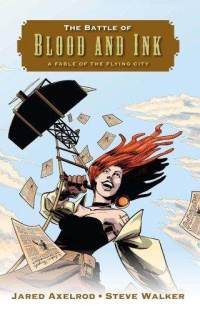
The Battle of Blood and Ink by Axelrod and Walker

The Battle of Blood and Ink: a Fable of the Flying City
Jared Axelrod and Steve Walker
2012

This book has my qualified approval. Without the time (or ability to concentrate) for reading a full book, I recently read a graphic novel instead. Given the adage “a picture is worth a thousand words,” if all of your descriptions can be replaced by images, a graphic novel can be read a whole lot faster than a traditional novel and in fact I read The Battle of Blood and Ink in about forty-five minutes.

On the up-side, it was wonderful to just relax with a book and this one had fun characters and interesting intrigue and really beautiful illustrations. The art is both lovely and lively and was what first attracted me to the book. Then, the characters drew me in, as well as how the authors addressed moral issues regarding ethics versus pragmatics and personal versus political responsibility. It was both beautiful and interesting.

The story is about a woman, Ashe, who grew up as a street kid on a flying city and now makes her living printing a newsletter regarding city events and happenings. The city is a place of wonder, but from Ashe’s perspective, we see some of the gritty underpinnings of how things actually work, and so too does her readership. This gets her into trouble with the city ruler and events progress. Since the role of information and censorship are currently particular interests of mine, this plot was just right for me.

On the down-side, the climactic scene relies on a lot of world building that wasn’t actually presented previously in the book. Given the setting is a flying city, the universe is obviously a science-fiction/fantasy one, but the physics of the world isn’t really explained at all, and the climax depends on certain premises that I hadn’t expected.

Having read and enjoyed the book but feeling a bit bemused by the ending, I discovered that the book was intended as a stand-along sequel to a set of 44 online pod casts (i.e., audio recordings). I listened to the first two of them and was not nearly as impressed by them as by the graphic novel. The world building issues may or may not be addressed in these pod casts, but of the two that I listened to (each about 15 minutes), both times the speaker rambled for a significant period of time before getting to the story and then the story was filled with poorly written descriptions that were much better presented as images in the graphic novel.

So, on the whole, while there are serious flaws in this graphic novel, it’s still lovely, fun, interesting, and well worth the half-hour to an hour that it would take to read. If you want to get a taste of it, the first twenty or so pages are available online.

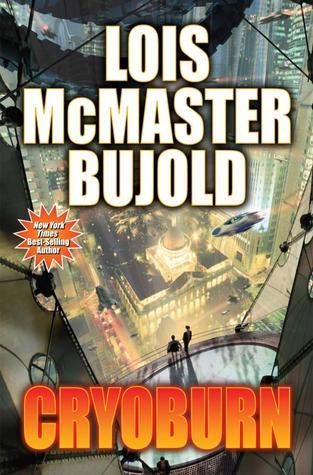
Cryoburn by Lois McMaster Bujold

Cryoburn
By Lois McMaster Bujold
2010

So I finally got around to reading Cryoburn, which is a ludicrous statement for me to have made. I adore Bujold. I discovered her about fifteen years ago and have read her books ever since. She has three different series, set in three wildly different universes, each of which I love. I have read everything she has ever published and loved them all. She was the first author for whom I actually started purchasing new-released hardcover books and even now is one of only four authors for whom I have done that. So why, then, did it take me nearly two years to read this book, checking it out from the library?

When it was first announced, I was super excited. A few months before it was finally due to be published, the publisher posted the first several chapters online as a teaser and I raced over to read them… and found myself kind of, well, bored.

First of all, this is the fifteenth book set in this universe and the eleventh book following the adventures of Miles Vorkosigan. And it is the first book in which there is no major character development.

It makes a certain amount of sense. Miles was introduced in The Warrior’s Apprentice (incidentally, that book (awesome-awesome-awesome) is available for free online, because both Bujold and Baen Publishers are very cool) as a high-born teenager in a military culture who failed to pass the military entrance exam due to physical disability despite all the nepotism in the world. He’s an awesome character: a brilliant, hyperactive dwarf with brittle bones, a lot of high-ranking family connections, and a deep desire to prove himself. It gets him into and then out of So Much Trouble.

But he does, slowly and painfully (and awesomely!), grow up. He grows into himself and faces set backs and failures and grows into himself again and changes who he is and what he wants and if the teenage years were hard, the twenties were driven, and the thirties were vicious, but now he’s settled. He’s happy with who he is and where he is and what he’s doing.

This makes me very happy for him.

But, well, there’s a reason most stories end with the whole “happy ever after” summary of the rest of characters’ lives. Happy settled people aren’t really as interesting as manic, driven people.

Now, character development isn’t the only thing that Bujold does fabulously well.  Her world-building is amazing and rich and deep. Her plot lines and mysteries are complex and tricky and hilarious. And Miles does remain an excellent character and driven in his investigations once they get going.

Cryoburn absolutely demonstrates Bujold’s skills at both science-fiction world-building and tricky plotting. The problem is that since the storyline is a mystery, and the reader only sees Miles’ discoveries as he’s making them, it takes a while for both Miles and the reader to get the momentum going.

Once it gets going, though, the book is excellent. I love the twisty plots and plans and characters and Miles’ manic investigation into them all.

It occurs to me that this book actually might work best as a stand-alone, without having read any of the previous books in the series, and thus coming to it without expectations.

The only thing that needs real background to get the full impact is the epilog, after all the plot ends have been tied up. The epilog, oh, the epilog: it hits like a punch to the sternum and makes my heart skip a beat. (You do need to have read the series to get the full impact, but oh, my heart, oh Miles, oh Bujold, love-love-love!)

So expect to slog a bit through the beginning, but the later two-thirds are really, really good.

What happened to conclusions?

There are some traditional plot arcs out there that various authors use, re-use, re-interpret, or ignore entirely, depending on their choice. But there is one basic plot arc that I consider pretty universal: beginning, middle, end.

First there’s the beginning in which the writer starts the story and introduces the characters and the world and the problem at hand. Then there’s the middle in which stuff happens. Finally there’s the end in which the results are revealed for the stuff that happened in the beginning and the middle.

Is there some post-modern style now that considers endings to be passé? Because I have recently read two young adult books that I enjoyed right up until I realized that the last few pages weren’t actually going to involve any sort of conclusion.

There’s a difference between a book being the first in a series and just hacking a book into multiple pieces. Or so I had thought. But twice in a row, two otherwise well written books suddenly stopping like this. It feels like a conscious choice. It’s not a style that I approve of, but I’m beginning to really think it might be a stylistic thing rather than simply bad writing, especially since, aside from the lack of any conclusion, they were good books, or at least two-thirds of good books.

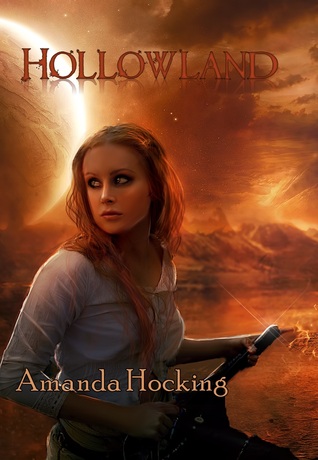
Hollowland
By Amanda Hocking
2010
(Free kindle edition on Amazon)

Remy King is nineteen, the world has fallen apart in a zombie apocalypse and she is going to go across country to get to her brother if she has to walk to do it, beating off zombies all the way. She is kick-ass and awesome, acquires a few companions and loses a few companions (but luckily not the lion, because I never before realized that a proper kick-ass heroine needs a lion companion, but this book convinced me), and is generally determined. This was pretty much exactly what I was in the mood for during my own finals madness.

Except for the fact that this is book #1 of The Hollows series and the plot transitions smoothly into plot #2 before the book ends, leaving me going: Seriously? That’s where you decided to break off? Seriously?

Cinder
By Marissa Meyer
2012

Cinder is a mechanic with a stall at the local market bringing in the only income her family sees. She’s also a sixteen-year-old cyborg in a world that considers cyborgs to be less than human. Her step-mother was not happy that Cinder’s adopted father had decided to adopt a cyborg and even less happy that he then proceeded to die of the plague just a few months later.

A lot of people are dying of the plague these days. Including the Emperor.

Which leaves the prince and heir to the throne in the rather unhappy position of being pressured to marry the queen of the independent moon colony. The lunar people have mind control powers and their royalty tend to use assassination and mutilation to get what they want.

This is the kind of crazy re-imaging of the Cinderella fairy-tale that I just can’t resist. It was excellent and crazy and fun… right up until the final climactic scene turned out to be less climactic and more of an introduction to a whole new plot arc with no conclusion in sight. Apparently there are four more books in the works.

So, what’s up with this?

Neither ending is really a cliff-hanger, per se. They’re just incomplete stories. For anyone who reads amateur fiction published online, it feels like I just came to the end of the posted portion of a WIP (Work in Progress). I had rather thought that the benefit of reading formally published books is that none of them are WIPs. It’s depressing to discover that’s not the case.

So, I ask again, is this really a style of writing that’s going around now: plot arcs composed of beginnings and middles, but no ends?