The Book of Strange New Things

By Michel Faber

The_Book_of_StrangeWhew, this book. I’ve been reading The Book of Strange New Things off and on now for the past two months. The very basic, ridiculous-sounding premise is that a minister is sent to a newly established human colony on Mars in order to bring Christianity to the native martians. I had thought that this interesting combination of science fiction and religion might be a good Christmas present for my dad, who is interested in both, but I also thought that I better read it myself first since I’ve had bad luck in the past giving unread books to people.

I went back and forth several times on whether to save this as a gift. One the one hand, it really is an interesting look at the role religion plays in people and their relationships and how that translates to a literally alien setting. (For instance, how do you explain both The Good Shepherd and The Lamb of God to beings that have no concept of sheep, or even any grazing animal?) On the other hand:

  • Women in general don’t come off great, though that is something that almost every reader of science fiction has to build a tolerance for. (By the end, though, the men weren’t coming off all that great, either, and I was struggling to find a sympathetic character at all.)
  • There were multiple descriptions of non-Christians and people of color that made me uncomfortable, while not being overtly racist.
  • In the end, there were just way too many random and gratuitous mentions of male genitalia than I felt comfortable giving to my dad. (Clearly, he is an adult and would be fine reading it, but maybe just not coming from me.)

After trying to weigh the balance between a really thoughtful overarching premise and problematic details, I finally just decided that any book that takes me two months (with frequent breaks) to get through is not a strong recommendation.

—Anna

World War Z

RHWorldWarZ500World War Z
By Max Brooks
2007

So I “read” this as an audio book that was marked as unabridged, but does appear to have lacked a few sections from the original book written in 2006. I now need to go back and read that whole book, because this was AMAZING and there are still parts I haven’t read!

Just, wow! So, so good!

The audio book was particularly good for an audio book because it was read by a full cast of voice actors, not just a single reader, and it really highlighted the way that this book was presented as an oral history.

For the rare person who doesn’t recognize it, it’s a fictional book inspired by the nonfiction book The Good War: An Oral History of World War II. In World War Z, though, the war in question is the zombie war, but for all the fantasy element, it’s addressed in a serious manner. I love the world building that went into figuring out how a zombie war could start, how different people would react, and how it would eventually end. I also loved the characters, who were all faced with this impossible conflict and did the best that they could.

I may very well be the last person to have gotten around to reading this book, so it hardly needs me to recommend it, but if you happen to have been living under a rock for the last decade, you really should read this!

The only thing that could have made it better is if it were longer, and apparently that wish got granted since there’s more for me to read once I get a text copy to read. (I really want to know more about the blind Japanese mountain man! But I’ll also take anything else.)

As a side note: ignore the movie. They took a really unique book essentially consisting of dozens of epic interlinking short stories and tried to shoehorn it into a traditional movie plot.

On The Beach

By Nevil Shute

Book Cover: On the BeachOn The Beach, published in 1957, is by far the most relaxed post-apocalyptic book I’ve ever read. The basic premise is that large-scale nuclear warfare broke out in the northern hemisphere, apparently destroying all civilization. Because of something about wind patterns that I have no frame of reference for, the blasts and radiation have not hit the southern hemisphere, though they are expected to slowly come over with the changing of the seasons.

Our two main protagonists are an Australian naval officer and an American submarine commander who was undersea during the war. The two of them, and about a dozen other military personnel and neighbors and such, all get along very well, hosting small dinner parties and beach outings, while the Australian navy sort of desultorily sets up an exploratory mission to search for survivors or intact land or such.

One of my (many) pet peeves with police and military dramas is how angry and confrontational all of these supposed professionals get with each other. On The Beach continually shocked me with how each introduced character — the Australian naval officer, the American commander, the civilian engineer, and even the Australian Prime Minister — seemed to enjoy meeting the others and working with them in what should have been an extremely emotionally fraught situation.

The first submarine expedition lasted a week and only one page; I actually had to go back and reread it since I thought maybe I’d missed a part. Truly, the only suspense came from me as a reader not quite believing that there wasn’t going to turn out to be some horribly twisted character or other manufactured drama-for-the-sake-of-drama. I think some readers might struggle with this because nothing much seems to happen, but I somehow found it so reflective of the little things one would fill one’s life with at the end, that is was soothing to read. (To add a caveat to this, after I finished the book, I read some other reviews, in which people did not find it quite so soothing, and described the calmness as frustrating and terrifying, so take that into consideration, I guess.)

I highly recommend it, even if just for the extremely novel experience of reading about a bunch of adults dealing with an unpleasant situation in as mature a way as possible. Seriously, when is the last time you’ve read a book where you liked and understood the motivations of every single one of the characters? Where there isn’t a single ‘villain’ in the piece? One of the women is a little thinly written, but compared to other female characters in 50s and 60s scifi novels, she is still quite a strong character. The other central woman was particularly well done, starting from pretty much a spoiled brat to becoming sort of the heroine of the story, though, again, ‘heroine’ is perhaps too active a word for it.

The book starts with the line from T. S. Elliot, “This is the way the world ends / Not with a bang but a whimper,” and I can’t think of a better overall description for this book than that, quite frankly.

—Anna

The Last Policeman

By Ben Winters

Book Cover: The Last PolicemanThe Last Policeman is a murder mystery set in a pre-apocalypse Earth – an asteroid has been discovered that will hit Earth and most likely destroy all of humanity in six months. Lots of people commit suicide (which I don’t understand; maybe this is my laziness speaking, but why bother if the Earth is going to shortly do it for you?) and lots of people have abandoned their homes and jobs in order to fulfill their bucket lists. Our protagonist, Henry Palace, however, was a beat cop who was promoted to detective after enough of the detectives quit or died. He has always wanted to be a detective, and so is very dedicated, driving everyone else crazy with his scrupulous attention to detail and his eagerness to actually investigate a death that he claims is suspicious and everyone else says is yet another suicide.

There are spots of humor (all the McDonald’s and Duncan Donuts have closed, but Panera is still running strong, albeit as a religious organization), but the overall tone of the novel is definitely dark. The world is completely topsy-turvy with internet and cell service collapsing, most major corporations shutting down, and just about every other job, including the government, depending on a skeleton crew of dedicated employees. Inflation is through the roof, of course, though I was confused that there was any monetary economy at all, actually. The people, too, are all different levels of crazy, with depression and drug use way up, naturally, making tracking down motives and following rational clues particularly difficult.

One of my favorite things about the book is that, through showing instead of telling, I am fairly sure that both the detective and the victim are on the milder side of the Autism spectrum. It is cool to see that (possible) representation laid out so matter-of-factly. Separate from that aspect, however, there were the occasional times when I wondered about an unreliable narrator. He isn’t unaffected by the coming doom, either, and there are definitely times when I wondered whether he purposefully twisting the truth to make his case better match the cases he’d hoped he’d be working on as a detective.

This is the first in a trilogy, and I definitely plan to read the next two, so I’ll report on those when I get to them. Rebecca asked me how there can be three if the world only has six months to go, but this book only spanned a month. I wondered, though, if something unforeseen happens and the asteroid does not hit, how do you rebuild after all of Earth’s societies have been living as though it is the end of times?

—Anna

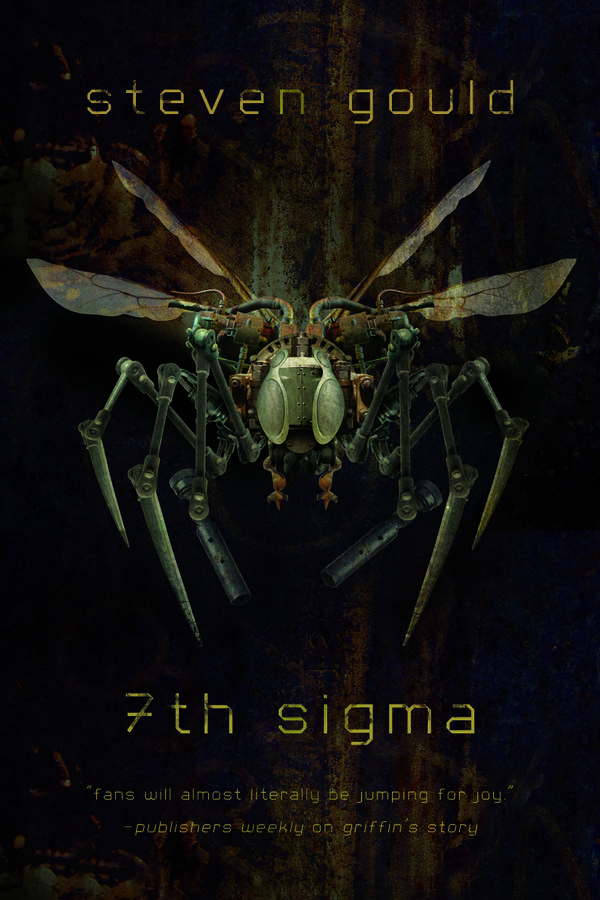
7th Sigma by Steven Gould

7thSigmacoverart7th Sigma
by Steven Gould
2011

This was a fun and interesting science fiction book that was mostly a character study, with the science fiction largely a backdrop for the Wild West atmosphere. Most of the chapters are essentially stand-along short stories about what our main character, Kim, is getting up to.

In many ways, this book reminded me of Zenna Henderson’s The People series, what with the mixture of high-tech knowledge and low-tech life and the overall theme of people being people. Much more blatantly, the story is also heavily influenced by, or possibly a re-write of, Rudyard Kipling’s Kim. It’s been a while since I read that and don’t particularly remember it, but I do think they suffered the same issue: Kim as a child is adorably precocious; Kim as a young man is somewhat irritatingly perfect.

Luckily, as Kim grows older in 7th Sigma, the world building also begins to expand, so it balances out and I enjoyed the book as a whole. I do wish there were more, because the world building was pretty fascinating and I wanted to see the implications of one of the final reveals.

The Martian

Sometimes you want to read a carefully-crafted literary masterpiece, where each sentence is like a tiny poem, where you find yourself going back to re-read passages just to enjoy the language. If that’s what you’re looking for, let me suggest that you pick up All the Light We Cannot See by Anthony Doerr or The Bone Clocks by David Mitchell. But sometimes you’re sick of depressing, heavy prose and you just want to read something FUN and AWESOME that makes you stay up reading until 2:00 in the morning because you absolutely have to know what happens next. In that case, go find The Martian by Andy Weir.

Part of the fun of the story is not knowing what’s coming next, so here’s all I’ll say about the plot: Mark Watney is an American astronaut on mission to spend two months on Mars. But six days into the mission a disastrous series of events leaves him stranded on the surface. He’s alone, NASA thinks he’s dead, he has no way to communicate with Earth, and both his air and food are limited. What’s he going to do? The author prided himself on being as accurate as he could be (in a book about people on Mars, anyway) so there’s a lot of very technical discussion–not science, exactly, more like engineering–and, I’m going to be honest here, a lot of math. But it was easy to skim over the various calculations of air volume and explanations of how things work and focus on Mark himself, a resilient, resourceful smartass who you start rooting for immediately.

Andy Weir has gotten all sorts of press for the Cinderella story of this book–he initially published the book chapter-by-chapter on his website, then self-published on Amazon before getting picked up by a publisher and getting on all the best-seller lists. And the book somehow feels like a self-published serial story, but I don’t mean that in a bad way. The plot moves like a freight train, and Mark has a very clear, strong voice. I am not sure whether Weir’s going to be able to follow this one, but I had lots of fun reading The Martian more than anything I’ve read in a long time.

Kinsey’s Three Word Review: Completely un-put-downable fun.

You might also like: Space movies! Specifically, Apollo 13 and Gravity, which are both more like this book than anything else I can think of. And, in fact, The Martian is going to made into a movie starring Matt Damon, who is exactly who I would have picked to play the smart and likable main character.

Special Father’s Day Alert: Is your dad as impossible to shop for as mine? If you’re also at loose ends for a Father’s Day gift, consider The Martian! While I loved this book, it also struck me as a very Dad Book. I am aware that dads are different, but mine is getting a copy of this because it is perfect for him–science-y, funny, space-y, guy-ish, full of problems to be solved, etc. Very Dad.

Kindred

By Octavia Butler

Book Cover: KindredBefore reading Kindred, Connie Willis’ Doomsday Book was the most painful time-traveling book I’d read, but boy does Kindred blow it out of the water. (I’d also previously only read one book by Octavia Butler, Fledgling, considered by herself and everyone else to be her ‘lightest’ book by a long shot.) The basic premise of Kindred is that Dana, a young African-American woman from contemporary times (1970s, when the book is written), is pulled back to a slave plantation several different times in the early 1800s in order to save the life of the plantation owner’s son.

I think we can all acknowledge that the current news has made it increasingly clear that there is a white world and a black world in our country, and even sympathetic whites can’t understand what it is like to live in the black world. Reading Kindred shares some of the sense of what it must be like, though: for every interaction with a white person, even one trying to be kind, to have the possibility of death hanging over it. I was so scared for Dana all the time, and the tenseness of reading the book was exhausting, and about halfway through, I realized that this tenseness and exhaustion is not something confined to the antebellum south at all. So, while it was painful to read, it is also incredibly important, and I was so grateful to Butler because I can’t think of another author that could have communicated this feeling to readers so well.

The kind of funny thing about it, though, is that there are really three time periods: the 1810s, the 1970s, and 2015 for me, as a reader, so there’s that layer on top. Sad to say there doesn’t seem to be a huge difference in race dynamics, but the gender dynamics of the 1970s were occasionally different enough to give me pause, though that was more towards the beginning of the book when she and her husband were confused about what was going on.

It felt like it ended a bit abruptly, but I think that is more a testament to Butler’s writing than anything – I was so deeply involved in the story that coming to the end would have felt jarring no matter what the ending was. I will give this very minor teaser spoiler for people who might be hesitant about the book: it doesn’t end nearly as badly for Dana as I’d expected it to, given that the very first sentence in the book is “I lost an arm on my last trip home.”

—Anna

For a quick laugh: 3 Fanfiction plus 1 Nonfiction

It’s been a while since anyone’s posted, so I’m going to recommend four short stories that are crazy good for a laugh. Two of them are so short that they don’t even have titles, but still, go read them!

LINK for FIC
by kyraneko

Fandom: crossover between State Farm Insurance Commercials and All State Insurance Commercials

Original Inspiration for Fic: “Like a good neighbor, State Farm is there” we chant, and another agent appears in the pentagram. He screams. The Dark Lord feasts tonight.

LINK for FIC
by paginationline

Fandom: Marvel’s Avengers comic books

Original Inspiration for Fic: “Clint.”
“I know—“
“You have the army after you and no health and you’re falling out of a crashing plane.”
“I know, Nat—“
“It’s a bass fishing simulator, Clint.”
“I know! It just—it just happens!”

LINK for FIC: Your Highnessness
By shadydave

Fandom: crossover between Guardians of the Galaxy and Jupiter Ascending

Summary: A long time ago, in a galaxy far, far a—
Yeah, I know that’s not when it happened, but that’s how you start this kind of—
I don’t know, do I look like George Lucas?
No, he made the movie. No, it doesn’t have Kevin Bacon. Not everything has Kevin Bacon!
Of course it’s still good!
Fine, you dicks. If you think you know better than one of the greatest stories of the human race:
A short time ago, in this galaxy…

LINK for FIC: So I used to be a martial artist
By textuallyaroused

Fandom: nonfiction, autobiographical

Example paragraph: Now, Sensei Diven was not a stupid man and he hated high-ranking kids that showed a bad attitude. This kid had a bad attitude. So he must have seen the evil gleam in my eye from a mile away and decided it was time for a little improvisation.

Not Actually Fanfiction

As should be obvious, I really enjoy fanfiction. They are (often) fun stories by (presumably) amateur authors who can sometimes do amazing things unconstrained by thoughts of salability. They write because they have ideas they want to get out. And sometimes, it’s not actually fanfiction. Sometimes an amateur author, in the same spirit of fanfiction, will write an original story and post it online for anyone and everyone to enjoy.

There are even a few archives specifically for these types of short stories, presented like fanfiction except for being entirely original. The parallel for Fanfiction.net is FictonPress.com. ArchiveOfOurOwn simply added a category for Original Fiction.

Here are a few recommendations for original short stories presented online:

Suite for the Living and Dead
By Inland Territory
Summary: When he was twenty three years old, Mike Lafayette took it on himself to write an oratorio for a people without a god.
Why I like it: This is just beautiful. A beautiful concept and beautifully written, but also speaks directly of the particular pain of seeing a deadly and important conflict happening in front of you and, for one reason or another, not joining the fight.
Extra comment: This feels a bit like a fanfiction story in that it references a much more epic story with main characters who are minor characters here. It makes me wonder if there is a book out there this is connected to but I haven’t been able to find. My current assumption is that it is that the author of this short story has an idea for a book and maybe she’s even half-written it, but it’s not available anywhere.

Toad Words
By Ursula Vernon
Summary: Terri Windling posted recently about the old fairy tale of frogs falling from a girl’s lips, and I started thinking about what I’d do if that happened to me, and…well…
Why I like it: One of the problems with traditional fairytales that I (and many other women) are increasingly aware of is how they often reward young girls for being quiet, polite, beautiful, and awaiting rescue, while punishing young girls for being outspoken, ugly, and actively attempting their own rescue. This takes one such fairytale and shows the repercussions, and how a curse can ultimately be made a reward and a blessing can ultimately be a punishment.

Never the Same
By Polenth Blake
Genre: science fiction
No summary, but the first paragraph: Everyone thinks my brother is nice. He set up a rescue centre for birds, after the terraforming accident poisoned the lake. That’s always the image of him, holding a bird covered in sludge. The birds are never the same after they’re cleaned, but the gossips never talk about that.
Why I like it: This is a lovely little mystery, with a main character with mental health issues. With a somewhat unreliable narrator investigating a situation in a highly biased community, the story looks into the difference between right and wrong actions and right and wrong motivations.

The Emperor’s Last Concubine
By Yamanashi Moe
Warning: this has explicit sex in it
No summary, but I bookmarked it as: a story of love and politics
Why I like it: This story has the standard Cinderella structure but focuses on what happens after the handsome prince whisks his beloved away and the difficulties faced by both prince and beloved as they both become aware of the golden cage the palace makes.

All Seated on the Ground

By Connie Willis

Years ago, author Connie Willis released a collection of delightful Christmas-themed scifi stories called Miracle. The two best stores are considered annual reading in my family: one is about a woman who gets “haunted” by a Christmas spirit that insists on granting her heart’s desire; the other is about an invasion of puppet-master type aliens during Christmastime. My extremely brief summaries here do not at all capture how funny these two stories are, which is what makes them so wonderful (not all the stories in the book are funny, and be warned, when Connie Willis goes serious, she goes very serious indeed.).

Then, in 2011, Willis released the novella “All Seated on Ground,” which I put off reading due to my dislike of novellas (they always seem both too short and too long), even though it sounded like it recaptures the tone from her earlier Christmas stories. Unfortunately, I felt that it recaptured her earlier writing a little too much, becoming a bit of a retread. Once again, aliens have come to earth, but in this scenario, they have landed and then proceeded to stand around, saying nothing but glaring disapprovingly, while an array of academics and politicians attempt to communicate with them. This has been going o for nine months until just before Christmas, when they react to something for the first time by promptly sitting down upon hearing the line “all seated on the ground” in a Christmas carol.

The novella then follows the rush to determine what they are reacting to and what their reaction is trying to communicate. I love the idea of having to deal with disapproving aliens on top of all the other holiday stresses, but the implementation was just so similar to some of Willis’ other stories that while it was still quite funny, it was just not as surprisingly funny as some of her earlier work.

—Anna

P.S. – In case you are looking for a quick holiday-themed distraction at work, may I recommend Cracked’s “6 Things People Get Wrong About the Bible’s Christmas Story”? This line made me snort on the metro: “It wasn’t until the Middle Ages that the magi began to be described as kings, largely to make the New Testament story better match the Old Testament messiah prophecies, and probably because ‘kings’ sounded better than ‘magical spice perverts’.”