Fast Women by Jennifer Crusie

FastWomenFast Women
by Jennifer Crusie
2001

This was both a perfect palate cleanser after How To Be Alone and something of a direct rebuttal of it as well. Because this is definitely a romance novel, with a plot focused around two characters getting together and a guaranteed happy ending, but it’s also a remarkably nuanced look into a number of complex relationships. Fast Women is very much on the literary side of things — it deals with divorce, alcoholism, abuse, neglect, despair, and having to start over — and but is saved from that genre by maintaining a generally optimistic outlook on life. While a lot of purported ‘literature’ is unpleasant people living unpleasant lives, this book is consists of delightful people living interesting lives, but it’s no less complex or nuanced. It also has a number of ridiculous situations and conversations that had me giggling every other page.

The main character is Nell and her love interest is Gabe, but Nell has a friend group of two other women, and Gabe has a friend and business partner, and they each have a college-age kid, and each of these five characters is fully developed with their own personal issues and plot-lines.

The plot, such as it is, is an investigation that’s in large part trying to figure out what to investigate because there’s blackmail and murder and arson and theft and they’re all connected in some way, but it takes a good 400 pages for our characters to figure out how.

Anyway, it’s delightful and funny and I definitely recommend it. It’s also a reminder to me that the romance book genre is massive and contains pretty much any subgenre a person could possibly want to read.


A Sky Painted Gold

A Sky Painted Gold

I recently took a trip that involved many, many hours on a plane. I usually use flights like this to catch up on movies I never got around to seeing, but this time none of the movies really called to me, so I watched that Zac Efron as Ted Bundy thing (he was good, the movie is not worth your time) and then decided to just read instead. Over my many flights I read Daisy Jones and the Six (fun, quick, perfect vacation read, a fiction version of an oral history of a 70s rock band), One Day in December (perfectly nice rom com story set in London), and most of the latest Elizabeth Gilbert City of Girls (so far, pretty fun, but I’m still finishing up so no promises). But the book that I want to tell you about is a YA coming-of-age story called a A Sky Painted Gold by Laura Wood. I have no idea where I heard about this book–a copy was on my Kindle but my library doesn’t have it, so I must have bought it? On someone’s recommendation? I don’t remember any of this, but it was exactly the kind of book I like and I was so glad it was there waiting for me.

Without giving too much away, Lou is a teenage girl who lives with her big, wild family on the coast in Cornwall between the World Wars. She has dreams, but leaving home and living a life outside her village seems impossible. She stumbles into a friendship with some local aristocrats and gets sucked into their Bright Young Things circle of fun, but what will happen when they ultimately go off to their city lives and she is left behind in Cornwall? This description makes her sound like an ugly duckling among swans, but I think one of the smartest things the book does is acknowledge those optics, while never making Lou seem dumb or lesser than some of the more glittering characters.

The book contains many, many things I like, including:

  • Detailed descriptions of elegant clothing
  • English village life
  • Characters enjoying lots of cocktails
  • A little bit of romance
  • Sympathetic parents, so the main story isn’t about how her parents just don’t understand

Overall, A Sky Painted Gold is a fairly traditional story, nothing terribly surprising is happening here, but it’s got a modern air about it. It was like rereading an old favorite from childhood, but without discovering any weird racist or sexist things that you’d forgotten about but that now make you cringe.

Kinsey’s Three(ish) Word Review: Dreamy, romantic interwar England coming-of-age.

You might also like: I’ve definitely recommended all these before, but A Sky Painted Gold fits so well into a set of books I love that includes Cold Comfort Farm, I Capture the Castle, and The Lost Art of Keeping Secrets.

Unmarriageable

Unmarriageable: A Novel by [Kamal, Soniah]

I think it’s safe to say that we here at Biblio-therapy are connoisseurs of all formats of Jane Austen tributes/adaptions/updates. In the past we’ve raved about the Lizzie Bennett Diaries and Longbourn, and I quite enjoyed Eligible, the most recent modern-day version of the story I’d read. The latest entry into the Pride and Prejudice but with X catalog is Unmarriagable,  which initially struck me as just a relocation of the classic but ultimately turned out to have a little more going on underneath.

This telling of the story takes place in Pakistan in 2000-2001, and positions the Bennetts as a family that slid from the upper-middle class after some business disasters. They’re now trying to maintain respectability in a small, backwater city. The two oldest girls teach at the English language high school in town, while their mother clings to her old status through the connections of family and friends. The author sticks very, very closely to the original–essentially every character and plot point has a direct translation to the new setting. This made the book feel a bit rote as I read through the very familiar beats: now we’re at the first ball, now it’s the first proposal, now Lizzie (Alys in this version) is traveling with her aunt, etc. But it was fun to see how names and clothes and celebrations were adapted to twentieth-century Pakistan, and I found myself doing a lot of Googling to make sure I could accurately picture the shawl a character was wearing, or the food they were eating.

So it was an enjoyable read, but I wasn’t sure if I initially felt it was adding anything new to the genre (at this point, I think retellings of Jane Austen is its own genre). However, as the book went along, it became clear that the author was using this story and setting as a vehicle to explore colonialism and culture. Alys teaches literature at the English school, which mostly consists of teaching her Pakistani students classics of English literature. But is this their culture? British colonization of India resulted in generations of Pakistanis who speak English and were raised on English classics, so these are their stories as much as anyone else’s. But how can Alys and her students also see themselves and their lives and cultures reflected in the cannon? Unmarriagable doesn’t necessarily have answers to these big questions, but watching Alys try to work them out for herself forces the reader to face them, as well.

Kinsey’s Three(ish) Word Review: Elizabeth Bennett in Pakistan!

You might also like: Other than the many other Pride and Prejudice-adjacent materials I’ve already mentioned, I’m going to recommend two widely different books. First, When Dimple Met Rishi by Sandhya Menon is a charming YA story about teenagers whose parents may have planned for them to marry and how they choose to deal with that in present-day San Francisco. Second, A Suitable Boy by Vikram Seth is literally 1,000 pages long and reading it felt like entering a long-term relationship, but it is a classic story of love and class and gender in 1950s India.

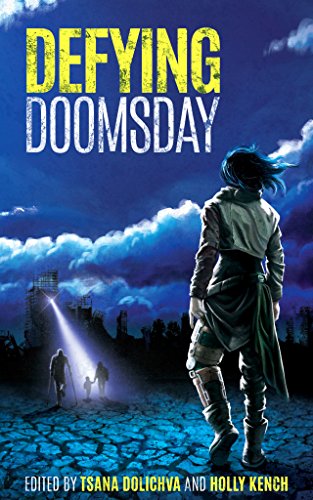
Defying Doomsday

defyingdoomsdayDefying Doomsday
edited by Tsana Dolichva and Holly Kench
2016

It was probably not my best idea to read this anthology of apocalyptic and post-apocalyptic short stories while dealing with a local black-out caused by heavy storms. It’s the type of situation that’s all the worse for the stories being really well-written and interesting. Beyond just dealing with the apocalypse (“just”, I say), the theme that brings these stories together is disabilities.  The heroes and heroines of each story have some disability — physical, sensory, and/or mental.

The introduction made a really good point about how so many post-apocalyptic stories act like people with disabilities will be the first to die and are a burden to those around them. The stories in this anthology refute that. A few of the authors look at how something that our modern world calls a disability could well be an adaptive feature in a massively changed one. Most of them, however, look at how people who are used to living in a world that doesn’t cater to their needs have experience and practice that more abled people don’t get in our modern world. Reading my kindle by candle light was already highlighting to me how unprepared I was for any sort of harsh living: I live a very catered-to life.

I’m not going to write individual reviews about each story, although I certainly thought about it since the stories are all very good, but also all significantly different from one another. Instead, here are my top three:

“Something in the Rain” by Seanan McGuire is probably my favorite. I find the apocalypse situation particularly terrifying and I like the heroine the best with her ruthless perseverance. And spoiler: the cat lives.

“Given Sufficient Desperation”, by Bogi Takács, felt like a wonderfully subtle modern take on Gordon R. Dickson’s classic, “Danger-Human”.

“No Shit”, by K. L. Evangelista, is an subversion of a couple of classic post-apocolyptic tropes that also directly addresses the issue of how just the idea of roving bands of robbers would impact the people who survive.

The whole anthology a love song to the old adage: what doesn’t kill you makes you stronger. What doesn’t kill you can make you more broken, but it also gives you the experience of carrying on anyway. I definitely recommend it.

The Orphans of Raspay by Lois McMaster Bujold

OrphansOfRaspay1The Orphans of Raspay
by Lois McMaster Bujold
2019

Yay! Another Penric & Desdemona short story by Bujold! For the first time, Amazon’s update email was actually useful to me despite going out a full week after the novella was published on July 17th. Normally I stalk Bujold’s listing much more carefully but I’ve been busy recently and thus only learned about this title on the 24th when Amazon finally got around to emailing me.

It is a delight! It’s also a novella of extreme self-indulgence, with both plot and character arc being mostly absent, but adventure and swashbuckling in quantity!

This is also an amazing example of what you can get away with if you set up the world-building right. Because in this fantasy world, there are five gods (father, mother, son, daughter, and bastard) and Penric is a devotee of the Bastard: literally the god of luck (good and bad) and all things out of season. And thus, it actually makes perfect in-universe sense for Penric to have amazingly good and bad luck in all things, especially when one takes into account his demon Desdemona who sheds chaos even as she also provides him with extraordinary powers.

The story starts with his ship being attacked by pirates and continues on in wacky hijinks after he’s taken on the temporary guardianship, as best he can, of two young orphans who were also taken by the pirates.*

This is an utter delight and I have no idea how comprehensible it is to anyone who hasn’t read the rest of the series but I’d be interested to know if it’s so indulgent that it actually can stand on its own. It’s essentially a day-in-the-life (or, in this case, week-in-the-life) of a temple sorcerer in a fantasy world.  And I love it!

* While I love this story, here’s a warning for pirates being pirates and actually genuinely bad and there are threats of sexual assault.

Awesome New(ish) TV By and About Women

Do other people fall into reading ruts where you’re reading all the time and finishing lots of books, but nothing really excites you or even sticks in your memory? Over the past couple of months I’ve read all sorts of things, including some with quite a bit of buzz (The Woman in the Window, The Immortalists), but have been pretty uninspired by all of them.  But I have been watching lots of great TV, across the full range of steaming services I apparently now have to pay for. I have particularly enjoyed several short series that show some realities of being a woman that I haven’t often seen on TV before. So here are Kinsey’s official recommendations for your spring TV viewing. They’re all short enough to knock out in a single evening, although they are all also at least a little raunchy and maybe things you don’t want to watch with your mom or your kids. Although, I don’t know your life or your mom or your kids, you do you.

Derry Girls (Netflix) is a comedy about a group of friends who go to a Catholic girls school in Northern Ireland in the 1990s.  It captures the intricate social strata of high school girls perfectly, and the family interactions have a completely non-saccharine ring of truth to them, while also being very funny. There’s a scene where someone drops a glass on the kitchen floor and a character’s mom acts like a nuclear spill has occurred and makes everyone stand on chairs–I loved it so much I had to rewind and watch that bit again. But as funny as the show is, the Troubles in Northern Ireland are always hovering on the edges, never letting anyone completely forget that they are living their lives in a battle zone. Also, there is amazing 90s music for my fellow Gen Xers, and Northern Irish accents that required me to have subtitles on to understand everything going on.

Shrill (Hulu) Lindy West’s memoir didn’t originally strike me as good source material for a fictional show, but the first season absolutely charmed me. Aidy Bryant (who I didn’t know before because I hate Saturday Night Live and never watch it) is amazing as a woman trying to navigate life as an entry-level journalist with a meddling mom and a terrible non-boyfriend. I guess you would say that her weight is the hook of the show, but it’s not like every episode is about how hard it is to be fat. Very early on she decides she is going to stop obsessing and just live her damn life, and most of the episodes are about her doing just that. Within the first five minutes of episode one I started googling to try to figure out where to buy her cute clothes and the infuriating answer is that they had to custom make basically everything because plus-size clothes are so awful. So enjoy the show, but know going in that you will not be able to buy those dresses.

Fleabag (Amazon) When I started writing this I initially thought, “Oh, I have three women-centered comedies to recommend!” But Fleabag might stretch the definition of comedy, so be warned. It follows a young London woman though encounters with men, her father and stepmother (played by the marvelous Olivia Coleman as possibly the worst woman in the world), and her sister. The main character is clearly on the verge of falling apart after a tragedy that is only slowly revealed in the show, and her relationships with her family make me want to use words like “searing” and “blistering.” Phoebe Waller-Bridge is the star and creator, and she is so observant and specific about the absurdity of life that the show is funny, while also pressing on some very painful areas of the psyche. Season 1 has been out for a couple of years, but I was finally inspired to watch it because Season 2 just showed to raves in the UK, and will be coming to Amazon in May. So now is a good time to get on this dark, dark train.


short stories on tumblr

Since the management of tumblr appears to be going insane as they implement rules to destroy their own user base, I’m going to recommend these stories while they’re still around to link to. None of these are fanfic, but they’re very much in that mode, ie, much more character driven than plot-driven.

How to Bury a Gentile
by Tentacular Investigations

This is a really interesting short story in the intersection of religion and supernatural fantasy, that strikes me as similar in tone to Manly Wade Wellman’s short stories in Who Fears the Devil?. If you haven’t read those, then you absolutely should as well. But in this as well as in Wellman’s stories, spirits and humans have intersecting needs and if you’re lucky, you can deal with the situation that occasionally arise without ever learning what the consequences of failure would have been.

In response to the prompt: You are the wind’s interpreter. What’s it saying? 
by CaffeineWitchcraft

This is hilarious and while I wouldn’t mind a full novel about it, it’s also a very cute if somewhat sketchy short story of high fantasy style with kings and castles and swords and sorcery. And it opens with the line, “Tell Miles, the wind whispers, that he’s a little bitch.” Which just cracks me up.

In response to the prompt: With all the instances of people getting retrieved from the fae, I think it would be pretty interesting to free a person that you aren’t looking for. 
by ElsewhereUniversity

This is really quite short, less than a full scene even, maybe half a scene?, that is pretty much exactly what the prompt says. And it’s hilarious!

My Sister, the Serial Killer by Oyinkan Braithwaite

mysistertheserialkillerMy Sister, the Serial Killer
by Oyinkan Braithwaite
2018

This book was very good and I highly recommend it, but it was also not at all what I expected even though I’m not quite sure what I was expecting. I’ll start by saying that it’s Nigerian noir. I haven’t read very much Nigerian literature or very much noir, so I’m not sure if it was one of those aspects or something entirely unique to the author that had the characters and their interactions fall into a sort of odd uncanny valley for me. It was unnerving and I was never quite sure what to expect. And despite it being less than two hundred pages, I had to take multiple breaks to relieve my poor nerves, as I walked around the house going, “oh no…., oh, no….”

The premise is pretty much exactly what the title says: at the beginning of the book, Korede’s sister Ayoola has just killed her third boyfriend “in self defense.” One time, sure: that’s terrible but good for her for defending herself. Two times, is terrible, how can these things keep happening to her just because she’s so beautiful. Three times, though, three times, Korede feels is just increasingly unlikely to be self-defense.

Then Ayoola shows interest in dating the guy Korede has a crush on. And events proceed.

The book was very factual and never gory but it sure ramped up the uncertainty of events as they happen while at the same time revealing in bits and pieces events from the past.

Anyway, I highly recommend this not only because it’s excellent but also because I desperately want to hear someone’s take on it. I’ve now read a bunch of other reviews online, but this is pretty much the perfect book for a bookclub where the members can get together later and talk about it with a lot of waving hands and inarticulate noises of amazement and distress.

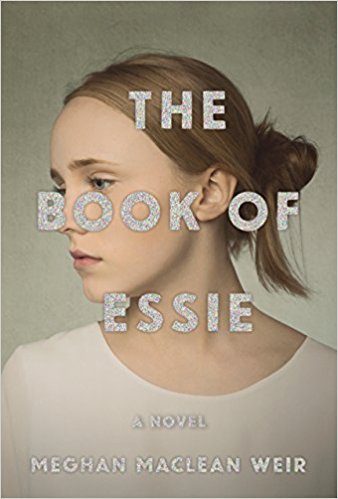
The Book of Essie

41qvnhhvupl._sx336_bo1,204,203,200_I am obsessed with the Duggars. Yes, in this golden age of peak TV, I have devoted many, many hours to watching various iterations of their TV show and even reading gossip blogs. As someone raised as an only child, I have long been fascinated with stories about big families. As a kid, I used to LOVE the Boxcar Children books and a 1950s time capsule series called the Happy Hollisters about a family with five kids who solve very gentle mysteries. So the reality show genre following big families was made for me, and I have watched them all. The Duggars are obviously the biggest, in terms of family size, popularity, and scandal level, and they just fascinate me. I wish I could be embedded in the family, like an anthropologist, so I could truly see how their unconventional beliefs play out in real life and how much of what you see on TV is really just for the benefit of the cameras. Meghan MacLean Weir must feel the same way, because The Book of Essie is a fictionalized behind-the-scenes story of a religious reality show family, with all the hidden secrets and scheming you can imagine.
The book kicks off with Essie, the teenage daughter whose life has been lived on TV, revealing to her mother that she is pregnant. This will not fit with the family’s public image and Essie’s mother immediately starts strategizing how to spin this unexpected development. But Essie is not about to sit around and wait for someone else to decide her fate–she’s been planning for years and has her own strategy for getting herself and her baby out of the reality show rat race. The book’s point of view alternates between Essie, one of her high school classmates who get swept into her plan, and a reporter who has her own experience with how the media and the truth intersect. This cleverly allows you to see Essie’s perspective from inside her family, but also how the rest of their small town and the larger outside world perceive the reality show circus.

There are plenty of twists and turns in the book, although nothing particularly took me by surprise. The story largely goes where you expect it to and most of the twists are fairly well-telegraphed.  Although this is not classified as a YA book, as far as I can tell, it read that way to me–the main characters are teenagers and the story is presented entirely from their point of view, and it was a quick and easy read. But I enjoyed the peek into this family with its wildly different public and private faces, and I appreciated reading a story in which a cast of female characters are running the show, for better or worse.

Kinsey’s Three-ish Word Review: Emotional behind-the-scenes drama

You might also like:  Educated by Tara Westover is a memoir, not a novel, but it was one of the best books I read last year and tells a similar harrowing story of a childhood in a family on the religious fringe.

A Concise Chinese-English Dictionary for Lovers

By Xiaolu Guo

chinese-english_dictionaryThis novel is described as “a novel of language and love that tells one young Chinese woman’s story of her journey to the West—and her attempts to understand the language, and the man, she adores.” I was expecting a love story, quite honestly, though one with a unique approach. It is, uh…not that.

The hook, for me, was that the book is written in Zhuang’s voice, and over the length of the book, the text itself becomes more mature as her English improves. According to the inside blurb, Guo used her own journals from when she first came to London as a reference, and the developing language is really interesting to follow.

The thing is, the relationship stuff is…rough. I spent the vast majority of the book stressed over this young woman in a foreign country with very little support, convinced that any minute, things were going to go dangerously wrong. I wasn’t completely wrong, either, but traumatic events are written in the same sort of wondering tone as everything else she experiences in the West, which lessened the stress a little, I guess.

Less of a story about love, Guo is talking about how our cultural expectations, and even our individual wants and needs, can interfere with relationships, even when people love each other. Our society often addresses sexual incompatibility in romantic relationships (so many letters to advice columns!), but Guo delves into something that is mostly overlooked: emotional intimacy incompatibility. Some people like a higher amount of connective-ness in their relationship than others, and if you are very mismatched, like the couple in this novel, it will be frustrating and exhausting for both sides.