World War Z

RHWorldWarZ500World War Z
By Max Brooks
2007

So I “read” this as an audio book that was marked as unabridged, but does appear to have lacked a few sections from the original book written in 2006. I now need to go back and read that whole book, because this was AMAZING and there are still parts I haven’t read!

Just, wow! So, so good!

The audio book was particularly good for an audio book because it was read by a full cast of voice actors, not just a single reader, and it really highlighted the way that this book was presented as an oral history.

For the rare person who doesn’t recognize it, it’s a fictional book inspired by the nonfiction book The Good War: An Oral History of World War II. In World War Z, though, the war in question is the zombie war, but for all the fantasy element, it’s addressed in a serious manner. I love the world building that went into figuring out how a zombie war could start, how different people would react, and how it would eventually end. I also loved the characters, who were all faced with this impossible conflict and did the best that they could.

I may very well be the last person to have gotten around to reading this book, so it hardly needs me to recommend it, but if you happen to have been living under a rock for the last decade, you really should read this!

The only thing that could have made it better is if it were longer, and apparently that wish got granted since there’s more for me to read once I get a text copy to read. (I really want to know more about the blind Japanese mountain man! But I’ll also take anything else.)

As a side note: ignore the movie. They took a really unique book essentially consisting of dozens of epic interlinking short stories and tried to shoehorn it into a traditional movie plot.

Kindred

By Octavia Butler

Book Cover: KindredBefore reading Kindred, Connie Willis’ Doomsday Book was the most painful time-traveling book I’d read, but boy does Kindred blow it out of the water. (I’d also previously only read one book by Octavia Butler, Fledgling, considered by herself and everyone else to be her ‘lightest’ book by a long shot.) The basic premise of Kindred is that Dana, a young African-American woman from contemporary times (1970s, when the book is written), is pulled back to a slave plantation several different times in the early 1800s in order to save the life of the plantation owner’s son.

I think we can all acknowledge that the current news has made it increasingly clear that there is a white world and a black world in our country, and even sympathetic whites can’t understand what it is like to live in the black world. Reading Kindred shares some of the sense of what it must be like, though: for every interaction with a white person, even one trying to be kind, to have the possibility of death hanging over it. I was so scared for Dana all the time, and the tenseness of reading the book was exhausting, and about halfway through, I realized that this tenseness and exhaustion is not something confined to the antebellum south at all. So, while it was painful to read, it is also incredibly important, and I was so grateful to Butler because I can’t think of another author that could have communicated this feeling to readers so well.

The kind of funny thing about it, though, is that there are really three time periods: the 1810s, the 1970s, and 2015 for me, as a reader, so there’s that layer on top. Sad to say there doesn’t seem to be a huge difference in race dynamics, but the gender dynamics of the 1970s were occasionally different enough to give me pause, though that was more towards the beginning of the book when she and her husband were confused about what was going on.

It felt like it ended a bit abruptly, but I think that is more a testament to Butler’s writing than anything – I was so deeply involved in the story that coming to the end would have felt jarring no matter what the ending was. I will give this very minor teaser spoiler for people who might be hesitant about the book: it doesn’t end nearly as badly for Dana as I’d expected it to, given that the very first sentence in the book is “I lost an arm on my last trip home.”

—Anna

Thug Notes

Like Anna, I’m a bit embarrassed to make this next recommendation during Black History Month because while this is awesome and by black creators and celebrating black culture, it shouldn’t be restricted to just the one month. This isn’t just awesome within the context of black culture, it’s just plain awesome.

Thug Notes is a YouTube series of videos and it is AWESOME! And I really wish it had been available when I was in high school. These videos take classic books and, in about 5 minutes each, summarizes the plot and talks about the main literary analysis.

  • Great Expectations, which I slogged through in high school and just got entirely bogged down in the details, laid out nice and neat in 5 minutes.
  • Lord of the Flies, which I never managed to get past the first page of, broken down for me and presented.
  • Pride & Prejudice, which I have read way too many times and absolutely love, getting shown in a new light that I hadn’t noticed before.

What makes them particularly funny is that they’re all narrated by Sparky Sweets, PhD, coming at you from the Houston Rap subculture and he is keeping it real about what these homeboys of literature are up to, from a set straight out of Master Piece theater with all of its proper British overtones.

The implied culture clash is hilarious mostly because no clash is ever actually realized. As Jared Bauer, one of the creators, says:

The idea behind Thug Notes was always that ‘the joke is that there is no joke…’ because the analysis is just so accurate and so smart.

There are 64 of them (so far) and they are just brilliant. Go check them out!

Station Eleven

It’s still early in 2015, but I feel pretty confident saying that Station Eleven by Emily St. John Mandel will be on my list of the year’s best. I just loved this book. And I think that almost everyone could love this book, because it is so cleverly structured and covers so many kinds of stories without being too dense or 1000 pages long.

The short plot summary is that at some point much like today a pandemic swept the planet and killed 99.9% of the population. Twenty years later, a traveling symphony/theater company tours around the Great Lakes, playing music and performing Shakespeare for small settlements of survivors. This makes it sound very grim and futuristic, but it isn’t. The story jumps around in time and from character to character, so there are bits of stories happening long before the pandemic hits, and then during it, and at different points in the years afterwards. Which means that part of the book is “what you do when the world is falling apart” and part is “how we live in the new normal,” but another big piece of the story is about actors and artists trying to balance fame and creation and marriage in current-day Hollywood. The brilliant Swistle called the shifts in time and characters a relief, and that’s the perfect word–just when I would start to think I couldn’t handle what was happening in a particular story, the narrative would move forward or back and let me take a deep breath and keep reading.

In general, I appreciated that the story wasn’t unbearably dark. While the pandemic certainly doesn’t sound like any fun, Mandel focuses mainly on the very beginning as people are realizing what is happening, and then on life years later as people have adapted to to world post-pandemic. Maybe some people want the realism of The Road, but I am a delicate flower who can’t handle reading that sort of thing. And I was much more interested in hearing about how even with all the losses, there is still beauty in the world (painted on the side of the traveling symphony’s caravans is the motto “Because survival is insufficient”). I also loved the question that came up over and over of whether it was better/easier to remember what once was, or to have been raised only knowing what is possible now.

I always joke that my plan for the zombie apocalypse is to die in the first wave and not have to try to survive, and I stand by that. But this is one of the first books I’ve read that managed to make me incredibly grateful for air travel and refrigerator lights and antibiotics, while also making me feel like the World After might have some hope after all.

Kinsey’s Three Word Review: Graceful, sad, and hopeful.

You might also like:
This book has the DNA of about 12 different books–it reminds me of everything. If you like the world-falling-apart bits, I’d recommend reading the Susan Beth Pfeffer Life As We Knew It trilogy, the The Age of Miracles by Karen Thompson Walker, or How I Live Now by Meg Rosoff (one of my favorite books of all time, although it’s so sad I’ve never been able to reread it). For more of the how-society-rebuilds pieces, try The Passage by Justin Cronin (actually mentioned by Mandel in Station Eleven). But if you like the traveling band of actors/Shakespeare parts the most, you might try The Great Night by Chris Adrian or the Canadian TV show Slings and Arrows. And while Could Atlas is a hard book to recommend–long and dense and people tend to love it or hate it–it has a similar “a bit of everything” feeling to it.

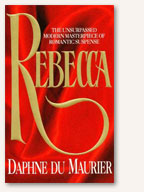
Rebecca

By Daphne du Maurier

Book Cover: RebeccaI’d tried reading Rebecca years ago, but it starts off with a lengthy dream sequence that is just a description of a decaying estate, and that is a lot to get through right off the bat. I was inspired to try again by the “Rebecca” chapter in Mallory Ortberg’s Texts from Jane Eyre. (I received two copies of this for Christmas, which was good, because it meant that my cousin’s wife didn’t have to steal my copy. This is also the second classic it has inspired me to read.)

The thing is, Rebecca makes me feel old. Perhaps if I’d read it when I was 22, the age of the unnamed second wife and narrator, I’d have been full of righteous indignation about what an awkward situation she’s in and how much more difficult everyone around her is making it. But, instead, I find myself sympathizing with the disdainful and bullying housekeeper, who loved and respected Rebecca, the first wife, and now has to deal with this shrinking child who can’t seem to do anything but apologize for her existence.

As soon as her much older husband starts showing exasperation, though, I’m all in her corner, and she gets somewhat less cringing as the book goes on and she even starts to show some personal agency. Also, du Maurier has a real skill at building a suspenseful atmosphere, so I was still invested in the scenes when not totally invested in the characters.

It took me a few chapters to realize something, but once I did, I was able to enjoy the book even more: I’d had a vague sense that this was a ghost story, either literal or metaphorical, but it is in fact a mystery, and unnamed second wife is not unlike Nancy Drew (in that she behaves like an exceptionally naïve teenager). Rebecca died under mysterious circumstances, and there are hints that she was not exactly as people thought she was. Reading the unfolding of that is actually quite satisfying, and I was even surprised by the series of big reveals at the end, which is always nice.

I wish I’d thought to live blog this one because just every scene is so full of craziness: the costume ball that goes predictably but still agonizingly wrong! The demonic housekeeper trying to hypnotize our narrator into suicide! The shipwreck unearthing secrets of the deep! (Another horrifying reveal that is too spoilery for me to discuss here, but that all the characters took in much better stride than I did!) It is not unlike The Shining, really, with an unbelievably passive woman feeling oppressed by a building and her emotionally distant husband, and would have been fun to go through chapter by chapter, but I was also able to read the book in under a week, which makes a bit of a rush job out of live blogging.

—Anna

The Poison Eaters and Other Stories

poisoneatersThe Poison Eaters and Other Stories
by Holly Black
2010

I checked this book out of the library less because I actually wanted to read it and more because I was testing out the ability to check out kindle books. (It works! I love it! I can get books when the library is closed, when it is snowing out, and without getting dressed for the day.)

It also wound up being an interesting book of short stories. This is clearly the author experimenting with different characters and plot points. Some of them work better than others, but they’re all quite interesting. It makes me think that I need to read more of her Black’s books, because I really do think these stories were testing grounds for her books, and I want to see what she made of the more successful stories.

I thought it was pretty funny that one short story, The Coldest Girl in Coldtown, is set in the same universe as the author’s book, The Coldest Girl in Coldtown, but has an entirely different set of characters and plot arc. There’s a single throw-away line in the book that references the events of the short story. I really liked both the book and the short story, but I am left wondering: who does the author think is the coldest girl in Coldtown?

I’m virtually sure that The Land of Heart’s Desire is set in the same universe as Black’s Modern Faerie Tales series, using characters that I would recognize if I had read those books. And it probably would have made more sense if I had recognized them and thus knew their various backstories. I might need to go ahead and read at least one of those books to see.

I liked the short stories, The Night Market and The Coat of Stars, both of which are complete in and of themselves in a way that most of the other stories in this compilation are not. The rest tend to be character studies (Going Ironside) or plot summaries (The Dog King and The Poison Eaters) or single interludes from larger universes (Virgin). So while they’re interesting, they don’t really stand on their own. I enjoyed them, but I don’t necessarily recommend them.

Not Actually Fanfiction

As should be obvious, I really enjoy fanfiction. They are (often) fun stories by (presumably) amateur authors who can sometimes do amazing things unconstrained by thoughts of salability. They write because they have ideas they want to get out. And sometimes, it’s not actually fanfiction. Sometimes an amateur author, in the same spirit of fanfiction, will write an original story and post it online for anyone and everyone to enjoy.

There are even a few archives specifically for these types of short stories, presented like fanfiction except for being entirely original. The parallel for Fanfiction.net is FictonPress.com. ArchiveOfOurOwn simply added a category for Original Fiction.

Here are a few recommendations for original short stories presented online:

Suite for the Living and Dead
By Inland Territory
Summary: When he was twenty three years old, Mike Lafayette took it on himself to write an oratorio for a people without a god.
Why I like it: This is just beautiful. A beautiful concept and beautifully written, but also speaks directly of the particular pain of seeing a deadly and important conflict happening in front of you and, for one reason or another, not joining the fight.
Extra comment: This feels a bit like a fanfiction story in that it references a much more epic story with main characters who are minor characters here. It makes me wonder if there is a book out there this is connected to but I haven’t been able to find. My current assumption is that it is that the author of this short story has an idea for a book and maybe she’s even half-written it, but it’s not available anywhere.

Toad Words
By Ursula Vernon
Summary: Terri Windling posted recently about the old fairy tale of frogs falling from a girl’s lips, and I started thinking about what I’d do if that happened to me, and…well…
Why I like it: One of the problems with traditional fairytales that I (and many other women) are increasingly aware of is how they often reward young girls for being quiet, polite, beautiful, and awaiting rescue, while punishing young girls for being outspoken, ugly, and actively attempting their own rescue. This takes one such fairytale and shows the repercussions, and how a curse can ultimately be made a reward and a blessing can ultimately be a punishment.

Never the Same
By Polenth Blake
Genre: science fiction
No summary, but the first paragraph: Everyone thinks my brother is nice. He set up a rescue centre for birds, after the terraforming accident poisoned the lake. That’s always the image of him, holding a bird covered in sludge. The birds are never the same after they’re cleaned, but the gossips never talk about that.
Why I like it: This is a lovely little mystery, with a main character with mental health issues. With a somewhat unreliable narrator investigating a situation in a highly biased community, the story looks into the difference between right and wrong actions and right and wrong motivations.

The Emperor’s Last Concubine
By Yamanashi Moe
Warning: this has explicit sex in it
No summary, but I bookmarked it as: a story of love and politics
Why I like it: This story has the standard Cinderella structure but focuses on what happens after the handsome prince whisks his beloved away and the difficulties faced by both prince and beloved as they both become aware of the golden cage the palace makes.

The Best of the Rest of 2014

I’ve said here before that when I read a really great book, I am so excited to share it with people that I immediately write a blog review. Hence, my short list of the best things I read this year would be The Goldfinch, The Signature of All Things, Love, Nina, and Americanah. (I was looking at the list of the books I read this year and wondering why it was so much shorter than last year–I read about 45 books this year, rather than my typical 80-100. Maybe it’s because I spent half the year reading giant doorstop literary novels that took forever? At least most of them were good; let’s just not talk about The Luminaries.)
But  I did read a few other things in 2014 that I loved but that never made an appearance here. So before this year runs away from us entirely, let me put in my vote for a few more things:

1) Bridget Jones: Mad About the Boy

I have a love for the first Bridget Jones book that I cannot explain. I just think it’s brilliant and is working on about four different levels and I still reread it once a year. Even Helen Fielding would probably admit that the second one went off the rails a bit, but I really, really enjoyed this third Bridget installment. Rather than picking up where things left off, the book ages Bridget and puts her in an entirely different situation. Bridget is still recognizable, but she’s gown up a little, and as predictable as the book was, I found it charming and surprisingly touching.

2) Mastering the Art of Soviet Cooking

I am kind of obsessed with the Soviet Union, but I find it really difficult to find things to read about it. Nonfiction books tend to be incredibly dense, academic tomes along the lines of “and then that other diplomat issued a statement that countered the previous statement  . . . ” And fiction tends to be unbearably dark, which is understandable but difficult to read (Child 44, you still give me nightmares). This memoir uses food–from pre-revolutionary excess to the siege of Leningrad to Soviet institutional cafeterias–to show how the Soviet state affected the everyday life of it’s citizens. And it shows how one family rebelled against that state, at least partly through food. Really charming, although I’m not likely to cook any of the recipes provided.

If you are not already reading the website Bitches Gotta Eat, you should go do so immediately, because it is one of the funniest things on the Internet (assuming you’re over 18–if you’re not, please go look in our YA tag for something more appropriate, because this sure isn’t). Meaty is a collection of essays by Samantha Irby, who writes the site, and it is equally funny. However, I should warn you that she uses the essay format to also tell some less funny stories about her life, including one about her mother that was so sad it made me put the book away in a drawer for several months so I could recover. But the funny stories are really funny, the sad stories are stunning, and Irby definitely deserves a bigger outlet than she’s gotten so far.

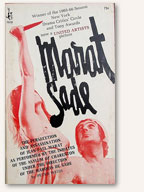
Marat/Sade

The Persecution and Assassination of Jean-Paul Marat as Performed by the Inmates of the Asylum of Charenton Under the Direction of the Marquis de Sade

A Play by Peter Weiss

Book Cover: Marat/SadeI’d heard of this play years ago, and not to put too fine a point on it, it sounds like a complete clusterfuck, and I have been curious about it ever since.

The premise is based on the historical facts that Marat was assassinated during the French Revolution in 1793, that Sade participated in the revolution and even made the memorial address at Marat’s funeral, and that Sade later put on plays with the other inmates during his internment in Charenton Asylum from 1801-1814.

In this fictionalization, Sade is producing a play about the assassination of Marat, casting the various other asylum inmates. It is quite short, just two acts that together are just 102 pages, and it starts off surprisingly funny, with sort of slapstick humor around the extremely amateur production. I was pleasantly surprised, and thus lured quite capably into the subsequent ugliness surrounding the French Revolution and Sade’s personal philosophies.

Both the revolution and Sade committed horrific atrocities, though they came from opposite justifications: the French Revolution declaring that some violence must be committed for the improvement of society (so, basically, a regrettable side effect in the search for good), and Sade declaring that the only way to understand the human condition is to explore the very worst of it (the search for evil as humanity’s defining feature). This basic disagreement is explored through debates between Marat and Sade that appear to happen outside the play-within-the-play, and possibly only occur in Sade’s head.

The back blurb advertises that “It is total theatre: philosophically problematic, visually terrifying…. The play is basically concerned with the problem of revolution. Are the same things true for the masses and for their leaders? And where, in modern times, lie the borderlines of sanity?” My main take-away, however, was to wonder how much of the political and philosophical grandstanding by Marat and Sade was purely self-serving to justify their own personal indulgences. Sade likes to rape and torture, but he wants to see himself as something greater than just a violent sociopath, so he claims that all of humanity has these same urges, but only he has the courage to explore them honestly. And, though I am more sympathetic to Marat’s ambitions, he clings to his ideal of how the revolution will be played out, with himself as the people’s savior, and any deviation from that is treason and must be eradicated violently and completely.

I would pay quite a bit to see this live, actually – the descriptions of the sets, with a rudimentary stage and props within an asylum, the inclusion of a four-person chorus to punctuate points throughout the play, and the wide variety of players, often wandering on their own would make it quite the spectacle. (I would also like to see the movie from 1967, but the library doesn’t have it, and I don’t want to swing $38 for it, which is amazon’s very cheapest offer.)

—Anna

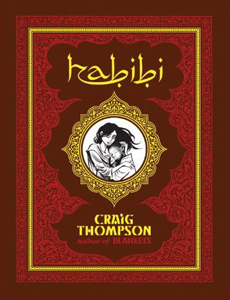
Habibi

HabibiCoverHabibi
by Craig Thompson
2011

Wow. This is a graphic novel that really earns both of those words: it’s definitely a novel, and it’s definitely graphic (in every sense of the word.) It is most definitely not a comic book.

I’d noticed this book in passing for a while now, because it’s beautifully bound and the illustrations are gorgeous. Just, it’s a really beautiful book. It also has an obvious theme of exploring religion, which is something I often enjoy. On the other hand, it was struck me as trying really hard to be high literature by means of showing a life fraught with hardship, pain and suffering, and yet perseverance through it all.

Then I found myself waiting for a couple of hours in a library for which I didn’t have a library card. So I settled down to read this. And sure enough, I was absolutely right.

It shows a grim world filled with caricatures of characters who still have a bit of individuality to bring them to life and make them interesting. It’s really obviously trying very hard, and yet it largely succeeds in being that story about strength of will and perseverance and the times when there are no good options and so you just carry on. The characters are heartbreaking.

It makes me think of the story of Scheherazade, the narrator of the 1,001 Arabian Nights, and think of what her life must have really been like. After all, she was literally telling stories to preserve her life. (The main character also retells some of Scheherazade’s stories.)

It also reminds me of Caravan by Dorothy Gilman, a book I enjoyed a great deal but was possibly the first book I read in which it was clear that neither the main character nor the love interest were going to be protected by their status as the main characters of the book.

Bad things happen. A lot. And are, with one notable exception, shown rather explicitly.

It is not my particular kind of book, for all that it is just really, really beautifully drawn and bound. After reading half of it while waiting at the library, I got up and walked away when my class started. But when I saw it again at my local library, I thought, you know, let’s carry on. So I checked it out and read the rest.

It joins the ranks of books that I’m impressed with, proud that I’ve read, but feel no particular urge to re-read or own.