Ink by Angela Woodward

Ink: a novel
by Angela Woodward
2023

Every so often I try reading a literary work and relearn why I don’t read that genre. Woodward is a skilled wordsmith and her writing is lyrical, but her worldview is distasteful and her world-building is poor. Both the characters and the narration are unpleasant in an undeserving way.

I was reminded of a time when I went on a walk with a work friend: we were having a good time mostly window-shopping and chatting in a walking district, when I tripped: stumbled over my own feet, fell to my hands and knees. A few passersby paused but I was fine, I got back up and we continued to walk. The only reason I remember the instance at all is that my work friend said that if that had happened to him, it would have ruined his whole day. He lived in a world where tiny meaningless mistakes could overwrite hours of enjoyment, and the attention of strangers meant critical judgment and inspired shame.

That was his lived experience and I imagine something similar is also Woodward’s experience, and it is certainly her characters’ experience, and it’s such a miserable world to live in: constant judgment both internal and external and no freedom to just enjoy what you can. As Anna pointed out when I complained to her about it: there’s also the meta aspect of Woodward and her characters expecting to be criticized for everything and here I was criticizing them. So it’s not necessarily wrong, but just overly weighted in that direction.

This book is trying to do something interesting, with three different threads: the expected thread of the novel with it’s characters and events, a series of digressions into the history of ink as a substance, and a first-person account of the author discussing her life and writing process for this book.

I found the history of ink fascinating, but untrustworthy. I wish I had read it in a nonfiction book. The first-person accounts I found mostly confusing as to it’s purpose. Perhaps to differentiate Woodward from her even more unhappy characters?

The novel section is what had inspired me to read the book (and not just because that’s the only part that’s in the blurb): it’s about two women who are transcribing the Abu Ghraib detainee statements in the early 2000s. That was around the same time I was doing freelance transcription for various studies in academia: nothing as terrible as first-person torture accounts but enough difficult subjects that I understand some of the impact it can have.

Unfortunately, the book treats the subject as a simple conceit and doesn’t otherwise address it. There are a few short recurring excerpts from those interviews interspersed for shock value, but that was it. At the beginning I thought it was an interesting demonstration of how the mind can shy away from horror by considering more minor aspects: Here’s a single sentence about torture, let us now read several pages on the history of ink. But by the end of the book, as the few repeated excerpts came up, they were treated more like intrusive thoughts to be entirely disregarded, rather than parts of stories that the women were spending days, weeks, months, listening to.

The experience of listening to stories of trauma for hours on end, or even the experience of straining your ears to hear exactly what is said, the click-whirr of the machine, the delight in slow speakers and the difficulty of quick speakers, or the shear physicality of typing all day… None of it was addressed. The characters’ experience was so completely different from mine that it seemed unlikely that Woodward had ever tried transcribing. Or maybe her body, ears and hands all work as differently from mine as her worldview does. 

Woodward explicitly states that she was imaging what these people who must have existed would be like, but increasingly it frustrated me that this isn’t at all what they would be like, starting with being English-speaking only. Woodward wrote a novel about two women in an office environment who both have various levels of unpleasantness in their home lives, but the details of their job appeared to have no impact on them whatsoever.

This book had so much potential: a fascinating premise by a talented wordsmith, and it’s really irritating how poor the results were.

Into the Riverlands by Nghi Vo

Into the Riverlands
by Nghi Vo
2022

I had somehow failed to notice the publication of this third part of The Singing Hills Cycle, sequel to The Empress of Salt and Fortune and When the Tiger Came Down the Mountain, but am delighted to have found it now. Each novella stands alone, but they show the experiences of Cleric Chih and Almost Brilliant in their exploration of the world in search of stories and histories to bring back to their abbey.

While this world has always had a certain magical element, this book is more traditionally wuxia than the previous two. Chih is not a martial artist, and they are present as a witness rather than a direct actor of events, but there are current events of bandits and martial arts masters as well as legends of heroes and villains, and there’s a real question of how much or little overlap there is between the tales and the truth, with each of the characters having their own opinions too.

I’d already commented in my review of Zen Cho’s The Order of the Pure Moon Reflected in Water that it fits in well with this series, but I was reminded of it even more when reading this newest novella. I also felt both ridiculous for not noticing immediately and a bit proud of myself for realizing eventually that the jianghu, where most wuxia stories are set, translates directly to “riverlands”.

This book is only 100 pages long, but it packs a lot of rich details into those pages without ever feeling rushed. When I finished the book, I also had to go back an re-read the beginning again to see these characters in the context of the completed story. It’s a really beautifully written story with multiple interesting perspectives on how history is told.

Witch King by Martha Wells

Witch King
by Martha Wells
May 30, 2023

I’ve been having trouble focusing on books recently, but this wonderful book managed to break through that malaise. Possibly in part because at the beginning it fit right in with The Untamed fanfic that I’ve been reading.

In many ways it felt like Wells might have seen that show and/or read that book and decided to write her own take on it: The titular Witch King is awoken from the dead, has a new body, and has to figure out what happened and why. The story also alternates between current events and prior events when he was an adolescent fighting what seemed like an impossible battle against powerful villains, with uneasy allies.

It is very much Wells’ own story, though, with fascinating, complex characters and even more fascinating, complex societal world-building, and turning so many stereotypes just ninety degrees, so that they’re not inverted so much as just going off in unexpected new directions. I love this author’s writing so much, but her Murderbot series has been so fabulous recently that I just hadn’t thought about how much I love her fantasy books as well. Wells’ fantasy worlds are all multicultural, in a wonderful way, such that it’s not the plot, but it’s important background the characters and how they interact with each other and the plot.

This book has a lot of action and adventure and fights and rescues and escapes in both the current events and the past events plot lines, but it also has a remarkably calm and focused perspective that reminds me a bit of The Empress of Salt and Fortune. The past plot line is many decades in the past and time has had a chance to heal some of those wounds, or at least scar them over. And in the present plot line, Kai (the Witch King) is an experienced adult with those scars giving him perspective and distance even from the current events.

Wells also does an amazing job of running both plot lines in parallel such that they interact with and give important context to each other. Although it did take several chapters for me to get over being dismayed each time it switched because I’d gotten so invested in one plot line that I couldn’t remember how invested I was in the other until I was back in and dismayed to swap back.

The whole book was fascinating and fun and kept me focused to the point where even as I set it down nearly as often as I had any other book I’ve tried to read recently, I consistently picked it up again, and read it over the course of four days. I highly recommend it.

Let Us Do The Best That We Can, by Cawein and Heller

Let Us Do The Best That We Can
Written by Madison Cawein
Illustrated by Helen West Heller
1915

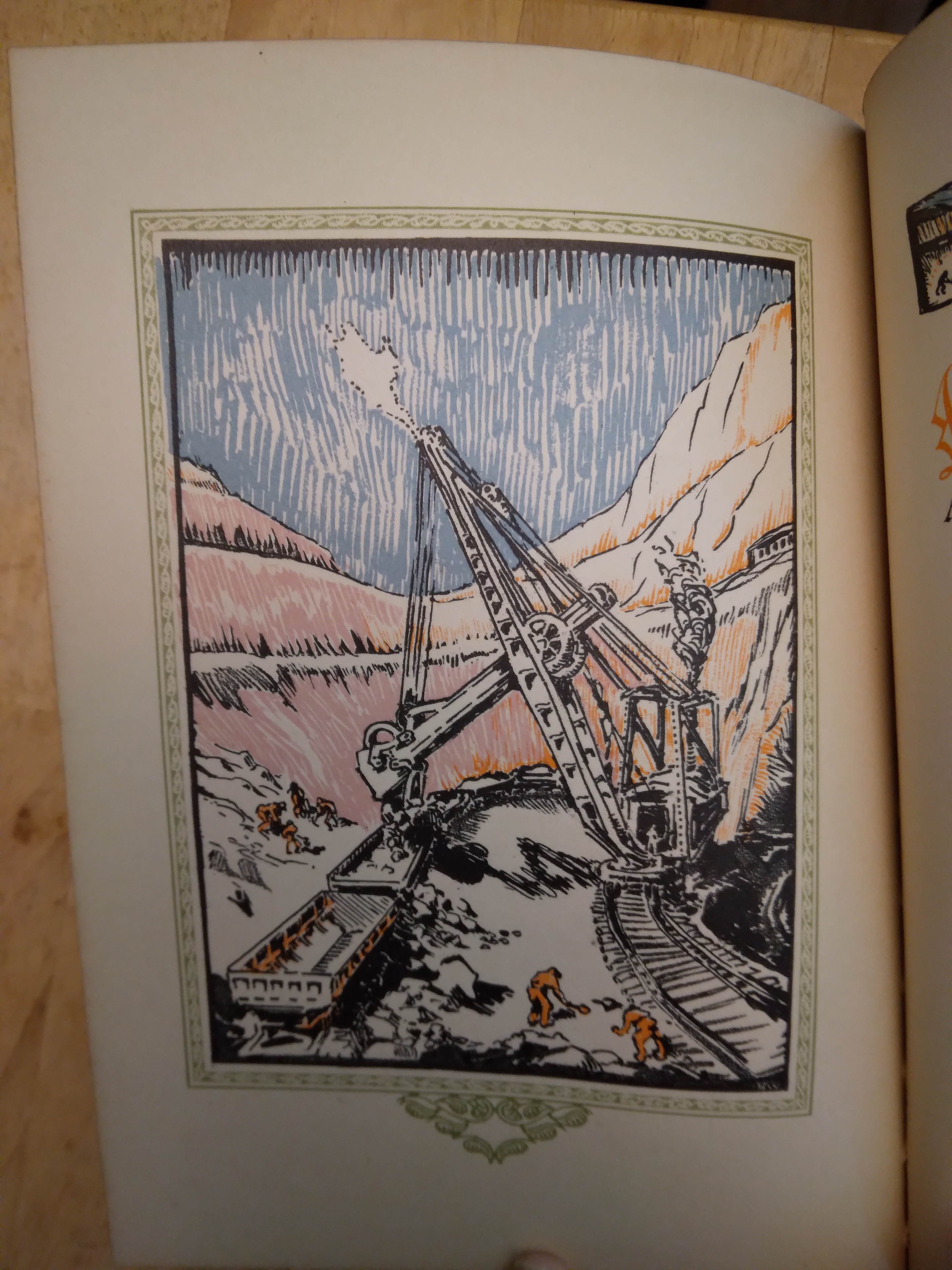
I bought this book for $8 in an online auction, sight-unseen, because the pictures looked really cool. And then I saw it in person and it’s adorable! Physically, it’s 5”x6.5”x0.25” and in not great shape, but uses thick paper to make up for the fact that it’s only 10 pages long — 5 verses of a poem and 5 wood cut illustrations – plus a handful of opening and closing pages.

The illustrations are beautiful woodcuts. It’s going to join Gods’ Man in my small collection of beautiful old illustrated novels.

The poetry is… sweet. It feels like something out of one of the red bound Children’s Hour books. It’s lovely and motivational about doing the best one can and being happy regardless of the results because you did the best you can. The message is how everything will work out in the end if you just do your best. It strikes me as an excellent poem for children.

I just have to remember that it was written at the beginning of the first world war. This is the innocent version of Ayn Rand’s dream world: everyone does their individual best and it’s enough.

In today’s economic climate of corruption, stock prices before product quality, and massive corporations setting employees against one another, the impact of this poem feels more like propaganda against taking the larger view or addressing systemic inequalities and injustices. And, frankly, I suspect that there was both similar propaganda and the need for it in the early 1900s, as well.

But it still is a sweet poem about enjoying the pleasure and pride of a job well worked and I do appreciate that. Plus, just physically adorable as a book. This publisher was like: yes, I will publish a beautiful little book with ten pages!

Kickstarter comics

As the year at work started off with a cascading series of problems, I have been in a bit of a reading slump , not able to focus on reading and getting distracted even from stories that I’m actively enjoying. I’ve started a number of books and haven’t completed any of them, and it’s definitely me rather than any judgement on the books. Hopefully I’ll get back to those later and be able to enjoy them when I’m in the right mindset.

But one of the things I enjoy doing is browsing the comics section of Kickstarter. There’s always a wild array of possibilities there with stories that couldn’t or wouldn’t or just haven’t found a way into mainstream graphic novel publishing, at least not in the US. I semi-regularly support the stories that catch my eye and then just wait to see what shows up as a surprise gift to myself however many months later.

Last week while I was moping around not able to read anything much, one of the projects I supported was fulfilled and I received a package that contained two thin volumes that were each short enough that I could just sit down and read them in one go:

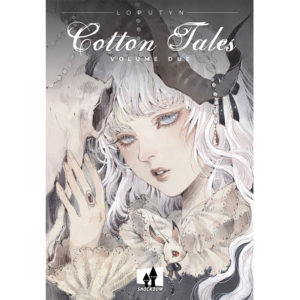
Cotton Tales, Volumes 1 & 2
by Jessica Cioffi, AKA Loputyn
2022

These beautiful books full of ethereal images tell a gothic story of a boy who has woken from an injury with no memories in a mansion that’s haunted by a ghost and there are a huge number of rabbits that only he can see. The world has magic in it, but it’s unclear what is real to that world and what isn’t. And everyone he meets has ulterior motives and hidden histories.

It’s a fairy tale story with a simplicity that let me read and enjoy it within a day and break my streak of unfinished books. I’m also looking forward to seeing if there is an eventual volume 3, although volume 2 does end with a satisfying conclusion even as it sets up for the next stage of events. Volume 1 ended with much more uncertainty so I’m glad I got these both at once.

Having enjoyed these books so much, reminded me of another Kickstarter comic that I’d received some time back and then never got around to completely reading:

Elements of Fire
edited by Taneka Stotts
2016

This more hefty book is a limited-palette graphic novel (black, white, and red) anthology of 23 stories with lengths ranging between two to sixteen pages each. The first couple of stories reminded me of why I hadn’t completed this before: they weren’t bad, just not to my taste: one high fantasy and one overly twee. But this time I persevered and I am so grateful that I did because the third story blew my mind! It was so good and so beautiful both visually and conceptually. And then there were twenty more stories!

With any anthology there are going to be better and worse stories but this is really an amazing collection. I loved more stories than I didn’t and now I’m a bit embarrassed for having set it down for so long. The artists made some amazing and fascinating choices with how to use the restricted palette to best effect, and created vast and complex worlds in just a few pages each.

Each story is unique — Stotts did an amazing job of curating a wild diversity with this collection that went above and beyond the stated intent of diversity in having all creators of color. It really shows a diversity of cultures and styles and approaches to the art of graphic novels.

While they all very good, my favorites — the ones where the stories and the art combined to touch my heart — were:

  • Cactus Flower by Sara Duvall
  • Pulse by Der-Shing Helmer
  • Hearth by Jaid Mandas and Marisa Han
  • Preta by Chloe Chan and Nina Matsumoto
  • Meta Helmet by Deshan Tennekoon and Isuri Merenchi Hewage
  • Caldera by Jemma Salume and Taneka Stotts
  • Firestom by Melanie Ujimori and Chan Chau
  • Home is Where the Hearth Is by Veronica Agarwal

I highly recommend this anthology to any and everyone to see which stories and images touch them. Because all of the stories are skillfully written and drawn: after that it’s a matter of personal preference.

This anthology also really presses home why I browse Kickstarter so much more often than I step into any comic bookstore anymore. A good comic book store will have an “Other” section in addition to their Marvel and DC, but they necessarily cater to the masses in a way that Kickstarter doesn’t have to. Plus each comic is a unique creation of love by an artist rather than a business decision by a corporation, so even when they wind up not to my taste (which happens sometimes), I never regret supporting them.

It was also wonderful to sit down with some books and actually read them, cover to cover, and have a sense of completion that I’ve been missing in the last couple of months.

The Screwtape Letters by C.S. Lewis

The Screwtape Letters
by C. S. Lewis
1961

Having enjoyed The Great Divorce and found it extremely thought-provoking and had a casual book club with various members of my family, it was proposed that we read The Screwtape Letters next. It was just as thought provoking, if not more so, although somewhat less enjoyable. It consists of 31 chapters/letters plus one toast, and it’s all told from the perspective of a demon, the titular Screwtape, who is giving advice on how to lure humans into sin.

Despite having been written 80 years ago, it is decidedly timely today, as it addresses the devil’s goal of keeping humans constantly focused on doom scrolling and headlines and thoughtless denigration of anyone who disagrees with you, while avoiding humility, charity, respect, or thoughtful consideration. I felt decidedly called out at various points. I should be better! I will try to be more thoughtful and focused and enjoy the pleasures that are available to me in the present and worry less.

At other points, however, it feels dated in the way that it appears to be arguing about social trends that I’m not even aware of. At one point the devil is recommending that people should stay focused on government policies rather than prayers since those are so much less important and I really hope that Lewis had no expectation of “thoughts and prayers” becoming such a catch phrase for politicians refusing to update policies. As Screwtape presents himself as the arbiter of what is evil, Lewis comes across as an arbiter of what is good, and that is, occasionally, rough. Historians, modern artists, and unions are all mentioned as being misleading to Good Christians.

Lewis definitely takes the opportunity to call out some of his personal most and least favored theologians, placing them either as godly agents or thoroughly controlled by the devils’ temptations to sin. This book also has a nearly Ayn Randian Objectivist perspective on the world: what is Good is very clear and natural and unaffected by different lives, perspectives or understandings. Devils provide temptation and people provide false information but a Good Christian will just know what is right due to God, much the same way that Ayn Rand’s protagonists will know what is right due to Logic, despite any lack of education or resources for either. Peak individualism, despite the differences in both methods and goals.  

I found that I needed to read this book one chapter at a time and take at least a little break between. They were thought provoking and inspiring and occasionally quite funny, but they were also quite dense and more than occasionally rather florid.

This book also made me think that I should get around to reading Lolita, at some point, as the only other book I can think of that has the protagonist/narrator also be the unrepentant villain of the story. I did wonder how many people read this book and think Screwtape is an anti-hero instead. Some of his advice came across as fitting right in with big business and some of my least favorite managers at my job, so it’s not out of the question.

I got a lot out of this book and enjoyed talking about it with Anna as we progressed through, but the book started out strong and then got progressively more wearying as it continued. It’s worth reading, but be prepared to decide what you take seriously. (Note: Cherry-picking what to take seriously is also advice that Screwtape would offer a human and C.S. Lewis specifically rejects when it comes to religious contemplation. So, you know: Enjoy!)

At the Feet of the Sun by Victoria Goddard

At the Feet of the Sun
Lays of the Hearth-Fire, Book Two
by Victoria Goddard
2022

If I had any sort of self-control, I would not have finished this book quite so quickly, because it’s essentially five books all presented together in one omnibus. Which I’m glad of! Because otherwise there would have been some real cliff-hangers. But, it’s really long with multiple interlinked plot arcs and side quests that are massive enough to be regular quests all on their own. And, also, the book (that’s really five books) does come to a satisfying emotional conclusion at the end, but it doesn’t actually conclude the original plot that was set up at the end of the first book. So I’m already looking forward to Book 3, but am glad enough to have a breather before presumably reading another 1000+ pages.

This book starts up soon after the end of Book 1: The Hands of the Emperor, and the first part runs parallel to The Return of Fiztroy Angursell, and then just keeps going with the adventures and development of Cliopher “Kip” Mdang. Kip is a wildly successful bureaucrat who has spent his life successfully dismantling an empire and replacing it with a more egalitarian system of government. And now he’s retiring. He’s not yet officially done, but he’s transferred the majority of his work and responsibilities to others and has the space to figure out who he is now that he’s not so driven anymore, and that’s not an easy path. And also, this whole universe is an amazing creation where there are nine interconnected worlds, magic and gods are real, religion is complicated and diverse, and time fluctuates wildly. Kip’s career is somewhere between 45 and 1100 years long, depending exactly where you stand, and his own personal experience varied as well as he experiences long periods of timeless effort. The story moves seamlessly between practical struggles and legendary adventures; travels on the sea around Kip’s home archipelago and travels on the Sky Ocean between the stars; searching for Kip’s lost cousin Basil and going to get a new fire from the Palace of the Sun.

Kip is amazingly and wonderfully competent in achieving his goals for the greater good of the world, but still struggles to find his place and self-promote when it’s about him and not some greater achievement. And figuring out how to communicate with his emperor as a person whom he loves after spending decades/centuries working with him as an untouchable god is an ongoing struggle, even as they both want equality between them. Through all the struggles, there’s a sense of certainty that it will all work out, or if it doesn’t, then it will be a loss of what could have been but what already is, is still sufficient.

It’s a beautiful and optimistic book, and I really enjoy it immensely.

The Golden Enclaves by Naomi Novik

The Golden Enclaves
Lesson Three of The Scholomance
by Naomi Novik
September 27, 2022

This book has been out for a week, but I was finally able to check it out from a local library and then read it over the course of maybe 27 hours (in the middle of a work week). And just wow! It’s so good and so satisfying and so tense.

This book starts immediately after the second book ends, and is very much a continuation of everything that has happened before in the previous two books and I probably need to go back and reread both in order to better enjoy some of the clues that had been casually dropped as world building before but abruptly become extremely plot significant here.

Each book centers around a conflict that’s slightly larger impact than the previous book. In the first book, the plot is focused on our protagonist’s personal survival; in the second book, it’s about the school’s survival; and in this the third book, it’s about the community’s survival. This is also the first book where the action is outside of the school and there are adults involved and hoo boy does that make things even more complicated. The kids in the school were just trying to survive: well the adults outside of the school are doing the same but have had even more time to make mistakes and make compromises and make hard decisions that have consequences down the years, decades, and centuries. And our protagonist El has to figure out how to live in the world where it’s the people rather than the mals who are the greatest danger.

This book also reminded me of Rainbow Rowell’s Anyway the Wind Blows, the third book in her Simon Snow series, in a variety of ways that I can’t write out without spoilers.

Anyway, I adore this book, but it’s definitely not a stand-alone. So if you haven’t already, go read the first one first.

The Great Divorce by C.S. Lewis

The Great Divorce
by C.S. Lewis
1946

I’ve been having trouble getting into any of my usual genre books and then my aunt recommended this book, which felt like a bit of a palate cleanser. It’s a fascinating premise with a somewhat disinterested perspective and it gave me so many thoughts. I really enjoyed it. It’s fourteen chapters across only 128 pages, but took several days to read because I had to pause and think about it periodically, to give each character their due.

The premise is that the narrator is on a bus trip from hell to heaven. It’s a regular bus route and anyone is welcome. Many are even eagerly awaited by those in heaven. And yet, very few of the travelers choose to stay. Each character is unique in their circumstances, but also the same in the way they consider themselves to have been in the right, and yet their self-defense is also their condemnation.

It gave me so many thoughts.

I’m going to make a cut here more for length than spoilers. In part because I think the experience of this book is not something that can be spoiled by advance knowledge. It’s not exactly plot driven. It’s characters and perspectives and metaphors. They’re fascinating and I want to talk about them.

Continue reading