Temeraire by Naomi Novik

His Majesty’s Dragon
Naomi Novik
2006

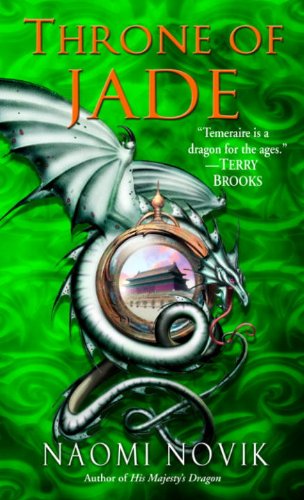
Throne of Jade
Naomi Novik
2006

In honor of Crucible of Gold being released this last Tuesday, I have to go back and review His Majesty’s Dragon and Throne of Jade, the first two book in the Temeraire series.

The books are:
His Majesty’s Dragon
Throne of Jade
Black Powder War
Empire of Ivory
Victory of Eagles
Tongues of Serpents
Crucible of Gold

I have to admit that I’ve actually only read the first two books. However! The reason for that is that I am clearly insane. Despite how I don’t do this for any other series in the world, I can never seem to start the third book without wanting to go back and re-read the series from the beginning. There are so many good scenes and characters and dialog that I can’t resist it. So I go back and read the first two books, at which point I discover that these are really wonderfully dense books in which the plot and action just keeps coming, and so I can’t really read more than two in a row without beginning to feel a bit glutted. But glutted with awesome!

Eventually I’ll have simply memorized the first two, and then I’ll be able to move on to the third and fourth book, I suppose, and I’m very excited about that prospect. But in the mean time, I have to go back and re-read the scene in which Temeraire hatches, and their first air battle, and when Laurence confronts Rankin, and has dinner with Roland, and… and… and…!

Anyway, plot: This is historical fiction based around the Napoleonic War… with dragons. As it turns out, I like historical fiction a lot more when there are dragons inserted. Especially these dragons.

The main character is Captain Will Laurence, formerly of the British Navy. A variety of circumstance, however, lead him to harnessing a young dragon, Temeraire, at which point, he was, perforce, part of the British Aerial Corp. While the war is, of course, a large driving force for the plot, a larger part circles around the differences between the very formal British society that Laurence is accustomed to, the more casual environment of the Aerial Corp, which bridges that of British society and that of the dragons, and the dragon perspective. While Will Laurence and many of the other characters are definitely characters of their time period, the dragons often act as an outside perspective on events and social mores. Dragons, for instance, have their own perspective on sexism and slavery and right and wrong, which isn’t really anachronistic because, well, they’re dragons.

His Majesty’s Dragon and Throne of Jade both really come together because Temeraire is an absolute delight, Laurence is wonderful in his awkward formality and concepts of honor, and they are absolutely devoted to each other, which just makes their differences with and regarding the world around them all the more apparent.

It’s a story about the love of a man for his dragon, and a dragon for his man. Anyway, these are wonderful books and I definitely recommend them.

Hiring the Best by Martin Yate

Hiring the Best: A Manager’s Guide to Effective Interviewing and Recruiting, Fifth Edition
By Martin Yate
2006

This is yet another assigned book. One day I will again read for pleasure, but that day will likely not be until the summer. Sigh.

In the mean time, though, I was surprised and pleased to discover that I actually enjoyed this book. Job interviews are not a topic that I consider particularly interesting, beyond the sheer necessity, but the book wound up being enthralling. It goes through all sorts of questions, discussing what those questions are actually asking, how to pick which questions to ask, and how to interpret the answers that you get back. It was also a really slow read, because I was constantly scripting out how I would answer certain interview questions.

As the subtitle states, the book is about recruiting and interviewing. Yate does an amazing job of introducing and concluding with a thorough discussion of how to think about recruiting. Then about half the book in the middle lists and discusses potential questions to ask in a job interview, going over hundreds of possible questions.

It covers what traits an employer should be looking for in potential employees for different positions and then how to tailor a job interview to get at those traits. As someone who is more likely (I hope) to be in a job interview next as an interviewee rather than an interviewer, I found it helpful to consider what these questions are actually asking and how the answers will be judged. However, given my one and only experience running job interviews from the other side of the table, I am extremely grateful that I will never again be quite as incompetent at it as I was then.

Yate writes with a blunt conversational style that I enjoy, and while I don’t agree with his perspective on a couple of things (he’s very corporate sector while I’m more nonprofit sector,) it’s not a pervasive issue. It’s more of a sense that I like him but I wouldn’t talk politics with him for fear of changing that.

Despite the fact that I’m not all that interested in management, I do acknowledge that it’s useful to know about and Yate seems to know what he’s talking about and describes it well. I strongly suggest this book to anyone who’s on the job market or in management.

The Non-Designer’s Presentation Book by Williams

The Non-Designer’s Presentation Book
By Robin Williams*
2010

Yay! This is a good book. The streak of unpleasant books has ended! This book is current, it has good advice, and, I admit, it’s also pretty (lot’s of sharp pictures illustrating the various principles.)

Like the other books I’ve read recently, this covered a lot of basic foundational concepts, but this time I felt they were covered in a way that respected me as the reader.

I’m now a bit daunted by the thought of actually trying to give a good presentation and a bit retroactively embarrassed by some of my previous presentations. I think the main argument to this book is that it’s important to learn how to actually use a presentation program (like PowerPoint or Keynote or a couple of the other program) and to not ever depend on their templates. You can create really excellent and elegant presentations with these programs if you know what you’re doing and what to pay attention to.

It’s a challenge; I’m going to have to spend some serious time with a PowerPoint tutorial before putting together my next set of presentation slides. But I think my next presentation will be a lot better than my various previous ones.

I imagine this book will go out of date relatively quickly, by say 2015 or 2020 at the latest, as the norms of presentations change again and the technologies described here get replaced by something newer and fancier. But for now, it’s current and lovely. I definitely recommend it.


* This is a woman, and not an actor.

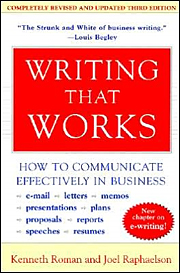
Writing that Works by Roman and Raphaelson

Writing That Works
By Kenneth Roman and Joel Raphaelson
2000

I don’t generally read books that I don’t like. Why bother?

As it turns out, the answer to that is, if they are assigned, then it matters to my grade and thus I had better go ahead and read them.

But really, this makes four for four for this one class, and I just want to read something that I unambiguously enjoy.* At least this book was relatively short and easy to speed read.

Writing That Works is a how-to book that is both extremely basic (know the meanings of the words you use and don’t confuse “its” and “it’s”) and highly dated (a lot of people are now using this crazy thing called “e-mail” to communicate with.)

The simplified nature of the rules it gives for writing means that they remain true. As important as it was to learn them in elementary school, it’s probably equally important to review them periodically. I just get irritated by being told rules that I already know AND that I would argue are often best demonstrated by their exceptions.

It is important to know the rules so that when you break them, you do so intentionally.

Oddly, Writing That Works acknowledges that some rules are meant to be broken but only in the chapter on political correctness, quoting Bernard Shaw’s definition of a gentleman as someone who “never insults a person unintentionally.” While admitting that you may occasionally want to insult someone, it fails to acknowledge that sometimes you don’t want to use the most common words in short sentences.

Sometimes it is useful to use rarer words and complex phrases. I quote Mark Twain: “The difference between the almost right work & the right word is really a large matter—it’s the difference between the lightning bug and the lightning.”

So overall, I would say that if you want to improve your writing, this is a somewhat useful book. But read it with the goal of thinking about what it says as if the statements were suggestions for you to consider rather than rules for you to follow.

* Although being able to grammatically write “four for four for” might well make it all worth it.** It’s not quite up there with “I, where you had had ‘had,’ had had ‘had had;’ ‘had had’ had had a better effect.” but it’s still fun.***

** Actually another thing that makes it worth reading is it introduced me to the story of David Ogilvy and his Russian matryoshka dolls. Ogilvy would give these dolls to his board members with notes saying: “If you hire people who are smaller than you are, we shall become a company of dwarfs. If you hire people who are bigger than you are, we shall become a company of giants.”

*** The fact that enjoy these examples of phrases which are grammatical but excruciatingly difficult to parse may have something to do with the fact that I didn’t enjoy a book about writing in a simple and straight-forward fashion.

Bargaining for Advantage by G. Richard Shell

Bargaining for Advantage: Negotiation Strategies for Reasonable People, 2nd Edition
By G. Richard Shell
2006

I’m going to start off by saying that I recommend this book: it’s well written and it’s useful.

That is not to say that I enjoyed it. But for now, I’m going to focus on the “useful” aspect.

Bargaining for Advantage did an amazing job of teaching me a topic that I really wanted to avoid and doing so in as enjoyable a manner as possible, which just wasn’t all that enjoyable. It was kind of like having a really nice, capable guy for a dentist. He’s a nice guy, it’s a necessary experience, and wow do I not want to deal with it.

As I mentioned in a previous review, I did not find Difficult Conversations particularly useful because the conversations that book dealt with were not the ones that I find difficult. What do I find difficult? Bargaining.

So, my first reaction is to shudder in horror at the title. I hate bargaining, I consider myself quite bad at it, and I avoid it whenever possible. I don’t even like thinking about bargaining. To me, paying a higher price for something is an irritating but acceptable price to pay for not having to bargain.

Despite this, once more and for the same class, I read a book that I found painful to force my way through. However, I’m willing to acknowledge that it’s my own idiosyncrasies that made it so, and the book itself is actually quite good. It’s both well written and provides useful information and good advice on implementation.

The book has two main parts: the first half discusses the foundations of any negotiation and it just made me cringe because I didn’t want to have to deal with any of them. The second half is about the negotiation process and that, while still painful, was also somewhat soothing to my poor introverted and avoidance-heavy sensibilities. It walked me through how to deal with the six foundations previously introduced. I still don’t want to deal with them and I’m not looking forward to any actual bargaining experiences, but I do think I have a much better handle on how to approach those situations when they’re necessary.

Also, the negotiation styles and techniques were all illustrated with a plethora of examples from around the world and throughout history. The stories were all fun, fascinating, and informative. They consisted of little anecdotes about modern and historical figures, familiar and foreign cultures, and successes and failures at the bargaining table. They were pretty much the saving grace of this book for my sanity, since every time I started to worry too much about having to (oh dear god) deal with some bargaining technique myself, there would be some bit of historical or cultural trivia coming my way.

So to sum up, I hated reading it, but it was still an excellent book and I learned a lot.

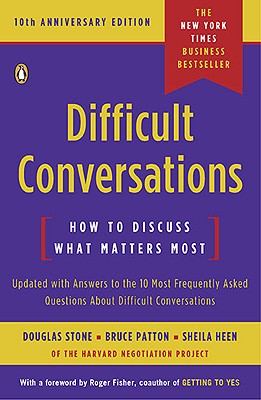
“Difficult Conversations” by Stone, Patton and Heen

Difficult Conversations, 10th Anniversary Edition
By Douglas Stone, Bruce Patton, and Sheila Heen
1999, 2010

There is a reason why I don’t tend to read self-help type books (or attend church services very often either), and that problem is separating the wheat from the chaff. I believe that no one is perfect but everyone has something of value; it’s the ratio of valuable insight to crap that can get annoying.

I rediscovered this as I was reading my next assigned text, Difficult Conversations.

There was a lot of chaff in the book and not much wheat.

I was not looking forward to reading this book anyway, because I hate difficult conversations and will attempt to avoid them if I reasonably can. I have had several situations over the years that maybe could have been improved by my being willing to confront a situation head on and a couple more situations where I was impressed with another person for their strength of will that allowed them to start a needed conversation. So, I started this book, not looking forward to the reading, but expecting it to be good for me.

Instead I discover that once more I am enough of an odd duck that when the authors talk about how I think X, Y, or Z, — and the author’s do write in the second person, “you do this”, “you do that” in order to make all of their pronouncements as personal as possible — I’m over here going, wait, but I almost always respond with G or H or J, rarely with X, and think Y and Z are idiotic. So why are the authors telling me that I always make a certain set of assumptions (which I don’t) and should instead soliciting the other person’s interpretations, when they (the authors) are making all sorts of assumptions about me and, by virtue of the medium being a book, not giving me the opportunity much less an invitation to clarify my side?

At which point I’m feeling all maligned like one of their example cases AND feeling like I’m unnatural in some way, AND feeling like an idiot for taking this personally.

When I brought up my problem with the book in class, though, expecting other students to have had similar thoughts, I discovered that apparently I really am that odd and no one else had a similar take. A lot of the other students thought it was an excellent book that helped a lot. A few of the other students didn’t care for the book for one reason or another (it was simplistic, it contained too many scenarios and not enough theory, the scenarios were all a bit too contrived, etc.), but none of them disliked it for the same reason that I did.

There were some good points. The book did offer some useful ideas about how to distinguish the real goal of several different types of difficult conversations, how to think about each type of confrontation, and how to prepare for each type. Plus, the actual writing is quite well done, and the book goes pretty fast (or it would if I didn’t have to put it down and walk away periodically.)

However, my big conclusion is that while everybody has some set of conversations that they find really unpleasant to participate in, we don’t all agree on what set of conversations those are — a conversation that I consider difficult may not be one that you do and vice versa. And this book really was not addressing my issues at all.

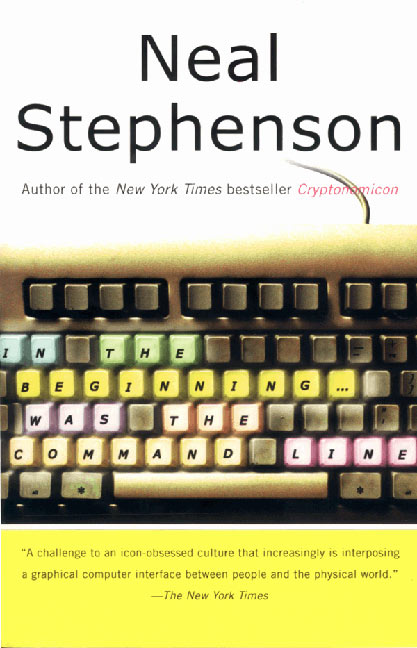
“In the Beginning… was the Command Line” by Neal Stephenson

In the Beginning… was the Command Line
Neal Stephenson
1999

As an opening caveat, I should say that this is the first in what is likely to be a series of reviews of assigned readings. I read this book because one of my professors said to, rather than through any choice of my own. Arguably, I did make a higher-level choice to take the course, but since I’m writing a review of a book rather than the course, the caveat is still important.

I will say that I was delighted at the assignment.

This is the same author as Snow Crash, Diamond Age, and Cryptonomicon, all of which I loved. Stephenson has also written a variety of other books that I have not read, and given that this book came out in 1999 and I’m only just now reading it because it’s assigned, it should be evident that while I like this author, I choose books that I think look interesting rather than reading just anything he’s written as I do for a couple of other authors.

My first reaction is that this is a really useful introduction to the history of the personal computer. Despite the speed at which computer development happens, or maybe because of it, it’s a useful to understand what computer operating systems are and how they’ve developed and what the competing market pressures have been regarding them.

On the other hand, I’m reminded of why I am wary of interacting with authors and actors as people rather than simply enjoying their work. There are often occasions when I like a book or movie or whatever and don’t want that enjoyment to be tainted by the fact that I don’t care for the author or actor. (Robert Heinlein, I’m thinking of you. And, oh, Tom Cruise. Tom, Tom, Tom. Why?)

Stephenson isn’t too bad though. He seems like an okay sort of guy even when he’s writing a nonfiction essay and not writing with the voice of characters developed specifically to be sympathetic. However, there were multiple times when I wanted to argue back at the book and explain that while I didn’t understand the details of computers that he obviously does, a couple of his metaphors were still poorly applied and had internal inconsistencies, and the motives that he projects onto the people who act more like me than like him are not the motives that I actually have for my actions.

So, over all, this is not the most perfect book ever that simply, clearly, and correctly explains the history of operating systems. If you know such a book, please let me know, but I’m guessing it’s a logical impossibility. Instead, it makes a good attempt, succeeds at a good portion of it, introduces some interesting ideas to think about even if I don’t agree with all of them and does so with a sprinkling of fun, geeky humor.

Incidentally, the book is only 150 pages long and while it can be purchased from Amazon (which I did) or various physical bookstores, it’s also available online for free. If you’re interested in understanding more about computers without reading a computer book, go and read In the Beginning… was the Command Line.

Fate’s Edge by Ilona Andrews

Fate’s Edge
Ilona Andrews
2011

As my last hurrah before starting a new semester, I read Fate’s Edge. Of the authors who are currently producing new books, Ilona Andrews is my favorite. However, she has two series and I prefer the other one.

The Edge series has a wonderful premise:  There are two worlds, the Broken (our non-magical world) and the Weird (the magical realm), with the Edge as a thin stretch of land that divides the two realms. The Edge is essentially the gateway between both realms and is largely invisible to both as well. Plus, it’s the poor backwoods residents of either land who actually live there.

In this series, they’re our heroes.

This is an awesome premise!

I like it a lot.

A lot of the plot comes in from the fact that various lands in The Weird have rather tense relationships. It’s kind of Cold War-ish, with spies fighting spies and neither side wanting to really declare outright war unless they have a better chance of winning.

So there’s spies and magic and a long stretch of land that is best known for it’s violently clannish population and smuggling operations.

There is oodles of fun to be had there.

The weakness of the series is in the characters, who come across as fairly cookie-cutter standard romance-novel love-interests. However, each book in this series is slightly better than the one preceding it, and Fate’s Edge is the third book in the series, so it’s characters are the best yet.

One reason for the increasing complexity of the characters is that so far the pattern is that the next male protagonist is introduced as a side character in the preceding book. As a side character can’t be allowed to upstage the main hero of a book, the side characters are given flaws that make them lesser than the hero but also a lot more interesting and realistic. If Audrey and Kaldar, the pairing in this book, had been the main pair in the first book, I would have been a lot happier.

However, since a lot of the characters are introduced in the preceding books, I’m not really sure how well this book can stand on its own. To get a full sense of the world building, you definitely need to read the first two books.

So over all, it’s a good, fun read, and I do recommend it, but you have to choose between reading the first two first two books with their character issues or missing out on some of the awesome world-building.

Touch of Power by Maria V. Snyder

Touch of Power
Maria Snyder
2011

I read the first few (short) chapters on Amazon, got hooked, checked the book out from the library and read it in an evening. It was a fun light read that was pretty much just what I needed to relax with. It’s one of those books that balances between being a fantasy-adventure novel with a strong romance plot line and being a romance novel with a strong fantasy-adventure plotline.

I believe this is the second fantasy universe for this author, and while the universes have distinct rules of magic and society, the character dynamics in Touch of Power were really similar to those in Poison Study (the first book in the other universe). If you like the one, you’ll probably like the other, (I certainly did) but go in expecting the same type of thing rather than anything spectacularly new or inventive.

The plot is a really common one for romance novels: There are two secretly awesome people – sometimes their awesome is secret from the world, other times their awesome is just secret from each other – who each feel that the other person has wronged them in some way. They then proceed to act either aggressively or passive aggressively at each other in response and things escalate until a final showdown reveals that they have both misunderstood the situation and wronged the other, not in the original perceived acts but in their responses. This can be written at various levels of quality, but when done well it’s a wonderfully self-indulgent bit of character drama. When done poorly, it convinces me that both characters are judgmental idiots. Snyder does one of the better jobs of writing this plot line (although no where near as good as Jane Austin’s Pride and Prejudice) and manages to largely avoid the pitfall of idiocy.

In this book, Healers with magical healing abilities have been blamed for the great plague that swept the land and thus they are generally killed on sight. Our heroine is a Healer and our hero is a guy who badly needs someone healed and will do whatever it takes to help his friend. Under the circumstances, you can see why they start off with the wrong impression of each other. It was a great deal of fun seeing the characters struggle to work together and waiting to see when the big reveal would happen.

I’ll discuss that  a little more under the spoiler cut, but in general, this is a fun book. I enjoyed it and I recommend it the same way I would recommend a summer blockbuster or a soap opera. It’s not high literature, but I’m rarely in the mood for high literature. It’s fun and relaxing and should be enjoyed as such.

Continue reading

“Magic Bites” by Ilona Andrews

Magic Bites
by Ilona Andrews
2007

Since I reviewed Magic Gifts yesterday, I decided I needed to go back and introduce the universe. Magic Bites is the first in a seven-book series, five of which have been published at this point and two of which I am avidly waiting for. While each book has it’s own stand-alone plot, the characters develop across books. There are also four short stories and an upcoming book that are tangential to the main series.

But first, some background:

There have been a huge number of books published recently with:
1. Spunky female protagonist
2. Vampires
3. Werewolves

Off the top of my head, authors who have written these books are:
Patricia Briggs
Stephanie Meyer
Laurel K. Hamilton
Charlaine Harris
Robin McKinely
Ilona Andrews

And whole lot more.

These are, frankly, just the ones that I’ve personally read, and read recently. (Some of these I liked, some of these I didn’t, and I’ll tell you all about it if you ask nicely… or if you refrain from yelling “No!” loudly enough.) There were a lot more whose covers I’ve seen in bookstores and simply couldn’t bear to read because I was positively glutted with spunky female protagonists dealing with vampires and werewolves (SFPDwV&W).

However, I am still going to write a review of Magic Bites recommending this book to all of you other readers out there who are similarly glutted on SFPDwV&W.

It’s fabulous and you should read it.

Ilona Andrews the author, incidentally, is actually made up of a married couple: Ilona Andrews the person and Gordon Andrews her husband. I went to a convention they were at recently and got my copy of Magic Bites signed by Gordon Andrews. He wrote:

This book is terrible. Start with Magic Strikes. It’s the best.
To Rebecca
Gordon and Ilona Andrews
Don’t read this book!

I, on the other hand, am perfectly willing to tell you that despite being half of the author, he doesn’t know what he’s talking about and you should definitely read Magic Bites, and you should read it before reading Magic Strikes (which is the third book in the seven book series.)

Magic Bites is their first published novel and shows some of the uncertainty of a first book, but were it shines is in world building. This book is an introduction to the characters and to the world. The characters are fun and idiosyncratic and the world is magnificent.

It’s urban fantasy, set in Atlanta, Georgia, with magic, but the book explains how and why the magic is there, from an educated layperson’s perspective.

The werewolves aren’t just werewolves, they have an extremely contagious magic-based virus that has both physical and mental symptoms. They have a culture and a reason for that culture.

Vampires, on the other hand, are dead. They are dead and they are bloodthirsty and they will kill you unless piloted by a “Master of the Dead.” The Masters of the Dead have a massive corporate/cult structure of their own.

And our main character, spunky female protagonist that she is, has motivation and history and reason for all of her character strengths and weaknesses.

This book introduces the reader to a world that has vampires and werewolves and a spunky female protagonist and also, unlike pretty much all other others, makes sense.

(In fact, it makes enough sense that I can quibble about little mistakes in the logical structure of the world because there’s enough logic there for there to be mistakes! If you’re at all interested, I would absolutely love to nitpick in the comments section, because this is a book, and the beginning of a series, well worth reading and thinking about and nitpicking.)