Maya Angelou

I read I Know Why the Caged Bird Sing in high school after my particularly awesome English teacher won her stare-down with the school board. Unfortunately, I don’t actually remember it all that well and didn’t remember much about the author either, for all her name recognition. Clearly that needed to change.

So for my Christmas road trip, I picked up (thank you public libraries!) three of Maya Angelou’s audio books, each of which she read herself. I like audio books that have been read by their authors. All readers add their own nuances to texts and when the authors read them you know it’s the intended nuance. Maya Angelou has the added benefit of actually being a professional performer and reciter.

Curiously, her speech pattern reminded me of William Shatner’s, and I wonder if he modeled his after hers. Very well enunciated, and with frequent, intentional pauses. She carries the style off better, though.


asongflunguptoheavenA Song Flung Up To Heaven
2002

Maya Angelou had a pretty amazing life with many ups and downs. Where before my impression of her was as this iconic individual almost out of sight on a pedestal, this autobiography shows her as fully human with all the attending strengths and weaknesses. One of her many strength is surely her willingness to show the world her weaknesses.

Rather than a single long book, this felt like a themed collection of short stories. Rather than telling the story of her life, she’s telling stories from her life, giving the reader a look at different times and events. Each chapter could potentially stand alone and be well worth reading.


momandmeandmom2Mom & Me & Mom
2013

Wow. Maya Angelou’s mother, Vivian Baxter, sounds like a truly amazing woman who lived her life to the fullest. As tumultuous as Maya Angelou’s life has been, her mother’s seems to have been that much more so. This book focuses on Maya’s relationship with her mother, which was excellent, but I also wish there was a full biography of Vivian Baxter, because just the glimpses we see into her life as it intersected with her daughter are pretty amazing. She was strong and determined and opinionated and just an amazing woman but she was not necessarily a comfortable woman to be around. She seems to have been utterly and completely herself and lived out loud.


lettertomydaughterLetter To My Daughter
2009

This struck me as pretty much a perfect graduation gift (highschool? college? some other major life transition where you’re not sure what you’re going to be doing next?). Many of the chapters are slightly edited versions of chapters from her other books, but they’re collected here for a reason. The overall message of this book is that life is going to throw a lot of different things your way, some wonderful opportunities and some awful experiences, so stay strong and try your best to take advantage of the first and get through the second.


I recommend all of these.

The Man Who Loved Books Too Much

The-Man-Who-Loved-Books-Too-Much-937489The Man Who Loved Books Too Much
By Allison Hoover Bartlett
2010
Read by Judith Brackley

This was an interesting look into the both the rare book collecting community and the criminal mentality as a journalist recounts her research into an unrepentant book thief and the book seller who tracked him down to bring to justice.

It reminded me of a combination of Mr. Penumbra’s 24-Hour Bookstore, with its quirky book lovers, and The Art of the Steal, with its discussions of how con jobs and thefts are both implemented and guarded against. With a side of Marching Powder, with it’s unpleasant main character who just gets less sympathetic the more he tries to explain his perspective.

And actually, regarding that last bit, Gilkey’s (the thief) attempts at gaining sympathy and explaining his rational is so crazy that even the Bartlett (the journalist) is completely taken aback by it. But she’s still more accepting of it than I am, to the extent that her writing almost reads like an unreliable narrator as she first recounts a conversation verbatim and then describes how he still seems like such a nice, polite guy… and I’m going: nope!

But it’s still quite fascinating and does make me want to visit a rare book convention and see the stalls where different book sellers set up with their books with prices that range from less than a $100 to more than $100K.

Bible: illustrations

So it’s probably pretty obvious that I’m falling behind in my year schedule for reading the Bible. I will excuse it because a) this has proven to be a remarkably difficult year, and b) the Bible is really amazingly dense.

However, I just ran across some pretty awesome biblical artwork that I want to share:

Photographer James C. Lewis noticed that while the bible is set in the Middle East and Africa, most of the illustrations of the people involved look really northern European. So he decided to fix that:

What Would Characters From The Bible Really Look Like? Here’s One Photographer’s Idea (The Huffington Post article shows 10 of the photographs)

An antidote to lily-white Bible characters (The Church Times article shows 14 of the photographs)

A Tumblr post (shows 51 of the photographs)

I’ll also take this opportunity (despite not having gotten anywhere near the New Testament yet) to reflect back on a really gorgeous painting by Janet McKenzie, “Jesus of the People”, which won the 1999 National Catholic Reporter’s competition for a new image of Jesus, judged Sister Wendy Beckett.

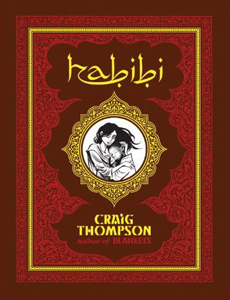
Habibi

HabibiCoverHabibi
by Craig Thompson
2011

Wow. This is a graphic novel that really earns both of those words: it’s definitely a novel, and it’s definitely graphic (in every sense of the word.) It is most definitely not a comic book.

I’d noticed this book in passing for a while now, because it’s beautifully bound and the illustrations are gorgeous. Just, it’s a really beautiful book. It also has an obvious theme of exploring religion, which is something I often enjoy. On the other hand, it was struck me as trying really hard to be high literature by means of showing a life fraught with hardship, pain and suffering, and yet perseverance through it all.

Then I found myself waiting for a couple of hours in a library for which I didn’t have a library card. So I settled down to read this. And sure enough, I was absolutely right.

It shows a grim world filled with caricatures of characters who still have a bit of individuality to bring them to life and make them interesting. It’s really obviously trying very hard, and yet it largely succeeds in being that story about strength of will and perseverance and the times when there are no good options and so you just carry on. The characters are heartbreaking.

It makes me think of the story of Scheherazade, the narrator of the 1,001 Arabian Nights, and think of what her life must have really been like. After all, she was literally telling stories to preserve her life. (The main character also retells some of Scheherazade’s stories.)

It also reminds me of Caravan by Dorothy Gilman, a book I enjoyed a great deal but was possibly the first book I read in which it was clear that neither the main character nor the love interest were going to be protected by their status as the main characters of the book.

Bad things happen. A lot. And are, with one notable exception, shown rather explicitly.

It is not my particular kind of book, for all that it is just really, really beautifully drawn and bound. After reading half of it while waiting at the library, I got up and walked away when my class started. But when I saw it again at my local library, I thought, you know, let’s carry on. So I checked it out and read the rest.

It joins the ranks of books that I’m impressed with, proud that I’ve read, but feel no particular urge to re-read or own.

The Bible: Samuel 1

With all the horrible things that happen in the bible, it’s been easy to forget how funny it is sometimes. I find myself chortling a bit.

In chapter 3, young Samuel is dedicated to the temple and is very devoted in his duties to the elderly priest Eli. Samuel is still quite young when God first reaches out to make him a prophet.

One night, God calls to him: “Samuel.”

And Samuel leaps out of bed and to Eli’s bedside: “I am here! You have summoned me!”

And Elis says, “No, I didn’t. Go back to bed and get some sleep.”

So Samuel goes back to bed, but then God calls out to him again, “Samuel.”

And Samuel leaps up and to Eli’s side, and once more Eli sends him back to bed.

The third time, though, God calls, Samuel goes to Eli, Eli (who is in his nineties at this point and dealing with an eager young devotee “realizes” what must be happening and tells Samuel: “It must be God calling you. So next time you hear someone call your name, stay in bed, and say, “I hear you, Lord! I am listening.” And then you can tell me all about it in the morning.”

😀

This works admirably.

And so God talks to Samuel and tells him that something big is going to happen soon.

The Lord said to Samuel, “See, I am about to do something in Israel that will make both ears of anyone who hears of it tingle.” — Samuel 3:11

“… make both ears of anyone who hears of it tingle.” That just… hee! There are bound to be some parts of the bible that get a bit mixed up in translation, but there’s only so far off it can be.

😀

In chapter 8, the people of Israel offend God by asking for a king. Samuel is an elderly priest by this point, and tries to convince them against this (his arguments come down to the idea that God is their king and is offended that they would want anyone else; their arguments come from wanting an actual physical person who can do people things like interact with people who are not the head priest.) God is offended, but does the passive aggressive thing where he’s, like, oh, I’ll show you, I’ll give you what you’ve asked for and then you’ll see how wrong it all goes!

So this does not speak well of the future king, and you’ll notice that while the people are demanding a king, none of them are exactly volunteering for the position. And thus along comes Saul, in chapter 9, who’s searching for a pair of goats who wandered away from the herd. In chapter 10, Samuel waylays poor Saul, strong arms him into having dinner with him, and then anoints him the new king of Israel.

Afterwards Saul sneaks off, gets his goats, and returns home hoping to never speak of these events again.

😀

It doesn’t really work, though, and in chapter 11, Saul is forced to take up the kingship in a more practical sense, ie, raising an army and defeating the enemies of Israel.

Chapter 14 is pretty hilarious too, not so much intrinsically as because I recognize the storyline from Tamora Pierce’s Alanna: The First Adventure, right down to it being Prince Jonathan who disobeys his father the king to cross a battle line. I’m not sure if it would be funnier if it was pure coincidence or if Pierce was inspired by this.

😀

Anyway, there are more battles after that and much hewing of various people, and David the shepherd is introduced and has his infamous battle with Goliath in chapter 17.

Then seriously, the rest of the book starts reading like a somewhat more developed version of Wiley Coyote and the Road Runner. David gains much renown and Saul becomes jealous and tries to kill him. But David is too clever to be caught and is always running away just out of reach, and occasionally counting coup back on Saul but never makes a serious attack.

Samuel dies at the beginning of chapter 25 (out of 31) of Samuel 1, which is particularly odd because there’s whole second book of Samuel. But the death of Samuel does not stop the somewhat ludicrous chases and ambushes attempted by Saul on David.

There’s still battles against external enemies though (ie, the original inhabitants of the land) and thus both Saul and his armies and David and his roving band of dissidents are having battles with other people. Ultimately, though, David is favored by God and is victorious; Saul is the poor schmuck who was coerced into fulfilling the role of king and thus offending God even in his obedience to God, and thus dies along with all of his sons. (Poor Prince Jonathan!)

And with the death of Samuel ages ago, and Saul more recently, apparently Samuel 2 will be all about David?

Summary: This is kind of a somewhat black slapstick comedy of war and religion and conflict. Samuel is an adorable kid, Saul just wanted to get his goats, and David is the Road Runner.

Moral: Stay away from priests: they can con you into getting a bit too close to God.

Next up: Samuel 2

Happy Halloween!

Happy Halloween, dear readers!

As a bit of terrifying Halloween fun, here’s a short online comic strip for you:

Bongcheon-Dong Ghost
written and illustrated by Horang

I ran across this several years ago (the link was messaged around my classroom at the time and you could tell who had clicked on it by the flinches and stifled shrieks) but all the text was in Korean. When I went looking for it again, I found it translated into English. It remains really well done.

Spooky Graphic Novels

In honor of the approaching Halloween, I’ve been reading some extremely good graphic novels, that seemed seasonally appropriate. Although possibly more thematic to a more traditional concept of All Hallow’s Eve than to the modern concept of Halloween, per se. This is a time when the barriers between the living and the dead are the weakest and who knows what could be roaming the streets… you’d better prepare to be scary, too, to fit in.

Anyway, the artwork for all three of these are just gorgeous, which can possibly go without mention, since I don’t read graphic novels if I don’t like the art. But still, the art is really gorgeous.

East of West
written by Jonathan Hickman
drawn by Nick Dragotta

200px-East_of_West  east-of-west-vol02  East of West 3

This is a futuristic western based on an alternate past with a whole lot of mystical beings thrown in for good measure. I love it.

One of the main characters is Death. The three other horsemen of the apocalypse are also wandering around, and there’s some sort of evil prophesy that a scary number of the world leaders are fanatical believers of. No one is really good or nice in this, by they’re all really dedicated to their various (and generally conflicting) causes. And there’s something very appealing about competency, good or evil, and something fascinating about manipulative people attempting to manipulate each other.

The back sums it up well:

“We would tell you to pray. But it wouldn’t do any good. You have earned what is coming to you.”

Anna gave the first one of these to me for Christmas last year and then I bought the second one for myself last month, and the third one has just been released a couple of days ago but I haven’t gotten it yet. I’m still going to review this whole series as awesome.


Pretty Deadly
written by Kelly Sue Deconnick
drawn by Emma Rios

PrettyDeadly_Vol1-1

This is another mystical western, although minus the science fiction aspect of East of West. Instead, the whole story has a surreal quality as it is structured as a fairytale told by a bunny (or rather the skeleton of one) to a butterfly (who might be part of death’s daughter) and there are stories within stories. I still need to read it again (probably a few more times) to really track down who all is who and what their intents are, but it’s fascinating. It’s also a complete story, which is nice. There are plenty of other characters who can be developed in the next volume, whenever it comes out (and that I’m looking forward to getting when it does), but the main plot arc following the girl in the vulture cloak is resolved at the end of this volume, and thus ends the story told by bunny to butterfly.


Peculia and the Groon Grove Vampires
by Richard Sala

Peculia

This is a stand-alone single story, and a much quicker read than the others. The story-line is extremely straight-forward without any real surprises. The plot-line sort of reminds me of a Nancy Drew story, although with even fewer surprises. In that way, it seems like something for a fairly young reader.

On the other hand, a lot of characters die, some in relatively gruesome ways. The focus on the gruesome deaths is actually the opposite of gratuitous, though. They’re shown quickly and casually and it all comes across as fairly light. It reminds me of the some of the older Grimm’s fairytales where, say, children push witches into ovens and then go home to celebrate with their families. So, you know, maybe it is intended for youngish children, but cheerfully bloody-minded young children.

And me, too, because I liked it a lot.

The art is also interesting in the way it’s all in black and white, with the appearance of woodprints.

2-sentence horror stories

In honor of approaching Halloween, I present you with some short horror stories.

The background is: about a year ago, a Reddit user asked “What is the best horror story you can come up with in two sentences?” The response was tremendous and there are currently 3397 comments in that chain (admittedly, a lot of them are responses to the responses, so there are fewer than 3K stories, but still.)

To see nine of them, nicely formatted, go here.

To see all of them, with the original formatting, go here.

Warning: these really are terrifying. Oof. Who needs sleep anyway?

The Bible: Ruth

This is an extremely short book, only four chapters long. In some ways it reminded me of the Book of Job, since it’s a single story with more developed individual characters. For the first time, this is really a more focused story about family love and loyalty; goodness on the scale of individuals.

It was a much appreciated palate cleanser from the previous few books.

In this story, Naomi was a married woman with two adult sons who had each married. Over time, though, both her husband and her two sons died. While she directs both of her daughters-in-law to return to their families as being better able to care for the widowed women, one of them, Ruth, insisted on staying with Naomi.

Where you go, I will go: where you lodge; I will lodge; your people shall be my people; and your God my God — Ruth 1:16

I had known this quote, of course, but it had always seemed the epitome of romantic and I’d assumed it was spoken by a woman to her husband or lover. I’m actually rather pleased to discover that it is spoken by the widowed Ruth to her mother-in-law. This isn’t about marriage, it’s about found family.

Naomi returns to her homeland accompanied by Ruth but are poor beggers. They work together to identify and then seduce for Ruth a new husband, so that Naomi can have an heir and Ruth can have a household. And they succeed in finding a nice older man who is both wealthy and kind (and flattered at being approached by a younger woman.)

And they all live happily after.

It was nice.

Summary: Widowed Ruth follows her mother-in-law Naomi home to a strange land and, with Naomi’s assistance, finds a kind and wealthy second husband to take care of them both.

Moral: Loyalty and kindness can pay off in a happy ending.

Next up: Samuel 1

The Bible: Judges

So in Deuteronomy I complained about how Moses gave this lecture about how the people of Israel would betray the Lord and be punished for their sins, etc, and it really irritated me. Well, here’s the start of all the crap that’s going to happen to them, and sure enough it’s pretty thoroughly their own fault. Once more, I am reminded of Game of Thrones (a show that I actually don’t watch, but keep up-to-date on via summaries) in the way a bunch of unpleasant people wander around doing awful things to one another.

Plus, this should probably have an NC-17 rating, and more likely just be banned, because it is gruesome. And while previous books have been all pro-genocide, this one is pretty pro-rape.

Four nations* were left alive in order to provide a lesson in warfare to the generations of Israelites, and thus we have a timeline made up of conquerings and rebellions, covering the various “Judges” of Israel. There is no particular explanation of how a Judge is chosen or found, and very little information on some of them. (Footnotes mark the six who actually got stories.)

Bad guy: King Cushanrishathaim of Aram-naharaim conquered for 8 years
Judge: Othniel son of Kenaz judged for 40 years
Bad guy: Eglon of Moab conquered for 18 years
Judge: Ehud son of Gera, the Benjamite judged for 80 years**
Judge: Shamgar son of Anath judged (killed 600 Philistines)
Bad guy: King Jabin of Canaan conquered for 20 years
Judge: Deborah wife of Lappidoth judged for 40 years***
Bad guy (nation): Midian conquered for 7 years
Judge: Gideon, called Jerubbaal, son of Joash judged for 40 years****
(Judge? Bad guy?): Abimelech son of Jerubbaal, conquered? judged? for 3 years+
Judge: Tola son of Puah son of Dodo judged for 23 years
Judge: Jair the Gileadite judged for 22 years
Bad guy (nation): Philistines and Ammonites conquered for 18 years
Judge: Jephthah the Gileadite, bastard son of Gilead judged for 6 years ++
Judge: Ibzan of Bethlehem judged for 7 years
Judge: Elon the Zebulunite judged for 10 years
Judge: Abdon son of Hillel judged for 8 years
Bad guy: Philistines conquered for 40 years
Judge: Samson judged for 20 years +++

After Samson we trail off away from judges and get a random story about Micah who gets wealthy in chapter 17 and then gets it stolen away from him by a bunch of other Israelites in chapter 18.

Then comes the really rape-tastic story of the Benjamites (chapters 19-21), which starts out reminiscent of Lot’s situation in Genesis 19, where he offers his daughters to a mob in Sodom in place of his angelic visitors. Except that in Genesis, Lot’s daughters were not accepted as suitable replacement, while in Judges a mob of Benjamites do wind up accepting a Levite’s concubine in his stead. So they gang rape the concubine to death. In the morning, the Levite cuts his dead concubine into 12 parts and sends the parts to the different tribes of Israel to call up an army. The Benjamites refuse to give up to justice the actual participants in the gang rape and thus a series of remarkably even battles takes place, with the Benjamites eventually losing to the extent that their entire tribe was killed with the exception of 600 soldiers who fled into a particularly inhospitable area. Victory was declared but then they had the problem of 600 males left in the tribe of Benjamin and no women and all the other tribes of Israel had sworn not to give any wives to Benjamin but were also unwilling to just let them die out.

The army that had just slaughtered all the women and children of the Benjamites figured out that they could fix this by invading a Canaanite town, killing all the males and the adult females and delivering the young females to the remaining Benjamites to be their wives. This plan provided 400 young girls to “marry” but wasn’t enough to give each Benjamite soldier a wife of his own. So the army told the remaining Benjamites to just kidnap sufficient girls from the religious celebration happening Shiloh, north of Bethel, and then explain to their unhappy fathers and brothers that at least the oath not to give wives to the Benjamites hadn’t been broken, because the Benjamites had taken the wives by force.

So everything worked out?

Blech.


Summary: There were a bunch of people who weren’t as great as Moses or Joshua, but still somehow acquired the title of “Judge.” Occasionally they did stuff (ie, killed people.) Some other people did a lot of raping and sometimes it was bad and other times it was good.

Moral: Hahahahahahaha! “Moral,” you say. Hahahaha! The very last verse in the book is:

In those days there was no king in Israel; all the people did what was right in their own eyes. — Judges 21:25


* Philistines, Cananites, Sidonians, Hivites (Judges 3:1-4)


** The Moabite king he killed was so fat that Ehud left the sword in his body, hidden by the layers on fat, as he wandered out past the servants after his assassination of their king.


*** Deborah gets a song in addition to a rather convoluted story of manipulations.


**** Gideon makes God prove himself and then raises an army of some 20,000 people, but God decides that it’s too even a battle to really show God’s might, so has Gideon send 19,700 of them away, keeping only the soldiers who lap up water from the river like dogs.


+ It didn’t even seem clear to the narrator whether this guy was a good guy or a bad guy. He’s the son of Gideon, a previous judge, but he also killed his 70 brothers in order to inherit and winds up getting cursed and dying.


++ First occasion of human sacrifice: Jephthah sacrificed his daughter as a burnt offering.


+++ Samson gets four whole chapters (13-16) and is an idiot and an ass. Among other things, he makes a bet that he can’t afford, and when he loses, he goes out and kills some local townspeople to take their stuff so he can pay off his bet. And, of course, there’s the famous story of him and his hair and his wife Delilah who cuts it off to weaken him. Four times (4 times!) Delilah asks Samson what will weaken him, and then does it, and calls his enemies in. The first three times, Samson lies to her, breaks his bindings and kills his enemies. The fourth time he decided to tell the truth???


Next up: Ruth