The Bible: Chronicles 1

This broke me. Not the book itself, although it took an audiotape and a long drive to get through it, but the write up. I had originally planned to illustrate it with a family tree. Except that the first four verses of the first chapter are a vertical family tree through thirteen generations from Adam to Japheth. The fifth verse lists Japheth’s seven sons. Verses six and seven list the sons of two of Japheth’s seven sons, one of whom had three sons and the other four. And it just keeps going.

There are more than a hundred names (although only approximately 75 unique individuals because of course every father is listed twice, once as a “son of” and then again as a “father of”) within the first 26 verses of chapter 1, at which point we get to the sons of Abraham: Isaac and Ishmael, who at least are names I recognize. After that, there are a lot more names that I don’t recognize at all. A lot.

The first chapter has 54 verses. The book as a whole has 29 chapters. And it’s the first of two scrolls that make up Chronicles 1 and Chronicles 2 respectively.

What do you even do with this?

Although as a baby name book, it’s pretty excellent. If you can get over some of the names themselves. I do feel like no one should be named after Ham (1:4), but then there’s Tilgathpilneser (king of Assyria, listed in 5:6 and again in 5:26 because why make things easy to keep track of?), since that is a bitching name.

“I wanted to give my son a biblical name, but also a unique one.”

“So, little baby Tilgathpilneser?”

“We call him Tilgy.”

(Also, rather than just a name in a list, like so many are, we learn that God roused Tilgathpilneser’s spirit in order to punish the Israelites – even the Reubenites! – so… there’s that? 5:26)

The family trees just keep going, but we do occasionally get some few verses dotted here and there giving a few details about what’s actually happening with and to at least some of these people.

There’s also the occasional woman mentioned, such as Hammoleketh who bore three children of unspecified gender (but certainly not unspecified name!) listed in 7:18. And then there’s Sherah (7:24) who makes me grin because Shera! Princess of Power! which was a favorite cartoon that dates me horribly (and also aged horribly.)

We also get to a few parts where the people don’t always have names, but do have hereditary positions of employment such as porters of various quarters, overseers of vessels, cooks, and singers. Of course, sometimes they do have names, and those many, many names are listed. (chapter 9.)

And, sometimes there isn’t familial connections, just being in the same battle but still needing a chapter devoted to the roll call of those valiant warriors. (chapter 11).

By chapters 15, it became too much for the original writer apparently because it breaks down into numbers rather than lists of names, or at least lists of names associated with the number of children rather than lists of names associated with lists other lists of names.

Chapters 16-22 actually get back to story telling with King David and the ark of the covenant, a list of rules of behaviors, and the temple that David really wants to build and has very specific ideas about but that can’t be built within his lifetime because God says so and thus needs to be described to his son Solomon for him to do later.

After that break, chapters 23-27 are back to genealogies and employment records.

Chapters 28-29 are a rousing speech that King David gives, somewhat about the greatness of the Lord but mostly about exactly what the temple he wants built after he dies to look like, described in extremely excruciating detailed instructions. It all finally ends with a quick summary of King David’s reign (good) and his biographies (three of them)  and mention that King Solomon is the next king.

Summary: There are a lot of people and population increases geometrically over time if couple has more than two kids. They’re mostly employed being porters, priests, singers, cooks, warriors, and kings. And wow, does King David want to be in charge of building his temple even if it can’t be started until after he dies.

Moral: As time goes by, being one more name in a long list of names is not a great legacy, in my ever so humble opinion.

Next up: Chronicles 2

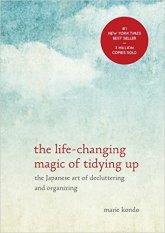
The Life-Changing Magic of Tidying Up

tidyingupThe Life-Changing Magic of Tidying Up: The Japanese Art of Decluttering and Organizing
By Marie Kondo
2014

This book was amazing. I have now recommended it to virtually everyone in my family and am passing it around so they can all read it and you should read it too. It’s joining The Art of Learning as one of now two nonfiction self-help books that I really enjoyed and was impressed by.

Marie Kondo is kind of crazily obsessed with tidying and organizing. (Her family members are clearly saints for having put up with her trying out different methods.) But it makes the book pretty funny in addition to useful and interesting as she writes about what methods she’s tried and the ways in which they did and did not work.

Kondo’s actual method, the one she’s describing in the book really does work, and I love that she takes the time to show how she came up with the method and how and why it works. Not only is the theory something I find generally interesting, it also makes it possible for me to modify the method for my own use. Because I don’t have the time and energy to implement her massive 6-month reorganization bonanza, but working bit by bit, as I feel inspired does work.

Despite it not being a particularly long book, it took a while to get through because I would get inspired to just start tidying. It’s surprisingly fun to do and the results leave me feeling all pleased and happy with myself.

While there are a lot of specific suggestions about how to really work her system (so go and read the book!), the basic premise is that you should keep the stuff you love and get ride of the stuff you don’t. The first part of her method is to spend time looking through your possessions and identifying all the things that you love. It’s amazing how much stuff I had because I had it and had no reason to get rid of it. I had a lot of clothing due to inertia rather than enjoyment. While reading this book, I wound up with several large bags and boxes of clothing and books to donate and now am left with a room with a much higher concentration of things I love, because there’s less dilution with things that I just sort of have.

I highly recommend this book. You don’t have to follow her advice, but at least read the book and see if you’re interested in trying it out. Because I have been working through my stuff and it has been fun to do and I love the results.

The Watchmaker of Filigree Street

watchmakerThe Watchmaker of Filigree Street
by Natasha Pulley
2015

I got the automated email from my library letting me know that a book on my hold list had finally come in, but I only vaguely recalled putting a request in and no real memory of why I had done so. But, wow, am I glad I did!

The book is set in 1884 London, although with a significant section of backstory set in 1870s Japan. Our protagonist is Thaniel, a telegraph clerk at the Home Office in London at a time when Irish nationalists are trying to instigate a revolution and are throwing bombs at government buildings. It’s also about ten years after Japan underwent a revolution, and they still have their own set of nationalists vs modernists, and have a significant immigrant population in England. One of those immigrants is Mori, the titular watchmaker of Filigree Street. Another main character is Grace, a female physics student at Oxford college. Then there are dozens of other characters who are all interesting and quirky and suspicious in their own ways.

It reminded me a bit of Mr. Penumbra’s 24-Hour Bookstore but better. It’s unclear for a significant portion of the book whether or not there’s a magical/supernatural element to the world. Is this book fantasy, science fiction, or straight up literary fiction? The answer to that would be a spoiler, so I’m not going to answer.

The plot, such as it is, is to discover the mystery of a particular watch that came into Thaniel’s possession and saved his life from a bombing. The vagueness of the plot does not stop it from being amazingly suspenseful. The tension really comes from Thaniel trying to figure out just what is going on, and who he should be trying to help versus who he should be trying to hinder. I stayed up way too late finishing this book, the day after I picked it up from the library.

The climax wobbled a bit with Pulley trying to add more traditional plotting and tension in unnecessary ways, but I still really enjoyed the book and highly recommend it.

Newt’s Emerald

NewtsEmeraldNewt’s Emerald
by Garth Nix
2015

This was a fun book, but I went into it with high expectations and it never matched them. I’ve read a lot of really good, fun regency romance adventures, with and without magic, and this one feels like what it is: a fan of that genre wrote his own take for fun, but without really going all out.

Regency romance is fun genre over all, with complex manners and dresses and marriage missions, and Georgette Heyer is the clear founder and leader of the genre. Her characters are quirky and her plots of romance and manners are complex, and it all defines a time and culture of arbitrary rules that make so little external sense and yet have perfect internal structure. Garth Nix is clearly a fan, but his characters are a too flat and caricatured while the rules of society don’t have the same clarity and internal consistency.

For regency romance with magic, Patricia Wrede and Caroline Stevermer with their Sorcery & Cecilia series or Patricia Wrede alone with her Mairelon series have brilliantly added layers of magical realism to the rules of society and it all really works well. Despite how amazing the world building was in Nix’s Old Kingdom series (a series I definitely recommend), the rules of magic in Newt’s Emerald are mostly vague and hand-wavy while occasionally contradictory.

The book that Newt’s Emerald was trying to be would have been awesome. Unfortunately, it just never quite developed enough–not the characters, the plot, or the world. None of this means that the book is terrible. It just… wasn’t great.

Heather Wells Mysteries

Heather Wells Mysteries
by Meg Cabot

size12_cabotSize 12 Is Not Fat
2006

size14isnotfateitherSize 14 Is Not Fat Either
2006

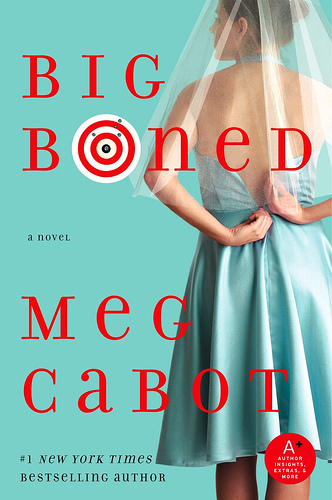
big-bonedBig Boned
2007

Like all of Meg Cabot’s books, these are delightful romps with crazy characters. The plot is, more or less, there to keep the characters focused and give the books a defined ending. I love her characters so much! And one of the many things that makes Cabot a great author is that she clearly loves her characters, too, every insane little bit of them.

I’m particularly pleased with these books, because unlike her 1-800-WHERE-R-YOU series or her Mediator series, both of which I also loved, the Heather Wells mysteries have an adult protagonist. Most of Cabot’s books are set in high school and I am (very belatedly) aging out of the time when I can really empathize with the high school drama. But it’s wonderful to know that Cabot writes for adults as well, because there are times in life when I need to read something with her warm-hearted fake-it-till-you-make-it-even-when-it’s-really-very-fake-right-now approach to life. None of these characters have it all together, even though they’re adults, but that’s okay. They can still try and they can still succeed. And I will still laugh (mostly with them, but sometimes at them) as they do so.

The protagonist of this series, Heather Wells, is an ex-pop star who, in quick order before the first book begins, lost her recording contract, her pop-star fiance, and all of her money, as well as her mother/manager who ran off to the Bahamas with the money. There’s surprisingly few hard feelings about any of this, c’est la vie.  The books start with Heather renting a room from her ex-fiance’s brother (who’s a private detective) and getting a job as assistant dorm manager at a local college campus.

And then there’s a death in the dorm!

And the police think it was an accident!

And Heather Wells must solve it!

Not to spoil anything but (A) she solves the mysteries! and (B) by book number three the dorm has gotten the nickname “the death dorm” since people keep on dying in it and needing Heather Wells to solve their murders.

Anyway, these are wonderful, comfort books. I read these first three and am all happy and satisfied and ready to read something else for a while. But I’m also glad to know that there are two more books in the series waiting for me when I next feel the need for some Meg Cabot.

World War Z

RHWorldWarZ500World War Z
By Max Brooks
2007

So I “read” this as an audio book that was marked as unabridged, but does appear to have lacked a few sections from the original book written in 2006. I now need to go back and read that whole book, because this was AMAZING and there are still parts I haven’t read!

Just, wow! So, so good!

The audio book was particularly good for an audio book because it was read by a full cast of voice actors, not just a single reader, and it really highlighted the way that this book was presented as an oral history.

For the rare person who doesn’t recognize it, it’s a fictional book inspired by the nonfiction book The Good War: An Oral History of World War II. In World War Z, though, the war in question is the zombie war, but for all the fantasy element, it’s addressed in a serious manner. I love the world building that went into figuring out how a zombie war could start, how different people would react, and how it would eventually end. I also loved the characters, who were all faced with this impossible conflict and did the best that they could.

I may very well be the last person to have gotten around to reading this book, so it hardly needs me to recommend it, but if you happen to have been living under a rock for the last decade, you really should read this!

The only thing that could have made it better is if it were longer, and apparently that wish got granted since there’s more for me to read once I get a text copy to read. (I really want to know more about the blind Japanese mountain man! But I’ll also take anything else.)

As a side note: ignore the movie. They took a really unique book essentially consisting of dozens of epic interlinking short stories and tried to shoehorn it into a traditional movie plot.

A Net of Dawn and Bones

chancyA Net of Dawn and Bones
By C. R. Chancy
2015

This is a self-published book available on Amazon, written by one of my favorite fanfic authors, who described it as:

Urban fantasy for anyone who’s stared at the latest vampiric/werewolf/whatever supposed “love” interest, and prayed the main character would have the common sense to set them on fire.

It really was a joy, with a great deal of awesome world building, and wonderful characters and interesting plot. In addition to the general fantasy elements, it also has a lot of religious exploration, which is something I enjoy a great deal. Plus a significant amount of interesting historical information is inserted into the story, too, to the extend that there’s a bibliography at the end of the book with recommended non-fiction books.

One bit of lovely backstory is the premise that a lot of people wind up in Hell –- via original sin or being cursed or whatnot — who don’t really deserve it. Our main character is a “Hell raider”, who breaks into Hell and then back out again, carrying souls with her to be released to face a more fair judgment. The book starts with our main character in Hell, discovering a rather worrying link to Earth that will need to be fixed from the Earth side of things.

Meanwhile, on Earth, the backstory is more like that of the Anita Black series: that various supernatural creatures have revealed themselves to the public and are now granted citizenship and legal protections. And the police are struggling a bit to figure out how this all works out. This is an awesome premise, and I’m still somewhat bitter about how awful the Anita Black series got after a really wonderful start. Chancy is doing something similar, but doing it right.

And thus our Hell raider and our local police attempt to work together to stop a supernatural evil. Yay!

It’s fun and relaxing while also being fascinating and surprisingly informative, and addresses a lack in the vampire/werewolf fantasy genre, for heroines who aren’t going to fall for beautiful monsters.

My one caveat to a positive review is the presence of a few casual anti-Islamic descriptions which threw me off, both for the prejudice and for it’s offhandedness, given that most of her other statements tend to be more backed up with either research or world-building. The anti-Islam sentiment had neither, alas, and I honestly think her editor should have removed them for literary as well as ethical reasons.

That said, I have a lot of experience reading and enjoying problematic things and it only came up twice and I, at least, was able to easily put that aside and enjoy the rest of the book for what it does right.

The first chapter and a half are readable in a preview on Amazon if you’re interested.

Darths & Droids

Screen Shot 2015-10-11 at 7.16.08 PMDarths & Droids
by The Comic Irregulars (Andrew Coker, Andrew Shellshear, David Karlov, David McLeish, David Morgan-Mar, Steven Irrgang, Ian Boreham and Loki Patrick)
and, of course, Lucas Films
2007 – present (and ongoing)

So, I’m currently reading book 3 of this series, while the authors are still regularly updating book 6. And, with the soon-to-be released Star Wars episode 7, I’m sure hoping the authors continue to write a book 7.

Because this is a graphic novel parody re-telling of the Star Wars movies and it is hilarious!

I actually blasted my way through Books 1 and 2 and am now laughing my way through Episode 3, even as I also go back to Episodes 1 and 2 to laugh at that over Anna’s shoulder as she reads it.

The great thing about this is that it doesn’t actually deviate from the plot (as best as I can tell, although I admittedly don’t really remember the movies all that well) – it uses screen captures for the illustrations. The parody aspect comes with the fact that it’s told as the adventures of a Dungeons & Dragons style role playing game and has the dialogue of the players, both in and out of character, overlaying the events. And let me tell you: all the things that make no sense in the movies, suddenly make all sorts of perfect (and perfectly hilarious) sense when you see the motivations of the players making the decisions.

I have no real interest in role playing games, but this almost tempts me to try because it’s so funny, except that then I remember that I find them kind of tedious. It doesn’t matter, though: this makes it look fun and awesome! And the author’s comments below each page are also hilarious bits of commentary either on making that particular update or on the joys/frustrations of role playing games.

Plus, I had not thought it possible to be absolutely charmed by Jar Jar Binks, but apparently I can be. And I really want to tell you all about the hilarious things that happen (Shmi! Sally! “Summon bigger fish”!) but once I started, there’d be no end and you really just need to go start reading it yourself.

Go forth and read Darths & Droids: here!

I’m also going to include a couple of other somewhat related links, which are well worth exploring too:

DM of the Rings: Darths & Droids was originally inspired by DM of the Rings, another webcomic parody with the same premise of role playing gamers being the Lord of the Rings characters. It’s also hilarious, although I think Darths & Droids does it even better, in part at least because the Star Wars movies are active/ludicrous enough to support going through it scene by scene, while DM of the Rings necessarily skips over large sections.

Star Wars: Before The Force Awakens (original Korean: “스타워즈: 깨어난 포스 그 이전의 이야기”) by Hong Jacga is actually a fully licensed and approved addition to Star Wars that is also a free online webcomic being regularly updated. It’s also beautifully illustrated and adds scenes of Luke Skywalker’s early life even as it retells much of the story of the original trilogy.

Fallen Angel: To Serve in Heaven

FallenAngelFallen Angel: To Serve in Heaven
by Peter David (author) and J. K. Woodward (illustrator)
2006

This graphic novel was beautifully drawn and had a quite interesting philosophical take on God and the meaning of life, etc. I like religious themed stories, especially ones that deal with the motivations and choices of god-like beings, so this was right up my alley. On the other hand, it was a bit too noir-ish for my particular taste.

The premise is that there’s a city, Bete Noire, that’s sort of the center of reality and fully of dark grittiness and only certain special people are able to access that city. It’s a pretty common trope (Simon Green’s Nightside springs to mind, but also Neil Gaiman’s Neverwhere, Melissa Marr’s Carnival of Souls, etc.) Our main character is a fallen angel and the plot circles around some machinations by the city’s Magistrate and conspiracy, but mostly serves as an exploration of Liandra’s backstory and introducing the other main players in the city, introducing the series as a whole.

So it was beautiful, it introduced at least one really interesting idea, and there was at least one really funny scene (the Magistrate is furiously trying to interrogate Liandra about her past, but she’s spent the last several hours trying to drown her sorrows about an entirely different part of her past, and it was pretty hilarious failure to communicate). However, that failure to communicate isn’t uncommon as these characters mostly alternate between being threatening and being cryptic. It makes the characters come across as both unpleasant and more than a bit dumb.

It wasn’t great but was still worth reading.

Uprooted by Naomi Novik

uprootedUprooted
by Naomi Novik
2015

This was so good! I love it!

I love this so very much, and luckily I’ve been on vacation so I was able to just blast through this book within 30 hours (which did include a full night’s sleep, for which self-control I should definitely get kudos.) Of course, now I’ve finished it, and that is a travesty and I may need to start it all over again.

Novik created a world of magic and politics and then wrote these gorgeous, vivid descriptions, and complex characters. I love Agnieszka (the main character) and I can empathize with literally every other character who appears, good and evil and in-between. The characters are complex and human. The story is a fairytale, but it’s also a fully developed novel and it addresses the difficulties and horrors that get skimmed over so easily in a short fairy tale.

Uprooted reminded me of Robin McKinley’s various fairytale books, but I think I like this even more. Unlike McKinley’s stories, Uprooted is an original story with original characters, but is steeped in Polish and Russian folklore.

The story starts with Agnieszka being picked as the once-very-ten-years tribute to the Dragon. The Dragon is actually the local lord and an immortal wizard who protects the land from the Woods, which are quite dangerous. It’s unclear what happens when he takes his tribute except that when they are released after ten years, they are well-dressed, well-spoken, are delighted to see their families, but refuse to live anywhere near the Woods ever again.

After that, things happen! And it’s all very exciting.

You can read the first chapter here.

Go read it!