I Am a Zombie Filled With Love

by Isaac Marion

A friend sent me a link to a short story available online, which she found from The Bloggess:

I Am a Zombie Filled With Love is the sweetest, zombie-perspective love story you will ever read! It isn’t very long, so jump over there and read it right now! I was thrilled to read at the very end that it has become a full-length book called Warm Bodies that will be available in the U.S. in March. It is definitely going on my to-read list. I can’t wait!

Amended: It is out right now! It is being shelved at my library at this very moment, according to their website! I’ll have to run over there as early in the morning as I can drag myself out of bed (which probably means right at the crack of noon). I’m usually pretty frugal in my use of exclamation marks, but I’m just so excited!

Fables

by Bill Willingham

Photo: Book Cover of FablesSo, I’ve watched the first two episodes of “Grimm,” one of the two new fairy-tale-themed tv shows this season; I’m not convinced yet that I even like it that much, but I’m not ready to completely give up on it, either. It stars a kind of doofus detective, but has a very funny Big Bad Wolf as a supporting character. While watching the second episode, I thought, “I really wish the Big Bad Wolf was the main character.” Which promptly reminded me of the graphic novel series, Fables, and how much I enjoyed them when I read them several years ago, borrowing the first 5 or 6 volumes from my neighbor.

That weekend when browsing a used bookstore, I ran across and promptly purchased the first issue of Fables. (They also had issues 3 and 5, which I might go back for, continuity-be-damned.) In the series, one of the two central characters is the Big Bad Wolf (named Bigby Wolf now), and he is a hard-boiled sheriff helping keep Fabletown under control.

Quick backup: the basic premise is that an enemy named only as the Adversary has conquered the magical world in which all the fable characters lived, killing many of them and forcing the rest to escape to our world (the Mundane world, i.e. New York City), and set up a hidden community there.

The first graphic novel introduces the reader to many of the characters, gives us the background history, and explains some of the nitty-gritty details of trying to run and control a secret community filled with disparate characters, all while being a clever detective story.

The other main character is Snow White, who is the Director of Operations of the new Fabletown, and is a strong, competent, ambitious businesswoman, which isn’t overwhelmingly common in the comic book world. All the other characters are fun and interesting twists on many traditional fables.

Anyway, the point is, I wish “Grimm” was Fables instead, or that they would make a tv show of Fables, or even better, a high-budget Lord-of-the-Rings-like movie!

The Shining (Part III)

Cover Image: The ShiningAlright, I know this is shamefully late, but here is the rest of the book in one long dump. I’m just so, so grateful to be done and moving on to other books!

Maybe I haven’t been giving Stephen King enough credit; perhaps he has been realistically recreating for the reader the sensation of being stuck in a miserable hotel for months on end with horrible people.

Anyway, here’s the final installment of my journal through The Shining (with spoilers, of course):

Continue reading

The Shining (Part II)

Cover Image: The ShiningI’m halfway through the book now, and this is the point where I’ve started fantasizing about the light, funny book that I’ll read next, with characters I actually like and am interested in. I’m even starting to wish I’d chosen a different Stephen King book, though still not The Stand. Here’s my the blow-by-blow account of the second quarter of the book, with spoilers:

Continue reading

The Shining (Part I)

Cover Image: The ShiningOoh, you guys are in for a treat (you are not in for a treat). This is perhaps the longest book review in the history of books! It is not as long as The Shining itself, only because that book is very, very long (it’s not actually hugely long, but it sure does read like it is).

I’ve always thought that I just don’t like Stephen King’s books, but to date, I’ve managed to only read his two most commonly disliked books, Dolores Claiborne and Thinner (actually I only read the first third or so of Thinner). Fans assure me that I need to retry King with one of his more famous works. In fact, several people have recommended The Stand, since it takes place in Boulder, but I’m not reading a 1000+ page Stephen King book.

This year for Tom’s* birthday I made us reservations for a night at The Stanley Hotel, where King was staying when he was inspired to write The Shining. (They also play the Jack Nicholson version on loop on one of the tv channels, leading me to rewatch it and scare the bejeesus out of myself on what was supposed to be a romantic weekend.) Watching Shelley Duvall sob and shriek her way through the movie, I was curious as to whether the novel has more nuanced characters, and decided to give it a shot.

Since The Shining is definitely going to take me more than a week to read, I thought I’d give semi-live-blogging a shot. This is a journal of sorts of my progress (absolutely with spoilers):

*I related a story to Tom in which I referred to him as “the dude I live with,” to which he took some exception. However, Tom is the dude I live with.

Continue reading

The Peter Grant Books

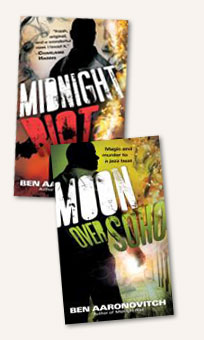
Midnight Riot and Moon Over Soho
by Ben Aaronovitch

The cover of Midnight Riot, Ben Aaronovitch’s debut novel (he has previously written episodes of Doctor Who), has a praise blurb from Charlaine Harris. I get that Charlaine Harris is a popular bestseller, and I sincerely hope that her quote helped Aaronovitch sell more books, but it inspired in me similar outrage as Roger Ebert giving Nicholas Sparks my current favorite author burn:

“I resent the sacrilege Nicholas Sparks commits by even mentioning himself in the same sentence as Cormac McCarthy. I would not even allow him to say “Hello, bookstore? This is Nicholas Sparks. Could you send over the new Cormac McCarthy novel?” He should show respect by ordering anonymously.”

Now, I’m not daring to say that Ben Aaronovitch compares to Cormac McCarthy, but he is a significantly better author than Charlaine Harris.

The praise blurb on the back of the book says, “Midnight Riot is what would happen if Harry Potter grew up and joined the Fuzz.” (Diana Gabaldon) I would say rather it is like if The X Files was British and funny. I’m not entirely clear on what the difference between those two is, maybe that the magic elements are addressed in a practical, scientific manner.

Here’s the highest praise I can give a book: the protagonist, Peter Grant (“rookie cop and magical apprentice”) catches onto plot twists as quickly as I do as the reader. Pretty much as soon as I start to think, “hmm, that other character seems kind of suspicious,” Peter Grant thinks the same thing and acts on it. It is extremely satisfying as a reader.

The third book in the series, Whispers Under Ground, is due out in May 2012, and I can hardly wait!

A Night in the Lonesome October

Cover Photo: A Night in the Lonesome OctoberOne of my comfort books, A Night in the Lonesome October by Roger Zelazny, is an especially good read this month, of course, leading up to Halloween. I reread it just about every year. (This year I’m working through a Stephen King book in honor of Halloween; review pending, but so far it’s falling far short of this book).

A Night in the Lonesome October is actually all the nights in October; it is broken up into 31 short chapters, one for each day in October, and is narrated by a dog. The writing and structure of the book both make it read like a book for young readers, but the plot is full of intrigue and murders that may not necessarily be appropriate for all ages. The dog narrator belongs to Jack the Ripper, who is also the protagonist while still doing the sort of things Jack the Ripper would do (however, no prostitutes are harmed in the making of this story).

For me, it is the perfect combination of the whimsy of a children’s book applied to an adult plot, but it is such an unusual combination that I think it wouldn’t be every reader’s cup of tea. Additionally, if you really love Roger Zelazny’s other works, like the Princes of Amber series, you may not love this one. It is so unlike any of his other works that it feels like it is from a different Roger Zelazny. I myself read this book first, and was subsequently disappointed in all his other works, which are much more serious, convoluted, and adult (less narrating dogs, too).

As you may have noticed, I haven’t even touched on the plot of the book; I don’t want to give away even the most superficial plot points—just read it and have a happy Halloween!

The Martian Chronicles

Whew, barely made it for Banned Books Week! I did not care for Ray Bradbury’s The Martian Chronicles, and this is a  lengthy review of me thrashing around for a reason.

The Martian Chronicles was published over 60 years ago, in 1950, and it reads like it. Ray Bradbury imagined amazing technology, but the social norms feel very grounded in mid 20th century to the point where I struggled to even understand, let alone empathize, with any of the characters. Every female character is either resignedly submissive to an overbearing husband or an innocent child even in adulthood (or sometimes both—I’m looking at you, Ylla).
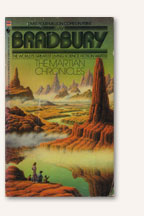
Photo: The Martian Chronicles Book CoverThere is greater variety in the male characters, but they too seem outdated. They all feel like characters from old TV shows, either the stern but kind father figure, the intelligent and care-worn authority figure, or the brutish and ignorant everyman.

The technology is an extension of what was cutting edge in the 1950s—robotic houses and people and rockets. Which, of course, we still don’t have today, but that isn’t the direction technology went. There is no way Bradbury could have anticipated the microchip and then the Internet, but those inventions changed how our entire society thinks about technology. To way oversimplify, we’ve gone smaller, not bigger, and into intangible information-sharing realms, not large metal structures. So, it reads a bit like looking down a path we didn’t take as a society, but less interesting.

And then, even more pervasive but harder to describe, there is the overall messages of the book. The United States had dropped atomic bombs on Japan, and the Cold War was brewing. People were starting to think about and be terrified by the power of destruction we as a society held. Sadly, at this point, this is all pretty old hat. Sure, we all have the power to blow each other up; it probably won’t happen, but if it does, well, that’s life, right? I think previous all-consuming fear has turned into mild concern but mostly apathy for today’s population, and that early panic feels melodramatic and a bit naïve.

As with Lord of the Flies, I wondered how I would have felt about this book if I’d read it in high school 20 years ago. The book starts in the year 1999, and concentrates mostly in the early 2000s, so it would have still been set in the (very near) future. 20 years ago, our space program was still thriving, and our idea of the cutting edge of technology was still concerned with the idea of androids instead of nanorobotics.

I was commenting to a friend how disjointed the book reads, and he told me that it was a compilation of short stories that Ray Bradbury had previously published individually in magazines. That helped me understand the structure of the book somewhat better, but it made me wonder if perhaps Bradbury had shoehorned short stories into a Mars setting that had previously nothing to do with Mars?

My favorite section, the recreation of Poe’s House of Usher as an automated haunted house, had very little to do with colonizing Mars, and was much more a Catch-22-like commentary on out-of-control bureaucracy. Maybe I liked that part so much because that’s one aspect of our society that hasn’t changed a bit.

I think that’s both the positive and the negative of The Martian Chronicles; it doesn’t read like one complete book, so it shifts in tone, characters and plot wildly. That means if you don’t like one section, there’s a good chance you’ll like another one.

(I should cut Bradbury some slack; this review is even more scattered than The Martian Chronicles! I will call it an homage.)
Lord of the Flies

Banned Books Week (Sept. 24-Oct. 1, 2011)In high school, I had an excellent English teacher, Mrs. Fort. She was tough with students and passionate about her job. Every year she had to do battle with the conservative Texas school board. Because of her, I was able to read and discuss Mark Twain’s Huckleberry Finn and Ralph Ellison’s Invisible Man in a classroom setting. However, she wasn’t able to win every fight.

On graduation day, the Valedictorian gave a speech criticizing censorship in our schools, and mentioned both William Golding’s The Lord of the Flies and Ray Bradbury’s The Martian Chronicles as books that got cut from our reading lists. Before I fell asleep (I was the second person across the stage in a graduating class of 400), I determined that I would go back and read both of those books.

Continue reading

The Lady Julia Grey Novels

Silent in the Grave, Silent in the Sanctuary,
and Silent on the Moor
by Deanna Raybourn

Silent on the Moor book coverI am currently halfway through the third book in this series of murder mysteries set in Victorian England, and it looks like there are at least three or four more books already published in the series. They were recommended by my friend Kinsey, and I’m really enjoying them; the books are well-written and the heroine is very likeable, which are pretty much the most important qualities for me.

In fact, for me, the heroine and the romantic hero reminded me of what Gail Carriger was trying to go for with her supernatural heroine and werewolf hero in her very poorly written Parasol Protectorate Series. A strong, independent woman raised solely by her father with unusual freedom in the Victorian Era and a detective with rough edges on the fringe of society. Only, Carriger’s are even less than one-dimensional, if that’s possible, while Raybourn’s are relatable and engaging. (I’m hoping to get a friend who enjoys Carriger’s books to write a review on them later.)

Continue reading