Wuthering Heights

By Emily Brontë

Book Cover: Wuthering HeightsLast night I was watching the new Fright Night movie (it’s okay—a fun, distracting movie; nothing mind-blowing or anything), and there is a scene where the female love interest is sitting on the hero’s bed, reading Wuthering Heights, when he comes in. She starts the conversation by saying, “You know, this book is actually really sexy, in a frustrated, unconsummated kind of way.” And it made me laugh and laugh.

It also reminded me of the stories from several years ago, when publishing companies were trying to sell Wuthering Heights to Twilight fans. (Apparently, Wuthering Heights is mentioned in Twilight as Bella’s favorite book? I read Twilight, but I don’t actually remember that.) And, I was so curious as to what those poor, bamboozled teenage girls thought of it.

Now, I haven’t actually read Wuthering Heights since high school, but I absolutely hated it then. I get that they are selling it now as a tragic romance for the new goth teen, but I think of tragic romances as people who are kept apart due to circumstances beyond their control á la Romeo and Juliet, not situations where the people are so hateful that they bring upon themselves every terrible thing that happens to them (no spoilers, though!).

So, what do you guys think of Wuthering Heights?

—Anna

Comic Book Glut

In a ridiculously extended simile/metaphor, books are like food—good literature is a hearty meat-and-potatoes kind of meal; fluff novels are something delicious and comforting like baked mac-n-cheese; nonfiction is a nice big salad, healthy and perhaps a little goes a long way.

All of this is to describe how I feel about comic books—they are the candy of my book meal. I love them, but once I start reading them, I always crave more, and finally after hours of reading them, I feel a little off, in a kind of empty and stale way. So, I try to indulge in comic books in moderation.

However, this afternoon, it was a beautiful day, and my work let me out early. I went to the library to check out a nice, healthy salad of a nonfiction book, but for some peculiar reason, my local library organizes the graphic novels in the nonfiction section, so I also walked out with five graphic novels, and then proceeded to glut myself on literary candy.

1) The League of Extraordinary Gentlemen, Century: 1910

Cover: The League of Extraordinary Gentlemen, Century: 1910I loved The League of Extraordinary Gentlemen, Volume 1 (I even enjoy the movie in a very guilty-pleasure kind of way). The premise of having characters from famous literature join a crime-fighting group, lead primarily by a strong female character, sold me within the first few pages. That it was a period piece, set in the 1800s was an additional bonus. The character dynamics were engaging and the plotting was clever.

Then, Volume 2 got a little more outlandish in plot, made the female lead weaker and more traditionally “feminine,” and added some jarring sex scenes. I not only began to feel like I wasn’t the target audience, but that perhaps they were actively discouraging female readers. The League of Extraordinary Gentlemen, Century: 1910 goes even further. It is maybe a third of the length of the previous two volumes, and feels more like an introduction of new characters than a complete story, but it still manages to squeeze in seven illustrations of topless women, three illustrations of full frontal female nudity, and two rapes. There’s shock value, and then there’s just being disagreeable.

2) American Vampire, Volumes 1 and 2
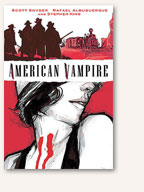
Cover: American VampireI really wanted to like these, and I did enjoy parts of them. The premise is interesting and had some good possibilities: a group of traditional European vampires come to America during the expansion of the railroads in the Wild West. One of them unintentionally “converts” a train robber, and the American vampire is a new breed—he draws strength from the sun. The two volumes follow him to the 1920s, where he “converts” a young starlet, and then the story follows them both (in separate plotlines) through the 30s as they battle both the clan of original European vampires and a secret society of vampire hunters.

I love both vampires and historical fiction, and like I said, it had great potential. It’s hard to pinpoint exactly what was missing because it wasn’t terrible, it just wasn’t as good as I had hoped or thought it could be. The writing was a bit clichéd, the characters were two-dimensional and not very sympathetic, and the plot eventually devolved into little but violence. The art itself had a rough, sketchy quality that I liked on first view, but began to just look increasingly muddy and almost blurred to me. It is clearly an ongoing series, but not one I’ll be continuing with.

3) Baltimore: The Plague Ships
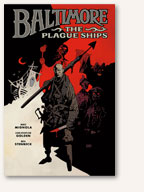
Cover: Baltimore: The Plague ShipsAnother historical vampire comic, but this one was everything and more I was hoping for with American Vampire. The author is the same as for Hellboy, but this one has a darker atmosphere that I really appreciate. The book jumps right into the action with our hero, Lord Baltimore, hunting down vampires in a small village off the coast of France in 1916. His background and the history of this world unfold throughout the story, along with some nicely paced plotting.

The art is a really nice screen-printing style, with minimalist, flat color fields, with a muted palette that gives the illustrations a really nice atmosphere. It is fairly clearly the beginning of a series, though Volume 2 doesn’t come out until June. In the meantime, the introduction mentions that this comic book is a companion piece to the illustrated novel, Baltimore or, The Steadfast Tin Soldier and the Vampire. I’m not entirely sure what an illustrated novel is, but I definitely plan on finding out.

4) Blacksad
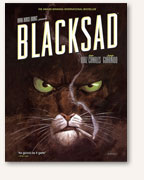
Cover: BlacksadThis was the one I was the most excited about (I may have even done a little jump in the library aisle), so I saved it for last. I already knew that I was going to love it because I own it, sort of. First, a quick story: my dad travels a lot for work and he would bring all of us kids souvenirs from everywhere he travelled. He brought us each anime comics from Japan when I was a young teen, and that hooked me (even though after very careful perusal of the illustrations, I finally discovered that my dad had accidentally bought me a schoolboy romance story). Subsequently, I asked for a comic book from every country he went to, so I now have comics from Germany, Sweden, Holland, China, Ireland, Croatia (from my wonderful friend, Hannah), and France.

One of my two French comic books is Blacksad, and it is brilliant! From what I could piece together from the illustrations, it is a gritty noir mystery, which you already know I love, with anthropomorphized animal characters, drawn more beautifully than any other comic I have seen. Blacksad is John Blacksad, a black-and-white cat and private detective. I was so, so excited to actually be able to read it, instead of poring over the pictures and trying to read a word or two of the French with my high school Spanish learning. It turns out the writing is almost as lovely as the pictures, and I can’t recommend the whole package enough.

A Reliable Wife

By Robert Goolrick

Book Cover: A Reliable WifeA Reliable Wife is apparently a quintessential workplace “water cooler” book. It was among the books literally stacked on top of the water cooler at my old job, and is one of the books in my new job’s kitchen (though on a table diagonal from the actual water cooler). I had admired the cover (I like the maroon and gray color scheme) and read the back blurb* several times while filling my water bottle, but had been reluctant to read it. It sounded like it could go two different ways, either a high-brow character portrait or a low-brow romance, and I like to at least claim that I don’t enjoy either, though I’ve been known to indulge in both.

I had asked a coworker whether this was an inspirational, love-conquers-all kind of story, and she said no, but I wasn’t entirely sure I believed her. Then, my previous book, the fifth in the Lady Julia Gray series, made me so irritated with romantic leads that I decided I wanted a book with at least the possibility of two people in a relationship scheming against each other until one kills the other (I wasn’t even that particular about who killed who, though I’m usually pretty biased toward the wife).

Anyway, without spoilers, it is not really a love-conquers-all story, though it could perhaps stretch to be interpreted that way. It is a bit of both high-brow and low-brow, and I really enjoyed it! There is lots of character portraiture of the two main protagonists, background to demonstrate how they each got to be at this current point in their lives, interspersed with some fairly unexpected intrigue and deceit. It was not exactly the book I was looking for when I started to read it, but I was quickly engaged and then satisfied with it in the end.

In addition, this book is all about sex. The characters all have sex, talk about sex, imagine having sex, imagine other people having sex, etc. Sex drives most of the characters and their motives most of the time. I’m always kind of on the fence about reading about sex; it often makes me feel uncomfortably voyeuristic. At the same time, it is a fragile story of two very damaged people coming together and trying to do right by each other and themselves, which resonated a bit more for me than all the sex.

P.S. – This book is also ALL about the small tragedies of everyday life, so clearly not for you, Kinsey.

*Here’s the back blurb: “He placed a notice in a Chicago paper, an advertisement for a ‘reliable wife.’ She responded, saying that she was ‘a simple, honest woman.’ She was, of course, anything but honest, and the only simple thing about her was her single-minded determination to marry this man and then kill him slowly and carefully, leaving herself a wealthy widow. What Catherine Land did not realize was that the enigmatic and lonely Ralph Truitt had a plan of his own.”

—Anna

The Fabulous Clipjoint

By Fredric Brown

Let’s talk a little bit about Pulp Mysteries. I LOVE them, even though they are deeply offensive by most of today’s standards, and the mindset of a hardboiled detective is about as far from my own as it is possible to be.

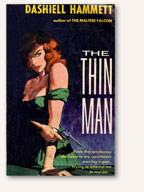
Book Cover: The Thin ManI was first introduced to them in high school, when my family went through a phase of watching movies from the 40s, including The Maltese Falcon, The Big Sleep, and The Thin Man. I went from there to reading Dashiell Hammett, who I absolutely love, and a little Raymond Chandler, who threw around the n-word enough to make me too uncomfortable to read most of his books.*

For a while, I looked for contemporary authors who also used the hardboiled style, and found Robert B. Parker (entertaining fluff that my mom accurately criticized for never allowing his characters to grow), Bill Pronzini (who has a nice gimmick of having a narrating detective who is never given a name), and my then favorite Joseph Hansen (featuring a gay insurance investigator who is as tough and stoic as any Sam Spade or Philip Marlowe).

Book Cover: Detective DuosSeveral years ago I picked up a collection of short stories titled Detective Duos, and was introduced to Fredric Brown’s Ed and Am Hunter, who immediately supplanted all other pulp mysteries in my heart forever. He wrote seven novels and one short story about the detective pair, all of which were published between 1947 and 1963 and are currently out of print, as far as I know. Tracking down each precious copy might have added just a little bit to my love of the series. (Much thanks to my wonderful sister for finding the seventh and rarest novel for me as a Christmas present a few years ago!)

In my opinion, Fredric Brown has not gotten the recognition he deserves as an author in any genre, though he is more known in the science fiction genre. I haven’t actually read any of those, but my impression is that they fit in fairly well with other contemporary science fiction novels, while his pulp mysteries really stand out from the rest.

The first book of the series, The Fabulous Clipjoint, introduces us to Ed Hunter, who is just 18 and teams up with his uncle, Ambrose “Am” Hunter, to solve the murder of his father. They live in gritty noir-ish Chicago, and feel the bitterness and cynicism of every other pulp detective, but Brown writes them with honesty and vulnerability that makes them more relatable and likeable than any other pulp mystery characters I’d read. I knew this book was something special when Ed makes a speech about wanting to have a drink of whiskey in honor of his dad, downs a hefty shot of whiskey, and promptly throws up.

Funny story, though: My first copy of The Fabulous Clipjoint ended with a plot dead-end with the detectives stumped, and I was a little taken aback but impressed at Brown’s moxie at showing that real-life mysteries don’t always end in tidy packages. Then, I ran across another copy in a used book store, and realized that my first copy was missing the last third of the book. The actual ending isn’t as bravely unusual, but is a lot more satisfying as a reader.

*Rereading The Fabulous Clipjoint, there are more casual racial slurs than I’d remembered, which is very unfortunate. They never actually describe a specific character, which is something of a poor salve for my conscience, but one I have to hang on to or else quit pulp mysteries forever.

—Anna

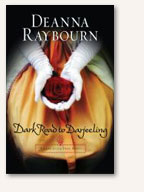
Dark Road to Darjeeling

By Deanna Raybourne

I wasn’t really intending to review this book because it is the fourth in a series that I’d already talked about, but I haven’t posted in a while and I had a serious issue with the conclusion, which I’m going to spoil the hell out of below the break.

But first, some non-spoilers. One thing I really appreciated is that the Dark Road to Darjeeling takes place at least several months after the third book, which is kind of refreshing. So often each mystery novel in a series happens within a week of the last one that it becomes kind of ridiculous how often the main characters run across murders.

Again, like the first few books, the relationship between the hero and heroine kind of wavered for me. Pretty much scene-by-scene I would go between appreciation and irritation. The relationship is very progressive for the Victorian setting (perhaps anachronistically so), but also very repressive by today’s standards, so when I recalled the Victorian setting, I would be impressed with the relationship, but when I compared it to my own relationship, I would get my feminist self all riled up.

Anyway, this book is set in a remote area of India, and I found the descriptions of the setting and various peripheral characters the most interesting of any of the books in the series so far. And, after the mystery was solved, there was an additional twist that didn’t bother me nearly so much as the mystery solution and which bodes for some interesting characterization in the fifth book.

Alright, so now that the pleasantries are taken care of, I’m going to spoil the entire murder mystery of the book after the break. I actually feel a little hesitant to do this, like I’m breaking a reader’s cardinal rule, but here goes:

Continue reading

Cool, Calm & Contentious

By Merrill Markoe

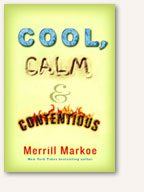
Book Cover: Cool, Calm & ContentiousI did not know who Merrill Markoe was when I first saw her touting this book on The Daily Show with Jon Stewart, but she was so funny on the show and the excerpts from the book were so funny that I immediately put my name on the waiting list at the library. Apparently along with everyone else in Boulder, too, because it took several months for the book to come to me.

Then, I mentioned the book to my office-mate, and she caught me up that Markoe was a comedy writer for David Letterman and dated him for several years, which was good information to have for several of the essays which discuss her love life in satirically veiled terms.

I expected the book to be really funny; what I didn’t expect was for it to be so insightful. At least three different points she makes were directly applicable to my life, and at least one has already made an improvement in my life. How many books can you say that about? Especially ones that are already sidesplitting.

I have to warn that one of the essays, about two-thirds of the way through the book, starts funny like all the others, but then veers into pretty dark territory. After that, it is all comedy again, but it threw me for a bit of a loop.

—Anna

Miss Peregrine’s Home for Peculiar Children

By Ransom Riggs

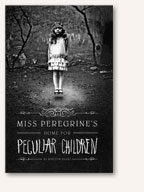
Miss Peregrine's Home for Peculiar ChildrenI’d seen this book a couple of times in bookstores and been hooked in by the eye-catching cover and title, but hadn’t gotten around to even looking it up at the library. But, last week a coworker and friend brought it in to work, having just finished it, and she happily leant it to me, saying it was a quick read.

It was a quick read, and one that I enjoyed very much, but I’m also finding it kind of difficult to describe here. If you pick up the book at a store or library, you’ll first notice the cover, and then, flipping through, see that there are odd, vintage photographs reproduced throughout the book.

At first I thought the photos were simultaneously something unique but also a bit of a gimmick, and they continued to cause a bit of a dilemma for me as a reader. On the one hand, they were extremely interesting illustrations to the story; at the same time, pondering these real-world artifacts took me out of the narrative a bit each time. So, I’m torn over whether I think they added or subtracted from the overall book.

So, photos aside, the plot felt like it took themes that I love from a variety of young adult and fantasy books – special abilities, time travel, WWII child evacuees (a favorite theme of my childhood since seeing “Bedknobs and Broomsticks”)– and combined them into something pretty original and very entertaining.

The strongest element of the book for me was the characters. Just about every single character is multi-dimensional, mostly sympathetic but with realistic flaws. Even side characters that only got a couple of pages caught my attention, and I wanted to read more about them, as well.

It doesn’t hurt, also, that the beginning of the story takes place in Florida, which is always portrayed in books as being full of fun craziness, but then the majority of the book takes place in Wales, which is the most beautiful place I have ever been, bar none.

Though the book wraps up the immediate storyline, it seems fairly clear that the author is intending to write more with these characters and this world, and I am very much looking forward to reading them. (Author confirms that he has started work on the sequel.)

—Anna

Death Comes to Pemberly

By P.D. James

I read a very brief mention of this book a couple of days before Christmas, and thought to myself, “I better put a hold on that at the library.” I promptly forgot, of course, but on Christmas Day my wonderful father had bought it for me! I finished Comfort & Joy while on vacation, so was able to crack open Death Comes to Pemberly on the plane ride home.

Basically, Death Comes to Pemberly is an old-fashioned British murder mystery, picking up about 5 years after the end of Pride & Prejudice, centered around the married life of Elizabeth and Darcy. I’m normally a little ambivalent about novels that pick up where other famous novels ended, but a couple of things overcame that for me here: 1) I’m not actually a die-hard fan of Jane Austen, so her writing isn’t as sacrosanct for me as it is for many readers, and 2) P.D. James herself has her own excellent reputation as an author.

I have a vague memory of trying to read some of P.D. James’ other novels before, though I can’t remember which ones, and finding them a bit too…technical is the best word I can come up with, though it isn’t quite right. Anyway, her trying to pick up the style of Jane Austen corrects that for me, softening the prose and the characters, and while she can’t write exactly as Jane Austen does, I think she does a fairly good job of capturing the spirit of the characters. Darcy in particular is a surprisingly sympathetic character, and it is actually really interesting to get his perspective on events.

A not-too-long divergence: I feel like male characters in regency novels, even those written contemporarily, are often inaccessible. I think it is probably an accurate portrayal—that men at that time even more than now were expected to be stoic—but as I’ve gotten older, I’ve realized how very young some of these characters are, and how unsure of themselves they must have been in spite of themselves.

P.D. James actually plays on that a bit, making more overt for modern audiences what Jane Austen might have expected her audience to already know, the responsibilities laid on older sons to carry on family duties at a very young age.

I enjoyed the book so much that I hate to even write a criticism (and I’m not convinced that it is a fault of the book), but an odd occurrence happened enough that I can’t quite overlook it. Several times while reading the book, I would turn the page to continue reading, and have to go back and check that I hadn’t accidentally turned two pages together, that there seemed to be the occasional jump in plot. Now, I should qualify this with mentioning that the entire time I was reading this book, I was recovering from a cold and was pretty well dosed with cold medicine, so I can’t say that I was firing on all cylinders, either.

—Anna

Comfort & Joy

By India Knight

I checked this book out from the library after Kinsey discussed it in her post about recommended holiday readings, and it was a very good holiday book indeed.

Here’s the thing about Comfort & Joy: the narrator, Clara, feels just like a very good friend. I wish I could just sit down and chat with her, hearing her opinions about life and sharing my opinions and just comparing our viewpoints. Just like with any friend, most of the time I think she’s very smart and interesting, and sometimes I think she’s being silly and melodramatic, and sometimes I imagine that she would think that I was being the same.

The book is broken up into three years’ worth of Christmases (or Christmi, to use an inside joke from the book). Five pages in, I had my first laugh-out-loud moment; seven pages in, I felt Knight had already perfectly captured an aspect of Christmas with this quote:

“That’s the thing about presents, isn’t it? Especially Christmas ones. The judiciously chosen present, the perfect gift, is offered up in the spirit of atonement and regeneration. It says, ‘Look, I know I don’t call as often as I should, and I know you think I’m grumpy and short-tempered’—insert your own personal failings here; I’m merely précising mine—‘but the thing is, I know you so well and I love you so much that I have bought you the perfect thing. And so now everything’s okay, at least for today.’ Which is all very lovely but a great deal easier said than done, and which is why I can feel the hair at the back of my neck curling with heat and stress.”

Honestly, it actually felt a little odd reading it at my own family Christmas. It is so realistic and engrossing (with some similarities but mostly very different from my own life) that I felt like I was almost experiencing two realities layered on top of each other.

—Anna

some readings about readers

I’ve run across a couple of readings this past month, celebrating readers (sort of).

The first was an article in Scientific American Mind magazine, titled “In the Mind of Others,” and subtitled “Reading fiction can strengthen your social ties and even change your personality.”

The article initially left a bit of a bad taste in my mouth, seeming to say, “You know that weirdo that is always reading alone? They might not be as dumb as we all thought!” The intro to the article spends a bit of time describing insulting assumptions about readers that I hadn’t totally realized were common (“people who read a lot of fiction are socially withdrawn bookworms who use novels as an escape from reality”), and then debunking them.

After I got over my initial bristling, though there were some interesting accounts of the experiments themselves. One tests viewers’ abilities to recognize emotions from just photos of eyes, with the premise that fiction-readers are more empathetic to other people’s emotions and will thus get better results.

Over the holidays, my whole family took it (being a very quiz-happy group), including one nonfiction reader and one non-reader, and all six of us fell comfortably in the average zone, so our very small pool did not demonstrate significant results, but did make for an interesting hour as we all compared our results. (There was some extensive joking that men seemed to read almost all female expressions as “desiring” or “flirtatious.”)

The main conclusion I took from reading this article was that I am not partial to reading scientific articles. (The four-and-a-half page article took me three days to actually get through.)

The second reading, forwarded to me by a friend who had also sent it on to her son, was a blog entry. Called “A Girl You Should Date,” it cuts through all the scientific pedantry that I’d previously been struggling through in Scientific American Mind, to create a very poetic epistle celebrating female readers. I don’t agree with every single thing it says (I do not like to be asked what I’m reading while I’m currently engrossed in a book), but it makes me feel good about myself and I’m glad that it got put out there.

—Anna