Being Henry David

By Cal Armistead

Book CoverI ran across BuzzFeed’s list of The 21 Best YA Books of 2013, and had only read two (both courtesy of Kinsey). So, I read through all of the descriptions and a bunch of them held no interest for me (there is nothing for me in a story about an outcast teenage girl who finds herself through DJ-ing), but several promptly got added to my to-read list. Being Henry David was the only one immediately available at my library, so it has come first.

The premise is extremely basic, which I like: a teenaged boy wakes up in New York City’s Penn Station with no knowledge of who he is or how he got there or anything about his past. His only possession is a copy of Henry David Thoreau’s Walden, and for lack of any better clues, he decides to go to Walden Pond and see if anything there can bring back his memories. Since he doesn’t know his real name, he gives his name as Henry David whenever asked. “Hank” is very engaging, and the various characters he meets are equally interesting.

The mystery is quite enthralling and kept me guessing for the majority of the book: Is he a government super-soldier a la Bourne? Is he running away from the massacre of his family a la Dark Places? Could he possibly be Thoreau himself brought forward in time?! The ending wasn’t quite as interesting as some of my admittedly farfetched imaginings, but was still quite satisfying. It occasionally got a little too teenage-angst for me, but I have a lower-than-average tolerance for that, so that criticism is more due to that I am not really the intended audience for this type of book than any sort of flaw in the story. I was overall quite pleased.

I additionally enjoyed the occasional discussions about Thoreau and Walden Pond because I read Walden in high school and did not relate to it at all (I am really very much not an outdoorsy person). So, I liked reading about how other people, even fictional characters, took inspiration from it. (I had also initially thought that that I was getting a somewhat unusual, for me, story about a male character by a male author, since I primarily read female characters and authors, but then I double-checked and author Cal Armistead is a woman, so not too off the beaten path – haha, Walden!)

Alternate Book CoverCan I also indulge in a quick graphic design exercise? I thought the cover to the book sucked – it was generic, discordant, and missed several different opportunities. I mulled over this throughout the several days of reading it, and so threw together a quick fan-art cover instead, courtesy of the great M.C. Escher.

The other books I’m waiting on from the list are Mermaid in Chelsea Creek by Michelle Tea (#9), Fangirl by Rainbow Rowell (#15), and Out of the Easy by Ruta Sepetys (#21), so hopefully those reviews will be coming up, too, though I’m interspersing my YA reading with graphic novels, so those will be sprinkled throughout, as well.

—Anna

Girl of Nightmares

By Kendare Blake

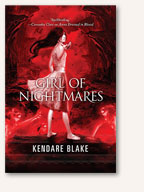
Book Cover: Girl of NightmaresGirl of Nightmares is the sequel to Anna Dressed in Blood, which I enjoyed as my palette cleanser after a brutal few months with Atlas Shrugged. Anna Dressed in Blood was an awesome way to recover from Ayn Rand, but wasn’t so engaging that I was intending to read the sequel. However, I was looking for casual reading over the holidays, so I picked it up on a whim at the library, figuring it would be a fun distraction.

And it was! It was actually even better than the first book! My one complaint about Anna Dressed in Blood was awfully vague, just that the pace of the plotting seemed odd to me in a way I couldn’t quite put my finger on. Well, I’ve figured out what the plotting issue was because Girl of Nightmares doesn’t have it at all. So, here’s the thing, I like a very linear storyline: protagonist has a problem, works towards a solutions, and finally succeeds. It is a little simple, perhaps, but that’s how I like it. Anna Dressed in Blood had a lot of red herrings as the protagonist and supporting characters tried to figure out what challenge they were facing and then how to solve it, but this book is more straight-forward.

Girl of Nightmares starts just a couple of months after the end of Anna Dressed in Blood, and picks up the same story, so is definitely not a standalone. I can’t really describe the plot at all without spoiling Anna Dressed in Blood, so I’m not going to do that, beyond saying that the other thing I really like is that this book is sort of the flipside of the first book. The first book follows the protagonist Cas as he hunts murderous ghosts and sends them to the afterlife; in Girl of Nightmares, Cas is trying to bring a ghost back from the afterlife. I just love that kind of mirror-image reversal treatment in sequels!

Cas also travels to London to meet with a group that sounds very similar to the Watcher Council, and any similarity to Buffy the Vampire Slayer is a-okay with me!

—Anna

Hyperbole and a Half

By Allie Brosh

Book Cover: Hyperbole and a HalfI received the Hyperbole and a Half book for Christmas and it was awesome! I tried to portion it out so it would last longer, but was only able to stretch it out over four days. A lot of her fans say this, but author Allie Brosh seems to live, at least part of the time, inside my head.

If you’ve never heard of Allie Brosh or Hyperbole and a Half, the book is a selection of stories, both new and from her blog by the same name, which you have to go visit right now. You should read my two favorite stories, which are also in the book, “The Simple Dog” and “The Party.” And read Wolves, too, because that one is also really funny. Oh, and Sneaky Hate Spriral is great. Basically, just start at the top and read until you hit the end. And buy the book, especially to read “Motivation,” one of the new stories, because I’ve been quoting it all week: “I don’t want to do anything more than I don’t want to hate myself.”

It was actually a perfect gift for me because although I’m a big fan of hers, I’d mostly stopped reading her blog for the last year, for a reason that shames me a little. She stopped posting for several months, during which I checked back regularly, but when she came back, she discussed how she was recovering from a serious bout of depression, and I couldn’t bring myself to read about that, and I got too anxious to check back in afterwards. So, basically, I’m pretty much as unsupportive as can be, and was seriously ashamed of myself, but luckily her book actually addressed her own coming-to-terms with her selfishness and egotism, so once again, I felt very like she was talking from my own head.

—Anna

The Reason I Jump

By Naoki Higashida

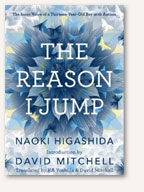
Book Cover: The Reason I JumpJon Stewart interviewed the translator for this book, and then continued to rave about this book in subsequent shows, so I figured I’d give it a shot. That the book itself exists is amazing: the thirteen-year-old author with autism answers questions that he frequently hears. It is a fascinating look into a viewpoint that is usually inaccessible, and I imagine it is an immeasurable benefit to those who interact with people with autism. For myself, I found it very interesting—it is a short book, but not a quick read, since I kept putting it down so I could think more about what Higashida was saying—but occasionally a bit repetitive, which makes me sound like the worst person ever, since that is clearly one of the traits of autism. I try to justify my criticism by saying that Higashida is so mature and perceptive that it is easy to forget that he is working with quite a severe handicap.

My only previous insight into autism was the sporadic postings by one of my favorite bloggers, Matthew Baldwin, aka Defective Yeti, on raising his autistic son. He hadn’t posted in several months, so I’d gotten out of the habit of checking, but this book reminded me to check back in, and it turned out he spent all of October posting each day about his son. His love and delight in his son are evident in each post and make the posts such a pleasure to read.

And, finally, while I’m bringing up blogs about interesting parenting situations, I ran across Gender Mom just about a month ago, and have been completely caught up in it ever since. Gender Mom’s five-year-old daughter was born male, but announced she was female at age three, and a year later they decided to raise her female. It is a truly fascinating look at a mother trying her best in fairly new territory.

—Anna

The Ocean at The End of the Lane

By Neil Gaiman

Book Cover: Ocean at the End of the LaneI have a bit of a love–hate relationship with Neil Gaiman. I loved the Sandman series, of course, and American Gods, and I hated his short story collection Smoke and Mirrors. All of his other stuff sort of falls between those two extremes, and The Ocean at The End of the Lane is pretty smack dab in the middle.

It is quite short, less than 200 pages; really more of a novella, despite “A Novel” being printed on the cover right under the title. And to go off on a side rant: I hate novellas! Somehow they are always both too long and too short. Like, authors write short stories to be compact and novels to be all-encompassing, but novellas pretty much always fail at both, and seem like initial outlines for a full novel. I almost always end up feeling like I’m reading an incomplete work and it has been a waste of my time. I then get sulky about the author being lazy, and bitter about the state of publishing, and it all cycles down from there, so novellas are not my thing.

So, I wasn’t too enthusiastic about this one, but I follow Neil Gaiman on twitter, and lots of people were raving about it. When I ran across it in the library, I figured I’d give it a shot, since I really did like American Gods and this seemed all fantastical, too.

It was okay. It starts off pretty slow, with the narrator reflecting back on the summer when he was seven, when a boarder in his house dies, kicking off a string of supernatural events. He meets his mysterious neighbors, a family of three-generational women including a girl just a few years older than him, and helps them try to contain the odd happenings. It all takes some time to get rolling, but by the middle, the story is quite engaging, though at times I felt it followed a very standard “yellow brick road” narrating style, as the two children walk a path into another reality, and must deal with one strange thing after another.

Gaiman does introduce some quite intriguing characters and imagery that simply don’t have the space to really grow to their full potential in such a short book. It ends up feeling a bit like Chis Van Allsburg’s The Mysteries of Harris Burdick, in which the readers must flesh out the story on their own, and it makes me bitter, having to put all this unexpected work into a story. I just told Tom that this review was circling the drain, and he commented that while I often talk about how much I like Gaiman, I don’t really like the majority of his work, so I guess maybe I’m not really a fan at all. Oh, well.

—Anna

Julian Kestrel Mystery Series

By Kate Ross

Book Cover: Cut to the QuickSo, I’ve been having a bit of a rough time over the last couple of weeks with some family medical issues, and as usual, I’ve turned to my main comfort, rereading old favorites. There is nothing quite so comforting as reading a book where you already know everything that happens, so you can give it as much or as little attention as you have to spare at any given time (highly recommended for waiting room waits). You already know the outcome, so there is no anxiety (you probably have enough of that in your actual life already).

All of this to say that I’ve just reread Cut to the Quick and A Broken Vessel, the first two in Kate Ross’ Julian Kestrel mystery series, and they were exactly right for my current mood. The protagonist, Julian Kestrel, is the epitome of a dandy in Regency-era London, focused entirely on his appearance and amusements until he is framed for the murder of a strange woman who appears at the country house in which he is attending the engagement party of a slight acquaintance. In order to clear himself and his valet, an extremely endearing former pickpocket named Dipper, he must uncover the true murderer among his host’s upper-crust family. The plot and characters of Cut to the Quick aren’t anything new in the extremely well-covered genre of Regency-era mysteries, but they are all just so well written that the book and the series really stands out.

Book Cover: A Broken VesselNow, A Broken Vessel is another matter entirely, introducing Dipper’s sister Sally, who shares narration of the book with Julian. Sally is clever, courageous, and a completely unrepentant prostitute, who has stolen a letter pleading for help from one of three men. Sally is wonderful, the mystery is even more intriguing than in Cut to the Quick, but the most interesting thing for me in A Broken Vessel is how it describes the various levels of society in Regency London, with the aristocracy at top, to their servants, to the shop and pub keepers, and finally to the dregs of the crime world, and how people either fall down those layers or claw their way up.

The series contains two additional books, which I read years ago, and haven’t reread yet, though I remember them both as being quite good as well. Our mother first introduced Rebecca and me to the series, and she had a theory on where Ross was taking Kestrel’s character, and we were eagerly awaiting to see if this proved true when unfortunately Ross died, and so no more books in the series will be forthcoming. This shouldn’t dissuade anyone from reading these, though: each book stands alone, plot-wise, though they occasionally refer back to previously introduced characters, and no book ends on a cliff-hanger. You’ll just be sad that there aren’t additional books to enjoy, but you can always just reread these four in times of need.

—Anna

Nonfiction Graphic Novels

I previously read Pyongyang and Shenzhen by Guy Delisle, and really enjoyed them, and when I saw that he also had books on Jerusalem and Burma, I was very interested in reading those, as well. I was living in Boulder at the time, though, and the local library didn’t have copies, so I backburnered it and of course forgot about it until a couple of weeks ago, when I thought to try my new library system, which happily had both! Jerusalem was available first, and when I went to go pick it up, I browsed the other offerings in the adult travel graphic novel section (a small section, certainly). I picked up Joe Sacco’s Palestine and Waltz with Bashir: A Lebanon War Story as well.

Being your typical clueless American, I hadn’t quite put together that all three books were pretty much talking about the exact same region. I had just figured that I am generally sort of confused over issues in the Middle East, and perhaps a graphic novel or three would be able to break some of the issues down in a way that I could understand. If libraries weren’t stringently against keeping rental records (for exactly this reason), I’m sure I’d be on some list somewhere.

Jerusalem

By Guy Delisle

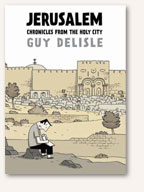
Book cover: JerusalemJerusalem is about twice as long as Delisle’s previous books, which is explained toward the beginning when he describes how he and his family are moving to Jerusalem for an entire year for his wife’s work for Doctors Without Borders. By this point, he has made enough of a name for himself as an author that he is spending the year solely working on this graphic novel, while also taking care of the children and doing the occasional lecture.

Delisle’s style is quiet and nonjudgmental. His strength as an author and illustrator comes from showing the reader these foreign cultures through his eyes as a traveling Westerner (he’s French Canadian), so it feels very personal. Several times, I laughed out loud, which is somewhat unusual in a visual media such as graphic novels, and two specific pages related to the other two authors of this blog: 1) Kinsey, apparently you are not alone in playing the game “Hipster or Priest”, and 2) Rebecca, I believe you, too, own some of the Helsing manga?

Like his previous books, this one focuses primarily on his own small, daily experiences trying to navigate a new culture, only referring to more global politics when it touches on him directly. For instance, a recurring theme throughout the book is him attempting and failing to get permission to travel into Gaza to lecture at a university there. In fact, after his fourth and final failure, he wonders if perhaps he is being mistaken for Joe Sacco, a reference that pleased me since I was reading his book next.

Palestine

By Joe Sacco

Book Cover: PalestineI have to admit that after Guy Delisle, Joe Sacco came as a bit of a shock and I was initially quite turned off. Like Delisle, Palestine is an autobiographic account of Sacco’s experience in Palestine, but where Delisle is quiet and personable, Sacco is loud, crude, and in-your-face. He is very clearly influenced by the R. Crumb school, which is not my favorite either, and I found his bold lines and clustered text boxes aggressive and claustrophobic. Sacco portrays himself as a bit of an asshole, self-centered and cowardly, and I initially took his word for it, but slowly began to think it is defense mechanism on his part, protecting himself emotionally from so many needy people that he is not in a position to help.

What finally sold me on the book is the sheer amount of information he has managed to pack into it. While I enjoyed Jerusalem more, Palestine gave me a much better understanding of the current situation, and the history that brought about it. As the title might reveal, the book is very much in support of an internationally recognized Palestine, which is not a perspective we hear much here in the United States, and it seems to me that it is an important perspective to hear.

Once I got over my initial bias, too, I started to notice that Sacco is a beautiful illustrator when he wants to be, drawing very detailed and delicately inked vistas depicting the scope of the conditions in the settlements.

Waltz with Bashir: A Lebanon War Story

By Ari Folman

Book Cover: Waltz with BashirI had initially picked this one up because the illustrations are beautiful, like little paintings in each panel. I was not real clear on where Lebanon is (I may or may not have thought it was in South America, the Texas public school system at work.) I had certainly never heard of Bashir before.

It turns out Waltz with Bashir was actually an animated film first (you can see the trailer here) and the graphic novel is made up of frames from the film. It also turns out that Lebanon is just above Israel, and Waltz with Bashir centers around the Israel Defence Force’s invasion of Lebanon. I figured that after the previous two pro-Palestine books, this would be my Israeli perspective.

The book (and film) is an autobiographical account of Folman attempting to recreate memories of his experience as a young soldier in the Israel Defense Forces during the 1982 Lebanon War, when Israel invaded Lebanon in order to install a pro-Israeli Christian government headed by the titular Bashir Gemayel. Folman knew that he had been stationed near the horrific Safra and Shatila Massacre (Christian soldiers under Israeli protection slaughtered between 762 and 3,500 Palestinian and Lebanese civilians), but had no memories at all of that time or place.

A friend of Folman’s, also stationed nearby, began having nightmares 20 years later, which inspires Folman to begin to dig into his own past. Clearly, it is not a happy book, and it, too, is quite critical of the Israeli military, so I am three-for-three on the pro-Palestine front. (If anyone wants to recommend a solid pro-Israel book on the subject, I’d be happy to check it out, though I’d prefer a graphic novel, clearly.)

Which brings me to my conclusion: while nonfiction graphic novels seem a little odd at first, they are palatable media for communicating very complex and charged information. There is no way that I would read a multi-hundred-page book, or even a dozen-page article, on the Israel/Palestine issue, but I happily and quickly ran through several hundred pages of these three comic books combined. They only made me marginally more informed, but they made me a lot less ignorant, if that makes sense. I don’t think that I could instruct someone else on the nuances of the various issues, but I know enough now not make pat judgments, either.

Burma Chronicles

By Guy Delisle
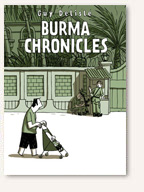
Book Cover: Burma ChroniclesDelisle’s Burma Chronicles came as a welcome relief after the building heaviness of the Israel/Palestine books above, though it is also Delisle’s most political book. He still writes very much in his first-person perspective, but Burma (or Myanmar, depending on your politics) has such a restrictive government that it interfered quite a bit in his daily life. Burma Chronicles takes place after Pyongyang and Shenzhen, but before Jerusalem; Delisle, his wife, and their infant son travel to Burma for his wife’s work in Doctors Without Borders. For the nine months that they are there, Doctors Without Borders attempts to reach outlying minority groups, with the government blocking their efforts until they eventually pull out altogether. This book highlights Delisle’s main charm for me: at the same time as he lightly touches on global politics, he shows us individuals in a very real light, so it becomes easy to look past the cultural differences and see the basic humanity underneath it all.

—Anna

Sin City Series

By Frank Miller

So, after reading Frank Miller’s A Dame To Kill For, I rewatched the movie “Sin City” and then decided to read ALL the Frank Miller Sin City graphic novels. I went on a wild reserving spree at the library; the library rental system just sort of lists “Sin City Frank Miller” for each of the volumes, so I had to do scattershot holds on all the books. I ended up reserving multiple copies of some volumes and no copies of the first volume until about a month after all the rest. So, I’ve been reading them as they come, completely out of order, but I’m going to quickly review them all in order here.

Quick caveat upfront: Frank Miller is not to everyone’s taste, so while I love the comics, I can’t indiscriminately recommend them to everyone. If you don’t like broad noir stereotypes and ultra violence, it doesn’t matter how well it is done, this is not going to be for you. For the rest of us, here’s my rundown, with semi-spoilers (revealing a character is in volume 5 sort of spoils that he doesn’t die in volume 4, I guess? Although, actually, only sort of. I was reading them out of their published order, but the volumes weren’t written in strictly chronological order, either):

Volume 1: The Hard Goodbye

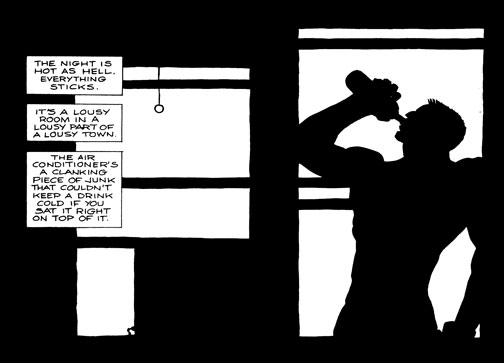
The first panel of the book and the series:

First Panel: Sin City

It doesn’t get more classically noir than that. Most noir mysteries are sweltering hot; sometimes they are bitter cold, but mostly roasting. Reading this issue last, I can tell that it was Frank Miller’s first (he is still finding his style for this series) and I can understand why it made such a splash in the comic book world. Everything is just so in-your-face: the violence, the machismo, the sex – I think it was probably unlike anything else people were reading at the time.

Book Cover: Sin City Volume 1

The Hard Goodbye is Marv’s (Mickey Rourke) story from the “Sin City” movie, the plot line with the most action but the least explanation, so I was happy to get more of the backstory this time around. With a couple of well-placed lines, The Hard Goodbye also gives a very quick overview of the origins of Sin City itself, which was most welcome after reading the other six volumes. At the end of this volume, too, I realized that The Hard Goodbye bookends at least several other volumes, with several of the subsequent volumes occurring to other characters within the span of time of this volume.

Volume 2: A Dame to Kill For

Previously read and reviewed here, inspiring this extended post.

Volume 3: The Big Fat Kill

Book Cover: Sin City Volume 3

The Big Fat Kill is Dwight’s (Clive Owen) story, starting with him in Shelly’s (Brittany Murphy) apartment while she argues with her ex-boyfriend (Benicio Del Toro). I kept thinking that I had already read this one, but then realized that it is literally the same as the movie, frame by frame, line by line. It’s really quite impressive.

It also made me appreciate the movie even more. By entwining volumes 1, 3 and 4, they made for a diverse group of characters and quick pace that the original comics seem to lack a bit in comparison.

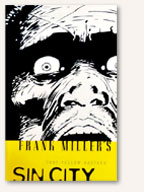
Volume 4: That Yellow Bastard

Book Cover: Sin City Volume 4

That Yellow Bastard is the Bruce Willis/Jennifer Alba story line from the movie. This is probably the most…problematic of the Frank Miller stories (and that is saying something). Spoilers for both the book and the movie, of course:

Continue reading

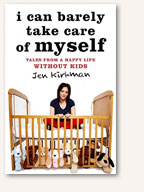
I Can Barely Take Care of Myself: Tales from a Happy Life Without Kids

By Jen Kirkman

Book Cover: I Can Barely Take Care of MyselfSo, I struggled a bit writing this review because this is a book-reviewing blog, not an autobiographical blog. But, clearly, I didn’t just pick up this book out of the blue, thinking, boy, I’d like to read more about comedian Jen Kirkman’s personal views on pregnancy and childhood.

Much like Kirkman, I have never felt a strong desire for children or even envisioned children in my future. Also like her, I have been told by people older than me, in very decisive tones, that I will change my mind when I get to be that age, and I guess I sort of believed them. I knew that I didn’t want children at the time, but accepted that I could change my mind (I’m a big fan of spinach now, and I wouldn’t have anticipated that when I was a kid, so, sure, tastes change) and that would be fine.

However, if I may put this delicately, I’ve come to the age, where perhaps sooner rather than later is a good time to plan for children, and I have experienced no change in my feelings. This really does seem to be a somewhat shocking aberration in our current society, and I thought it would be comforting to read someone else’s struggles with the same outlook.

So, I approached this book wanting a philosophical discussion on what it means to be a woman in our society who simply chooses not to have children. I was slightly disappointed right off the bat because it was no different than many other comedic memoires I’ve read, an overview of her childhood and young adulthood and what drew her to comedy; she’s funny and an engaging author, but it wasn’t what I was looking for in this particular book. About halfway through, though, she really delves into the subject of not wanting kids and her immediate surrounding’s reactions to that, and it was exactly what I wanted. I even understood that she had to set the stage before: that she was a normal kid, from a loving, intact family, with siblings who have happily chosen to have kids. There is no childhood trauma to be used as an excuse, and her lifestyle choice cannot be called a symptom of anything.

The most important thing that came out of the book for me is that she doesn’t ever explain exactly why she doesn’t want children, and I believe the truth is that she can’t. I certainly couldn’t, either. Can parents truly describe why they wanted children? I get that there are concrete reasons; I have concrete reasons, too, for not wanted children, but they aren’t really the whole story, or even most of it, are they? It is simply something deep down inside you that desires something, or does not. I have a million reasons why I don’t want kids, but reading this book helped me come to the understanding that they are all just extraneous excuses and it all boils down to the very basic truth that I simply don’t want them.

I have had various conversations about it with family, friends, and acquaintances, and found them all to be much more accepting than the conversations that Kirkman relates. Towards the end of the book, she goes on a bit of a screed about parents wanting to push everyone else to be parents, too. For me, though, reading this book made me more comfortable with my choice, but also more comfortable with people who chose to have children, as well. If my choice to not have children is deeply embedded in who I am (and it is), then their choice to have children is, too, and that is certainly something to respect and admire.

—Anna

P.S. – Jen Kirkman wrote a short column for Time Magazine, giving a brief overview of her book here.

P.S.2 – Jen Kirkman was also featured in the Boston episode of Drunk History, which I just love and you should definitely watch (but not at work)!

P.S.3 – A few days after reading this, I had a super realistic dream that I was pregnant and it was awful. Even in the dream, I thought “how ironic that after coming to a comfortable acceptance of not wanting children, now I will have one for the rest of my life.”

The Uninvited Guests

By Sadie Jones

Book Cover: The Uninvited GuestsThis is just the strangest little book! Kinsey recommended it last year as a good spooky story for Halloween reading, and I’ve only now gotten around to reading it. I’m not even sure quite what to think. Oh, I liked it a lot, but was never quite sure where I was standing with it, either.

It started as one of those impoverished English gentry books (you know, where the insular family starts to decay along with their surroundings?); it reminded me a bit of Dodie Smith’s I Capture the Castle. Then things took a turn for the worse and it was a bit of an adult Lord of the Flies, which was actually pretty horrifying, though still in a disconcertingly genteel way. As the various mysteries were revealed, though, I realized exactly what this book is: it is a written Edward Gorey illustration.

In fact, it is so much Edward Gorey that when I searched to find a representative illustration, I found the following eight that are literally characters or scenes from the book. I’m putting them after the cut, not because they are spoilers, really, but so I don’t fill up the entire home page with lots and lots of Gorey illustrations. Continue reading