More Fun Stories…

Rebecca and I exchanged a couple of short stories with twist endings that I thought I’d share with you to finish up this week:

I ran across this through io9, which I think I’ve recommended before, and they recommended it as not-your-normal-discontent-in-your-body story:

http://imgur.com/a/CgCaR

And, this one has a double twist ending in just a few paragraphs, the second of which is brilliantly provided in comments:

http://jaytothesun.tumblr.com/post/95881851021/hotmesswithouthehot-lemonmintcoughdrops

—Anna

Magic Breaks

By Ilona Andrews

Book CoverEach of the first three books of Ilona Andrews’ Kate Daniels series was better than the last, but once they passed that trilogy mark, each subsequent book got a little more joyless and plodding. Magic Breaks is the seventh book (of what was initially planned to be a seven-book run, but has now been extended to ten planned books) and the first to be released in hard cover,* so it was the first that I decided not to buy and instead checked out from the library. By halfway through the book, I was starting to think this might be the last book of the series I read at all.

I had initially been attracted to the series because it has such an unusual approach to the vampire/werewolf genre and it was laugh-out-loud funny. The last several books have lost pretty much all humor, just sort of slogging through long gory descriptions of violence. The first half of this book felt like a bit of a chore.

However, much like Patricia Brigg’s vampire/werewolf series, this one ends with such a game-changer that I am once again hopeful for the series. The violence continues to escalate, until things (temporarily) resolve in a very interesting way that should clear out some of the distracting clutter of previous story lines in a very interesting and potentially very funny way.

—Anna

*Unfortunately, as much as the authors and publisher try to market this hard cover edition as a possible introduction for new readers, it really isn’t a stand-alone book, and has to be read in the order of the series.

A Fun Story…

So, it’s been a week, hasn’t it? I have a treat for us all to see us into the weekend.

We occasionally link to other blogs that we have found particularly interesting, but I don’t know that we have ever linked to a specific piece of writing floating around the internet. However, Rebecca sent me this link that has been blowing up Tumblr over the last week or so, and it made me laugh until I cried, so if any of you haven’t seen it yet, treat yourself to what is being called by appreciative readers “Porn Prison”:

http://ofgeography.tumblr.com/post/94085997576/so-heres-a-fun-story-about-this-movie-guess-who

(Despite the title, this is completely fine for work; well, the content is fine – you will absolutely audibly laugh.)

—Anna

The Yellow Wallpaper

By Charlotte Perkins Gilman

Rebecca linked to The Toast in an entry a while ago, and since then, I’ve become a complete Toast convert, going to back and trying to read just about every entry. One of my favorite series is the “Texts From…”, which is imagined text dialogues involving famous authors or characters.

Texts from The Yellow Wallpaper was so particularly good that I was inspired to read the original, a 6,000 word story first published in 1892 and available on the Kindle for free. It was so good! The story is narrated by a woman confined to a room for her health, and it is considered an early feminist narrative, which didn’t actually increase my desire to read it, since I find that capital-F feminist writing can be overly sincere for me. However, the writing and characterization are so subtly creepy that it was really just a terrific suspense story first, with feminist commentary second, and it can all be read in just an hour or two.

Oh, and I haven’t had a chance to properly explore this, but Rebecca insisted I mention it. The Toast recently promoted another website that reviews works that are on the public domain: http://publicdomainreview.org/

It is understandably somewhat overwhelming, since that is a lot of content, but it should also be hugely interesting and worthwhile.

—Anna

The Gift of Fear

By Gavin De Becker

Book CoverSeveral years ago, Kinsey introduced me to Ask A Manager, a blog in which an experienced HR professional offers job advice and answers reader-submitted questions. It sounds like it should be dry, but she has a very entertaining writing style, and some of the letters are downright crazy. Reading through some of the older entries, someone had written in about the possibility of a coworker stalking her. She wasn’t sure about it, so she wanted advice about whether to talk to HR.

The advice was a resounding “talk to HR now” and also read Gavin De Becker’s The Gift of Fear, which many of the comments then seconded. They all said that it does a great job of advising when to actually be afraid of violence and what kind of action to take. I thought this would be really helpful to me, since I suspect that I’m often afraid in situations I need not be, and then not at all afraid in situations in which I should at least show a bit more caution.

I found the book both more entertaining than I had expected and less instructional than I’d hoped. Gavin De Becker himself is truly fascinating: his childhood in a violent home has led him to dedicate his life to predicting and preventing acts of violence, and he runs a corporation that provides security for politicians and celebrities. The book is chock full of tabloid-like stories, which reinforced a lot of the same themes (fame leading to complete loss of privacy and increased vulnerability to the people around you) from The Cuckoo’s Calling, which I was reading concurrently.

After the majority of the book details individual cases and De Becker’s analysis of them, the final chapter is a general summation, and was more of what I’d expected from the entire book: advice to the average reader on how to live safely and without unreasonable fear. My main takeaway was that we, as people, tend to put a lot of our energy toward general anxiety, which both exhausts us and does nothing to keep us safe. If we trust our natural sense of fear enough to ignore it until it alerts us, and then pay attention when it does alert us, we would have a much better ability to keep ourselves safe.

My main criticism of the book is that while I think this is excellent advice, I bet this is easier said than done, and most of the book is spent trying to convince the reader of this fact instead of instructing how to change to this way of thinking. I would have even liked some mind exercises, perhaps, that could help with training yourself to a general alertness. He does have several follow-up books so perhaps they go more into that. I am interested in continuing with his books, though perhaps after some more fiction.

Some other interesting asides from the book:

  • The life of a celebrity is INSANE! I truly don’t think that all the fame and money is worth the lack of privacy and the entitlement that the general public feels toward them. He has a story toward the end about a particular celebrity, which I’m not going to spoil, but just believe me that it is crazy.
  • De Becker claims that traffic jams caused, not by accidents themselves, but by people slowing down to gawk at them, are due not to our macabre fascination, but  to an instinctual need to analyze potential danger. I’m not sure I agree, but it makes me slightly less annoyed at those traffic jams.

—Anna

The Devil You Know

By Mike Carey

Book CoverThis book is chock full of pretty much every popular supernatural creature (okay, no vampires have shown up, but I wouldn’t bet against them appearing later in the series), but they are all treated in very unusual ways. The were-beasts are sort of dim, while the zombies are snarky, and the succubae are downright vicious. The story starts off kind of slow, and reminded me quite a bit of an adult version of Anna Dressed in Blood, which I only moderately liked. (Also, just about every reviewer on GoodReads compares it favorably to the Dresden Files, which I concur with.) Once it really gets going, introducing a whole new supernatural being pretty much ever other chapter, I had trouble putting it down again.

The world-building premise is both basic and clever: what if suddenly and inexplicably the dead began to return, like a reverse apocalypse? Our reluctant hero has a natural talent for sending them back again, and works as an exorcist-for-hire when money gets tight. If all this hasn’t already sold you on this summer escapism, let me just tell you that I reserved the second book of the series at my library as soon as I finished the first one.

—Anna

The King in Yellow

By Robert W. Chambers

Thomas and I both really enjoyed “True Detective” on HBO this spring, though Thomas’ philosophy background gave him more insight than I had. Very mild spoiler for the television show: I recently read on io9, a site I very much recommend for all your geek culture news, a very interesting argument that the story was in fact supernatural, the author’s primary proof being the many illusions to “The King in Yellow.”

The King in Yellow is an early collection of horror/fantasy short stories, published in 1895. The common element through the stories is the existence of a play titled “The King in Yellow,” set in Carcosa, which will drive mad anyone who reads past the first act. The stories are mostly about various readers, and while there are occasional excerpts, the play itself is never written out in a comprehensive whole.

The book is available for free on Kindle, and I’ve been reading it on my commute. The writing is surprisingly fresh, not feeling dated much at all, and the author does a particularly good job with an unreliable narrator, I thought.

Some of the stories are certainly grotesque, but also fairly tame by today’s standards, and I found the general tone of quiet gloom to be soothing. In fact, this gets a little spoilery, so I’m putting it after the cut: Continue reading

Leftover Life to Kill

By Caitlin Thomas

Book CoverJoan Didion mentioned this book in The Year of Magical Thinking, saying that when she read it in her 20s, she was exasperated with what she felt was Caitlin, Dylan Thomas’ widow, wallowing in self-pity, but that she could relate better now.

I was immediately struck by the name, because at times it describes my own feelings perfectly: how on earth am I going to get through the potential decades I have left when all of my plans for the future involved Thomas?

Unfortunately, Caitlin Thomas’ own strategy of alcohol, drugs, and shallow affairs while living off others’ charity in a small Italian villa is not the most helpful, and I have to admit to agreeing with 20-something Didion, that Caitlin’s raging against the world gets to be a bit much, even while I often feel similar myself. I would say that the entire book reflects my state of mind at the very worst 10% of the time, an emotional state of impotent rage and self-pity and self-destructiveness that I spend the rest of the time fighting against.

The most important piece of awareness this book did bring to me, though, was gratitude for the job that I often have to drag myself to with a combination of internal threats and bribery. I was occasionally resentful of Didion’s freedom from the need to work and juggle finances during her own recovery, but Caitlin (I’m avoiding calling her Thomas for obvious reasons) describes the emptiness of her days and her need for any sort of task to fill them (though she also refuses to find one), and I recognized that my work has kept me on a more structured path than I would have been able to create for myself during this time, and I am (grudgingly) grateful for that.

So, while the book was eventually worth while reading if only for that, I wouldn’t recommend it to anyone not particularly interested in the subject matter for one reason or another. Caitlin most often comes across as the stereotype that shows up in Austen novels and other period pieces of that time, always complaining of the ill treatment she gets from everyone around her, from no possible cause, since she herself is nothing but kindness, and would be more than happy to be of assistance to others if only she were in a better condition to do so.

I also had some doubts that I would even be able to finish the book, since Caitlin has an incredibly difficult writing style, which uses punctuation marks in very strange ways that actively block comprehension. Semi-colons are often used where comas should be, and comas are just sort of haphazardly thrown in wherever, along with the random colon and hyphen, as well. I eventually decided that I wasn’t going to get so hung up on reading comprehension, and instead was simply going to charge through the book at 50 pages a day and I would simply settle for taking in whatever I was able to at that pace, and that ended up working fairly well.

—Anna

The Year of Magical Thinking

By Joan Didion

Book CoverOn Wednesday, March 19, I sat in the living room and wrote my last post on this site, while Thomas, my partner for almost eight years, lay down for an afternoon nap that he wouldn’t wake up from. Thomas had been quite ill for several months, and I thought I had to some degree prepared myself for any possible outcome, but the immediate implosion of one’s life is literally unimaginable. There is no way to prepare for this, and no way to understand it without going through it. I don’t have the words for what the past couple of months have been like; everything seems insufficient.

A couple of weeks later I ran across a copy of Joan Didion’s The Year of Magical Thinking. I went back and forth on whether to read it; I wasn’t sure I was ready, but a phrase on inside blurb resonated with me: “This powerful book is Didion’s attempt to make sense of the ‘weeks and then months that cut loose any fixed idea I ever had about death, about illness…about the shallowness of sanity, about life itself.’” I felt so cut loose myself that even reading those words felt like a stabilizing force.

The Year of Magical Thinking describes the year in which Didion’s adult daughter almost died of a sudden blood infection and her husband did die of heart failure. She describes her various emotional states, along with research she did around the psychology of grief. I could read this book when I rejected more direct help books because I could experience her story at a little bit of a distance, even while I felt “yes, this is exactly how it is” at the same time.

It wasn’t always the same, of course; it couldn’t be since grief is so personal. I also had to remind myself that Didion writes from a world of great privilege: both she and her husband are renowned authors, very comfortably off in both finances and independence. They had top-quality medical care, and Didion was able to spend all her time and resources with her slowly recovering daughter and her own slow emotional recovery. Several times I had to decide not to get resentful of what she had, but instead to take advantage of what she was giving—a thoughtfully written account that kept me from feeling quite so isolated.

Several people expressed concern about reading this book right now, since it is not an uplifting or inspirational story. However, the reality is so much worse that her words were soothing and comforting. She doesn’t have any answers because there aren’t any. Didion simply gave me a way to define, and then begin to accept, something that still often seems indefinable and unacceptable in a very literal sense.

—Anna

Marvel Comic Books

My comic book binge continues!

The Uncanny X-Men: Days of Future Past
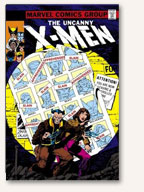
Book CoverMy partner and I are big fans of superhero movies, and really enjoyed the most recent X-Men reboot. When the previews for this summer’s sequel came out, though, I couldn’t make head or tails of the storyline, and Tom recommended that I read the comic books that it is based on. The storyline was originally published over two issues of The Uncanny X-Men in 1981 and released as a trade paperback in 2011.

I have repeatedly mentioned that artwork is very important to me, and I found the 80s aesthetic a little trying, but the dystopian future and desperate intervention from the past plotline was quite engaging. (Also, the dystopian future is set in 2013, and I wonder if they originally aimed for a release date last year.) Ultimately, though, I don’t know that reading the book helped with my initial issue, since I believe the movie is taking a lot of freedoms from the source material. The primary one being that now Wolverine is the pivotal character instead of Kitty Pryde. The comic book fan in me is attempting to argue that this change is just due to Wolverine being very popular, but the feminist in me isn’t totally buying it (not least because both sides of me suspect that Wolverine is starting to be played out).

The All-New X-Men: Yesterday’s X-Men
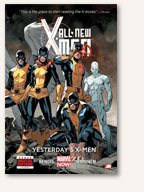
Book CoverReleased just this year, the “Yesterday’s X-Men” trade paperback is pretty much the mirror image of “Days of Future Past.” My X-Men reading heyday was many years ago, so a lot has happened since I stopped checking in monthly. Comic books are similar to soap operas in a lot of ways: a set roster of characters rotates through years of marriages, breakups, feuds, and deaths. This book actually builds on all of that, and references the past craziness in very nice and often humorous ways, without overwhelming the reader with past references.

The basic premise is that so much craziness has happened and the X-Men have gotten so fractured that Beast decides that he needs to bring the teenage X-Men from the 60s forward in time so that the current X-Men can face their past selves and recognize where they have gone wrong. This does not work ideally, of course, and the play between the two sets of X-Men is very interesting and entertaining. (And the illustration is some of the best I’ve seen recently in the big superhero comics—everyone is of course in peak physical condition but no one is ridiculously stacked in either musculature or T&A.)

Hawkeye: Little Hits
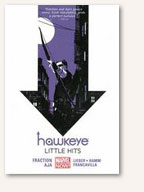
Book CoverRebecca previously reviewed Hawkeye, Vol. 1: My Life as a Weapon, and I wasn’t quite sure what to think about it. It is so different from any other superhero comic I’ve read: Clint Barton (aka Hawkeye) is just trying to get by in life when he isn’t with the Avengers, and is only somewhat successful at it. I was initially taken aback by the bleak and almost noir-ish world, but I think it is quickly becoming a favorite. Life is not easy for Clint Barton, partly due to circumstance and partly due to personal poor decision-making, but he perseveres, and I enjoy reading about it. (Oh, and not to harp too much on disappointing girl-power comics, but Hawkeye’s female protégé is so casually tough and independent that there’s no need to make a big deal out of it in the writing.)

“Little Hits” is the second volume, released just last year, and does some very interesting things with the comic book medium, including an issue entirely from the point of view of Clint’s dog, using a series of pictograms to communicate thoughts. The back of the book also includes several pages from the artist’s sketchbook, along with a description of his very minimalist approach toward color and it was fascinating, as well.

—Anna