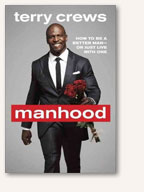
Manhood: How to Be a Better Man – Or Just Live with One

By Terry Crews

Book CoverI’ve been a fan of Terry Crews since I first saw him as the dad on “Everybody Hates Chris.” In fact, he did such a good job of inhabiting the overworked and often exhausted character that I was surprised to learn later that he is a body builder and ex football player. When I heard him interviewed on NPR in promotion of his autobiography/guidance book, he was just so charming that I was immediately interested in the book.

His writing is as humorous as his acting, but what really surprised me was his complete openness and honesty. He is upfront and unflinching when examining truly vulnerable things in his life, like what caused him to wet the bed until he was fourteen, and what led to a decades-long addiction to pornography that he only recently got help for. The real eye-opener for me, as a woman, was his discussion of the stresses that our culture puts on men. Because being scared or sad is considered weak in a man, he felt like his only outlets for these emotions were anger and aggression.

Crews writes with a sincerity that occasionally came across as oddly childish to me, and then he’d catch me off guard with something really funny in exactly the same tone, and I’d wonder, “does he even realize that he’s being funny?” But, of course he does; he’s a master comedian.

Some additional take-aways:

  • The NFL is crazy dysfunctional. Like, take every horrible work story you’ve ever heard and bundle them all up into one entity, and it would be the NFL.
  • Terry Crews has had to pull himself up by his bootstraps a shocking number of times. Every time I thought “oh, this is where his success began,” it would all crumble and he would have to start over again from scratch.
  • The person who most deserves to reap the rewards of Crews’ current success is his unbelievably patient and supportive wife of over 20 years.

To end this review on a more superficial note, I think the cover designer did Crews a real disservice. I was a bit embarrassed carrying it around in public, so I can’t imagine that the young men who could really benefit from his advice would love to be seen with it.

—Anna

The Girls at the Kingfisher Club

By Genevieve Valentine

Book CoverI’ve mentioned before that I’m a big fan of Genevieve Valentine. I love both her blog and her fictional writing, but am continually surprised by how different they are. She is so funny on her blog; her recaps of the television show “Penny Dreadful” were as much a delight as the show itself. Her books and short stories, however, are almost unrelenting melancholy. Her novels are not hugely long or densely worded, but she somehow gives everything a sort of portentous double-meaning which gives the narratives a heavy tone. It is such a vague feeling in the text that I’m struggling to describe it.

Anyway, The Girls at the Kingfisher Club is a retelling of the folktale of the twelve dancing princesses, set in New York City during Prohibition. (The titular Kingfisher Club is the dancing girls’ speakeasy of choice.) The Twelve Dancing Princesses was not a favorite story of mine as a kid, so I only vaguely recalled it. What is just sort of casual misogyny in the original story (of course the king locks up the twelve princesses in a tower – that’s just what you do with princesses in fairy tales), gets fleshed out here into true cruelty in the utmost neglect in a real-world setting. This builds up a strong sense of suspense throughout the novel, as the consequences are suddenly more real.

It made me cry several times in the privacy of my home, but it also, embarrassingly, made me laugh out loud on the metro.

—Anna

Rose Under Fire

By Elizabeth Wein

Book CoverShortly after Kinsey notified us all about the sequel to Code Name Verity, I checked out Rose Under Fire, with some trepidation, I have to admit. Code Name Verity was excellent, but also completely devastating in parts, and Rose Under Fire had the potential to be even worse. The majority of the book is set in a Nazi concentration camp for women, with extra focus given to the victims of the ‘medical’ experiments. I just wasn’t sure I could take it.

However, Elizabeth Wein is a genius and knows exactly how to tread the line. Most of the book is mercifully told in flashback, so readers can continually reassure themselves that at least these few characters have necessarily survived. This doesn’t mean it isn’t heartbreaking, of course; just not unbearably so. I would even say, all things considered, that overall it was more upbeat (not the right word at all) than Code Name Verity. (It also is not a direct sequel, per se; it has some shared characters, but features a newly introduced main character.)

Several weeks later, I followed this up with watching “Judgment at Nuremberg,” a 1961 film recounting one of the trials at Nuremberg, this one against four judges for crimes against humanity. Spenser Tracy stars as the retired American judge who agrees to oversee the tribunal for this trial, and wrestles with his own conscience in trying to reconcile the crimes that were committed in the past with the current devastation of the country.

The movie explores to what degree individuals are responsible for the actions of a government. Outside of the courtroom testimony, some of the more painful scenes are of regular citizens looking dazed and insisting they had no knowledge at all of the actions of the Nazi party. It inspires an unsettling mixture of pity and anger in both the judge and the viewer, and raises tough questions without easy answers. It was a good companion to “Rose Under Fire,” and now I’m ready to turn to some lighter books and movies.

—Anna

Queen Victoria’s Book of Spells

Edited by Ellen Datlow and Terri Windling

Book CoverThis anthology is collected by the same editors and many of the same authors as Teeth, which I read and reviewed previously. It is described on the cover as “an anthology of gaslamp fantasy,” and having the setting be the common factor instead of the characters allowed for a greater range in the stories, which I appreciated.

The Victorian Era, too, is an excellent setting to pick, since so much was going on! There was the very first world’s fair, an explosion of technology, science, and manufacturing, and a return to romance in the arts. It was an era of lots of contradictions, as well: most well-known for extreme wealth, it also had predominant extreme poverty; the British Empire was both strongly xenophobic and driven to colonize; and Queen Victoria herself was both a pretty and lively young girl, and a solemn and joyless widow.

Though, once again, I checked out the book for the short story by Genevieve Valentine, I was pleased that the anthology also included Elizabeth Wein and Caroline Stevermer. My favorite stories ended up being “The Governess” by Elizabeth Bear, in which a governess takes a position in a very troubled household, and “Phosphorus” by Veronica Schanoes, about the strike of the women who worked in the match factories. Don’t those two alone reveal the wide scope of the book?

Can I also describe how ridiculous I can be? I had always had a vague feeling that I didn’t care for Elizabeth Bear, because I believed that she had written Clan of the Cave Bear (because “Bear”) and/or Women Who Run with Wolves, or some amalgamum of both books that only exists in my head. In addition to the fact that Elizabeth Bear did not write either of those books, I have not actually read either of those books, or any books that Elizabeth Bear has actually written. No reality will keep me from my pointless prejudices!

— Anna

More Fun Stories…

Rebecca and I exchanged a couple of short stories with twist endings that I thought I’d share with you to finish up this week:

I ran across this through io9, which I think I’ve recommended before, and they recommended it as not-your-normal-discontent-in-your-body story:

http://imgur.com/a/CgCaR

And, this one has a double twist ending in just a few paragraphs, the second of which is brilliantly provided in comments:

http://jaytothesun.tumblr.com/post/95881851021/hotmesswithouthehot-lemonmintcoughdrops

—Anna

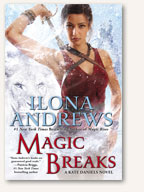
Magic Breaks

By Ilona Andrews

Book CoverEach of the first three books of Ilona Andrews’ Kate Daniels series was better than the last, but once they passed that trilogy mark, each subsequent book got a little more joyless and plodding. Magic Breaks is the seventh book (of what was initially planned to be a seven-book run, but has now been extended to ten planned books) and the first to be released in hard cover,* so it was the first that I decided not to buy and instead checked out from the library. By halfway through the book, I was starting to think this might be the last book of the series I read at all.

I had initially been attracted to the series because it has such an unusual approach to the vampire/werewolf genre and it was laugh-out-loud funny. The last several books have lost pretty much all humor, just sort of slogging through long gory descriptions of violence. The first half of this book felt like a bit of a chore.

However, much like Patricia Brigg’s vampire/werewolf series, this one ends with such a game-changer that I am once again hopeful for the series. The violence continues to escalate, until things (temporarily) resolve in a very interesting way that should clear out some of the distracting clutter of previous story lines in a very interesting and potentially very funny way.

—Anna

*Unfortunately, as much as the authors and publisher try to market this hard cover edition as a possible introduction for new readers, it really isn’t a stand-alone book, and has to be read in the order of the series.

A Fun Story…

So, it’s been a week, hasn’t it? I have a treat for us all to see us into the weekend.

We occasionally link to other blogs that we have found particularly interesting, but I don’t know that we have ever linked to a specific piece of writing floating around the internet. However, Rebecca sent me this link that has been blowing up Tumblr over the last week or so, and it made me laugh until I cried, so if any of you haven’t seen it yet, treat yourself to what is being called by appreciative readers “Porn Prison”:

http://ofgeography.tumblr.com/post/94085997576/so-heres-a-fun-story-about-this-movie-guess-who

(Despite the title, this is completely fine for work; well, the content is fine – you will absolutely audibly laugh.)

—Anna

The Yellow Wallpaper

By Charlotte Perkins Gilman

Rebecca linked to The Toast in an entry a while ago, and since then, I’ve become a complete Toast convert, going to back and trying to read just about every entry. One of my favorite series is the “Texts From…”, which is imagined text dialogues involving famous authors or characters.

Texts from The Yellow Wallpaper was so particularly good that I was inspired to read the original, a 6,000 word story first published in 1892 and available on the Kindle for free. It was so good! The story is narrated by a woman confined to a room for her health, and it is considered an early feminist narrative, which didn’t actually increase my desire to read it, since I find that capital-F feminist writing can be overly sincere for me. However, the writing and characterization are so subtly creepy that it was really just a terrific suspense story first, with feminist commentary second, and it can all be read in just an hour or two.

Oh, and I haven’t had a chance to properly explore this, but Rebecca insisted I mention it. The Toast recently promoted another website that reviews works that are on the public domain: http://publicdomainreview.org/

It is understandably somewhat overwhelming, since that is a lot of content, but it should also be hugely interesting and worthwhile.

—Anna

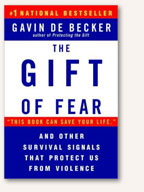
The Gift of Fear

By Gavin De Becker

Book CoverSeveral years ago, Kinsey introduced me to Ask A Manager, a blog in which an experienced HR professional offers job advice and answers reader-submitted questions. It sounds like it should be dry, but she has a very entertaining writing style, and some of the letters are downright crazy. Reading through some of the older entries, someone had written in about the possibility of a coworker stalking her. She wasn’t sure about it, so she wanted advice about whether to talk to HR.

The advice was a resounding “talk to HR now” and also read Gavin De Becker’s The Gift of Fear, which many of the comments then seconded. They all said that it does a great job of advising when to actually be afraid of violence and what kind of action to take. I thought this would be really helpful to me, since I suspect that I’m often afraid in situations I need not be, and then not at all afraid in situations in which I should at least show a bit more caution.

I found the book both more entertaining than I had expected and less instructional than I’d hoped. Gavin De Becker himself is truly fascinating: his childhood in a violent home has led him to dedicate his life to predicting and preventing acts of violence, and he runs a corporation that provides security for politicians and celebrities. The book is chock full of tabloid-like stories, which reinforced a lot of the same themes (fame leading to complete loss of privacy and increased vulnerability to the people around you) from The Cuckoo’s Calling, which I was reading concurrently.

After the majority of the book details individual cases and De Becker’s analysis of them, the final chapter is a general summation, and was more of what I’d expected from the entire book: advice to the average reader on how to live safely and without unreasonable fear. My main takeaway was that we, as people, tend to put a lot of our energy toward general anxiety, which both exhausts us and does nothing to keep us safe. If we trust our natural sense of fear enough to ignore it until it alerts us, and then pay attention when it does alert us, we would have a much better ability to keep ourselves safe.

My main criticism of the book is that while I think this is excellent advice, I bet this is easier said than done, and most of the book is spent trying to convince the reader of this fact instead of instructing how to change to this way of thinking. I would have even liked some mind exercises, perhaps, that could help with training yourself to a general alertness. He does have several follow-up books so perhaps they go more into that. I am interested in continuing with his books, though perhaps after some more fiction.

Some other interesting asides from the book:

  • The life of a celebrity is INSANE! I truly don’t think that all the fame and money is worth the lack of privacy and the entitlement that the general public feels toward them. He has a story toward the end about a particular celebrity, which I’m not going to spoil, but just believe me that it is crazy.
  • De Becker claims that traffic jams caused, not by accidents themselves, but by people slowing down to gawk at them, are due not to our macabre fascination, but  to an instinctual need to analyze potential danger. I’m not sure I agree, but it makes me slightly less annoyed at those traffic jams.

—Anna

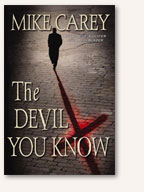
The Devil You Know

By Mike Carey

Book CoverThis book is chock full of pretty much every popular supernatural creature (okay, no vampires have shown up, but I wouldn’t bet against them appearing later in the series), but they are all treated in very unusual ways. The were-beasts are sort of dim, while the zombies are snarky, and the succubae are downright vicious. The story starts off kind of slow, and reminded me quite a bit of an adult version of Anna Dressed in Blood, which I only moderately liked. (Also, just about every reviewer on GoodReads compares it favorably to the Dresden Files, which I concur with.) Once it really gets going, introducing a whole new supernatural being pretty much ever other chapter, I had trouble putting it down again.

The world-building premise is both basic and clever: what if suddenly and inexplicably the dead began to return, like a reverse apocalypse? Our reluctant hero has a natural talent for sending them back again, and works as an exorcist-for-hire when money gets tight. If all this hasn’t already sold you on this summer escapism, let me just tell you that I reserved the second book of the series at my library as soon as I finished the first one.

—Anna