A Perfect Union of Contrary Things

By Sarah Jensen with Maynard James Keenan

A_Perfect_UnionRebecca referred obliquely to this book in her comment to my previous review, saying that she guessed I had lost all perspective of writing quality while in the middle of this book. We all have books that we are too embarrassed to review on this site, and thus admit to reading. I was torn about this one, but I think it is time for me to admit my love for Tool. I am a 40-year-old, mild-mannered woman, and yet I just love Tool’s music. I try to ignore the general Tool fanbase as much as possible, and honestly I’m super conflicted about frontman Maynard James Keenan – I have so much admiration for his music, but every time he stops singing and starts talking, my admiration steadily falls.

Still, when Keenan partnered his long-time friend Sarah Jensen on an official biography, I was certainly interested (though still a bit embarrassed).

The Forward opens with “Maynard James Keenan is a mysterious fountain of constant creation. From his soul-searching lyrics, and extraordinary music in multiple bands to his astoundingly delicious wine, he has permeated our culture like no other artist. He straddles guises and genres and makes us wonder what could fuel such original superhuman output.”

Uh oh, I thought.

Skipped the rest of the Forward to the Prologue: “He sings of the fire’s spirit, of the taste of ashes on the tongue, of the truth on the other side of the mirror. He sings of the desert that is no desert place but a land breathing, flying, crawling, dying—alive with spirits of ancestors and the untold tales of children to come.”

Oh, nooo.

Continue reading

BookBub

I’ve been sort of sulking over Kinsey suddenly discovering Dorothy Sayers and being able to read all of her books for the very first time, and wishing that I could discover some amazing new author like that, too. Then I ran across BookBub a few weeks ago, and while I’m not saying it is bringing me any Sayers-quality books, I’m having an enormous amount of fun with it!

BookBub is basically a site that lists the many, many free and discounted ebooks available through various venders. You can sign up to get daily emails with recommended deals, and I currently look forward each day to seeing what is on tap! Even if most of the books look terrible, I still love reading the little blurbs about them, and I’ve already downloaded five new books to try out, cost-free! Out of those, I’ve read two, and enjoyed both quite a bit, so I’m two-for-two, so far!

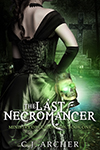
last_necromancerMy first free download was The Last Necromancer, by C. J. Archer. Set in Victorian London, Charlie is a young woman who has been living as a boy on the streets for the past five years after her vicar father threw her out after discovering she could raise the dead. She is kidnapped by a secret society trying to track down all necromancers for an unknown purpose. The secret society, of course, is headed by a handsome and fascinating man, who unfortunately turns out to be a very problematic love interest, the weakest part of the book. It sounds ridiculous, and it is, but I still got a kick out of it!

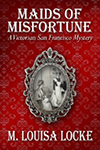
maids_of_misfortuneMaids of Misfortune, by M. Louisa Locke, is actually a good book, set in Victorian-era San Francisco, where Annie Fuller runs a boarding house and a small clairvoyance business out of it, in order to make ends meet. Right of the bat, it is charming, with wonderful details about both businesses and the various characters she meets through them. The characters are all so well written, with nuanced and realistic humanity, that it completely made up for the somewhat predictable mystery. It continually surprised me with little realistic details that most books brush right over, and which I appreciated a lot. I not only highly recommend it, I’m looking forward to continuing the series.

I excitedly told Rebecca about this, and she hasn’t had quite the positive experience I have. For one, she was lazier about setting up her account, so she wasn’t getting as interesting recommendations. She has also been not quite so fortunate in her downloads, though I’m ascribing at least some of that to a lack of discrimination. She downloaded thirteen, started five, finished three, and mildly enjoyed one. She’s sticking with it, though, for the love of browsing and then getting free books.

Honestly, the best thing about it is how completely risk-free it is: no cost and no clutter!

Some topical advice from “The Thin Man”

The stream of “alternative facts” from the White House over the last few days reminded me of a passage from one of my favorite books, Dashiell Hammett’s The Thin Man, which I’d like to share (no spoilers, but mild 1930s sexism):

We went into Mimi’s bedroom. She was sitting in a deep chair by a window looking very pleased with herself. She smiled gayly at me and said: “My soul is spotless now. I’ve confessed everything.”
            Guild stood by a table wiping his face with a handkerchief. There were still some drops of sweat on his temples, and his face seemed old and tired. The knife and chain, and the handkerchief they had been wrapped in, were on the table. “Finished?” I asked.
            “I don’t know, and that’s a fact,” he said. He turned his head to address Mimi: “Would you say we were finished?”
            Mimi laughed. “I can’t imagine what more there would be.”
            “Well,” Guild said slowly, somewhat reluctantly, “in that case I guess I’d like to talk to Mr. Charles, if you’ll excuse us for a couple of minutes.” He folded his handkerchief carefully and put it in his pocket.
            “You can talk here.” She got up from the chair. “I’ll go out and talk to Mrs. Charles till you’re through.” She tapped my cheek playfully with the tip of a forefinger as she passed me. “Don’t let them say too horrid things about me, Nick.” Andy opened the door for her, shut it behind her, and made the o and the blowing noise again.
            I lay down on the bed. “Well,” I asked, “what’s what?”
            Guild cleared his throat. “She told us about finding this here chain and knife on the floor where the Wolf dame had most likely broke it off fighting with Wynant, and she told us the reasons why she’d hid it till now. Between you and me, that don’t make any too much sense, looking at it reasonably, but maybe that ain’t the way to look at it in this case. To tell you the plain truth, I don’t know what to make of her in a lot of ways, I don’t for a fact.”
            “The chief thing,” I advised them, “is not to let her tire you out. When you catch her in a lie, she admits it and gives you another lie to take its place and, when you catch her in that one, admits it and gives you still another one, and so on. Most people—even women—get discouraged after you’ve caught them in the third or fourth straight lie and fall back on either the truth or silence, but not Mimi. She keeps trying and you’ve got to be careful or you’ll find yourself believing her, not because she seems to be telling the truth, but simply because you’re tired of disbelieving her.”

So, let’s do our best to take Mr. Charles’ advice and not get tired. We need to keep calling Trump on his lies each and every time. It will be exhausting and often seem pointless, but I think it is important to keep reminding ourselves what the truth is and reminding him that we won’t be exhausted into believing him.

And Then There Were None

By Agatha Christie

So, over the holiday season, Rebecca and I finally broke down and got Amazon Prime. I’d been resisting because Amazon does some really shady stuff with pricing and publishing, but that free two-day shipping is really seductive. The streaming service isn’t so bad, either, and I finally got a chance to see the recent BBC production of “And Then There Were None,” which I’ve been eagerly waiting to be widely available. I remember reading and really enjoying the novel in high school, so I remembered the basic premise – that ten people are invited on a holiday weekend at a remote island mansion, where they are murdered one by one over the course of a few days – though I didn’t remember all the details.

aidan-turnerI have to admit that I mostly wanted to watch the miniseries because I am a shameful sucker for a pretty face, and Aidan Turner is just so damn attractive. He is so attractive that I’ve watched two very mediocre shows (“Being Human” and “Poldark”) solely in order to look at him. He was very good in this, though his character also turned out to be the most problematic part for me.

Mild spoiler from the first few chapters: all the people on the island are accused of murdering one or two people, except for Turner’s character, who unrepentantly admits to killing about 20 African tribesmen. The other characters are appalled, but not enough to my mind, given we are talking about a large-scale massacre. The other characters make stifled British exclamations over it, but still seem to view him as dangerously fascinating. It really did come across as killing 20 Africans is equal in “badness” to killing one to two English people.

and-then-there-were-noneThat was the one sour note for me; overall, it was all very dramatic and fun to watch. Since there was a fair amount of sex and violence, I wondered what liberties the show had taken to ‘modernize’ the source material, so I checked out the book, and it turns out, not much. That Agatha Christie was quite the salty lady! The show ups the ante just a bit on both, but still sticks remarkably close to the original novel.

I’m not going to spoil anything more of the plot – murders! sex! violence! racism! – but Agatha Christie said that she considered this her most difficult plot to write, and her care and eye for detail really shows. Since I already knew whodunit, I could see all the small ways she had revealed that person throughout the plotting, which provided additional enjoyment to rereading it.

Sorcerer to the Crown

By Zen Cho

This has been a trying couple of weeks – I’ve been obsessively reading twitter and facebook until I can’t stand it anymore, and then I read fiction until I can’t stand being away from social media. Zen Cho, however, has been a real comfort during these times, though.

jade-yeoThe novella The Perilous Life of Jade Yeo features a Malaysian woman trying to make a living as a journalist in Victorian-era England. It is short and funny and touching, all told through her journal entries. It just felt very much like a story by a woman for other women.* The male characters, both good and bad, are only given context in relation to Jade, and the story focuses primarily on her growth as a young adult trying to establish her sense of self. So, this was extremely comforting in these worrisome times.

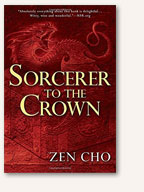
sorcerer-to-the-crownSorcerer to the Crown, the full-length novel, starts slowly and in very high-fantasy fashion, set in a magical version of Regency-era England. It reminded me almost immediately of Jonathan Strange and Mr. Norrell, but luckily it picks up the pace much more quickly. Zacharias Wythe, as a very young boy, proves his extraordinary magical ability in front of a large panel of sorcerers, who promptly all lose their shit. This is not because Zacharias shows such promise so early, but rather because he is a freed African slave. The lead sorcerer adopts him and trains him to be his successor as Sorcerer Royal, the position he holds at the time the book.

A large contingent of white sorcerers actively work against him, even against their own self-interest, solely in order to oust him from his position by spreading outrageous rumors and innuendos. As the story revolves around an extremely thoughtful and conscientious black man trying to navigate the world of magic through difficult times, while surrounded by white men who are actively rooting for his failure, it became much less of an escapist fantasy.

Zacharias then runs across a young woman who shows strong magical abilities, and decides to train her, in the face of all traditional lore saying that magic is beyond women’s understanding. Reading about this black man conquering his enemies and silencing his naysayers, while working with a woman to do the same with hers, just about broke my heart. We didn’t get the ending we deserved, but at least this fictional world did.

the_dressmaker*If I can be excused a diversion for an additional recommendation – a few months ago I saw “The Dressmaker,” and I absolutely loved it! It is an Australian film that didn’t get a lot of showings, even though it stars Kate Winslet and Liam Hemsworth. The preview looked amazing to me – a haute couture dressmaker has to move back to her very rural Australian town in order to take care of her elderly mother – but the reviews were mixed. The negative reviews all tended to revolve around uneven storytelling and shifting mood, and I started to formulate a theory that this movie might be telling a story in a more traditionally female way, one that focuses on relationships and character growth, rather than a single-trajectory action sequence. Seeing the movie absolutely confirmed that for me, and it felt amazing to see a movie that was so clearly by women about women and for women.


Prudence and the Dragon

By Zen Cho

You guys, is there any better feeling than when you discover a great new author? A link to Zen Cho’s story “Prudence and the Dragon” showed up sort of randomly on my Tumblr, with a comment saying that it was the best short story they read in a long time. I figured even if it wasn’t the best for me, I’m game for a decent short story about dragons.

Guys, it was the best short story that I’ve read in a very long time! It reminded me very much of Patricia C. Wrede’s dragon series (which were my favorites all through childhood) especially in how Cho provides this wealth of absurdist detail that gives such richness and humor to the story.

So read “Prudence and the Dragon” as soon as you get a chance, and then read the sequel short story about Prudence’s best friend in “The Perseverance of Angela’s Past Life” (both of which are appropriate for readers of all ages – there is light romance, but nothing graphic).

I don’t want to make a big deal out of it since the stories themselves don’t, but they are also just perfect examples of how to weave multiculturalism and different identities into a story without making it the focus of the entire storyline.

I have since also bought a novel, a novella, and a collection of short stories by Cho, since I think she might be my new favorite author, and I’ll review them, too, as I finish them.

Down Don’t Bother Me

By Jason Miller

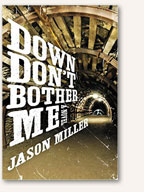
down_dont_bother_meKinsey set me up on Twitter a few years ago, and I’ve become quite the addict since. I follow a whole bunch of comedians, who then follow each other, so I’m not even sure how I found all of them. Jason Miller posts frequently and is so funny and smart and thoughtful that I may possibly have a little bit of a crush on him.

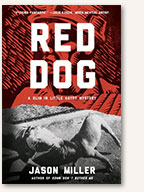
Miller has been recently posting about a new book he has published, Red Dog, which I looked up and turns out to be a sequel to an earlier book, Down Don’t Bother Me, which was described as a Justified-like noir mystery set in rural Pennsylvania coal mining country.

I’ve been recently watching and loving Justified, so I promptly bought Down Don’t Bother Me, and not only is it very, very good, but it is coincidentally the perfect counterpart to my earlier review of Savage Season. Like, Down Don’t Bother Me has the rural grittiness that first attracted me to Lansdale’s books, but eliminates all the racism and sexism and then also adds surprising nuance to the characters, as well.

Down Don’t Bother Me has a somewhat slow start where Miller introduces us to the characters and general setting, though the writing is very good. He hits the metaphors a bit hard, but they are always very clever and made me laugh. And once the action picks up, though, the story really gets going!

Down Don’t Bother Me is set in poor, rural mining country, and our main protagonist, Slim, is a miner barely makes ends meet in the dying industry. He is also a single father of a precocious twelve-year-old daughter, which is the first sign that this is a step above most other action-mystery novels. The owner of the mine that he works at offers him a secure pension in return for discretely finding his missing son-in-law, considered a person of interest by the police in the murder of a reporter investigating possible negligence in the mine. If that sounds a bit confusing, it is—Miller does not shy away from a convoluted plot.

I’ve been really struggling to write this review, because what do you say about a book that doesn’t really break any new barriers or anything, but just does its genre really, really well? It was just such a satisfying read – all grit and rural noir with some added poignancy and surprising humor for contrast.

Red Dog

red_dogMiller significantly upped his game with this sequel, with a plot that starts with a missing dog, and spirals out into a storm of dog fighting, gun running, and white supremacists.  The characters are where Miller really shines. I had some trouble following all the characters, but that is absolutely my fault as a reader and not Miller’s as the author. I read a lot of “tough guy” books and even though I love them, I still get tired of the tough-guy dialogue, and Miller’s dialogue surprises me over and over, and makes me laugh.

So, the dialogue, like I said, is refreshing, the pacing fast, and the violence described in realistic but brief impressions, not in the blow-by-blow detail that slows down the pacing in other action books. Which I especially appreciate, because the violence is not glamorized in these books (which is also a plus to my mind). Red Dog, though, also requires trigger warnings for animal abuse and sexual violence, for which I’ll put more specifics after the spoiler cut. Continue reading

The City of Mirrors

By Justin Cronin

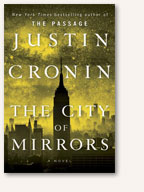
city_of_mirrorsI wasn’t going to review this book because it is the third in a trilogy in which I’ve already discussed the first two. However, the third book pissed me off so much that I had to rant. I am also about to spoil the hell of this book, starting right now, though I’ll throw a page break in before the more specific spoilers.

The City of Mirrors has a problem, and that problem is Timothy Fanning. The character Fanning is also known as “Zero,” as in Patient Zero, the original vampire. He is the main villain of the whole series, having orchestrated the spread of the vampire virus purposefully, though he has stayed mostly behind the scenes in the first two books.

Unfortunately, in the third book we get a much more in-depth look, via a 100-PAGE MONOLOGUE in which he gives his entire history, starting almost from birth, and it is just the most undiluted example of white male entitlement that I think I have ever read. I really wanted to believe that this was on purpose, to make a commentary on how dangerous this kind of unacknowledged privilege can be, but I had increasing suspicions that Cronin intended it to create a more complex villain with a sympathetic backstory. The monologue itself was insufferable, but the recipient of it, a previously strong woman, appears to receive it with sympathy and understanding.

Here’s where I’m about the spoil the hell of this book, by sharing a breakdown of his backstory.  Continue reading

Savage Season

By Joe R. Lansdale

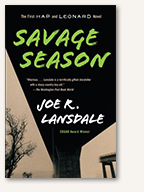
Savage_SeasonA few weeks ago, everyone on my twitter feed was mocking Jonathan Franzen for saying he wouldn’t dare write a book about race because he doesn’t have very many black friends. Now, I find Franzen as annoying as the next woman, but I figure, thank God for small favors, because I would bet good money that his thoughts on race would be almost unbearably outdated and condescending.

It is possible that author Joe R. Lansdale should have also put some additional thought into his cross-cultural relationships as well. I had high hopes for the crime-committing and –solving pair of friends, Hap, a white ex-hippy, and Leonard, a gay, black Vietnam veteran.

Unfortunately, it only takes the first novel, Savage Season, nine pages before the white guy, Hap, ‘teasingly’ calls his black friend, Leonard, the n-word, and it is just so awkward. It almost felt like the author had written an entire novel just to somehow get himself an “n-word pass” as a white person.

Racism aside, there’s plenty of sexism, too. Hap has an ex-wife who keeps coming into his life making trouble, and he is just helpless against her wiles! She is, of course, the one who starts the trouble in this novel, too. She is so weirdly portrayed that she come across as psychotic sometimes, though Hap and Leonard are unusually forgiving toward her.

Of course, with all my bitching, I read the book in two days straight – Lansdale keeps the plot hopping, and I started the sequel almost immediately, figuring that debut novels are often kind of shaky while the author is still finding his stride.

Mucho Mojo
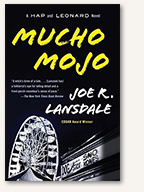
Mucho_MojoUnfortunately the sequel takes all the things I didn’t like so much in the first novel and hits them even harder. Lansdale takes some astoundingly racist rhetoric, about systematically oppressed people just victimize themselves with their own defeatism, and puts it in the mouth of Leonard while Hap just sort of goes, “well, I don’t know about all that…”

Rebecca was giving me crap for quitting the second book a third of the way through, so I read her passages from it, until she agreed it was the right decision:

Black children with blacker eyes wearing dirty clothes sat in yards of sun-bleached sand and struggling grass burrs and looked at us without enthusiasm as we drove past.

It was near midday and grown men of working ages went wandering the streets like dogs looking for bones, and some congregated at storefronts and looked lonesome and hopeless and watched with the same lack of enthusiasm as children as we drove past. [Comment: gritty noir always likes everyone and everything to be miserable, but this sounds a bit too close to poverty porn, which is also just a super gross phrase.)

“Man, I hate seeing that,” Leonard said. “You’d think some of these sonofabitches would want to work.”

“You got to have jobs to work,” I said.

“You got to want jobs, too,” Leonard said.

“You saying they don’t?”

“I’m saying too many of them don’t. Whitey still has them on his farm, only they ain’t doing nothing there and they’re getting tidbits tossed to them like dogs, and they take it and keep on keeping on and wanting Whitey to do more.”

As Rebecca pointed out, when a white author puts this kind of rhetoric in the mouth of a fictional black character, it is basically literary blackface, and it is gross. On a more positive note, I read a really thoughtful article online titled “There is No Secret to Writing About People Who Do Not Look Like You,” which discusses how important diverse representation is in literature, and how anyone, no matter their background, can help contribute to that representation. So I encourage everyone, writer or not, to read that article, and to skip Lansdale’s series.

—Anna

Very specific murder mysteries

I haven’t felt like reading anything new lately, so I’ve been dipping back into the well of old loved British murder mysteries. Seriously, there is not much that is more comforting than genteel aristocracy studiously talking around brutal murders.

'Coriolanus' play after party, London, Britain - 17 Dec 2013A few weeks ago, I ran across a discussion online of fantasy casting for a hypothetical Peter Wimsey movie, and the comments were pretty divided on whether Tom Hiddleston would make a good Wimsey. The “pro” side was, of course, he’s just so charming! The “con” side was, but isn’t he a little too handsome? And, I’m here to say that I don’t think so! After seeing him blonde in The Night Manager, he looks kind of like a silly doofus, which is pretty much perfect for Wimsey.

Tidus for dream-celebs.com

His love interest Harriet Vane is a trickier casting, since she’s first introduced as she is being charged with the murder of her lover. She is clearly as clever and witty as Wimsey, but is also understandably melancholy and a bit hostile initially. But then I had an epiphany that it couldn’t be anyone but Eva Green, and wouldn’t she be a phenomenal Harriet Vane! Also, doesn’t Green deserve a nice mannered storyline where she isn’t brutalized at any point?

Gaudy Night Strong Poison
Clouds of Witness

By Dorothy Sayers

So, after having settled the casting to my satisfaction, I decided to reread Gaudy Night Strong Poison, the novel in which Wimsey sets out to prove Vane’s innocence, having fallen in love with her at first sight on the witness stand. It is very silly but also truly romantic. However, there is another romance that happens very much in the background that I just love more: Peter’s sister, the Lady Mary, is in love with a middle-class policeman who doesn’t feel that he has the social status to propose.

I then went back and read Clouds of Witness, the book before Gaudy Night Strong Poison, in which Mary and Inspector Parker first meet, upon the suspicious death of Mary’s fiancée. Even in this novel, the romance is kept coyly in the background, with the reader discovering it through Lord Peter’s discussions with his sister Mary and Parker, a personal friend. So, I was frustrated in my search for class-crossed lovers after all.

The Cater Street Hangman

By Anne Perry

Then, I remembered that Anne Perry has a whole series set in the Victorian Era in which a woman of leisure falls in love with a policeman. In the first book, The Cater Street Hangman, central protagonist Charlotte lives with her well-off family in an upper-crust neighborhood. A series of stranglings, first of a couple of servant girls and then of the daughter of a neighbor, shock the entire neighborhood and bring the police to investigate. The lead investigator, Thomas Pitt, is well educated but still clearly working class, but he inspires Charlotte to challenge her assumptions about class and society as a whole. And of course, they fall in love, solve the crime, etc.

Upon my second reading, the focus on the constraints laid on the strict class system and the extremely complex set of manners that reinforces it reminds me quite a bit of Jane Austen. Charlotte and her sisters especially reminded me of Pride & Prejudice, though Perry does not have Austen’s wit and the book is very much not a comedy. It is still a very good book, of course, but more intense than I was looking for at this particular time, so my search of witty cross-class romance-mysteries continues.

—Anna