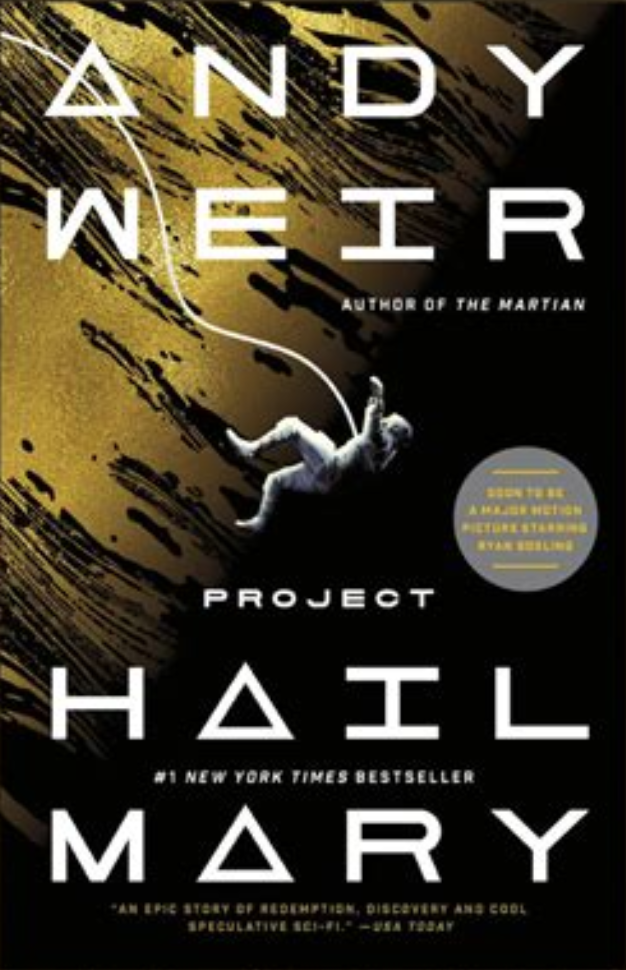
Project Hail Mary
by Andy Weir
2021
This book was a lot of fun and I read all 476 pages in three days. I do love a good science montage scene and and this was full of them. It was also extremely similar to Weir’s breakout novel, The Martian, which I had enjoyed very much. This one is obviously less bound by actual science — introducing both aliens and alien technology — but it’s clear that Weir is trying to at least keep some of the math accurate.
The book tells parallel stories of Dr. Ryland Grace waking up alone on a spaceship with no memories and figuring how what he needs to do and then doing it, interspersed with the flashbacks that tell the history that got him to that point as his memories return to him. I would sometimes wince at the choices the main character was making but I appreciated the in-story acknowledgements that his decision making skills were compromised because he’s working under a lot of stress with imperfect knowledge. I did have to suspend disbelief that it worked out for him (and humanity) as well as it did.
There were some points when I had to pretty actively suspend disbelief, less about the science technology and more about the social decisions. Having all the world governments come together to send an incredibly expensive space mission that *might* have results in 26 years seems a lot less likely than most of them deciding that it would be cheaper and quicker to come up with a local solution, but that’s not actually addressed at all: the premise is all the world unites to do this one mission. Talking around spoilers: At another point, there was an argument between two characters where it was pretty obvious that Weir was writing it purely for the drama of a conflict but didn’t actually know what the real counter argument was, so put a pretty dumb strawman argument into our protagonist’s voice. Events could easily have played out the exact same way just more interesting if it had been a real argument between two valid sides.
I enjoyed this book. It was fun and kept my attention. However, the more I think about it, the more the flaws stand out. In some ways it reminds me of Tom Godwin’s short story, The Cold Equations (1954). Both are science fiction stories that deal with the trolley problem and making hard decisions while ignoring how much their premises focuses on physics while ignoring engineering: the math works out, but it’s really bad engineering to create systems that are so inflexible. This particular book also has a meta-layer of unintentional satire provided by the interview in which Weir stated that his writing isn’t political at all, which is so fractally wrong that it’s more mind boggling than any part of the actual book.
So in summary: I enjoyed it, but it feels a lot like some of the classic science fiction stories of generations past with both the pluses and minuses that entails.

