World War Z

RHWorldWarZ500World War Z
By Max Brooks
2007

So I “read” this as an audio book that was marked as unabridged, but does appear to have lacked a few sections from the original book written in 2006. I now need to go back and read that whole book, because this was AMAZING and there are still parts I haven’t read!

Just, wow! So, so good!

The audio book was particularly good for an audio book because it was read by a full cast of voice actors, not just a single reader, and it really highlighted the way that this book was presented as an oral history.

For the rare person who doesn’t recognize it, it’s a fictional book inspired by the nonfiction book The Good War: An Oral History of World War II. In World War Z, though, the war in question is the zombie war, but for all the fantasy element, it’s addressed in a serious manner. I love the world building that went into figuring out how a zombie war could start, how different people would react, and how it would eventually end. I also loved the characters, who were all faced with this impossible conflict and did the best that they could.

I may very well be the last person to have gotten around to reading this book, so it hardly needs me to recommend it, but if you happen to have been living under a rock for the last decade, you really should read this!

The only thing that could have made it better is if it were longer, and apparently that wish got granted since there’s more for me to read once I get a text copy to read. (I really want to know more about the blind Japanese mountain man! But I’ll also take anything else.)

As a side note: ignore the movie. They took a really unique book essentially consisting of dozens of epic interlinking short stories and tried to shoehorn it into a traditional movie plot.

Maya Angelou

I read I Know Why the Caged Bird Sing in high school after my particularly awesome English teacher won her stare-down with the school board. Unfortunately, I don’t actually remember it all that well and didn’t remember much about the author either, for all her name recognition. Clearly that needed to change.

So for my Christmas road trip, I picked up (thank you public libraries!) three of Maya Angelou’s audio books, each of which she read herself. I like audio books that have been read by their authors. All readers add their own nuances to texts and when the authors read them you know it’s the intended nuance. Maya Angelou has the added benefit of actually being a professional performer and reciter.

Curiously, her speech pattern reminded me of William Shatner’s, and I wonder if he modeled his after hers. Very well enunciated, and with frequent, intentional pauses. She carries the style off better, though.


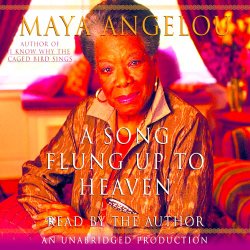
asongflunguptoheavenA Song Flung Up To Heaven
2002

Maya Angelou had a pretty amazing life with many ups and downs. Where before my impression of her was as this iconic individual almost out of sight on a pedestal, this autobiography shows her as fully human with all the attending strengths and weaknesses. One of her many strength is surely her willingness to show the world her weaknesses.

Rather than a single long book, this felt like a themed collection of short stories. Rather than telling the story of her life, she’s telling stories from her life, giving the reader a look at different times and events. Each chapter could potentially stand alone and be well worth reading.


momandmeandmom2Mom & Me & Mom
2013

Wow. Maya Angelou’s mother, Vivian Baxter, sounds like a truly amazing woman who lived her life to the fullest. As tumultuous as Maya Angelou’s life has been, her mother’s seems to have been that much more so. This book focuses on Maya’s relationship with her mother, which was excellent, but I also wish there was a full biography of Vivian Baxter, because just the glimpses we see into her life as it intersected with her daughter are pretty amazing. She was strong and determined and opinionated and just an amazing woman but she was not necessarily a comfortable woman to be around. She seems to have been utterly and completely herself and lived out loud.


lettertomydaughterLetter To My Daughter
2009

This struck me as pretty much a perfect graduation gift (highschool? college? some other major life transition where you’re not sure what you’re going to be doing next?). Many of the chapters are slightly edited versions of chapters from her other books, but they’re collected here for a reason. The overall message of this book is that life is going to throw a lot of different things your way, some wonderful opportunities and some awful experiences, so stay strong and try your best to take advantage of the first and get through the second.


I recommend all of these.

The Man Who Loved Books Too Much

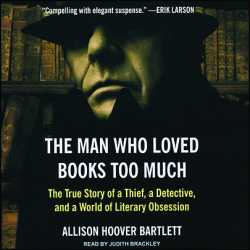
The-Man-Who-Loved-Books-Too-Much-937489The Man Who Loved Books Too Much
By Allison Hoover Bartlett
2010
Read by Judith Brackley

This was an interesting look into the both the rare book collecting community and the criminal mentality as a journalist recounts her research into an unrepentant book thief and the book seller who tracked him down to bring to justice.

It reminded me of a combination of Mr. Penumbra’s 24-Hour Bookstore, with its quirky book lovers, and The Art of the Steal, with its discussions of how con jobs and thefts are both implemented and guarded against. With a side of Marching Powder, with it’s unpleasant main character who just gets less sympathetic the more he tries to explain his perspective.

And actually, regarding that last bit, Gilkey’s (the thief) attempts at gaining sympathy and explaining his rational is so crazy that even the Bartlett (the journalist) is completely taken aback by it. But she’s still more accepting of it than I am, to the extent that her writing almost reads like an unreliable narrator as she first recounts a conversation verbatim and then describes how he still seems like such a nice, polite guy… and I’m going: nope!

But it’s still quite fascinating and does make me want to visit a rare book convention and see the stalls where different book sellers set up with their books with prices that range from less than a $100 to more than $100K.

The Opposite of Fate

TheOppositeOfFateThe Opposite of Fate
written by Amy Tan
read by Amy Tan
2004

This was a really interesting set of nonfiction essays by the writer Amy Tan, author of The Joy Luck Club and The Kitchen God’s Wife. Since it’s a collection, rather than a single piece, there was a great deal of overlap in the topics being discussed, and that actually made it more interesting for me, rather than less. Because the topics were often the same or similar but the writing time and intended audience varied, it gave very different perspectives on some of the events in her life. And she has had a quite eventful life.

While Tan’s fiction is very much fictional, I can see why so many of her readers think these stories are true. Tan’s real life would fit right in with that of her fictional characters.

I particularly liked her perspective on minority authors, and how they don’t need to be and shouldn’t be required to be minority spokespeople. The best stuff speaks to the human condition, not just the minority condition.

I was reminded of reading The Thousand and One Nights, the set of recursive stories that Scheherazade tells to her husband over the course of three years so as to postpone her execution. Her husband believes that all women and certainly all wives are evil and deceptive and deserve to die before they get the opportunity to betray their husbands. So Scheherazade tells story within story about people being people: men and women and husbands and wives and children and lovers who are variously good or evil or strong or weak or smart or stupid or silly. Because while Scheherazade’s husband believes all women are evil, the lesson Scheherazade is trying to teach him is not that all women are good, but that women are people just like men and each individual must be judged by their own merits.

Anyway, I enjoyed this book, but also think that I will probably not read any of her other books. I like to keep a certain amount of distance when looking at the human condition, and Tan seems to dive right in to look at the difficult and the gritty parts of being human.

Marching Powder

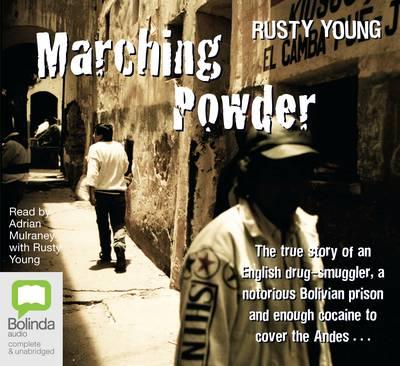
marching-powderMarching Powder
By Rusty Young
Read by Adrian Mulraney
2003

This was a fascinating book, but, once more, this was a book that I would not have managed to get through in anyway other than an audiobook. Even as an audio book, I almost quit it multiple times.

It’s essentially the memoirs of Thomas McFadden, a young British drug smuggler, about his years in Bolivia’s San Pedro Prison. I say “essentially” because I’m a bit unclear on why this book isn’t listed with two authors: it’s written in the first person and there are direct descriptions of how Rusty came to the prison and recorded McFadden’s story on audio cassettes.

The hardest part of getting through this book is that there was no one in the book that I liked. There were better and worse people. And there were definitely situations that no one should have to live through, no matter how nice or not they are, but being a victim doesn’t always make a person innocent. I went into this book knowing it was about a prison and a drug smuggler, but he’s described as being very personable, and I guess he is? But it came across to me as a highly manipulative, almost psychopathic type of personability where I couldn’t actually feel a connection and, through his recounting, couldn’t feel a connection to anyone else, either. As the book described actions, reactions, and motivations, I found myself just generally disliking both Thomas (the narrator) and Rusty (the author) and most of the other people too, regardless of whether Thomas was trying to present them in a good or bad light.

Surprisingly, while the people made the book difficult to get through, the events recounted were not as difficult. I’d gone into this book prepared by Hollywood and stereotypes to hear the conditions of a third-world drug prison (ie, awful, awful, awful conditions). I was surprised that while, yes, at some points in time and in some circumstances, it did live up to those expectations, at other times and in other situations, the prison as a whole acted more like a small city-state with strict immigration laws: ie, you couldn’t leave, but it wasn’t a half-bad place to settle down, start a business, and raise a family.

The corruption described is so prevalent that the it struck me that this wasn’t a corrupt justice/prison system at all, but was something entirely different, merely masking itself to the outside eye as a justice/prison system. It seemed like more of a state-run hostage business or some other money-making scheme that I don’t quite understand, but certainly wasn’t interested in either justice, rehabilitation, or even punishment. This is not is a justice/prison system marred by corruption, because the corruption has taken over. The corruption is so prevalent that it creates it’s own structure, completely replacing the structure that might otherwise have been there.

I’ve been trying to think of a good simile and the best I can come up with is that calling this part of a justice system with some corruption would be like calling a fishing net a sailboat sail with some holes. They can’t really be compared.

To sum up, I’ll steal Kinsey’s three-word review style and say, this book was: informative, interesting, off-putting.

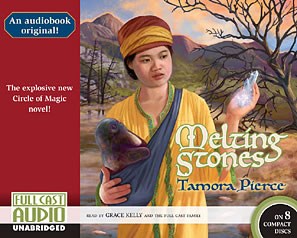
Melting Stone

Melting-Stones-Tamora-Pierce-unabridged-compact-discs-Full-Cast-Audio-books-MMelting Stone
By Tamora Pierce
Full cast audio
2007

This was interesting.

Tamora Pierce was a guest speaker at the National Book Festival this year and I was delighted. I was also somewhat shocked that the line to get a book signed by her started forming in front of the signing tent at least an hour before she gave her talk at a completely different tent, and several hours before she would start signing anything.

I’m pleased that she’s popular, but I think the kids in that line made a mistake in going for a signature rather than listening to her speak. She’s a wonderful and witty speaker, with a certain acerbic quality that I enjoy. Seeing her at the festival was also my first notice that her next book has come out: Battle Magic.

I put a hold on it at my local library and checked out Melting Stone.

I grew up reading Tamora Pierce and I still love her books, but I hadn’t gotten around to reading Melting Stone, in large part because it was a born-audio book. While it also came out in traditional book format, that was only after it was published as a full-cast audio-book: meaning each character was voiced by a different voice actor and some sound effects were included, too.

This is not the only thing that’s unusual about this book.  The main character, Evvy, was first introduced in a different book, Street Magic. Street Magic, in turn, in the second book that focuses on the character of Briar Moss. Both of those books focused on Briar Moss are single parts in four-book series. Melting Stone also references a lot of events that happen in Battle Magic, a book that was only just published recently in 2013, some six years later. It’s hard for me to tell exactly, given that I know this book series quite well and for some time, but I think this book was intended to be able to stand alone and even introduce the universe to a new generation of readers, who can then go back, if they’d like, and read the backstory of the original books, but don’t have to if they don’t want to, and can continue to read future books as they come out.

Anyway, it was fun, even though it was also intended for a younger audience even than most of Pierce’s books. As Kinsey noted in her last post, we all like reading YA fiction, but generally the audience of those books are teens or the particularly precocious, and the intended audience for this book was more elementary school.

One of the things I love about well-written fiction is that it’s often also well-researched and you can learn a fair bit of non-fiction facts along with enjoying a story with characters and plot-arch. This book, in particular, I thought did a good job of including some basic geology for kids.

So while I enjoyed the story and the characters, I was mostly interested in my own meta analysis of this book. Are audiobooks really becoming more mainstream and standard? Regardless of format, it’s rather brilliant of Pierce to break up the continuity a bit in order to bring in a new generation of kids. I wonder: are there people out there who grew up reading her books who are now introducing them to their own kids?

Predictably Irrational

Predictably IrrationalPredictably Irrational: The Hidden Forces that Shape Our Decisions
by Dan Ariely
2008
read by Simon Jones

I took a couple of courses in grad school about the information business, which is a growing industry that deals with the interesting paradox of having to use information as both a marketing tool and a product. It’s fascinating and complex, but was also my first introduction as an adult to standard economic theory.

Both my immediate and ongoing reaction is: standard economic theory is idiotic. It’s just blatantly false, based on two assumptions: 1. All decisions made by individuals are rational. 2. All those rational decisions are made with the primary goal of increasing that individual’s personal financial wealth.

Standard economic theory has a real hard time trying to explain nonprofits. Or, you know, families and friends.

Ariely is one of the active researchers opening up a new field of study: Behavioral economics. This is a field that comes out of psychology more than economics, and it looks at how people actually make decisions. (And is something of a balm to my soul after trying to comprehend what regular economics think.)

How do biases work, or habits form? How do our decisions change when we have an audience or not? Rather than always acting rationally, how do we rationalize some of our less acceptable behaviors?

He studies this, and he does so through a series of small experiments. (His students at MIT should really have started to be suspicious of some of his odder requests.  And I imagine the neighborhood kids roll their eyes at this point.)

It’s an excellent book, with a great deal of humor to it, but also caused a certain amount of introspection as I thought about how I make my own decisions, and a certain amount of horror, given the current political state of my country, in regards to how politicians make their decisions.

I highly recommend this book. My three word review: funny, fascinating, and important.

Rather Outspoken: My Life in the News

Rather_OutspokenRather Outspoken: My Life in the News
By Dan Rather and Digby Diehl
2012
read by Dan Rather

I almost quit this book several times, as I struggled to make it through the first three CDs of the ten-CD audiobook. Not because it was bad (I wouldn’t have had a problem quitting if it were just bad), but because it was very well done recounting of a couple of very hard stories. In the first two chapters, Rather recounts breaking the Abu Ghraib scandal and the Bush National Guard scandal, and having to deal with the push backs and the attempts both external and internal to CBS to squash those stories.

In my imagination, the news business is run by the type of irascible fictional news editors like J. Jonah Jameson of the Daily Bugle (from Spiderman) and Perry White of the Daily Planet (from Superman). They’re gritty and obnoxious abut are all about getting the news out there and aren’t going to put up with anyone trying to quash a story:

 “I’ve got a story,” I said. “My source has leaked a lot of highly classified information, and the paper could get in a lot of trouble if we run it. But if we don’t, my source is going to keep trying until he finds someone who’ll print it.”

Jameson’s face lit up like Christmas. “That’s just about my favorite thing in the world to hear,” he said, and chomped on his cigar for emphasis. “What’s the story?”

The Scoop (an Avengers fan fiction) by Hollimichele

And yes, I realize that’s a highly romanticized notion of how investigative reporting works, and yet, it is the image I have in my head. From Rather Outspoken, I got the impression that Dan Rather has a similar idea of how the news should run. News, by it’s very nature, is something new and the people who are currently in power, happy with their power, and happy with the status quo, are not going to want told. If no one is offended or angry about the news, then it’s probably not very useful news. A news organization, then, should know that it’s setting itself up to fight a series of battles, and those organizations who ignore stories and refuse to fight are failing at their jobs.*

With this vision in mind, for Rather, seeing CBS cave in to political pressure is a personal betrayal as well as a professional one and just… hard. For me, it’s painful to see that betrayal and to realize that, as a member of a very different generation, it doesn’t really surprise me at all. I have an idealized vision of news reporters, but I don’t actually believe it’s real.

Luckily, after that, Rather turns to looking with a more large-scale perspective on his life and career and goes back over events of the past. I do wonder though, if it becomes easier for me because he begins to discuss events that happened before I was born and if they would remain difficult to hear for people who had lived through them and could feel those traumas again in the recounting, of the Kennedy assassination, the civil rights movement, the Watergate scandal…

Anyway, it was a very good book, and while I didn’t always agree with Rather on his politics or his interpretations, I do whole heartedly agree with him on the importance of an informed public and the dangers of a progressively more corrupt news industry.

* Speaking of people who are failing at their jobs: I’m going to take a moment to call out the U.S. Congress: if they can’t keep the government running, then maybe we need to get a new Congress. Is there a way to make a vote of not confidence? This is the type of dirty politics that Rather managed to immerse himself in so he could report on it, but that I find so distasteful that I can barely stand to listen to.

The Men Who Stare at Goats

men-who-stare-at-goatsThe Men Who Stare at Goats
by Jon Ronson
2004
read by Sean Mangan

This book is awesomely hilarious. Hilarious, if, you know, you can get past the very real horror that is mixed in with the craziness. Apparently, I can. In many ways, the book as a whole reminded me of Keller’s Catch-22, an awesomely hilarious comedy all about the inhumanity of war.

And unfortunately, I once more have to warn for animal harm. Given the intent (by the men who stare at goats) of doing harm, I shouldn’t be surprised, but given the proposed method (i.e., staring), I found I was surprised after all. (It hadn’t occurred to me to ask: where are these goats coming from?) Plus, once we’re past the animal harm, we then move on to torture of prisoners.

Somehow it still manages to be super funny.

Jon Stewart on the Daily Show called Jon Ronson’s writing “investigative satire” and that’s pretty much what it is. This book is also an illustration of the phrase: “Truth is stranger than fiction, (because fiction has to make sense.)” In the final chapter of this book, Ronson sums it up by explaining that this is the story of how, in the aftermath of the Vietnam War, the discouraged and demoralized U.S. army attempted to incorporate some of the “New Age” culture that was developing, but in true military style, rather than seeking new ways to find peace, they looked for new ways to make war.

Ronson himself is also quite the character: a soft-spoken, somewhat nebbish guy. He’s gone on The Daily Show with Jon Stewart, twice, so you can see him for yourself. It’s worth seeing him for yourself, especially if you’re planning on listening to the audiobook version of this book, because, in stark contrast to Ronson, Sean Mangan reads the text with a deep intent and melodrama that just adds an extra layer of hilarity to it all.

There are a lot of conversations in which the various interviewees are saying something either crazy or horrifying or both, and Ronson is recounting the conversation:

So-and-so said: some crazy and/or horrifying thing

I said, “hmm.”

Now imagine that spoken in a deeply melodramatic fashion.

“I said,” Mangan intones, “hmm.”

I, the listener, can’t help but giggle.

To use Kinsey’s practice of a Three Word Review: funny, informative, disturbing

Simplexity

SimplexitySimplexity:
Why Simple Things Become Complex (and How Complex Things Can Be Made Simple)
By Jeffrey Klugger
2009
Read by Holter Graham

This was a fascinating book, although it wasn’t quite what I had expected. The subtitle is a bit of a misnomer as the book doesn’t really address why things become complex or how they can be made simple. Instead, it shows that many simple things actually are quite complex and many apparently complex things actually are quite simple. So I suppose it does tell you how, if only by showing you how to shift your perspective.

The book is essentially composed of a series of case studies. The studies range from the evacuation of the Twin Towers on 9/11 to regular New York traffic patterns, from stock market fluctuations to cholera outbreaks to Jackson Pollok paintings. All of these are used as examples of the simplicity-complexity continuum, in which both extreme regimentation and extreme chaos are conceptually simple, while in between these two extremes is the place where some extremely complex patterns form.

As is, perhaps, appropriate for a book on this topic, I’m not quite sure what else to say about it. It would be easy to recount some of the interesting details, of which there were many, but the premise itself was quite simple: some things are simple, other things are complex, but it is not always obvious which is which.

Kluger presents a different way to examining the world, and I enjoyed it a great deal.