Cool, Calm & Contentious

By Merrill Markoe

Book Cover: Cool, Calm & ContentiousI did not know who Merrill Markoe was when I first saw her touting this book on The Daily Show with Jon Stewart, but she was so funny on the show and the excerpts from the book were so funny that I immediately put my name on the waiting list at the library. Apparently along with everyone else in Boulder, too, because it took several months for the book to come to me.

Then, I mentioned the book to my office-mate, and she caught me up that Markoe was a comedy writer for David Letterman and dated him for several years, which was good information to have for several of the essays which discuss her love life in satirically veiled terms.

I expected the book to be really funny; what I didn’t expect was for it to be so insightful. At least three different points she makes were directly applicable to my life, and at least one has already made an improvement in my life. How many books can you say that about? Especially ones that are already sidesplitting.

I have to warn that one of the essays, about two-thirds of the way through the book, starts funny like all the others, but then veers into pretty dark territory. After that, it is all comedy again, but it threw me for a bit of a loop.

—Anna

Words on the Internets

I’m in an odd reading place right now, halfway through a bunch of different books and not feeling like any of them are things I want to review. So I thought instead I’d talk about the other main kind of reading I do: online stuff. Yes, I read Twitter and tiny bits of grammatically-incorrect blog content like everyone else, but there is also great, long-form writing to be found on the Internet. Some is just the online presence of traditional print magazines (like the Texas Monthly article I’m about to recommend) but lots of it is unique to the web and you shouldn’t miss it just because it is not on paper. Here are three of the best long-form pieces I’ve read online lately:

1) The Body on Somerton Beach by Mike Dash

The Smithsonian
blog posted this fabulous article about the decades-old mystery of a body found on an Australian beach. I watch enough 48 Hours Mystery and Dateline episodes to know that most murders are just not that complicated. The murderer is generally a spouse or someone that the victim owed money to, and the stories generally don’t get more exciting than that. I came away from this article convinced that the (still unknown!) truth behind this mystery man is way more exciting than anything I will ever come up with.

2) Winona Ryder’s Forever Sweater by Sarah Miller

It’s an article about . . . a sweater? And friendship? And becoming an adult? I don’t know how to describe it, but I found it sweet and funny and insightful.

3) The Lost Boys by Skip Hollandsworth

Okay, the last two articles were comparatively light and non-traumatizing, so let me warn you that this one is not. This is sad and features a lot of dead and missing children. (That sentence was for my friend Liz. She and I recently went to see The Woman in Black and agree that it needed some sort of warning that the central plot point involved MULTIPLE dead children.)  This Texas Monthly article about a serial killer who operated in Houston back before any one talked about serial killers, is amazing and heartbreaking. It specifically focuses on how, prior to the Internet and social media and easy communication between law enforcement agencies, it was almost impossible for the Houston police or the community to connect a series of disappearances of young boys. Instead, the police dismissed the individual cases as runaways and grieving families were left with no answers for decades.

Finally, I know I just said that I hate watching videos on the computer and I do, but this one about the what books in bookstores do at night when no one is around is worth making an exception for.

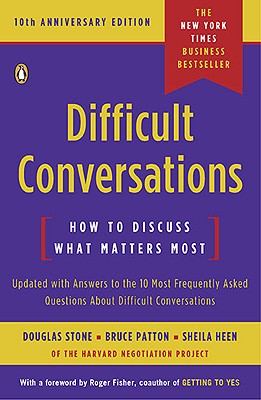
“Difficult Conversations” by Stone, Patton and Heen

Difficult Conversations, 10th Anniversary Edition
By Douglas Stone, Bruce Patton, and Sheila Heen
1999, 2010

There is a reason why I don’t tend to read self-help type books (or attend church services very often either), and that problem is separating the wheat from the chaff. I believe that no one is perfect but everyone has something of value; it’s the ratio of valuable insight to crap that can get annoying.

I rediscovered this as I was reading my next assigned text, Difficult Conversations.

There was a lot of chaff in the book and not much wheat.

I was not looking forward to reading this book anyway, because I hate difficult conversations and will attempt to avoid them if I reasonably can. I have had several situations over the years that maybe could have been improved by my being willing to confront a situation head on and a couple more situations where I was impressed with another person for their strength of will that allowed them to start a needed conversation. So, I started this book, not looking forward to the reading, but expecting it to be good for me.

Instead I discover that once more I am enough of an odd duck that when the authors talk about how I think X, Y, or Z, — and the author’s do write in the second person, “you do this”, “you do that” in order to make all of their pronouncements as personal as possible — I’m over here going, wait, but I almost always respond with G or H or J, rarely with X, and think Y and Z are idiotic. So why are the authors telling me that I always make a certain set of assumptions (which I don’t) and should instead soliciting the other person’s interpretations, when they (the authors) are making all sorts of assumptions about me and, by virtue of the medium being a book, not giving me the opportunity much less an invitation to clarify my side?

At which point I’m feeling all maligned like one of their example cases AND feeling like I’m unnatural in some way, AND feeling like an idiot for taking this personally.

When I brought up my problem with the book in class, though, expecting other students to have had similar thoughts, I discovered that apparently I really am that odd and no one else had a similar take. A lot of the other students thought it was an excellent book that helped a lot. A few of the other students didn’t care for the book for one reason or another (it was simplistic, it contained too many scenarios and not enough theory, the scenarios were all a bit too contrived, etc.), but none of them disliked it for the same reason that I did.

There were some good points. The book did offer some useful ideas about how to distinguish the real goal of several different types of difficult conversations, how to think about each type of confrontation, and how to prepare for each type. Plus, the actual writing is quite well done, and the book goes pretty fast (or it would if I didn’t have to put it down and walk away periodically.)

However, my big conclusion is that while everybody has some set of conversations that they find really unpleasant to participate in, we don’t all agree on what set of conversations those are — a conversation that I consider difficult may not be one that you do and vice versa. And this book really was not addressing my issues at all.
The Fault in our Stars by John Green

I promise that I don’t only read YA books. I’ve actually read a number of fancy grown-up books lately that I’m planning to write about, but first I’ve got to talk about one more YA book, because it apparently the hottest thing around right now–The Fault in Our Stars by John Green.

Now, Green is a big deal in YA circles and he has written a number of well-received and well-loved books, including Looking for Alaska and Will Grayson, Will Grayson (that one was with David Levitan). Plus, he and his brother have this whole YouTube thing where they post videos and, I don’t know, they also sing or something? To be honest, I don’t really understand all of this because I don’t like watching videos online. Yes, yes, I am very old, I just think that the computer is for reading and the TV is for moving pictures. But apparently kids today love all that video stuff, and you can read more about the whole John Green thing at the Kidliterate review.

His latest book, which debuted at Number 1 on the New York Times Children’s Chapter Books List (you know, the one created so Harry Potter wouldn’t knock all the pretentious adult books off the NYT list) is about two teenagers with cancer who fall in love. Cheerful, I know. But the thing about John Green is that it doesn’t really matter what any of his books are about, exactly–his strength is his characters and dialogue. He’s got a sharp sense of humor and creates teenagers who are precocious and flawed and funny and real. His voice is so strong and specific that each time I open one of his books I feel like a crisp breeze blows out of the pages.

One of my favorite sources of book recommendations on the Internet is Elizabeth at Princess Nebraska and she wrote a review of The Fault in Our Stars that pretty much says everything I want to say. I found it really interesting that she says that the first of Green’s books she read was Looking for Alaska and it was still her favorite. The first of his books I read was Paper Towns and it’s still my favorite, so I wonder if Green’s stuff is so striking that you’re always bound to love the one you first read the most. So while The Fault in Our Stars isn’t my favorite, it’s definitely very good and I would highly recommend any of John Green’s stuff. And I suppose you could watch some of his videos too, since I hear they’re popular with the young folks.

Miss Peregrine’s Home for Peculiar Children

By Ransom Riggs

Miss Peregrine's Home for Peculiar ChildrenI’d seen this book a couple of times in bookstores and been hooked in by the eye-catching cover and title, but hadn’t gotten around to even looking it up at the library. But, last week a coworker and friend brought it in to work, having just finished it, and she happily leant it to me, saying it was a quick read.

It was a quick read, and one that I enjoyed very much, but I’m also finding it kind of difficult to describe here. If you pick up the book at a store or library, you’ll first notice the cover, and then, flipping through, see that there are odd, vintage photographs reproduced throughout the book.

At first I thought the photos were simultaneously something unique but also a bit of a gimmick, and they continued to cause a bit of a dilemma for me as a reader. On the one hand, they were extremely interesting illustrations to the story; at the same time, pondering these real-world artifacts took me out of the narrative a bit each time. So, I’m torn over whether I think they added or subtracted from the overall book.

So, photos aside, the plot felt like it took themes that I love from a variety of young adult and fantasy books – special abilities, time travel, WWII child evacuees (a favorite theme of my childhood since seeing “Bedknobs and Broomsticks”)– and combined them into something pretty original and very entertaining.

The strongest element of the book for me was the characters. Just about every single character is multi-dimensional, mostly sympathetic but with realistic flaws. Even side characters that only got a couple of pages caught my attention, and I wanted to read more about them, as well.

It doesn’t hurt, also, that the beginning of the story takes place in Florida, which is always portrayed in books as being full of fun craziness, but then the majority of the book takes place in Wales, which is the most beautiful place I have ever been, bar none.

Though the book wraps up the immediate storyline, it seems fairly clear that the author is intending to write more with these characters and this world, and I am very much looking forward to reading them. (Author confirms that he has started work on the sequel.)

—Anna

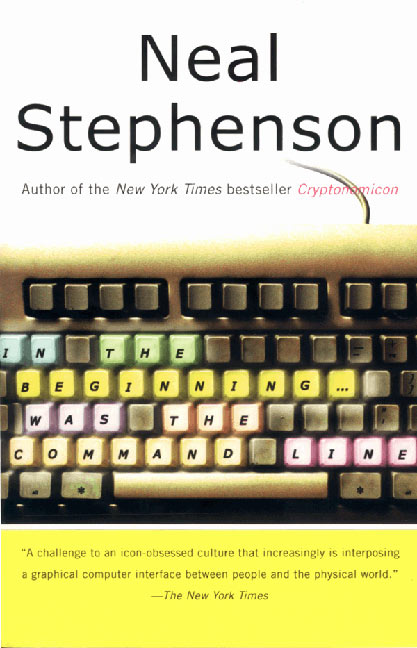
“In the Beginning… was the Command Line” by Neal Stephenson

In the Beginning… was the Command Line
Neal Stephenson
1999

As an opening caveat, I should say that this is the first in what is likely to be a series of reviews of assigned readings. I read this book because one of my professors said to, rather than through any choice of my own. Arguably, I did make a higher-level choice to take the course, but since I’m writing a review of a book rather than the course, the caveat is still important.

I will say that I was delighted at the assignment.

This is the same author as Snow Crash, Diamond Age, and Cryptonomicon, all of which I loved. Stephenson has also written a variety of other books that I have not read, and given that this book came out in 1999 and I’m only just now reading it because it’s assigned, it should be evident that while I like this author, I choose books that I think look interesting rather than reading just anything he’s written as I do for a couple of other authors.

My first reaction is that this is a really useful introduction to the history of the personal computer. Despite the speed at which computer development happens, or maybe because of it, it’s a useful to understand what computer operating systems are and how they’ve developed and what the competing market pressures have been regarding them.

On the other hand, I’m reminded of why I am wary of interacting with authors and actors as people rather than simply enjoying their work. There are often occasions when I like a book or movie or whatever and don’t want that enjoyment to be tainted by the fact that I don’t care for the author or actor. (Robert Heinlein, I’m thinking of you. And, oh, Tom Cruise. Tom, Tom, Tom. Why?)

Stephenson isn’t too bad though. He seems like an okay sort of guy even when he’s writing a nonfiction essay and not writing with the voice of characters developed specifically to be sympathetic. However, there were multiple times when I wanted to argue back at the book and explain that while I didn’t understand the details of computers that he obviously does, a couple of his metaphors were still poorly applied and had internal inconsistencies, and the motives that he projects onto the people who act more like me than like him are not the motives that I actually have for my actions.

So, over all, this is not the most perfect book ever that simply, clearly, and correctly explains the history of operating systems. If you know such a book, please let me know, but I’m guessing it’s a logical impossibility. Instead, it makes a good attempt, succeeds at a good portion of it, introduces some interesting ideas to think about even if I don’t agree with all of them and does so with a sprinkling of fun, geeky humor.

Incidentally, the book is only 150 pages long and while it can be purchased from Amazon (which I did) or various physical bookstores, it’s also available online for free. If you’re interested in understanding more about computers without reading a computer book, go and read In the Beginning… was the Command Line.

Awards Season

In addition to Oscar season, it’s also American Library Association Youth Media Award season! Am I the only one who remembers being gleeful when the Newberry Medal was announced each year? I didn’t care about the Caldecott (didn’t like picture books then, don’t like graphic novels now), but the Newberry was a highlight of my year. Would it be something I’d already read? Would it be a history book that wanted me to learn something (Lincoln: A Photobiography) or a story so fun I still reread it as an adult (The Westing Game)? The 2012 ALA winners were announced this week, although since I am actually not 10 years old anymore some of their other awards capture me more than the Newberry.

The Printz award is given to YA books, and we all know how I feel about YA. This year’s winner was Where Things Come Back by John Corey Whaley. The Honor Books were:

Why We Broke Up by Daniel Handler, art by Maira Kalman
The Returning by Christine Hinwood
Jasper Jones by Craig Silvey
The Scorpio Races by Maggie Stiefvater

I haven’t read any of those–in fact, the only one I’ve heard of is The Scorpio Races. My experience with Maggie Stiefvater (fun fact: her last name means stepfather in German) is through an entertaining but slightly cheesy trilogy of werewolf books that starts with Shiver, but the reviews I’ve been seeing of The Scorpio Races are in another league so I’ll have to check that one out. Another fun fact about the Honor Books: Daniel Handler is also Lemony Snicket of the Series of Unfortunate Events books, so he’s doing well on several fronts.

Another award category that caught my eye is the Alex Awards for the 10 best adult books that appeal to teen audiences. For 2012 the list is:

Big Girl Small by Rachel DeWoskin
In Zanesville by Jo Ann Beard
The Lover’s Dictionary by David Levithan
The New Kids: Big Dreams and Brave Journeys at a High School for Immigrant Teens
The Night Circus by Erin Morgenstern
Ready Player One by Ernest Cline
Robopocalypse: A Novel by Daniel H. Wilson
Salvage the Bones by Jesmyn Ward
The Scrapbook of Frankie Pratt: A Novel in Pictures by Caroline Preston
The Talk-Funny Girl by Roland Merullo

I have to say that I’m not entirely sure I understand this award. Looking at the award policies, it doesn’t appear that the authors have to think that teenagers will like their books, the awards committee simply gets to decide which are the 10 best books each year that have a special appeal to teen readers. But as former teenager who read lots of adult books, and as a current adult who reads lots of teen books, this award seems like it was made to give me a reading list. I think that Ready Player One might be up next.

Fate’s Edge by Ilona Andrews

Fate’s Edge
Ilona Andrews
2011

As my last hurrah before starting a new semester, I read Fate’s Edge. Of the authors who are currently producing new books, Ilona Andrews is my favorite. However, she has two series and I prefer the other one.

The Edge series has a wonderful premise:  There are two worlds, the Broken (our non-magical world) and the Weird (the magical realm), with the Edge as a thin stretch of land that divides the two realms. The Edge is essentially the gateway between both realms and is largely invisible to both as well. Plus, it’s the poor backwoods residents of either land who actually live there.

In this series, they’re our heroes.

This is an awesome premise!

I like it a lot.

A lot of the plot comes in from the fact that various lands in The Weird have rather tense relationships. It’s kind of Cold War-ish, with spies fighting spies and neither side wanting to really declare outright war unless they have a better chance of winning.

So there’s spies and magic and a long stretch of land that is best known for it’s violently clannish population and smuggling operations.

There is oodles of fun to be had there.

The weakness of the series is in the characters, who come across as fairly cookie-cutter standard romance-novel love-interests. However, each book in this series is slightly better than the one preceding it, and Fate’s Edge is the third book in the series, so it’s characters are the best yet.

One reason for the increasing complexity of the characters is that so far the pattern is that the next male protagonist is introduced as a side character in the preceding book. As a side character can’t be allowed to upstage the main hero of a book, the side characters are given flaws that make them lesser than the hero but also a lot more interesting and realistic. If Audrey and Kaldar, the pairing in this book, had been the main pair in the first book, I would have been a lot happier.

However, since a lot of the characters are introduced in the preceding books, I’m not really sure how well this book can stand on its own. To get a full sense of the world building, you definitely need to read the first two books.

So over all, it’s a good, fun read, and I do recommend it, but you have to choose between reading the first two first two books with their character issues or missing out on some of the awesome world-building.

Touch of Power by Maria V. Snyder

Touch of Power
Maria Snyder
2011

I read the first few (short) chapters on Amazon, got hooked, checked the book out from the library and read it in an evening. It was a fun light read that was pretty much just what I needed to relax with. It’s one of those books that balances between being a fantasy-adventure novel with a strong romance plot line and being a romance novel with a strong fantasy-adventure plotline.

I believe this is the second fantasy universe for this author, and while the universes have distinct rules of magic and society, the character dynamics in Touch of Power were really similar to those in Poison Study (the first book in the other universe). If you like the one, you’ll probably like the other, (I certainly did) but go in expecting the same type of thing rather than anything spectacularly new or inventive.

The plot is a really common one for romance novels: There are two secretly awesome people – sometimes their awesome is secret from the world, other times their awesome is just secret from each other – who each feel that the other person has wronged them in some way. They then proceed to act either aggressively or passive aggressively at each other in response and things escalate until a final showdown reveals that they have both misunderstood the situation and wronged the other, not in the original perceived acts but in their responses. This can be written at various levels of quality, but when done well it’s a wonderfully self-indulgent bit of character drama. When done poorly, it convinces me that both characters are judgmental idiots. Snyder does one of the better jobs of writing this plot line (although no where near as good as Jane Austin’s Pride and Prejudice) and manages to largely avoid the pitfall of idiocy.

In this book, Healers with magical healing abilities have been blamed for the great plague that swept the land and thus they are generally killed on sight. Our heroine is a Healer and our hero is a guy who badly needs someone healed and will do whatever it takes to help his friend. Under the circumstances, you can see why they start off with the wrong impression of each other. It was a great deal of fun seeing the characters struggle to work together and waiting to see when the big reveal would happen.

I’ll discuss that  a little more under the spoiler cut, but in general, this is a fun book. I enjoyed it and I recommend it the same way I would recommend a summer blockbuster or a soap opera. It’s not high literature, but I’m rarely in the mood for high literature. It’s fun and relaxing and should be enjoyed as such.

Continue reading

The Name of the Star by Maureen Johnson

Remember when I complained about All These Things I’ve Done being so unsatisfying, because it was the first book in a planned series and all it did was set it up for interesting things to happen in later books? The Name of the Star by Maureen Johnson does NOT have that problem. This is another YA fantasy book with a kick-ass young female protagonist, and another book that is leading off a planned series (The Shades of London), but this one walks the line between providing a complete story and setting up future action perfectly.

Rory is a New Orleans high school student who decides to attend a boarding school in London while her college professor parents are on sabbatical in England. Her school is in London’s East End, in the neighborhood where the Jack the Ripper killings took place and shortly after Rory arrives in town a copycat starts recreating the murders. As if that weren’t creepy enough, Rory begins to get the feeling that something strange is going on and that she can see things her classmates can’t. I’m sure you can all guess that something supernatural is going on and that Rory quickly finds herself at the heart of the mystery.

My favorite thing about this book is Rory’s voice–she’s funny and sarcastic and she sounds modern, like a teenager talking today (or at least, what I think teenagers today sound like). She also has a pretty distinctly Southern voice but doesn’t come off like a hick, which I (as a Southerner) always appreciate. The London stuff was nicely atmospheric and (without giving too much away) the fantasy side of things was sufficiently creepy. I also liked, as you probably guessed, that the book manages to wrap up a major mystery with a thrilling final action scene that provides a great deal of closure. But at the same time, the very last page of the book introduces a new twist that made me so excited about the possibilities of the next book I immediately went to Amazon to see if there was a publication date for book two (there’s not). The Name of the Star feels like the start of something new, while also being a satisfying story all by itself. My only small complaint is that it took a long time for things to get going, and a significant portion of the book is just Rory settling into school and having vaguely odd experiences that she doesn’t pay attention to but that the readers know are significant. As a reader, I like feeling smart enough to pick up on subtle hints but this almost tipped over into Rory seeming dumb, since I had figured things out and was just waiting for her to catch up. Since I read this on my Kindle I can be very precise about how much of the book was just working up to the real action and Rory’s discovery of the true nature of things: 47%, which seems like a lot. However, once things get going they are really going, and I suspect that in the future when folks read a few of the books in close succession the time spent introducing things will be less distracting. Again, minor quibble.

A while back BBCAmerica showed a mystery series called Whitechapel that was essentially this same plot, minus the supernatural element and told from the perspective of the detectives. If you find the Jack the Ripper aspect of the story interesting, you might also enjoy tracking down the TV series.