Ilona Andrews Spoilers, part 1

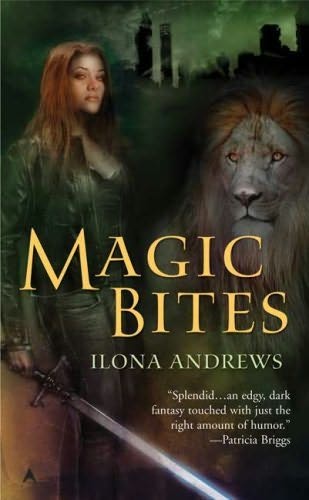
Ilona and Gordon Andrews, who jointly write under the name Ilona Andrews, were at BookPeople yesterday evening and I went to hear their talk and to get a signed copy of their newest book, Gunmetal Magic. The talk was a lot of fun, and their youngest daughter, who was maybe 14-years-old and constantly interjecting comments, was adorable. (The daughter actually kind of reminded me of Lydia from The Lizzie Bennett Diaries… big smile, rolling eyes, and a propensity for teasing her parents.) However, I told Anna that she was probably just as happy not being able to attend, because there were a lot of spoilers.

Thus, the reason for breaking the description into two posts:

This post, part 1, is going to be Anna-friendly, ie, discussing all the books and stories that were published prior to this week. The next post (part 2), will discuss all the books and stories that might be coming down the pipe.

It was interesting to see that Gordon loved talking about the plot twists coming up while Ilona (the individual) didn’t like any possible mention of spoilers, including mentions of facts that were stated in previous published books. However, since I’m going to recount some stories about the writing of different books, there will be spoilers below.

For those of you who haven’t read and don’t want spoilers for AlphaMenz, Magic Bites, or Magic Mourns, don’t click on the spoiler cut below.

Continue reading

Refining My Theory of Memoirs

I’ve mentioned before that I much prefer memoirs that center around one concept or event, and then use that frame the story of the author’s life. Recently I’ve read two books that support my theory and one exception that might prove the rule.

I Never Promised You a Goodie Bag by Jennifer Gilbert is the story of how Gilbert, as a recent college grad, survived a brutal attack and then recovered and built a thriving party planning business (hence the title) and family. Gilbert has an inspiring story, and I could have read an entire book about her narrowly-avoided party-planning disasters, but the book reads very much like a one-thing-after-another narrative account of her life. I’m sure that to her it felt like it was all part of one story, since it’s her life, but I’m not sure it hung together as a narrative for the reader. Also, I only figured out by Googling her later that she was one of the real housewives of New York, something she never mentioned in the book at all. (Apparently, she was phased off the show because she wasn’t dramatic enough, which probably speaks well of her.) So, you know, it was fine.

Then I read Wild, by Cheryl Strayed, about a young woman who decided to deal with grief over the death of her mother and a divorce by hiking the Pacific Coast Trail. Strayed talks about her childhood and marriage and about all sorts of things, but her story is all centered around her hike, which gives the story a solid structure that supports her tangents and digressions. I really liked Wild, but it was not necessarily a happy, feel-good story. Strayed was seriously grieving and seriously unprepared for the trail, and there are parts that were so harrowing I had to essentially read through squinted eyes. But Strayed so clearly described how empowered she felt by the hike that I felt kind of empowered myself. (She also describes her blisters and black toenails in such detail that my feet started hurting.)

Finally, A Girl Walks Into a Bar by Rachel Dratch didn’t have any single, centering event, but I found it so charming that I didn’t mind.  The book is nominally about how Dratch stumbled into a relationship and baby in her early forties, when she had all but decided she would not have a family. In reality, big swatches of the book are about her start in comedy, and Saturday Night Live, and dating in New York, and the story just sort of ambles along. But Dratch is funny and sharp and sounds like she would just be an awesome person to hang out with, and the book is fun and quick. So I think the exception to my memoir rule is that if you are a professional comedian, then you can write a less-structured memoir. Otherwise, I suggest everyone read Wild and then write your own memoir around a very specific event.

Daytripper

By Gabriel Ba and Fabio Moon

Confession #1: Daytripper is the only comic that has ever made me cry.

Book cover: DaytripperAfter reading the review of it on NPR’s Monkey See blog, I had sort of vaguely put this on my list and then forgotten about it until I ran across it in the library a couple of months ago.

I promptly picked it up but read it over the span of a week or so, which is pretty unusual for me with  graphic novels. It reads like poetry, really, where a little goes a long way and after every ‘chapter’ of the book, I had to put it down and think about it for a little while. The plot, such as it is, is tough to describe; it is really more of a philosophical exploration of life, death, and the relationships that make up our lives.

It took me a while to write a post about it, because it is unlike any other graphic novel I’ve ever read. Glen Weldon at Monkey See described it way better than I could as “the way death, whenever and however it comes, retroactively imposes a shape on a person’s life.”

Confession #2: I read comics almost primarily for the illustrations; I mean it has to be well-written, too, but if the illustrations aren’t to my liking, I won’t read it no matter how well-written it is.

And Daytripper is absolutely gorgeous. The inking is expressive of the mood of each panel but the coloring is where it really stands out, with gorgeous, watercolor-like spreads. It is set in Brazil, and beautiful, expansive spreads showcase the city- and country-scapes of the region.

Seriously, check these out:

Illustration from Daytripper

Illustration from Daytripper

—Anna

The Lizzie Bennet Diaries

The Lizzie Bennet Diaries
By Hank Green and Bernie Su
2012

I would not have thought it was really possible to transpose Pride & Prejudice into a modern setting, but then I watched some of the episodes of The Lizzie Bennet Diaries and was amazed. This is the Bennet family in the current time as told through Lizzie Bennet’s online video blog. And it’s delightful!

It’s also still a work in progress, still being updated twice a week with new episodes. So far there are 30+ episodes, each between 2.5 and 5 minutes long, and Lizzie and Jane are staying at Netherfield, visiting Bing Lee, his sister Carolyn, and friend Darcy.

The translation of the story from the 19th century to the 21st century is both really well done and kind of fascinating. What changes and what doesn’t change is pretty awesome.

While the majority of the story is told diary-fashion about off-screen events, some of the events take place while Lizzie is recording the videos and seven characters have directly appeared on camera (so far): Lizzie Bennet, of course, but her also her friend Charlotte who helps with the video editing, her sisters Jane and Lydia, Bing Lee and Caroline have appeared a couple of times, and, in one memorable episode, Mr. Collins.

It’s really well done, and it’s a bit like potato chips: each episode is short and quickly watched and yet you can’t just watch one. There’s more to watch and you want to watch them all!

Thus, you should go start watching! Here’s the first one.

The Checklist Manifesto by Atul Gawande

The Checklist Manifesto: How to get things right
By Atul Gawande
2009

To start off, this is a really excellent book and I recommend it to everyone. I’ve reviewed a few management books in the past, but this one is by far the best one, in part because it’s less about managing people in specific scenarios and more about managing complex situations in general, and in part because it’s focused on a single recommendation and discusses how and why that recommendation is important. As the title says, the book is about the importance of checklists.

As a manifesto, it set out to convince me of its premise: that checklists can be used to great effect. It succeeds. I am thoroughly convinced and now think you should be convinced, too.

A lot of jobs today are incredibly complex and only getting more so as time goes by. Checklists can go a long ways towards helping to compensate for this extreme complexity. The examples Gawande uses are surgery (Gawande himself is a surgeon), aviation, building construction, investment analysis, and cooking.

Historically, these jobs were all performed by individuals relying solely on personal experience and instinct. Now, these jobs are most often performed by teams of experts with access to vast quantities of research in addition to their own personal knowledge. This is an improvement, of course, but it also introduces problems of complexity in having to coordinate with multiple people and incorporate excessive amounts of information.

In performing these jobs, the professionals need to know and be able to instantly recall more detailed information than is really possible and they need to be able to trust that their teammates are performing equally super-human mental tasks as well. Such trust is often a mistake. When dealing with extremely complex tasks, professionals will sometimes focus so much on the difficult or tricky portions of their tasks that they forget to perform the basic preliminary steps. Even the best and most experienced experts in their fields are still just human. Checklists, however, can supplement memory to ensure that everyone remembers the basic steps, while at the same time running through a checklist as a group can ensure that everyone on a team is on the same page.

I would love to go through each of Gawande’s examples and explanations because the examples were all so interesting and the explanations were all so useful. For example, the discussion of how airplane pilots came to use checklists and why they go through some every single time they fly, no matter how experienced they are, is fascinating. Equally fascinating is the interview with Boeing’s master checklist writer regarding what defines a good or bad checklist. The whole book is both interesting and useful and I could burble on about each of the stories or arguments or lessons, but really, it’s probably better if you just go and read the book.

The Old Gods Waken

By Manly Wade Wellman

Book Cover: The Old Gods WakenSo, in my continued effort to not have to try anything new, I recently picked up The Old Gods Waken by Manly Wade Wellman, a favorite author of mine in high school. His main protagonist is ‘Silver John,’ a nomadic folk singer who travels throughout the Appalachian area, picking up old songs and stories and tackling the odd supernatural force along the way. (He’s called ‘Silver John’ because his guitar strings are silver.) The cover advertises The Old Gods Waken as Wellman’s first Silver John novel, but he had several books of short stories previously published.

As a teenager, I had been fascinated with the descriptions of the very rural characters and settings, it being unlike anything I’d ever experienced so far, growing up in suburbs of Boston and Austin. It felt so authentic, so…earthy! There was a purity to the simple country lifestyle and I loved it. Even the supernatural elements seemed more realistic somehow, since they were often the product of old folklore.

Today, it reads quite romantic, and I don’t mean that as a compliment. It feels a bit contrived, like the Romantic Period, with all those paintings of pretty, fresh-faced shepherdesses tending flocks of bright white, fluffy sheep. (The first time I saw sheep in real life—a field trip in college—I was appalled at how dirty and kind of mean looking they are.) Wellman’s characters are all perhaps a little too folksy, his settings a little too pastoral, and his dialogue a little too colloquial; the whole thing comes off a bit manipulative and twee.

In a discussion with Rebecca, however, I wondered if perhaps I wouldn’t have felt all of this so strongly in a pre-Palin world, where I hadn’t been inundated with “you betcha’s” for a year or so. Perhaps it is not just me, but that the whole world is getting too cynical for a true appreciation of simplified life in nature. Or perhaps I’m just crabby because it is so damn hot.

— Anna

Too Hot to Read

I’ve been struggling to write an entry the past couple of weeks. It’s been so hot and miserable that I’m hardly motivated to do anything more than slowly sip a cold beverage while staring into the middle distance–even reading seems like a lot of work–and nothing I’ve read lately has been inspiring. I want to tell you about books that I love, but recently every book I come across is one I am basically okay with, they’re all fine, whatever. But other people seem to like all of these books, so let’s do a quick round-up:

Rules of Civility by Amor Towles–This has gotten rave reviews and it seems like something I should love–bright young things in New York City in the 1930s! And I did love the descriptions of what it was like to work as a secretary and eat at the Automat. But the main male character (who I guess I was suppose to be pining over?) was a total blank to me and the best friend seemed like a terrible friend that the main character was better off without. Plus, I felt like we were eternally on the edge of a more interesting story that we never quite got to–the book kept making allusions to the fact that the main character was Russian but had Anglicized her name to get ahead in the world, but we never learned anything about her family or why she did that or what the costs were. I wanted more. If you know the perfect glittering 30s book, let me know.

The Pirate King by Laurie King–This is the latest in the Mary Russell/Sherlock Holmes mystery series (short version: after Holmes retires to the country, he teams up with a young girl and they end up solving mysteries together). I ADORE the first three, but the later ones have seemed lightweight, like generic mysteries that could be solved by any generic characters. The first few books were so enjoyable because Holmes and Russell and their relationship was so clearly drawn, and I feel like that’s been lost a bit. Only for diehards.

Shape of Desire–Remember when I was talking about how much I love Sharon Shinn? I do still love her, but please don’t read this one. I think this is her attempt to get on the Twilight bandwagon, not with vampires, but by setting a supernatural romance-type story in this world. I am on board with supernatural romance, but this one felt like a twenty-page short story blown out into a whole book. Go reread the angel books instead.

Slow Love by Dominique Browning–A memoir about a woman who gets laid of from her job and finds herself seemed like it would be right up my alley. It’s subtitle is “How I Lost My Job, Put On My Pajamas & Found Happiness,” and doesn’t that sound fun? Eh. Way too much of the book was taken up by her whining about a relationship that ANYONE could have told her was pointless, and as far as I could tell, her happiness consisted of her using her enormous severance to retire to the vacation house she already owned. Less inspiring than I had hoped.

Here’s hoping that my upcoming beach vacation results in a whole stack of books I love and can heartily recommend.

Fair Game

By Patricia Briggs

Book Cover: Fair GameA couple of weeks ago, I wrote about the first two Alpha & Omega books, and mentioned that the third one was out in hardcover. Fortunately for me, my new local library had it, so I was able to read it without paying a hardcover price. My expectations were moderate since Briggs has a tendency to lose steam with her ongoing series, but I was satisfied with Fair Game. It wasn’t as well-crafted as Cry Wolf, the first book, but I thought it stood on par with the second book, Hunting Ground, but in a different direction.

Cry Wolf had a really good balance of fantasy and mystery, while Hunting Ground tipped more toward the fantasy, pushing the mystery into the background a little bit and focusing more on the dynamics of the werewolves and vampires. Fair Game goes in the opposite direction, being a pretty surprisingly straightforward murder mystery with the fantasy elements just adding a bit here and there. Now, I really like murder mysteries, so this was a-ok with me, and if given my preference would almost always chose for the mystery to come first and the fantasy second.

I wish I’d thought to mention this in my previous post, but Briggs does this so well that while I really appreciate it, I don’t always notice it, if that makes sense. Her Alpha & Omega books are all written from multiple points of views, changing the narrating voice by chapter, or occasionally within different sections of chapters. It reads a lot more naturally than you’d think it would, with different characters stepping in when they have information that the reader needs. In the previous two books, the narrators have all been werewolves; in Fair Game, for the first time, one of the narrators is a human investigator, which is a refreshing outside perspective and emphasizes the mystery aspect of the story.

Spoiler-y, but not really: the very end does something very, very interesting with the world Briggs is building in the these books, so I’m actually now super-excited for the next books in both this series and the Mercedes Thompson series, which both take place in the same world, since there are going to be some dramatic changes.

— Anna

Author Unknown

Author Unknown: On the Trail of Anonymous
Don Foster
2000

I like books and I like reading but, while I am capable enough of literary analysis to have graduated from high school, I admit to a somewhat patronizing attitude regarding the field. My reaction opinion has generally been: well, if you want your life’s work to be looking for “hidden meaning” in texts, go for it, but really, what’s the point?

In Author Unknown, Don Foster answers that (rhetorical) question with six anecdotes about the real-world application of literary analysis.

A couple of the chapters support (in my opinion) my previous stance of: who cares? It was interesting to see how Foster investigated the authorship of a particular poem written centuries ago, but in the end, what does it matter?

However, other chapters demonstrated much more immediate relevance: Tracking down the authors of terrorist manifestos can save lives.  Proving the authorship of witness tampering documents in the White House can threaten administrations.

Each chapter describes the process of literary investigation and analysis, of a piece of writing with the intend to prove or disprove the authorship of the piece, relying on internal evidence. While Foster does look for external evidence as well (could the author have known of events the piece is discussing?), the investigations in this book are all focused on internal evidence (what person would have written these words in this way?) The way Foster comes to his conclusions and the evidence he looks at is pretty fascinating. Each chapter can also be read alone, as an individual story.

Chapter 5, Wanda, the Fort Bragg Bag Lady, is my favorite of the stories. It may not demonstrate a great deal of real-world impact but it does present a real-world black-humor farce, involving multiple anonymous authors, obsessions, murders, suicides, Hells Angels, bad poetry, good poetry, beat poetry, and a complete absence of bag ladies.

Over all, the book is fun and Foster has a lightly humorous way of writing even as he delves into close readings of archaic documents. For anyone who has doubted the importance of literary analysis: read this. I feel a nice combination of convinced that literary analysis is important after all while still vindicated that a lot of the use it’s put to is pretty darn silly.

The Cranes Dance

I am fascinated by any sort of TV show that shows people behind-the-scenes at work. Deadliest Catch? Ice Road Truckers? Dirty Jobs? Any of those 24 Hours in the ER things? I’m in. I love watching people do their jobs. So it was predicable that I would get completely sucked into Breaking Pointe, an extremely cheesy summer reality show on the CW. It’s set behind the scenes at a ballet company in Salt Lake City, following a number of young dancers and they fight for roles and get ready to perform their big ballets of the season. Unfortunately, Breaking Pointe spends way too much time on the dancers’ (completely dysfunctional) relationships, and not enough time letting us watch them get yelled by Russian teachers in rehearsals. Luckily, The Cranes Dance by Meg Howrey was there to meet my needs.

The Cranes Dance is fiction, told from the perspective of Kate, a twenty-something professional ballerina in New York City. Kate’s younger sister Gwen is a more successful dancer in the same company, but it’s clear from the very start of the book that Gwen has had some sort of mental breakdown and has been taken back home to the Midwest by their parents to recover. Left by herself in New York, Kate has to sort out how she feels about her caretaker role as the big sister, where she fits into the ballet world without Gwen, and whether she is still the “sane” one if there’s no one there to compare herself to. Oh, and all this is happening while she’s rehearsing for performances and dealing with a serious neck injury, partner problems, and other assorted daily ballet annoyances.

I initially picked this up because I wanted to read all the behind-the-scenes stuff about bleeding toes and eating disorders and ballet company politics, and all that is there in spades. Howrey was a dancer and you can tell. But I ended up being much more moved by the emotional story of the book than I expected. Kate is a really compelling character, smart and capable and funny even when she’s making terrible decisions. I’ve seen reviewers compare this book to Black Swan and there are similar elements, but they feel very different. While Black Swan was about someone falling apart, I found The Crane’s Dance to be more about Kate fighting her way out of the darkness. The book does fall somewhat into that category of first-person stories that show the main character going crazy by making the writing crazier and crazier (the two books like this that jump to mind are The Egypotologist and House of Leaves, both of which I found disturbing). I’m not usually a fan of that technique, but this only does a tiny bit of it and it works well.

My one quibble with the book, when I first finished it, was that things wrapped up awfully swiftly at the end and it felt a little jarring. But the more I think about it, the more true to life the ending feels–sometimes there’s not a huge event that helps snap us out of a cycle, it’s just the forward momentum of life, and that’s what The Crane’s Dance describes.