Gone Girl

I am fully aware that recommending Gone Girl at this point is like making sure that everyone knows that Apple makes a nice phone. Gone Girl, by Gillian Flynn, seems like the book of the summer and everyone has read it/is reading it/is recommending it. Well, that’s because it’s AWESOME. I picked it up to read on a business trip, thinking that it was a sizable enough book it should last few though a few days of work and travel. I started it when I got to the airport, read like a mad person, and finished it before I even got to my destination. It made summer afternoon air travel–which included thunderstorm delays, a drunk guy getting escorted off the plane, and a transfer in Charlotte (haaaate)–all seem enjoyable.

I don’t want to give away too much of the plot, but it’s the story of a woman who has gone missing, a la Dateline or 48 Hours or one of those awful-true crime shows. Did her husband do it? He claims to be innocent, but each chapter reveals a new bit of information that makes the reader swing back and forth between being sure he’s guilty and having no idea what happened. I believe that people call books like this “literary mysteries” or “literary thrillers,” maybe to try to make themselves feel better about reading a really exciting, plot-driven book? But there’s no need to worry on that front–it is a thriller, but what makes the book stand out are the really finely-drawn characters and focused writing. Even though your perceptions of the husband and wife are constantly changing, they feel like very complete, real people, and there is not an unnecessary word in the book. And the plot twists make the reading experience a bit like a roller coaster. The fabulous Linda Holmes from Pop Culture Happy Hour said that when she read this there was a point at which something happened, and she actually closed the book and hugged it. And I know exactly what point she’s talking about because I DID THAT TOO. My airplane seatmate thought I was crazy. I don’t care how many thrillers and mystery novels you’ve read, this one takes you to new places and does it in new ways.

I should say that this is not a happy books, and you end up spending hours of time with unlikeable people doing despicable things. I felt sort of icky when I had finished, but I was enthralled the whole time. If you have a plane flight or jury duty or just a free weekend day coming up, and you need a book that will make eight hours feel like nothing, Gone Girl should be at the top of your list.
Whispers Under Ground

By Ben Aaronovitch

Book cover: Whispers Under GroundI have been eagerly awaiting this third book in the series for several months now, and I should have been using that time to reread the first two books. Whispers Under Ground does not stand alone very well, and unfortunately I’d forgotten a lot more of the previous books than I’d realized. No doubt due to my poor memory, the plot seemed a bit muddled, but the characters were just as charming as ever (seriously, PC Peter Grant is one of the most likable characters I’ve ever read).

Addressing the characters, however, leads me to a bit of a rant about the book publishing industry: why don’t the people writing the blurb on the back of the book actually read the book?! Here’s the last few sentences of the back cover description for Whispers Under Ground:

“…It’s up to Peter to plumb the haunted depths of the oldest, largest, and —as of now—deadliest subway system in the world. At least he won’t be alone. No, the FBI has sent over a crack agent to help. She’s young, ambitious, beautiful…and a born-again Christian apt to view any magic as the work of the devil. Oh yeah—that’s going to go well.”

I first read that and was actually kind of dreading this new character, which seemed like such a fantasy and mystery trope: the mismatched partners, with the protagonist having to scramble to cover all evidence of anything magical. I don’t think it is a spoiler to say that this character doesn’t exist in this book. There is an FBI agent; she is female, smart and ambitious; the book never mentions her religion or level of attractiveness. I liked her, and I was impressed by Aaronovitch writing her. I’m not impressed with the author of the back blurb trying to fit an unusually professional relationship into a trite drama.

Okay, rant over and back to normal programming: Aaronovitch, who previously wrote episodes for Dr. Who, is clearly, and endearingly, a huge fan of the entire fantasy genre. Affectionate references to the Lord of the Rings, Avatar: The Last Airbender (cartoon, not movie), Dungeons & Dragons, and The X-Files are sprinkled throughout the text. It became kind of a game for me to try to track down all allusions.

—Anna

Management of the Absurd by Richard Farson

Management of the Absurd: Paradoxes in Leadership
by Richard Farson
1996

This was one of the books from the list of 40 that I posted about previously. It is essentially 33 quite short essays regarding some counterintuitive issues in management. I have mixed feelings about it.

On the one hand, I liked it a lot better than any of the other management books I’ve had to read. In some ways, it is very much a response to other management books, even. I’m not sure it would even stand alone very well if you haven’t already read others, since so much of the time it is pointing out flaws in common management techniques. It does give some background for the points it makes, so maybe it could stand alone. I’m just not sure. But anyway, I believed a much larger percentage of this book than I did any of the other management books I’ve read.

The main piece of advice that the book gives is that managers should treat people as people and give them some respect. Human interactions are complex and most people will react badly to managerial manipulation. This is a conclusion that I appreciate a great deal.

On the other hand, the book is more a series of philosophical discourses rather than any specific advice, and a lot of the examples the author uses are rather dated. Farson comes across as a bit of a technophobe with too much nostalgia for ‘the good old days.’ (And the fact a book published in 1996 comes across as dated makes me kind of depressed. I’m getting old! 1996 wasn’t that long ago, surely?) He also really likes the words “absurd” and “paradox,” using them whenever he possibly can.

Anyway, I would say that this is not an inherently good book, so I don’t recommend it as such. But, if you’ve read a lot of management books or are interested in management, this is a very useful book to give you an alternative perspective from the standard ones and I highly recommend considering that alternative.

The Far West by Patricia C. Wrede

The Far West
Patricia C. Wrede
2012

So much fun! I love this series and I love this book. Anna already reviewed the first two books, but The Far West just came out this month and I got a copy immediately. In hardcover, even. One of the things that impresses me about this entire series is the world-building and this book continued the process magnificently, continuing to delve into both the theory of magic and the unknown wildlife of out in the unexplored far West.

As you may have noticed from previous posts, I love me some world-building and Wrede does it beautifully. The series is set in the days of the settlers except that there’s magic, which has made a significant difference in history and national politics as well as ecology. There are three main theories of magic: Avrupan, Aphrikan, and Hijero-Cathayan, each with their own structure and way of manipulating magic. While these were each introduced in the prior books, The Far West looks more closely at the differences and similarities of each type as Eff, the main character, goes on an exploratory expedition further West than anyone else has gone before… or at least further West than anyone else has returned from. There’s new wildlife and new magical theories and a small group of people trying their best to figure out the world and survive the process long enough to report back.

One of the many wonderful things I appreciate about the book is that there’s no bad guy. There are disagreements and personality conflicts and wild animals and danger and adventure, but it’s all situational. There’s no one out there specifically trying to do evil… it’s just a dangerous world and Eff and the rest of the expedition have to work hard to survive. They don’t all get along, they certainly don’t all agree, but they all have a common goal.

The one thing that I really did not like about this book, however, was the fact of the epilog. Not that it was bad, but that it existed. Wrede did that thing where the epilog gives brief descriptions of the future lives of each of the main characters: So-and-so went on to do such-and-such, what’s-his-name went on to do this-and-that. It ended the series. This is book three of a trilogy and Wrede decided to tie it off the loose ends, at least as far as character development went. But there’s so much more out there. It’s this rich world and complex characters and no hope for another book in the series. Hmph. I will have to sulk and re-read it some more.

Thirteenth Child and Across the Great Barrier

Patricia C. Wrede

Book Cover: Thirteenth ChildPreface and warning: I have been a HUGE Patricia C. Wrede fan ever since my best friend gave me Talking to Dragons for my birthday when I was twelve. At the time, I’d never read anything like it: adventure, fantasy, humor, and light romance all together in a book with a narrating hero that a preteen girl can empathize with and a heroine that she can admire. Wrede is particularly clever with creating characters and narratives that subvert traditional fantasy tropes: clumsy knights, ditsy princesses, wizards that melt with soapy water, and dragons that demand complicated etiquette, I believe to date that I have read all of Wrede’s books, even though they tend to be quite young, “young readers” rather than “young adult.” (Upon a quick consultation with amazon, there is actually one of her books I have not read – a ‘junior novelization’ of The Phantom Menace, and I think I can be excused for not only not reading it, but pretending it simply doesn’t exist.)

She also manages to blend the fantasy genre and period-piece genre better than almost any author I’ve read. I won’t totally divert this review, but Sorcery & Cecilia is just such a wonderful fantasy story set in the Regency period, and is just such a perfect blend of historical romance and fantasy that it seems so easily done, but it clearly isn’t*.

Book Cover: Across The Great BarrierAnyway, the Frontier Magic series is set in an alternative universe that is obviously similar to our pioneer days in the United States, but with a world that developed with magic. The main character and narrator is a young girl who is born the thirteenth child in her family, which is considered extremely unlucky, to the point where relatives insinuate she probably should have been “taken care of” at birth. Within the first book, Thirteenth Child, she grows from about 5 years old to 18, growing up, going to school, and learning magic, and then the second book continues for the next couple of years, where she takes on her first magical job as a young adult. The third book, The Far West, sounds like it starts off where the second book ends.

Both books are a bit more atmosphere-driven, and less crisis-driven, so it has a leisurely pace that can take a little adjustment as a reader of rip-roaring adventure stories. However, it is such a charming book in every way, from the magical elements to just the frontier elements—it reads a bit like a fantasy version of Little House on the Prairie. And, seriously, what could be better than that?

—Anna

*Aside rant: how is this so difficult? Seriously, one would think the two would go hand in hand—vampires and all sorts of other magical creatures are immortal, after all. The audience that reads fantasy books has a pretty big overlap with the audience that reads historical novels and romances, I believe. How is almost every period-piece fantasy book I’ve read just terrible?

Bitterblue

One of the hazards of writing a book review blog is that if you’re not careful about what you review, giving books as presents becomes tricky. Your friends won’t be surprised by the books you give them for their birthday if they’ve already read your glowing review, and since probably 90% of the presents I give are books, this has made shopping somewhat challenging. So now when I read something that I know I want to give as a gift, I avoid writing a review even if I love the book. When I read Bitterblue a few months ago I knew immediately that it would be perfect for my friend Hannah’s birthday, so it’s only now that she’s opened the present that I will tell you how awesome Bitterblue is.

Kristin Cashore has written three young adult fantasy books set in the same world–Graceling, Fire, and Bitterblue–and they’re all great. I wouldn’t quite call it a series, since they all center on different characters and jump around in time quite a bit. But there a lots of overlapping characters and plotlines, so it helps to read them in that order. I loved Graceling, thought Fire was perfectly niceand now think that Bitterblue might be the best of the bunch.  But telling you even the teeniest bit about the plot of Bitteblue will give away all sorts of things about the other books, so instead I am going to just list some of things I like about all of them.

  1. They all feature strong young women at the center, but the women are very distinct. One has incredible physical/athletic strength, while another is a bookworm whose power is more political. They show a nice range of different ways a girl could be in control of her life.
  2. The world they are set in is, in some ways, your standard YA fantasy fiction world: castles, princes, magic, sailing ships, etc. We’ve all read a ton of these, but this one feels original and complete, and the magic follows some very specific and interesting rules. Cashore even manages to make the political part of the story–which kingdoms are trying to overthrow which other kingdoms–compelling, and that is generally my least favorite part of any fantasy book.
  3. I found the story resolutions in each book unexpected. I did not know where any of these were going, right up until the end.
  4. Cashore addresses some pretty intense political topics, while still keeping these young adult books. I’m going to assume she was not actually trying to create a parallel of post-Qadaffi Libya, but it was still an interesting take on what that might be like for these characters in this world.
  5. On a similar note, all three of the books do feature some romantic storyline, but the relationships that the characters have are all very complex and layered. Especially in Bitterblue, I was impressed by how willing the story was to leave a lot of the romance storyline up in the air.
  6. All of the books are big and long and chewy. I read fast and it can be disappointing when a good book only lasts a day or two. With Bitterblue I stayed up until two in the morning, on multiple worknights, reading as fast as I could. Each of these kept me busy for a while.

So I guess I’m recommending that you make a 1000+ investment, since I think you really need to read the first two before you get to Bitterblue, but it’s worth it! I’m now just waiting for the next one.

Rest in Peace, David Rakoff

I have been seeing and reading a lot of eulogies for David Rakoff today, and wanted to add my two cents. I knew who he was, of course, but hadn’t realized how ubiquitous he was. Author, commentator, artist, dancer, comedian: truly a Renaissance man in the modern world. I only realized now how much he contributed to so many of the mediums I love. I’m sad that I didn’t know his works better, and am going to try to remedy that as soon as I can.

—Anna

40 Modern Nonfiction Books Everyone Should Read

40 Modern Nonfiction Books Everyone Should Read
by Marc, of Marc and Angel Hack Life: Practical Tips for Productive Living
2009

I have, of course, read nonfiction books for classes, but I don’t tend to read them for pleasure. There are a few exceptions, but not many, and they certainly don’t include self-help books.

However, I was recently sent a link for this list of 40 Modern Nonfiction Books Everyone Should Read, all of them self-help oriented, and I was actually pretty impressed.

I started skimming the list, wondering if I had been assigned to read any of them and how much I had (or would have) disliked them. Instead, I was actually kind of impressed by the collection. Several of the titles and descriptions popped up as ones that I really should read.

There are four that I am actively excited to read. I checked that my library has them and I am looking forward to reading self-help nonfiction.

There are more about which I agree with the author of the article, that it would probably do me good to read, and not just in a putting-serious-effort-into-picking-out-some-small-amount-of-wheat-from-the-chaff type of good that I mostly see in self-help books. There are an additional ten of the books that I plan to check out and see if they live up to Marc’s descriptions. Because I think they might do me good without being too painful.

Of course, there’s also the other 26 books that I have no intention of reading, either due to disinterest or out-right dislike, but I still feel that, given a list of 40 books in a genre I don’t read, having a third of them look good is an amazing percentage and deserves some kudos.

I’m not going to list out here which books I thought were appealing and which I didn’t* because I think it’s well worth your time to skim the list yourself and see which ones you think sound interesting or useful for you.

So check it out and see what you think.


* There will be reviews here in the relatively near future of the some of the books I thought looked good as I go through the ones that I liked.

Restaurant Reviews From a Privileged Nine-Year-Old

By Jesse Eisenberg

A couple of nights ago, I was just feeling kind of off, you know? Like, nothing was wrong, but nothing seemed quite right, either. Probably because my days are no longer spent mostly on the beach, napping, and snacking. I couldn’t find anything interesting to me, and I was sort of half-heartedly browsing my regular blogs and one of them linked to a series of fictional essays that actor Jesse Eisenberg (The Social Network or Zombieland, depending on how high or low your brow is; I think you can probably guess which movie I know him from [go see Zombieland—it is awesome!]) has been writing for McSweeney’s.*

Anyway, Eisenberg is enviably as good an author as he is an actor, and the stories, called Restaurant Reviews From a Privileged Nine-Year-Old, both made me laugh and kind of broke my heart, and were just the perfect reading for an hour before bedtime.

*I don’t know what it is about McSweeney’s, but I find it really daunting, so I never just go on and browse. Maybe because it is so beautifully designed or so chock full of very clever writing? Whatever it is, it is clearly too nice a site for me. However, whenever anyone sends me a link to an essay on McSweeney’s, I can pretty much guarantee that I’ll love it.

—Anna

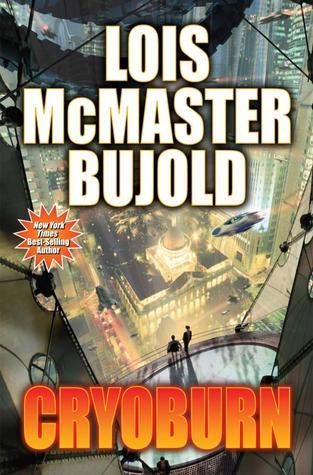
Cryoburn by Lois McMaster Bujold

Cryoburn
By Lois McMaster Bujold
2010

So I finally got around to reading Cryoburn, which is a ludicrous statement for me to have made. I adore Bujold. I discovered her about fifteen years ago and have read her books ever since. She has three different series, set in three wildly different universes, each of which I love. I have read everything she has ever published and loved them all. She was the first author for whom I actually started purchasing new-released hardcover books and even now is one of only four authors for whom I have done that. So why, then, did it take me nearly two years to read this book, checking it out from the library?

When it was first announced, I was super excited. A few months before it was finally due to be published, the publisher posted the first several chapters online as a teaser and I raced over to read them… and found myself kind of, well, bored.

First of all, this is the fifteenth book set in this universe and the eleventh book following the adventures of Miles Vorkosigan. And it is the first book in which there is no major character development.

It makes a certain amount of sense. Miles was introduced in The Warrior’s Apprentice (incidentally, that book (awesome-awesome-awesome) is available for free online, because both Bujold and Baen Publishers are very cool) as a high-born teenager in a military culture who failed to pass the military entrance exam due to physical disability despite all the nepotism in the world. He’s an awesome character: a brilliant, hyperactive dwarf with brittle bones, a lot of high-ranking family connections, and a deep desire to prove himself. It gets him into and then out of So Much Trouble.

But he does, slowly and painfully (and awesomely!), grow up. He grows into himself and faces set backs and failures and grows into himself again and changes who he is and what he wants and if the teenage years were hard, the twenties were driven, and the thirties were vicious, but now he’s settled. He’s happy with who he is and where he is and what he’s doing.

This makes me very happy for him.

But, well, there’s a reason most stories end with the whole “happy ever after” summary of the rest of characters’ lives. Happy settled people aren’t really as interesting as manic, driven people.

Now, character development isn’t the only thing that Bujold does fabulously well.  Her world-building is amazing and rich and deep. Her plot lines and mysteries are complex and tricky and hilarious. And Miles does remain an excellent character and driven in his investigations once they get going.

Cryoburn absolutely demonstrates Bujold’s skills at both science-fiction world-building and tricky plotting. The problem is that since the storyline is a mystery, and the reader only sees Miles’ discoveries as he’s making them, it takes a while for both Miles and the reader to get the momentum going.

Once it gets going, though, the book is excellent. I love the twisty plots and plans and characters and Miles’ manic investigation into them all.

It occurs to me that this book actually might work best as a stand-alone, without having read any of the previous books in the series, and thus coming to it without expectations.

The only thing that needs real background to get the full impact is the epilog, after all the plot ends have been tied up. The epilog, oh, the epilog: it hits like a punch to the sternum and makes my heart skip a beat. (You do need to have read the series to get the full impact, but oh, my heart, oh Miles, oh Bujold, love-love-love!)

So expect to slog a bit through the beginning, but the later two-thirds are really, really good.