The Talisman Ring

By Georgette Heyer

Book Cover: The Talisman RingComing back from vacation, I picked up an old favorite of mine, and a bit of a guilty pleasure. Georgette Heyer is known for her Regency romance novels (and, strangely, also for meticulously researched historical battles). My mother has all of her novels, so they were some of the first adult novels I started reading. Luckily for my tween sensibilities, the romance is actually quite light in these books, comparable in raciness to Jane Austen, I would say.

The Talisman Ring is one of my favorites, since it includes a murder mystery as well as romance. Heyer also does a bit of a switcheroo, where the first 50 pages features a young and somewhat insipid heroine before a more mature and much more interesting heroine is introduced, I believe in a conscious play on traditional romance tropes. Almost every review of Georgette Heyer mentions her humor, lively characters, and witty dialogue, and this one is no exception. Her characters and the farcical plot lines are what make her books such a pleasure to read.

What is not so much a pleasure to read is the racism. Heyer lived from 1902-1974, which of course was significantly more racist than today, and while most of her books don’t feature people of color at all, thereby avoiding racism by pure omission, a few are totally and irredeemably cringe-worthy. In fact, all of the reviews of Heyer’s novel The Grand Sophy are quite entertaining in how they start with how delightful all the characters and dialogue are, and you can just see each reviewer slowly winding down the praises in order to end up addressing the extreme bigotry. I just imagine all these slumped shoulders and heavy sighs, and the ominous tone in which they refer to the Goldhanger Chapter.

It can be quite appalling, and after rereading some of these scenes as a more culturally-aware adult (and an adult who couldn’t quite understand how I’d overlooked them as a tween), my pleasure in Heyer’s novels both diminished and became ethically confusing for me.

I was pleased to run across the essay “How to be a fan of problematic things” online just recently, and was somewhat comforted that I perhaps didn’t have to swear off all things Heyer as long as I stayed entirely open-eyed about the problematic things. Which, I mean, they are blatant enough that it would be really hard to try to explain them away.

The Talisman Ring doesn’t feature any people of color, but has some class issues instead. People of status and wealth are invariably smarter, kinder, and just better all-around human beings than middle- and lower-class people. My increasingly socialist heart couldn’t take quite the joy in seeing the aristocratic young smuggler best the poor working detectives that my teenage heart could.

So, this ended up being quite a negative review about a book that is very close to my heart, but I guess in the end, after all the very problematic issues, I can’t quite quit this author, and that says a lot, doesn’t it?

—Anna
Twelve Fables of Aesop

AesopTwelve Fables of Aesop
narrated by Glenway Wescott
illustrated by Antonio Frasconi
1954

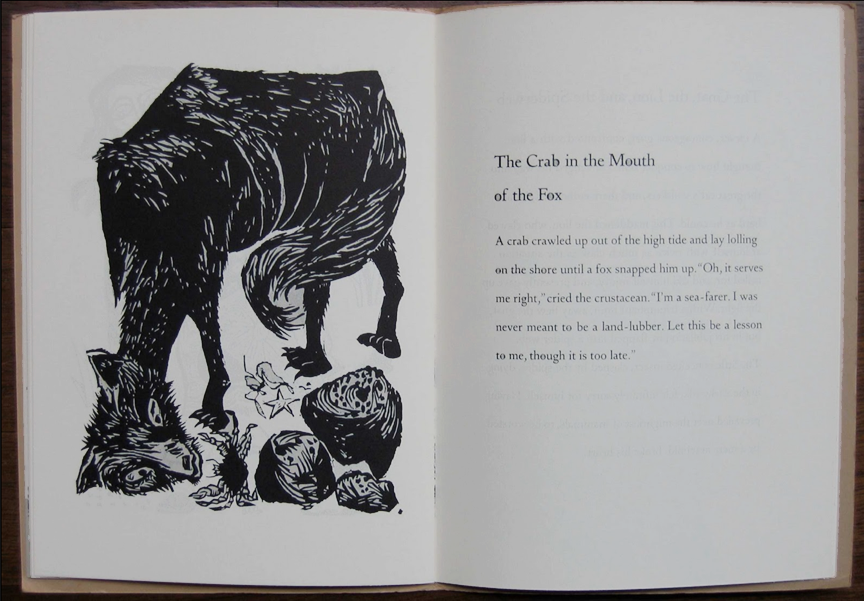
This is a gorgeous book with a series of really excellent woodcuts. I got it as a Christmas present and I love it. Gorgeous.

On the other hand, the text is kind of… um… odd? I remember Aesop’s fables in a sort of vague way from when I was much younger. They were short, yeah, but they tended to make sense. There were characters who did things and learned lessons, right? These versions, on the other hand, seem really pretty random. They’re actually oddly post-modern in their randomness.

This makes them hard to review. So in preparation for trying to review the book, I listened to The Dead Author’s Podcast (reviewed earlier by Anna) with guest Aesop.

It’s hard to tell how accurate/historical the podcast really is, but it’s certainly clear that I am not alone in thinking that some of these fables are really incomprehensible. And short.

So I loved this book for the art but I kind of suggest that you check it out for the stories for the bemusement factor as well.  It’s also really short. Twelve stories, none of them longer than two pages.

So to sum up: Beautiful but peculiar.

The Rest of 2012

When I read a really good book I almost always write it up on the blog, generally because I’m so excited I want to make everyone I know read it. However, when I looked back over the list of books I read in 2012 (yes, I keep a list, otherwise I can never remember) I realized that I read some awfully good things that never made it here. So, to wrap up 2012, here are the five best books I read this year that I never got around to mentioning.

1) How To Be A Woman by Caitlin Moran. This is such a fabulous memoir. Moran uses her own life story to make a lot of points about feminism, beauty, generally living life as a woman in this society. But she’s funny, while also being radical! She’s also hilarious on Twitter.

2) The Family Fang by Kevin Wilson. I feel like this book sells itself as story about family, yet at the end of the book I felt sort of repulsed by the whole idea of families. But it’s a fascinating book.

3) Bring Up the Bodies by Hilary Mantel. This is on everyone’s best of the year lists, for good reason. This one moved a lot faster than Wolf Hall, Mantel’s first book about Thomas Cromwell, but you need to read them both to make sense of it. I admit that Tudor history is an interest of mine, but the beauty of these books is that the characters are so well-drawn that the historical details are just a backdrop for Thomas’s story.

4) Angelfall by Susan Ee. The first in another series of YA post-apocalyptic novels. There is no shortage of these books out there, but I liked this one a lot. Dark, but an interesting premise in which angels are the cause of the destruction. It also takes an unexpected position on religion, and I’m intrigued with how future books will play that out.

5) Broken Harbor by Tana French. The fourth in French’s of mystery novels set in modern-day Dublin is actually less a mystery and more the portrait of a family falling apart. My favorite of her books is still The Likeness, the second book, but they are all completely compelling and very, very well-written. There are connections between the books, but they are not a series, really, and they can all stand alone. Feel free to start with whichever one sounds most interesting.

White Cat

By Holly Black

Book Cover: White CatThis Christmas, I’m spending the holiday with Tom’s family in Arizona, so I grabbed White Cat off of my to-read shelf on my way out the door to the airport. We had managed to get a nonstop, five-hour flight to Phoenix, and I had intended to take a nice long nap through most of it. Instead, I did nothing but read this book, and finished all but the last 50 pages by the time we landed, which I promptly finished that night.

Author Holly Black builds a very interesting world with crime families that deal in illegal magic that can control or kill others with just a touch of the hand.* Our protagonist (I don’t quite want to call him a hero) is introduced to us as the youngest son of a somewhat minor crime family and the only member without a magical ability, so he struggles to remain equal to the other members through mundane cons.

The brilliant thing about the book is that the whole thing is a string of cons, making up one giant one, and the reader is along for the ride. It is one of those rare narratives where each twist surprised me as it came up, but also made absolute sense in retrospect.

One of the praise blurbs on the inside cover of the book describes it as “part X-Men and part Sopranos,” and for some reason I find that really kind of off-putting, even though I enjoyed both of those. However, after having finished the book, I had to agree that it is a pretty good description, but instead of the amalgam of the kind of crappy parts of both, which is what I immediately feared, it takes the best of both and makes something even better.

The sequel, Red Glove, is already out, and I’m going to track that down as soon as I get home (although, I also now need a book for my flight home again), and then the third book of the trilogy, Black Heart, is due in April 2013.

Anyway, happy holidays to you all, and I hope you get lots of good books for presents!

—Anna

*Very minor spoiler and pet peeve: since a bare touch of a hand can be so dangerous, everyone is this world wears gloves, which I found vaguely interesting until they put in details like “licking the grease from the French fries off of the gloves” that both makes it so much more realistic, and somehow just really grosses the hell out of me.

Lincoln’s Dreams

By Connie Willis

Book Cover: Lincoln's DreamsSo, with all the movies about Lincoln cropping up (I’m counting Lincoln and Abraham Lincoln, Vampire Hunter as ‘all the movies’), I was inspired to reread Connie Willis’ Lincoln’s Dreams, which I’d only read once many years ago.

It is a bit of a mess, I’m afraid.

It also turns out to be just the second novel she wrote, which explains a lot.

There are four central characters to the book, and while there are other peripheral characters coming in and out of scenes, the whole book focuses on the tension between these four: an author writing a novel about the Civil War, his research assistant, a young woman having persistent dreams about the Civil War, and her doctor, who is also the old college roommate of the research assistant.

(With the limited characters and settings, it occurred to me that this could actually be made into an interesting stage play, though the script would definitely need some tightening-up. This is the one nice thing I’m going to say about it.)

Actually, one more compliment: each chapter begins with a piece of trivia about the Civil War, and the research assistant describes more within the chapters. For those readers like me who want a lot of narrative with their nonfiction, this is the most palatable way to take in Civil War facts. (I also know from Connie Willis’ other books that she is extremely interested in history and does meticulous research for her novels, so I trust her historical accuracy.)

Okay, now on to the savaging. About a third into the book, I started noticing that the single female character didn’t have very many actual lines, and when she does speak she is often interrupted or instructed by a male character.* The woman is pretty much the central character, around which the three male characters orbit, so it took me longer than it should have to notice what an extremely passive character she was, really more of a target for the male characters’ expressions of emotion than a character in her own right. Even the final climax of the book, in which the cause of her dreams is discovered, supports the idea of her as a vessel to be filled with male ideas rather than a fully functioning person.

From reading Willis’ other books, I trust that she was actually doing this on purpose, and making a commentary on how, by trying to protect people we care about, we can end up marginalizing them, and thus doing more harm than good. It ends up being kind of a pat observation, though, and is not sufficiently explored enough for me. I have to admit that I might be being a bit unfair to Willis, though; I find that I am judging her early books in comparison to her later books, and then criticizing them for not being nearly as good.

The final thing is, though, that I would actually continue to recommend this book to people. Certainly not as an introduction to Connie Willis (for that, read To Say Nothing of the Dog), and not even as a good read, necessarily, but definitely a book that gives a different and interesting viewpoint of the Civil War and even wars in general, and for that I still consider it completely worth-while.

—Anna

*This is becoming a bit of a bee in my bonnet, actually. I’ve just recently started noticing that female television pundits get interrupted and talked over a lot more than male pundits. I know that shouldn’t surprise me, and it doesn’t, really; it just makes me really mad at how blatant it all is.

Sequels, Follow Ups, Trailers, and Recommendations

As the holidays come barreling towards us, I first want to point you toward my entry last year on good Christmas books. I haven’t started my annual rereads yet, but I need to get on that. It doesn’t feel like Christmas to me until I’ve read a few Connie Willis short stories.

https://biblio-therapy.com/2011/11/27/christmas-reads/

But if you don’t want to create an entire holiday reading plan, here a few other things that have come up lately that relate to some of my past posts.

Remember when I raved about The Girl of Fire and Thorns by Rae Carson? And said that I wasn’t sure whether it was going to be part of a series? It is! The second book, The Crown of Embers, is out now and it might be even better. I’m not going to go into any detail, since talking about this one would spoil the first one, but I loved it and it reminded me a lot of Bitterblue. The only downside is that it ends on a bit of a cliffhanger–Elisa’s story is clearly going to be a trilogy.

Now remember when I, and everyone else in the world, raved about Gone Girl by Gillian Flynn? I recently read one of the books she wrote before that, Sharp Objects, and it was equally compelling and creepy. In fact, if anything I felt even ickier after reading that one. So if you liked Gone Girl and want to read a disturbing mystery novel, Sharp Objects is perfect. (Also, we get a surprising number of Google hits on things like “gone girl linda holmes hugged the book.” So for the record, future Google searchers, I feel confident that she hugged the book at the point where Amy’s journal ends, and that next section of the book starts. Is that clear without being too spoiler-y?)

One of the best things about seeing the last Twilight movie in the theater (oh yes, I did), was that they showed about 10 different awesome previews. My sister was thrilled about the Catching Fire trailer, but I was most excited about City of Bones. I’ve already explained how much I like those books and, at least in the previews, it seemed like they had the look of everything right. I am too old to recognize any of the teenagers playing the leads in the movie, but I am excited about the parental-level casting. Aidan Turner, who was a vampire in the Being Human series (the BBC one, not the Scyfy remake), is Luke and Jonathan Rhys Myers is absolutely perfect as evil, creepy Valentine.

Finally, if you’re not already reading Tomato Nation, well, I don’t see what you’re even doing on the Internet. But just in case, one of the recent entries in her advice column, the Vine, asked readers for book suggestions for preteen/teenage readers. The comments on the entry are great, reminding me of YA books I loved and introducing me to some new ones. The comments to Anna’s recent Sunshine post included some discussion about what ages that book would be appropriate–the comments on that Vine post might provide some other great options.

Captain Vorpatril’s Alliance by Bujold

Captain Vorpatril AllianceCaptain Vorpatril’s Alliance
by Lois McMaster Bujold
2012

This is an excellent fast-paced romantic adventure comedy. I sped through it in two days and kept giggling to myself. It just leaps from one ludicrous situation to another and yet, the plot still tracks beautifully. I can see why and how these situations came about, and I can also see why and how these characters managed to get themselves into these situations, even if I want to slap them upside the head for doing some of the things they do.

Interestingly, it takes place prior to Cryoburn, which might explain why Cryoburn made so few references to off-planet events in general, less to avoid spoilers than to avoid a sense of WTF?.

There’s an elopement with the use of a box of instant groats, a 100-year-old buried treasure, a 30-year-old hidden bomb, a handful of beautiful ladies (all of whom are extremely wily), a handful of wily men (many of whom are extremely beautiful), cross cultural laws and smuggling rings and bounty hunters. And, in the middle of all of this, is Ivan Vorpatril, who has, much to his dismay, lots of experience regarding such insanity.

In previous books in this series, Ivan generally gets drawn into his cousin Miles’ crazier plots despite his own efforts to remain an innocent bystander. In this book, though, Miles appears in only a quick cameo, and Ivan manages to get involved in a crazy plot all on his own. The book also develops a few other secondary characters from the series, showing more of Byerly Vorrutyer and Simon Illyan than we’ve gotten previously.

While it’s more than a bit self-indulgent, the book maintains its self-indulgence with aplomb and delivers an immensely fun roller-coaster of a story that I enjoyed immensely.

Steel’s Edge (excerpt)

By Ilona Andrews

Book cover: Steel's EdgeSo, Rebecca has previously reviewed the third book in Ilona Andrew’s Edge Series, and in her review she wrote that she thought each book in the series was better than the preceding one, which I disagreed with. The third book was actually my least favorite and had pretty much convinced me to bow out of this series.

Then, I was bored one day and noticed that Andrews had posted a lengthy excerpt from the brand new fourth book, Steel’s Edge, on her website; I figured it couldn’t hurt to read it, just to congratulate myself on my decision not to read any more of them.

However, as you have probably noticed from this lead-in, it is really good! Each books features a male protagonist introduced in a previous book and a new female protagonist, and I was almost immediately interested in the new female character. Both characters are also in their early- to mid-30s, which is both refreshing and increasingly more relatable to me. I’m now very much looking forward to reading this one, though I’m at least sticking to my guns on not buying it, so I’ll await the library.

—Anna

Sunshine

By Robin McKinley

Book cover: SunshineYou know those Eat This, Not That books? This is a Read This, Not That book review. During the height of the Twilight craze, whenever I saw someone reading or talking about the Twilight books, I wanted to grab them and shout, “Go read Sunshine!”

It is definitively the best spunky-young-heroine-and-vampire novel I’ve yet read, and that is saying a lot considering both how saturated that market is and how many of them I’ve read. McKinley has a long history of writing strong female leads (The Blue Sword was one of my favorites growing up), but lately she’s been sort of dicking around with dragons and pegasus, when she must know perfectly well that her fans all want a sequel to Sunshine.

The heroine, nicknamed “Sunshine,” is just out of high school and working as a baker in her family’s cafe (there are lots of extraneous but delightful descriptions of pastries) in a post-magic-war world where various magical creatures are an acknowledged reality but avoided if possible. The world-building is solid and interesting, and the action begins fairly quickly when she gets randomly kidnapped by a gang of vampires.

Avoiding spoilers, but attempting to describe what makes this book so much better than the Twilight series, especially for teen female readers: Sunshine acts almost entirely on her own recognizance at all times, relying on her own intelligence and summoning up unexpected personal strengths when the situations call for it. The particular vampire she aligns with is both frightening and intelligent, and their alliance is born out of need and not romantic in any sense (at least not right off the bat).

Sunshine actually takes three-dimensional characters, puts them in fraught situations, and then fleshes out how that changes and matures them. It is seriously the anti-Twilight, and everyone should read it (although perhaps not young kids, because it does have sex and violence).

—Anna

Twilight, An Argument For

Last week, Rebecca wrote quite a scathing review of the Twilight series, identifying a whole range of problems, from bad writing to bad gender models. However, we also wanted to offer another perspective on the whole phenomenon, and since I am the one here who has read all the books, saw all the movies in the theater, and say in my own bio that I like the books, the favorable review fell to me. But this is a challenging assignment, because it’s not that I actually disagree with anything Rebecca said. I think she’s right about all of it. On the continuum of me, Anna, and Rebecca, I am clearly the most pro-Twilight among us, but I will freely admit that these are Not Good books. Nonetheless, I like them, and I’m going to try to explain why.

First, let’s quickly run through some of the key problems with the books, just so that you know I’m aware of them:

1) The Twilight books are not-well written. The Host, Meyer’s non-vampire sci-fi novel, is actually kind of interesting, giving me hope that she might be able to turn out okay material. The Twilight series is not that okay material.

2) Bella is completely uninteresting. Seriously, totally blah. Say what you will about Kristen Stewart, she makes that more character more interesting than the source material. Which leads into the biggest issue . . .

3) Wow are these not feminist at all. Like, let’s make sure that the female characters have no agency whatsoever, and are completely at the whim of stalker-y, creepy, borderline-abusive men!

NONETHELESS, I like these books! They’re like Cheetos–you know they’re not good for you and you know you will feel a little ill when you’re done, but in the moment you enjoy yourself. I don’t want a relationship like Bella and Edward’s, but I sure wanted to find out what happened to them. The characters didn’t feel like real high school kids, but I enjoyed thinking about how much more interesting high school would have been if there had been vampires around. I also found that I enjoyed the books and the movies more when I had placed them in the proper context. These aren’t sci-fi books featuring teenagers, or coming of age stories with a supernatural twist. These are teenage romances that happen to feature vampires. When you read a Harlequin romance novel, you know that there’s a formula involved and that you’re going to get a certain set of ideas and characters. A romance novel may not lead to any epiphanies, but it will entertain you. The Twilight books aren’t trying to create an intricate vampire mythology, but once I read them as romance novels telling sort of fantastical love stories, it made more sense.

Plus, I am fascinated by Mormonism, and I love how you can SEE Stephenie Meyer’s Mormon worldview coming out in crazy vampire plot points.

Look, sometimes when I read I want to be challenged or to learn something or to be comforted. And sometimes I want to shut my brain off so that I forget the world around me. I wouldn’t want this to be the only thing I read, and I wouldn’t want for young women to read these without having taken the number of feminist theory courses I have. But I have read a whole lot of crappy Dan Brown and Michael Critchon books in my day, and if I’m going to pass the time on an airplane or at the end of a stressful day with something, I’m happy to pass it with sparkly vampires.