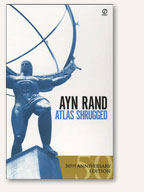
Atlas Shrugged, Chapter 8

AtlasShruggedThis chapter kind of highlighted for me how Rand appears to have an incredibly focused Monkey Sphere. She sees known individuals as individuals, but she fails to see groups of people as made up of individuals. Once some people are in a group, they immediately become some vague conglomerate that looses all interest and rights, even to the point of ignoring the individuals who make up that group. (Example from chapter 7: “Passengers” aren’t really people.)

I very much see this perspective as a symptom or a cause or some combination related to depression. The whole world can be against you and the individuals who support you don’t really count because they’re just individuals and you know that the whole world hates you… the whole world being this amorphous thing that you know without ever having to actually get to know it. There is much talk about how the “public” is against Reardon Metal and the John Galt line, how “people” are saying that it’s dangerous and horrible, how “the press” are writing scurrilous stories, etc. And yet, at the same time, there are long lists of individuals who are placing orders for the new metal, who are buying stock in the new train line, who want to be on the new train. But this chapter has a break through because in this chapter Dagny not only achieves a massive success but also recognizes for the first time that there are masses of people who support her, masses too large for her to comprehend as individuals, but must see as groups, as “the public” or as “the press.”

This is a happy chapter (at least in comparison to everything else so far.)   Continue reading

Atlas Shrugged (Chapter 7)

By Ayn Rand

Cover: Atlas ShruggedOh, Rand, you almost had me there, you tricksy Objectivist! (I’m breaking into Rebecca’s week of blogging because I can’t quite contain myself on Chapter 7.)

At the beginning of the chapter, when Dagny has run away from a rigged debate and found herself in a seedy diner, she discusses the state of the world with the lower-income diners. Like all good liberals, it was only from their mouths that I began to see what Rand has been trying to get at, and to perhaps even find some common ground between liberal and conservative viewpoints.

I think we can all agree that the state of the production in our country is in trouble, and, additionally, that one of the main sources of the trouble is that people have become disenfranchised from the act of production, that people are too afraid to buck the status quo to come up with original and ground-breaking ideas. From my liberal standpoint, the voices of the “little people” are too far away from the “big people” and if the “little people” try to make their voices heard, they have a very real fear of losing their jobs. Thus, people in the production line might notice incompetence, but are actively discouraged from acting on it. Of course, the two political sides break down when it comes to finding a solution, but I think even agreeing on the problem is a step in the right direction.

So, I was beginning to buy into Atlas Shrugged, right? I was even starting to think that this whole endeavor wouldn’t be as unpleasant as I had originally thought. Continue reading

Atlas Shrugged, Chapter 7

AtlasShruggedThis is an extremely dense chapter in which a great many events happen and I am enticed into having a great many thoughts and opinions. Thus, this post is going to be both very long and much shorter than would be required to fully discuss. This chapter deserves a discussion group. I’m beginning to realize how complex this book really is, what with the way it is thoroughly layered in unreliable narration.

The first layer is that all of the characters are either lying—to each other and/or to themselves in bouts of hypocrisy—or making false assumptions. One cannot accept at face value anything that any character says or thinks.

The second layer is Rand’s narration. An author can choose to write a book through the eyes of a character or write in what is commonly called a god voice, in which the author is telling the reader what is happening without any bias from the characters. Rand writes in this style, but still shows a clear bias in the way her summations do not match the details. (For example, as Anna pointed out, Hank Reardon has eyes “like pale blue ice” and has “prominent cheekbones” that made him look younger than his years, but is still considered “ugly.”)

The third layer, which is not the book’s fault, per se, but is nonetheless and important feature in my understanding of the book, is the cultural impact this book has taken. Randian philosophy is an established enough part of the culture that I cannot read Atlas Shrugged without having to deal with other people’s interpretations.

From all three sources, I have heard, for instance, that our heroic protagonists are cold and emotionless, that they prize money above all else, and that they never give charity or offer favors. And yet, given the actual events of the book and the look into the thoughts and ideas of these main characters, all three of these sources are wrong.

A common bit of writers advice is to show, not tell. For instance, if a character is really smart, show them being smart rather than simply telling the reader that they’re smart. I get a real sense of discordance here, though, because I am being told one thing and then shown something contradictory. I am told (by Ayn Rand, by Dagny Taggert/Hank Reardon, and by Paul Ryan) that:

  • Dagny and Hank are cold and emotionless. But then they show vast and painful emotions. They feel pride and pain, desire and concern, frustration and anger and pleasure and happiness.
  • Money is the only thing that matters. But then they spend vast quantities of money to achieve goals based on spreading truth and knowledge and quality, and they turn down vast quantities of money offered as bribes to turn aside from those goals.
  • They never give charity or offer favors. But then they go on to help their opponents who are being torn down by unfair means, and to provide opportunities and support to small businesses who need a chance.

Money is not an ends that these people are working towards, it’s a measurement of greatness, but is not the greatness itself. I watched a TED talk a while back, which pointed out that of all the various things societies and individuals needed to succeed, money was the only one that is purely a means by which other goals can be achieved, but is not a goal in and of itself.

I think Rand understood this perfectly well. The part where she and I diverge is that she appears* to think that money is a useful measurement of greatness, while I think is a deeply flawed measurement tool.

Anyway, I think the three main events of this chapter are:

Continue reading

Atlas Shrugged, Chapter 6

AtlasShruggedI recently read an article on how my particular job title tends to get blank stares and awkward silences at cocktail parties. Before reading this chapter of Atlas Shrugged, I might have nodded along with the article and felt smug about my clear superiority. Having now seen this perspective in excruciating detail in Hank Reardon, I have learned my lesson. I now roll my eyes and want to tell the article writer to suck it up. No matter how dull the party-goers are, you can find a conversational topic. And if none of the topics you are interested in, interest them, then maybe it’s time to ask questions and learn about a new topic that they find interesting. If all the other people at a party are super boring, maybe you need to consider the fact that you might be the boring one.

With that lead up: In Chapter 6 of Atlas Shrugged, we have one of the most uncomfortable parties ever.

Continue reading

Atlas Shrugged by Ayn Rand, first impression

So this is my first live blogging experience and I’m going to be making multiple posts before handing this back to Anna next week. If nothing else, this book brings up a lot of issues. First, a quick review of my general impressions of the first five chapters of:
AtlasShruggedAtlas Shrugged
By Ayn Rand
1957

Atlas Shrugged has come up in various political discussions since I’ve been in college but it really got highlighted by Paul Ryan’s run for Vice Presidency. When Anna was contemplating reading it, I offered to read it if she did.

I went into it with really extremely low expectations. It has surprised me in the ways in which the book has been both better and worse than those expectations.

For the better:

It’s not bad writing. While there are some writing issues that I don’t care for (she has a very active narrator voice, with clear opinions, describing landscapes as “seeming” one way or another, even when there is no character to whom it seems anything), the writing is well done. Rand’s real strength is the way in which she delves into the thought processes of her characters. She also does a reasonably good job of building suspense.

Plus, my first reaction to the first chapter was that this was the beginning of one of the creepier (and more awesome) Doctor Who episodes and John Galt is probably either a Moriarty-type character or possibly even The Master. After reading the first five chapters, I’m still not sure this isn’t true.

For the worse:

It’s even more of a punch in the face of all liberals than I had expected. It’s less that there are some awful characters who mouth liberal concepts merely as hypocritical excuses (because, honestly, people like that do exist, much to my dismay), it’s that there’s no acknowledgement that these people aren’t actually liberals. The whole thing reminds me a bit of a quote that I half-remember from years ago: a bad Satanist is not the same thing as a good Christian. In this instance, the application is that an incompetent Capitalist is not at all the same thing as a successful Socialist. Rand, however, does not appear to see any distinction between these. (She also doesn’t see any distinction between monopolies and unions. I have severe doubts regarding her knowledge of business principals.)

For the depressed:

It feels like the writing of someone working through depression. I don’t actually know anything much about Rand’s life and haven’t even read her Wikipedia page, but I assume she was fighting depression and writing Atlas Shrugged was one attempt to deal with it.

One of the aspects of depression, as I know it, is the combination of thoughts that say (1) the world is an awful place, (2) I have a perfect understanding of how awful it is, and (3) I know with absolute certainty that there is nothing to be done about it.

Rand’s characters desperately want to make a connection with other people and yet are completely unwilling to put any effort into it at all and will self-sabotage any situation that might help. Since they know that no one can understand them, they refuse to see that there are other people out there, understanding them. They also know that certain people aren’t worth knowing. Anyone involved in business and politics are viewed as unworthy of any consideration to the extent that both Dagny and Rearden skip board meetings, ignore journalists, refuse to either ask or answer questions, and expect that nothing that those people can do would in anyway impact their own lives. They already know that those people aren’t worth their time without actually knowing anything about them.

This is a mindset that I find particularly frustrating, all the more so as I very much recognize it from dealing with one of my friends who struggles with both depression and with drug/alcohol addiction. Since he already knows that nothing can help him, there’s no point in trying to get help. Since he already knows that everyone hates him, there’s no point in trying to get anyone to like him.

This is a view of the world that I strongly disagree with. You can’t just know what someone else is thinking or doing without knowing them. There are always surprises and change is always possible if not inevitable.

That’s my perspective on the world we actually live in.

The world of Atlas Shrugged, however, is a dystopian world where values and morals are absolute, people are worthy or not worthy, and everyone knows it. This binary concept of values  is incredibly frustrating although it actually cracked me up a bit when it was applied to music in chapter four. The critics who dislike a piece of music write that, “The music of Richard Halley has a quality of the heroic. Our age has outgrown that stuff.” and “The music of Richard Halley is out of key with our times. It has a tone of ecstasy. Who cares for ecstasy nowadays?” Everybody knows the music is good, just the populace in Rand’s world apparently hate good music.

In one of my graduate classes focusing on intellectual property laws, the professor liked to remind us students that “reasonable people can disagree.”

In the world of Atlas Shrugged, reasonable people have a shared understanding of what is right and good and proper. If you disagree, then you are clearly incapable, incompetent, and morally bankrupt.

In conclusion:

This book is well-written and while it doesn’t suit my particular tastes, I can see how it would have a lot of appeal to some people. It brings up some interesting ideas and would likely help people define their thoughts and opinions.

My real problem is not with the book itself, but with the people who are reading it for guidance and direction rather than for thoughtful conversation. There are real politicians who are using this as a serious political treatise. It feels a bit like if, after reading The Hobbit and Lord of the Rings by J.R.R. Tolkein, a politician were to decide that every covert military action should include at least one untrained civilian to carry out some vital task. Or, after reading Ender’s Game by Orson Scott Card, one were to start recruiting child soldiers. These books are all good and thought-provoking and can certainly be used to develop one’s political stance, but they should not be taken as holy writ.
Atlas Shrugged (Chapters 1-5)

By Ayn Rand

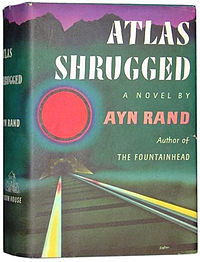
Cover: Atlas ShruggedMy only previous references for Atlas Shrugged are Paul Ryan, of course, and a very funny recap of the movie version of the first half on Grantland. This, however, has not stopped me from judging anyone who spoke positively of the book. So, when a friend of mine listed Atlas Shrugged as one of her favorite books, I mocked her without restraint. She, of course, replied that maybe I should try actually reading it, which seemed like a fair point, so here I go with another round of semi-live-blogging.

A quick warning, though: I lean so far left, politically, that President Obama and the Democratic party are significantly right of me. In the 2008 Democratic primaries, I caucused for Kucinich (devastatingly unsuccessfully), and if there were a viable socialist party in the United States, I would probably be a member. I am very obviously not the audience for this book, and I am, under no circumstances, diving into it with anything close to an open mind. I intend to hate it, with my reward being that I can then mock its fans with complete impunity.

Rebecca, who has also never read any Ayn Rand, has agreed to join me in reading Atlas Shrugged and ‘live-blogging’ it for the next several weeks. Kinsey has already read The Fountainhead, so she got a pass. So, with no more delay, let’s get started with the spoilers! Continue reading

Teeth

Edited by Ellen Datlow & Terri Windling

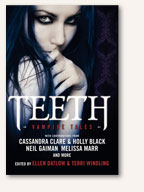
Book Cover: TeethI picked up this book as an impulse loan at the library when the title typeface caught my eye. (Design nerd moment: I really like how they were able to make the title actually look like teeth without being totally cheesy about it – very elegant, especially coupled with the lack of teeth in the image) I also had already heard of the book because one of my favorite blog writers, Genevieve Valentine, wrote one of the stories in the collection, and posted that story online. It was awesome, so I figured I wouldn’t mind reading it again and see if the other stories were of the same caliber.

Of course, some were and some weren’t. Well, Valentine’s was still the best, but there were others I really liked, too. In fact, Valentine’s story was first in the collection, and then the second story, All Smiles by Steve Berman, dealt with a vampire myth from a more unusual, non-European culture, as well, so I was pretty pleased. (Actually, both these first two stories are available in a preview of the book here.)

The problem with this type of anthology is that lots of people, me included, like to read about vampires, so it makes sense to collect stories about them. Good vampire stories, though, often use vampirism as a surprise twist in the story, so you see the problem. Just being included in this type of anthology spoils a lot of the stories, so there were certainly several that I think I would have liked a lot more if I hadn’t just been reading them waiting for the vampires to show up.

A not-so-brief gripe to close out this review: the book cover promises contributions from Cassandra Clare & Holly Black, Neil Gaiman, Melissa Marr, and more. Now, I’m a recent fan of Holly Black, and I really enjoyed her story here, co-written with Cassandra Clare; and I’m starting to think Melissa Marr’s Wicked Lovely was a fluke because I haven’t enjoyed any of her other writing nearly as much; but my real gripe is with Neil Gaiman. I love his Sandman graphic novels and every full-length novel he has ever written. I consider myself a huge fan of his. However, his short stories are crap. So, I knew not to actually consider his name on the cover to be any sort of selling point, but he must have disappointed legions of not-already-disappointed fans with his short and hasty-seeming poem that reads more like a pop song. Weak sauce, Gaiman, weak sauce.

—Anna

The Diviners

Despite my best efforts at remaining separate from the sick people surrounding me, I started 2013 off with a wicked cold that left me too dazed to read or to even watch a movie. Instead I spent most of the first week of the new year slumped on my couch, grimly watching How I Met Your Mother reruns. But I finally appear to be pulling out of it, demonstrated by the fact that I managed to actually finish a book! A big one, in fact: The Diviners by Libba Bray.

Bray is a popular YA writer and The Diviners is the first in her new series about teenagers with special power living in Jazz-age New York. And even after reading all 500+ pages, I’m not quite sure how I feel about it. As I was reading, I kept just coming up with a continual list of pluses and minuses that seemed to balance each other out.

Plus: It was a fun look into 1920s New York! Remember way back in the summer when I mentioned The Rules of Civility, and how I was still looking for a better book about the glittering 30s? Okay, the 20s are not the same as the 30s, but this met my needs. Bray did a great job creating a past-New York that felt real and alive.

Minus: The main character was weirdly flat. The reader was clearly supposed to identify with this young girl who comes to New York from small-town Ohio, ready to have fun and make her mark, but she came across as a brat with no depth or internal monologue. I got tired of her very quickly, and she felt like a character in a middle-reader or kids book.

Plus: While the main character left me cold, the supporting characters were really interesting and much more complex. Specifically, a showgirl with a history and a numbers runner in Harlem.

Minus: It was dark. Like, really, really, creepy Criminal Minds kind of dark. I generally don’t get too up in arms about kids reading adult material and I’m not easily spooked myself, but I am not sure I was old enough to read this. That, combined with the weird flatness of the main character, made me wonder who the audience for this was supposed to be.

Plus: This initial story in the series was wrapped up quite neatly and there was a good sense of closure.

Minus: Despite being a long, looong book, character reveals were made super-slowly and a few really major pieces of information were tossed out at the end and not really followed up on. I’m assuming these threads will get picked up in future installments, but it still felt like I had made a pretty sizable investment of my time to end up with so many unanswered questions.

Final verdict? I’m still in. I wouldn’t recommend it to younger readers (super creepy!), but I was intrigued enough by the setting and some of the side characters that I’ll read at least one more to see where this is going. I’m just going to hope that the next book focuses on the showgirl, because she was aces.

The Word Made Flesh

I ran across this site somewhere on the internet, probably via my current addiction, pinterest: The Word Made Flesh, www.tattoolit.com, is just photos of tattoos that people have gotten that either are text or reference a piece of text. Some of them include short descriptions from the people on why they chose the tattoos. (Also, the site is mostly, but not entirely, safe for work; some of the tattoos get a tad intimate.)

The tattoos themselves are of varying quality, but I find the whole site really interesting for a number of reasons:

  • I love reading about what pieces of writing have really impacted a person’s life. (Some of them even make me a little misty-eyed, especially when it is clear that the person is using the tattoo as a visible reminder of recovery.)
  • It is super interesting to see which texts pop up over and over again (Catcher in the Rye, of course, lots of Kurt Vonnegut and e. e. cummings, and just tons of The Little Prince)
  • It is additionally interesting to read about someone being so inspired by a piece of text that I have also read but completely shrugged off. What is it about those books that just connected to these people and not to me? (My eventual mild enjoyment of the one Kurt Vonnegut book I have read is nowhere close to the adulation people feel for that same book, and I simply don’t get it.)
  • Some people have tattoos that I consider a little ridiculous (perhaps when you are a young adult, you shouldn’t get a Harry Potter tattoo until you’ve seen if it will continue to be such an impact in your adult life,* and that goes double for A Series of Unfortunate Events), while some people are just way, way cooler than me (the full-color pelvic tattoo of Aubrey Beardsley’s illustration of Oscar Wilde’s Salome, which is also the tattoo that kicked off this website and the photograph of which is totally NSFW)
  • Placement of tattoos is also important (an Ayn Rand quote on the upper thigh seems like it might be a bit of a turn off)

After wasting entirely too much time on the site, I have to say, though, that whatever my thoughts on the tattoos themselves, it just makes me happy to see all these people so inspired by such a range of books.

—Anna

*On the other hand, I didn’t grow up with Harry Potter, having started the series well out of college, and I’m told by my much younger cousins that it is a whole different experience reading each book as roughly the same age as Harry, which I guess I can see.

The Prophet by Kahlil Gibran

the_prophetThe Prophet
By Kahlil Gibran
1926

This is a really gorgeous piece of writing. The version I read was also a beautifully illustrated version, with Gibran’s own illustrations. The text also happens to be available online for free.

It is essentially a collection of poetry essays addressing a variety of issues regarding life and faith and living life in a spiritual manner.

While it’s relatively short (less than 90 pages in the version I read), it is not a quick read. It is made up of 28 chapters and it’s the kind of text that you can read a bit at a time and spend a lot of time thinking about. The wording is beautiful, the imagery is beautiful, and the philosophy is beautiful.

In many ways, it reads a bit like the very best of Bible passages, but while it’s clearly deist, it’s not any one religion. I highly recommend it to pretty much everyone ever.

While it’s gorgeous in it’s own right – to the extent that I have a hard time describing it without making it sound significantly more schmaltzy than it is – I would also recommend it to anyone who has to give some emotional speech. If I ever need to give a speech or a toast or something at a wedding, a graduation, a funeral, or whatever, this will be my first go-to book for inspiration and quotes, before either Shakespeare or the Bible.  (I am clearly not the only person to have this thought, though, since I recognized several quotes from it.)

But anyway, I highly recommend it. Go forth. Read it. Or listen to it. Whichever.